Paper II — Q8
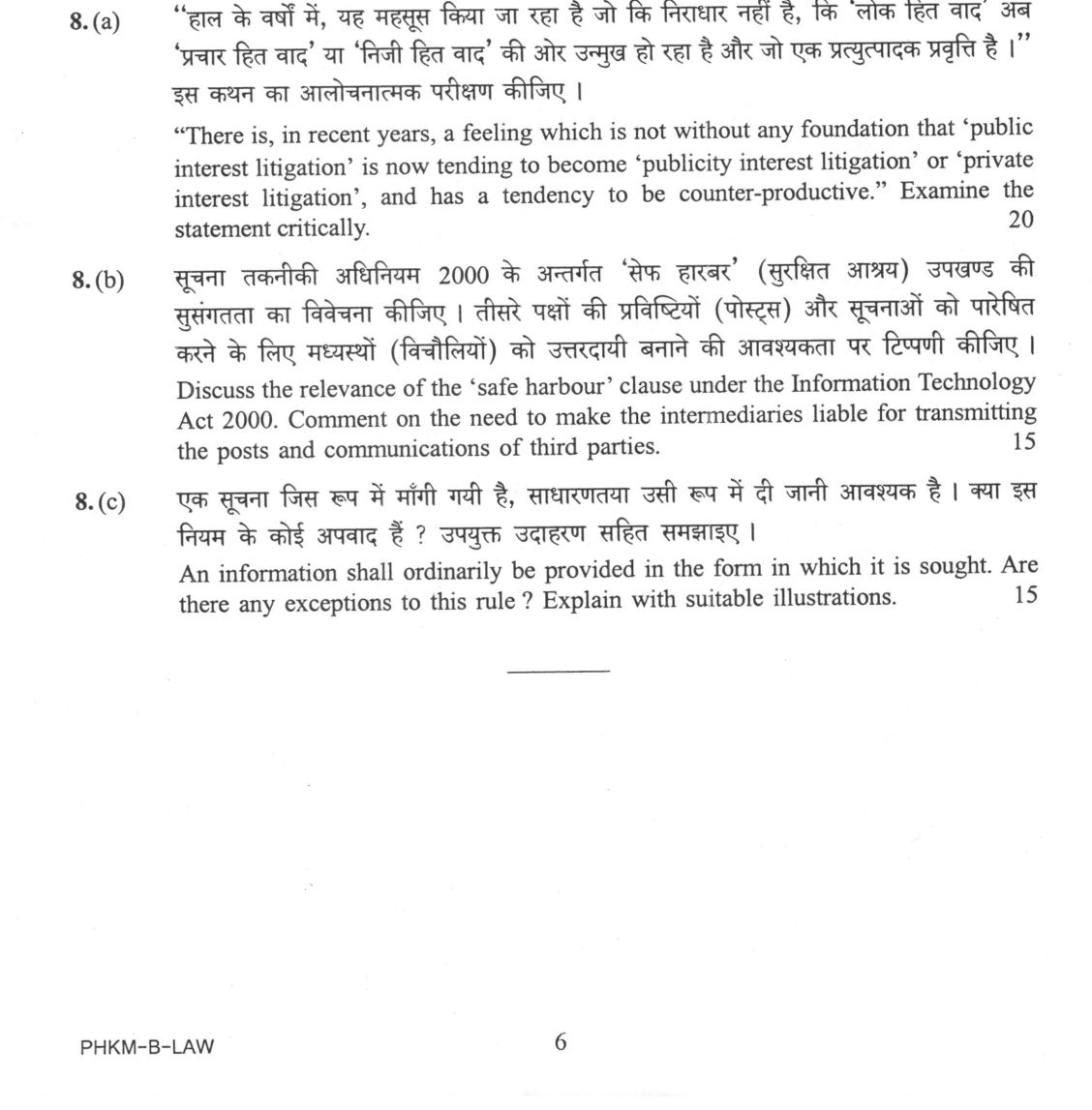
(a) "There is, in recent years, a feeling which is not without any foundation that 'public interest litigation' is now tending to…
"There is, in recent years, a feeling which is not without any foundation that 'public interest litigation' is now tending to become 'publicity interest litigation' or 'private interest litigation', and has a tendency to be counter-productive." Examine the statement critically. 20 marks
Discuss the relevance of the 'safe harbour' clause under the Information Technology Act 2000. Comment on the need to make the intermediaries liable for transmitting the posts and communications of third parties. 15 marks
An information shall ordinarily be provided in the form in which it is sought. Are there any exceptions to this rule? Explain with suitable illustrations. 15 marks
हिंदी में प्रश्न पढ़ें
"हाल के वर्षों में, यह महसूस किया जा रहा है जो कि निराधार नहीं है, कि 'लोक हित वाद' अब 'प्रचार हित वाद' या 'निजी हित वाद' की ओर अनुकूल हो रहा है और जो एक प्रत्युत्पादक प्रवृत्ति है।" इस कथन का आलोचनात्मक परीक्षण कीजिए। 20
सूचना तकनीकी अधिनियम 2000 के अंतर्गत 'सेफ हार्बर' (सुरक्षित आश्रय) उपखंड की सुसंगतता का विवेचना कीजिए। तीसरे पक्षों की प्रविष्टियों (पोस्ट्स) और सूचनाओं को परोक्षित करने के लिए मध्यस्थों (विचौलियों) को उत्तरदायी बनाने की आवश्यकता पर टिप्पणी कीजिए। 15
एक सूचना जिस रूप में मांगी गयी है, साधारणतया उसी रूप में दी जानी आवश्यक है। क्या इस नियम के कोई अपवाद हैं? उपयुक्त उदाहरण सहित समझाइए। 15
Model answer
Written by UPSC Answer Check against this question's marking rubric, to the expected length. UPSC does not publish answers for Mains — this is one way to score well, not an official key.
Evolution and Misuse of Public Interest Litigation
Public Interest Litigation (PIL), pioneered through landmark rulings like Hussainara Khatoon (1979) and S.P. Gupta v. Union of India (1981), relaxed the orthodox doctrine of locus standi under Articles 32 and 226 to democratize access to justice for the disadvantaged. Over time, however, this remedial mechanism has witnessed significant dilution, frequently transforming into "Publicity Interest Litigation" or "Private Interest Litigation". Litigants increasingly deploy PILs for political point-scoring, media visibility, extortion, and surrogate corporate warfare, precipitating judicial overreach and burdening already strained dockets.
In response, the Supreme Court has undertaken institutional self-correction. In State of Uttaranchal v. Balwant Singh Chaufal (2010), the Court laid down rigorous guidelines mandating constitutional courts to verify the bona fides of the petitioner, ensure substantial public interest is involved, and penalize vexatious petitions with exemplary costs. Critically, while the critique regarding frivolous and surrogate litigation is well-founded, PIL remains indispensable for securing environmental protection, human rights, and systemic administrative accountability. The solution is not to curtail epistolary jurisdiction, but to enforce strict, disciplined screening at the admission stage.
Safe Harbour and Intermediary Liability under the Information Technology Act
Section 79 of the Information Technology Act, 2000 grants "safe harbour" immunity to intermediaries—categorized as passive conduits, network service providers, caching services, and hosting platforms—shielding them from civil and criminal liability for third-party content. This protection is contingent upon intermediaries observing statutory due diligence under the IT (Intermediary Guidelines and Digital Media Ethics Code) Rules and refraining from initiating, selecting, or modifying the transmitted content.
In Shreya Singhal v. Union of India (2015), the Supreme Court harmonized Section 79 with Article 19(1)(a) by ruling that "actual knowledge" for content takedown under Section 79(3)(b) must strictly stem from a court order or an authorized government directive, rather than private user complaints. Today, the proliferation of deepfakes, hate speech, and viral misinformation has intensified calls to make platforms actively liable, aligning with global trends like the EU Digital Services Act. However, mandating general monitoring or strict proactive liability risks forcing private corporations into becoming arbitrary censors of public discourse, resulting in a chilling effect on legitimate free speech.
Form of Information and Exceptions under the Right to Information Act
Section 7(9) of the Right to Information Act, 2005 establishes the general rule that information shall be provided in the specific form sought by the citizen (e.g., electronic copies, printouts, or certified extracts). This rule is qualified by statutory exceptions: access in the requested form may be denied if it would disproportionately divert the resources of the public authority, or if it would be detrimental to the safety or preservation of the record. Furthermore, Section 9 bars requests that infringe the copyright subsisting in a person other than the State.
For illustration, if an applicant demands the collation, analysis, and reformatting of voluminous physical registers scattered across decades, the Central Public Information Officer (CPIO) is not required to create new information or divert administrative machinery; offering inspection of records satisfies the mandate (CBSE v. Aditya Bandopadhyay). Similarly, where fragile, unlaminated historical manuscripts could be damaged by photocopying, the CPIO may restrict access to controlled physical inspection to ensure the preservation of the public record.
What "Critically examine" is asking you to do
Test the proposition the question puts to you and return a finding on how far it holds. Examine stems carry a claim, or ask whether something has happened, and expect evidence weighed both ways before the extent is stated — often with remedial measures attached. “Critically” is not a section added at the end: name the yardstick you are judging by — the evidence, the stated objective, a constitutional principle, a rival explanation — and let a verdict close each part of the body. Where the question quotes a claim, that verdict must land on the claim itself, accepted, qualified or rejected, and not on the theme in general.
Structure that answers it
Restate the claim as the question frames it → evidence that supports it → evidence that undercuts it → the conditions under which it holds → verdict on how far it stands
Where marks are lost
Merits in one paragraph, demerits in the next, and a conclusion calling for a balanced and holistic approach. That is a survey with the judgement left out and it holds the answer in the middle band. The opposite error is reading “critically” as permission to attack — and with the odd pairings, critically describe or critically explain, the exposition still carries most of the marks, the judgement being a layer on it rather than a substitute for it.
How this answer will be evaluated
Approach
Framework: Issue > Rule > Authority > Application. (a) examine: intro > how/why with reasoning > evidence > conclusion | (b) discuss: intro > 3-4 dimensions > example > balanced close | (c) explain: definition/context > points in order > small example > short close Full marks: Precise legal citations, balanced analysis, and clear illustrations.
Key points expected
- Define PIL and its constitutional basis (Art 32/226)
- Cite landmark cases (e.g., SP Gupta, M.C. Mehta)
- Analyze the 'counter-productive' tendency with examples
- Provide a balanced conclusion on judicial safeguards
- Define 'safe harbour' under IT Act 2000 (Sec 79)
- Explain the conditions for safe harbour protection
- Discuss the need for intermediary liability
- Balance freedom of speech with accountability
Evaluation rubric
Each sub-part is marked on its own, against the marks and word limit printed on the paper.
- (a) Critical analysis of the shift of PIL from public to private/publicity interest. 20 marks
examine— intro → how/why with reasoning → evidence → conclusion
Must cover
- Define PIL and its constitutional basis (Art 32/226)
- Cite landmark cases (e.g., SP Gupta, M.C. Mehta)
- Analyze the 'counter-productive' tendency with examples
- Provide a balanced conclusion on judicial safeguards
Loses marks
- Restating the question without analysis
- Citing cases without explaining their ratio
- Ignoring the 'counter-productive' aspect
Earns more
- Mention specific recent Supreme Court judgments
- Reference Law Commission reports on PIL
- Discuss the role of the Bar Council
- Mention the concept of 'merit' in PIL
Extra mark
- Cite specific data on PIL petitions filed
- Reference specific amendments to PIL rules
- (b) Relevance of 'safe harbour' clause and liability of intermediaries. 15 marks
discuss— intro → 3-4 dimensions → example → balanced close
Must cover
- Define 'safe harbour' under IT Act 2000 (Sec 79)
- Explain the conditions for safe harbour protection
- Discuss the need for intermediary liability
- Balance freedom of speech with accountability
Loses marks
- Confusing 'safe harbour' with 'safe harbor' (US law)
- Ignoring the 'due diligence' aspect
- Failing to balance liability with free speech
Earns more
- Mention the IT (Amendment) Act 2008
- Reference the 'takedown' mechanism
- Discuss the role of the 'grievance officer'
- Mention the 'due diligence' requirement
Extra mark
- Cite specific cases on intermediary liability
- Reference specific government notifications
- (c) Exceptions to the rule of providing information in the form sought. 15 marks
explain— definition/context → points in order → small example → short close
Must cover
- State the general rule (RTI Act, Sec 5(2))
- List the exceptions (e.g., format not available)
- Provide suitable illustrations for each exception
- Explain the 'reasonable' standard
Loses marks
- Listing exceptions without illustrations
- Ignoring the 'reasonable' standard
- Confusing 'form' with 'format'
Earns more
- Mention the 'third party' exception
- Reference the 'exemption' provisions (Sec 8)
- Discuss the 'public interest' override
- Mention the 'fees' aspect
Extra mark
- Cite specific RTI cases on format
- Reference specific RTI guidelines
Practice this exact question
Write your answer and it is marked point by point against the model answer above — what you covered, what you missed, what you got wrong.
Evaluate my answer →More from Law 2024 Paper II
- Q5 Answer the following questions in about 150 words each. Support your answer with relevant…
- Q6 (a) Discuss the rules which are taken into account by the courts while awarding damages f…
- Q7 (a) "The principle of arbitral autonomy is an integral element of the ever evolving domai…
- Q8 (a) "There is, in recent years, a feeling which is not without any foundation that 'publi…