Paper II — Q3
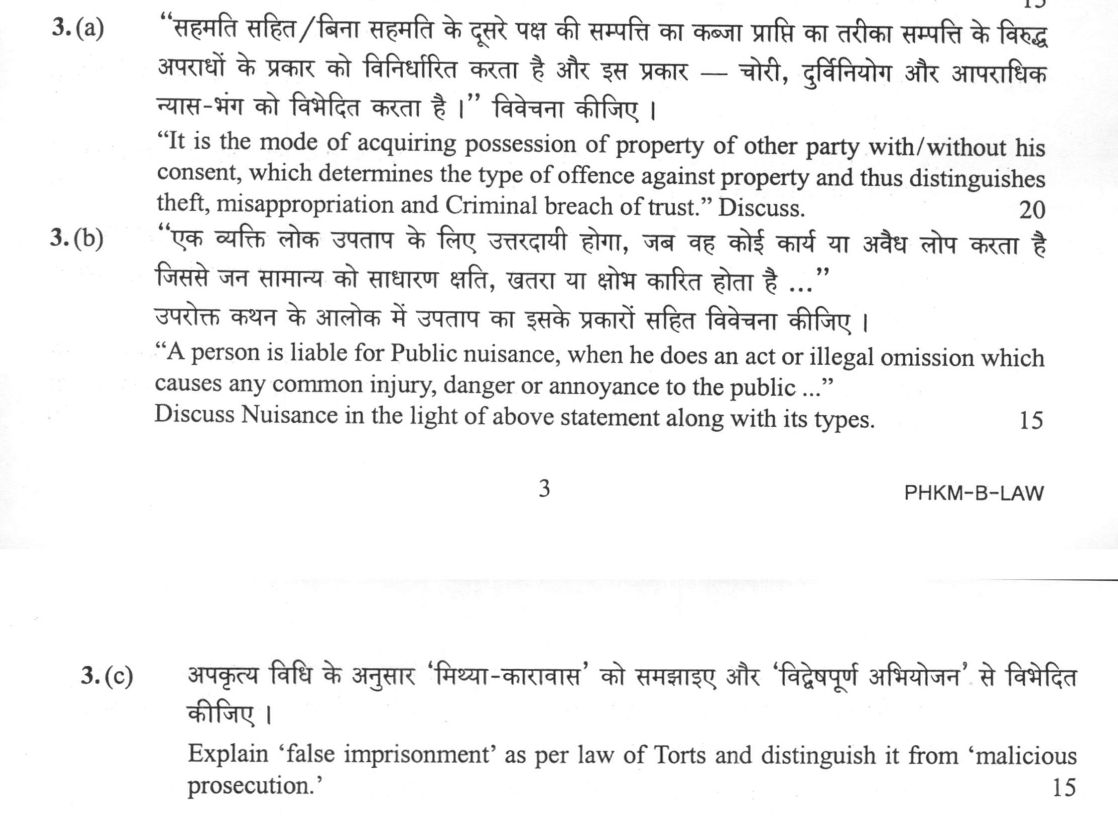
(a) "It is the mode of acquiring possession of property of other party with/without his consent, which determines the type of…
"It is the mode of acquiring possession of property of other party with/without his consent, which determines the type of offence against property and thus distinguishes theft, misappropriation and Criminal breach of trust." Discuss. 20 marks
"A person is liable for Public nuisance, when he does an act or illegal omission which causes any common injury, danger or annoyance to the public ..." Discuss Nuisance in the light of above statement along with its types. 15 marks
Explain 'false imprisonment' as per law of Torts and distinguish it from 'malicious prosecution.' 15
हिंदी में प्रश्न पढ़ें
"सहमति सहित/बिना सहमति के दूसरे पक्ष की सम्पत्ति का कब्जा प्राप्ति का तरीका सम्पत्ति के विरुद्ध अपराधों के प्रकार को विनिर्धारित करता है और इस प्रकार — चोरी, दुर्विनियोग और आपराधिक न्यास-भंग को विभेदित करता है।" विवेचना कीजिए। 20
"एक व्यक्ति लोक उपताप के लिए उत्तरदायी होगा, जब वह कोई कार्य या अवैध लोप करता है जिससे जन सामान्य को साधारण क्षति, खतरा या क्षोभ कारित होता है ..." उपरोक्त कथन के आलोक में उपताप का इसके प्रकारों सहित विवेचना कीजिए। 15
अपकृत्य विधि के अनुसार 'मिथ्या-कारावास' को समझाइए और 'विद्वेषपूर्ण अभियोजन' से विभेदित कीजिए । 15
Model answer
Written by UPSC Answer Check against this question's marking rubric, to the expected length. UPSC does not publish answers for Mains — this is one way to score well, not an official key.
Property offences The distinction between theft, misappropriation and criminal breach of trust turns on the mode in which possession is acquired and retained. Under S.378 IPC, theft requires taking movable property out of another’s possession without consent, with dishonest intention at the time of taking. The differentia is that possession is acquired wrongfully at the outset; consent is absent. Pyare Lal Bhargava v. State emphasises that dishonest intention must exist when the property is taken; later conversion after consented taking is not theft. Criminal misappropriation under S.403 IPC applies where property comes into possession lawfully, but without entrustment, and is later dishonestly converted, used or disposed of. Ratan Lal v. State of UP distinguishes this from CBT by asking whether the accused had mere possession or dominion by entrustment. CBT under S.405 IPC requires entrustment, dominion, and dishonest conversion. Emperor v. Basappa holds that entrustment is essential; mere custody is insufficient. Thus, taking without consent is theft; lawful possession without entrustment followed by conversion is misappropriation; abuse of entrusted dominion is CBT. Consent at acquisition and the quality of possession—mere possession or dominion—are the critical tests. The same conversion may be theft, misappropriation or CBT depending on how possession began.
Public nuisance S.268 IPC treats public nuisance as an act or illegal omission causing common injury, danger or annoyance to the public or persons who may come in contact with it. Read with S.290 IPC, it penalises public nuisance by a dangerous substance or act likely to spread infection. Elements are act or illegal omission, common injury/danger/annoyance, and injury to public or section thereof. It differs from private nuisance, which affects a particular person or limited class in use and enjoyment of land. Public nuisance is criminal and may also be a tort. Types include nuisance by encroachment, Dr. Ram Raj Singh v. Babulal; nuisance by noise, Fritz v. Hobson; trade nuisance; and statutory nuisances under municipal Acts. Rose v. Miles emphasises common injury to the public, not merely personal injury, while Attorney-General v. PYA Quarries shows industrial activity causing public danger or annoyance can be public nuisance.
False imprisonment and malicious prosecution False imprisonment is a tort consisting of complete deprivation of liberty without lawful justification. Its elements are an intentional act, complete restraint, and absence of lawful excuse. Bird v. Jones holds that confinement within limits with no reasonable way out is imprisonment. Rudul Sah v. State of Bihar links unlawful detention to Article 21. It is not an offence under S.340 IPC; S.340 defines wrongful confinement, and the offence is punishable under S.342 IPC. False imprisonment is actionable per se; malice or special damage need not be proved. Malicious prosecution is the wrongful initiation of judicial proceedings with malice and without reasonable and probable cause. Khagendra Nath v. Jacob requires that the proceedings terminate in favour of the plaintiff or accused. The distinctions are: false imprisonment restrains liberty, while malicious prosecution abuses process; false imprisonment is actionable per se, while malicious prosecution requires special damage such as loss of reputation or expense; in false imprisonment the defendant must prove lawful justification, while in malicious prosecution the plaintiff must prove malice and absence of reasonable cause; remedies are damages in both; apology or injunction may lie where liberty is restrained. Groundless arrest may attract compensation under S.358 CrPC, but that is not a specific remedy for malicious prosecution; false imprisonment may also invoke Article 32 or 226 for liberty.
In conclusion, consent and the mode of acquiring possession separate property offences, while public nuisance and the torts of false imprisonment and malicious prosecution protect collective and individual rights. The law thus balances dominion over property, public welfare, and personal liberty.
What "Discuss" is asking you to do
Lay the issue out from more than one side — how it arose, what is claimed for it, what is held against it, and where it now stands. UPSC attaches discuss to broad topics with several live dimensions, so coverage of the dimensions earns more than the strength of your opinion.
Structure that answers it
Set the issue up → the case as it is made → the case against → the dimension both sides leave out → where the balance now lies
Where marks are lost
Listing facts with no thread between them, or arguing one side throughout and calling it a discussion.
How this answer will be evaluated
Approach
Framework: Issue > Rule: statute or Article > Authority > Application and conclusion. (a) discuss: intro > 3-4 dimensions > example > balanced close | (b) discuss: intro > 3-4 dimensions > example > balanced close | (c) explain: definition/context > points in order > small example > short close Full marks: Precise statutory citations, clear distinctions, relevant case law, and balanced analysis.
Key points expected
- Define 'possession' and 'taking' under IPC.
- Distinguish theft (Sec 378) from misappropriation (Sec 403).
- Distinguish misappropriation from criminal breach of trust (Sec 405).
- Analyze the role of consent in each offence.
- Define public nuisance under Sec 268 IPC.
- Distinguish public nuisance from private nuisance.
- Explain the elements: act/omission, injury/danger/annoyance.
- List and explain types of public nuisance.
Evaluation rubric
Each sub-part is marked on its own, against the marks and word limit printed on the paper.
- (a) Distinguish theft, misappropriation, and criminal breach of trust based on the mode of acquiring possession. 20 marks
discuss— intro → 3-4 dimensions → example → balanced close
Must cover
- Define 'possession' and 'taking' under IPC.
- Distinguish theft (Sec 378) from misappropriation (Sec 403).
- Distinguish misappropriation from criminal breach of trust (Sec 405).
- Analyze the role of consent in each offence.
Loses marks
- Confusing 'possession' with 'ownership'.
- Failing to distinguish the point of acquisition.
- Restating definitions without comparative analysis.
Earns more
- Cite relevant case law on 'possession'.
- Use a table to compare the three offences.
- Reference the specific IPC sections for each.
Extra mark
- Mention Law Commission report on property offences.
- Cite a recent Supreme Court judgment on 'possession'.
- (b) Discuss public nuisance and its types based on the provided statement. 15 marks
discuss— intro → 3-4 dimensions → example → balanced close
Must cover
- Define public nuisance under Sec 268 IPC.
- Distinguish public nuisance from private nuisance.
- Explain the elements: act/omission, injury/danger/annoyance.
- List and explain types of public nuisance.
Loses marks
- Treating public nuisance as a tort only.
- Failing to distinguish from private nuisance.
- Ignoring the 'illegal omission' aspect.
Earns more
- Cite case law on 'common injury' or 'annoyance'.
- Discuss the requirement of 'public' or 'class of public'.
- Mention the remedy of abatement.
Extra mark
- Reference environmental law aspects of nuisance.
- Cite a specific statutory example of public nuisance.
- (c) Explain false imprisonment in Torts and distinguish it from malicious prosecution. 15 marks
explain— definition/context → points in order → small example → short close
Must cover
- Define false imprisonment as a tort.
- List the elements of false imprisonment.
- Define malicious prosecution.
- Distinguish false imprisonment from malicious prosecution.
Loses marks
- Confusing 'false imprisonment' with 'assault'.
- Failing to distinguish the two torts clearly.
- Ignoring the 'malice' element in prosecution.
Earns more
- Cite case law on false imprisonment.
- Discuss the 'totality' of restraint.
- Mention the requirement of 'malice' in prosecution.
Extra mark
- Reference the distinction in terms of 'stage' of proceedings.
- Cite a case where both torts were involved.
Practice this exact question
Write your answer and it is marked point by point against the model answer above — what you covered, what you missed, what you got wrong.
Evaluate my answer →More from Law 2024 Paper II
- Q1 Answer the following questions in about 150 words each. Support your answer with relevant…
- Q2 (a) "Justification for introduction of 'plea-bargaining' in India was that it will reduce…
- Q3 (a) "It is the mode of acquiring possession of property of other party with/without his c…
- Q4 (a) 'If an enterprise is permitted to carry on any hazardous or inherently dangerous acti…
- Q5 Answer the following questions in about 150 words each. Support your answer with relevant…
- Q6 (a) Discuss the rules which are taken into account by the courts while awarding damages f…