Paper II — Q2
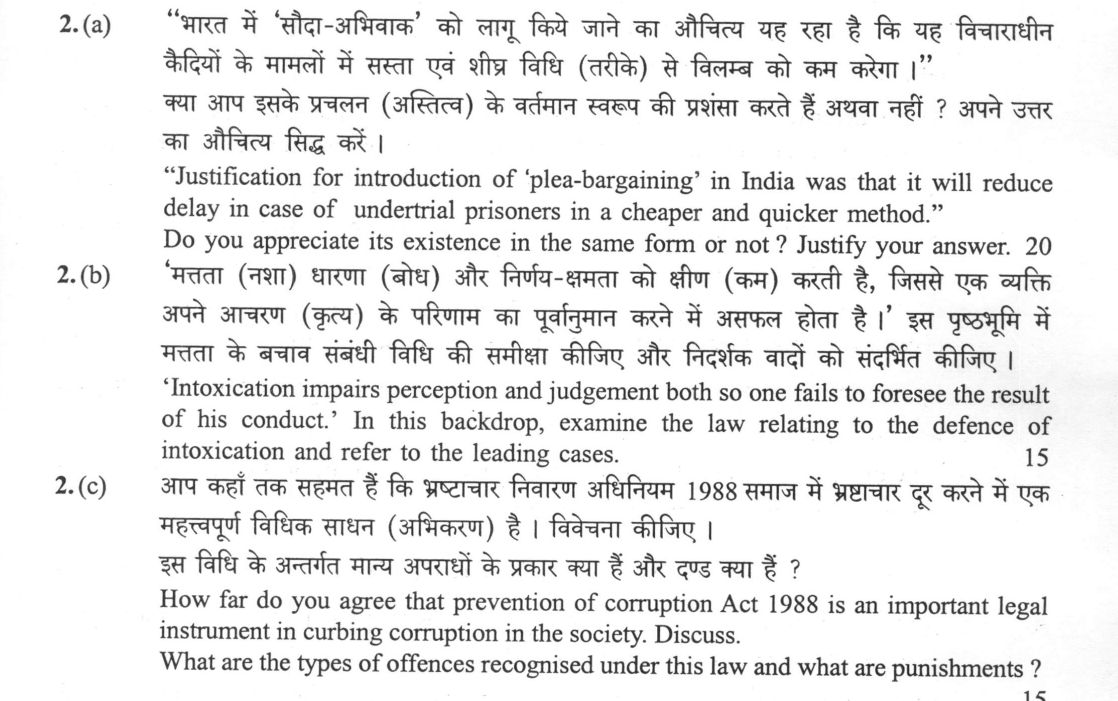
(a) "Justification for introduction of 'plea-bargaining' in India was that it will reduce delay in case of undertrial prisoners…
"Justification for introduction of 'plea-bargaining' in India was that it will reduce delay in case of undertrial prisoners in a cheaper and quicker method." Do you appreciate its existence in the same form or not ? Justify your answer. 20 marks
'Intoxication impairs perception and judgement both so one fails to foresee the result of his conduct.' In this backdrop, examine the law relating to the defence of intoxication and refer to the leading cases. 15 marks
How far do you agree that prevention of corruption Act 1988 is an important legal instrument in curbing corruption in the society. Discuss. What are the types of offences recognised under this law and what are punishments ? 15 marks
हिंदी में प्रश्न पढ़ें
"भारत में 'सौदा-अभिवाक' को लागू किये जाने का औचित्य यह रहा है कि यह विचाराधीन कैदियों के मामलों में सस्ता एवं शीघ्र विधि (तरीके) से विलम्ब को कम करेगा।" क्या आप इसके प्रचलन (अस्तित्व) के वर्तमान स्वरूप की प्रशंसा करते हैं अथवा नहीं ? अपने उत्तर का औचित्य सिद्ध करें। 20
'मत्ता (नशा) धारणा (बोध) और निर्णय-क्षमता को क्षीण (कम) करती है, जिससे एक व्यक्ति अपने आचरण (कृत्य) के परिणाम का पूर्वानुमान करने में असफल होता है।' इस पृष्ठभूमि में मत्ता के बचाव संबंधी विधि की समीक्षा कीजिए और निर्देशक वादों को संदर्भित कीजिए। 15
आप कहाँ तक सहमत हैं कि भ्रष्टाचार निवारण अधिनियम 1988 समाज में भ्रष्टाचार दूर करने में एक महत्वपूर्ण विधिक साधन (अभिकरण) है। विवेचना कीजिए। इस विधि के अंतर्गत मान्य अपराधों के प्रकार क्या हैं और दण्ड क्या हैं ? 15 marks
Model answer
Written by UPSC Answer Check against this question's marking rubric, to the expected length. UPSC does not publish answers for Mains — this is one way to score well, not an official key.
The criminal justice system seeks to balance procedural efficiency with substantive fairness. While reforms like plea bargaining expedite disposals, substantively nuanced doctrines govern culpability in defences like intoxication, and statutory frameworks like the Prevention of Corruption Act (PCA), 1988 target systemic governance failures.
Evaluation of Plea Bargaining in India
Introduced via the Criminal Law (Amendment) Act, 2005 (Chapter XXI-A, Sections 265A–265L, CrPC) on the recommendations of the 142nd and 154th Law Commission Reports and the Malimath Committee, plea bargaining was intended to decongest overcrowded prisons, where undertrials comprise over 75% of the prison population (NCRB data).
However, its retention in the existing form cannot be fully justified due to structural and operational limitations:
First, its scope is excessively restrictive. Section 265A excludes offences punishable with death, life imprisonment, or terms exceeding seven years, as well as offences affecting the socio-economic conditions of the country and offences against women or children below fourteen years. Consequently, a vast pool of undertrials remains excluded.
Second, the Indian framework permits only "sentence bargaining" before a judicial magistrate, excluding "charge bargaining" prevalent in jurisdictions like the United States. This reduces the incentive for accused persons who fear the social stigma of conviction, despite sentencing concessions.
Third, the institutional uptake is critically low. Due to public prosecutor indifference, lack of legal aid awareness, judicial conservatism, and the absence of institutional incentives, plea bargaining accounts for less than 1% of criminal disposals in India. Conversely, for indigent undertrials, it carries the inherent risk of coerced self-incrimination simply to escape prolonged pre-trial incarceration.
Thus, while the mechanism is conceptually sound, retaining it in its present narrow framework is unviable. It requires expansion into structured charge bargaining with institutionalised legal aid oversight to prevent coercion while achieving docket clearance.
Defence of Intoxication under Criminal Law
Under the Indian Penal Code, 1860, the defence of intoxication rests on the absence of mens rea due to cognitive impairment.
Section 85 covers involuntary intoxication, granting complete immunity if the administering act occurred without the accused’s knowledge or against their will, rendering them incapable of knowing the nature of the act or that it was wrong.
Section 86 governs voluntary intoxication, creating an asymmetric presumption between 'knowledge' and 'intention'. The law presumes the accused possessed the same knowledge as a sober person, but does not automatically presume specific intention (dolus eventualis).
In Basdev v. State of PEPSU (1956), the Supreme Court reiterated the rules laid down in Director of Public Prosecutions v. Beard (1920), holding that voluntary drunkenness is no excuse unless the intoxication is so extreme as to completely incapacitate the mind from forming the specific intent required for the crime. Merely proving that the accused's mind was affected, or that he gave way to violent passion, does not rebut the presumption. Furthermore, as seen in R v. Tandy (1989), chronic alcoholism only constitutes an involuntary state if brain disease is established or the drinking was entirely non-voluntary.
Prevention of Corruption Act, 1988: Scope and Efficacy
The PCA, 1988 remains an essential legislative instrument, significantly restructured by the 2018 Amendment to align with the UNCAC.
The Act recognises distinct categories of offences and prescribes stringent punishments:
- Section 7 penalises public servants obtaining, accepting, or attempting to obtain an undue advantage with intent to improperly perform a public duty (imprisonment: 3 to 7 years, plus fine).
- Section 8 and Section 9 criminalise the supply side—bribe-givers and commercial organisations—punishable with up to 7 years imprisonment.
- Section 13(1) defines criminal misconduct, confined to dishonest misappropriation of property (Section 13(1)(a)) and intentional enrichment via illicit, disproportionate assets during the tenure of office (Section 13(1)(b)). Under Section 13(2), these attract imprisonment of 4 to 10 years.
- Section 14 prescribes enhanced punishment (5 to 10 years) for habitual offenders.
Despite these statutory teeth, the Act faces implementation hurdles. Section 17A (mandating prior police inquiry approval) and Section 19 (prior sanction for prosecution) act as administrative shieldwalls that delay proceedings, as highlighted in Subramanian Swamy v. Manmohan Singh. Institutional challenges within the CBI, poor trial speed, and low conviction rates undermine deterrence, although decisions like Neeraj Dutta v. State (GNCTD) (2023)—permitting proof of demand and acceptance through circumstantial evidence—have partially fortified enforcement.
These statutory mechanisms reflect the tension between expeditious justice and fair procedure. Ensuring that plea bargaining safeguards individual rights, that penal defences preserve the integrity of mens rea, and that anti-corruption laws operate free from executive interference is essential to upholding the rule of law.
What "Justify" is asking you to do
Defend a position with reasons that carry evidence, and show why the contrary view does not hold. Where the stem runs as a question and asks you to justify your answer, the position is yours to choose and the marks lie wholly in the defence.
Structure that answers it
Position stated plainly → reason 1 with evidence → reason 2 with evidence → strongest objection, met → position restated as qualified
Where marks are lost
Reasons stated and none of them evidenced. The other standard loss is fence-sitting — an answer that finds merit on both sides and commits to neither has justified nothing.
How this answer will be evaluated
Approach
Framework: Issue > Rule > Authority > Application. (a) justify: claim > 3-4 reasons > evidence > conclusion | (b) examine: intro > how/why with reasoning > evidence > conclusion | (c) discuss: intro > 3-4 dimensions > example > balanced close Full marks: Precise legal citations, clear distinction of concepts, and strong application of law to the specific context.
Key points expected
- Cite Section 300 CrPC and Section 230 BNSS
- Reference Law Commission 26th Report
- Discuss the 'right to fair trial' vs 'expeditious justice' conflict
- Analyze the 'voluntariness' and 'informed consent' safeguards
- Distinguish between voluntary and involuntary intoxication
- Cite Section 86 of the Indian Penal Code
- Reference the case of Emperor v. Sankaran
- Explain the 'mens rea' requirement in the context of intoxication
Evaluation rubric
Each sub-part is marked on its own, against the marks and word limit printed on the paper.
- (a) Evaluate the plea-bargaining mechanism and justify its current form or propose changes. 20 marks
justify— claim → 3-4 reasons → evidence → conclusion
Must cover
- Cite Section 300 CrPC and Section 230 BNSS
- Reference Law Commission 26th Report
- Discuss the 'right to fair trial' vs 'expeditious justice' conflict
- Analyze the 'voluntariness' and 'informed consent' safeguards
Loses marks
- Defining plea bargaining without legal basis
- Ignoring the 'voluntariness' requirement
- Failing to mention the 'judicial approval' stage
Earns more
- Mention the 2005 amendment to CrPC
- Reference the 2023 Bharatiya Nagarik Suraksha Sanhita
- Discuss the 'undertrial' population statistics
- Mention the 'judicial discretion' in approving the deal
Extra mark
- Cite a recent Supreme Court judgment on plea bargaining
- Reference a specific Law Commission recommendation
- (b) Examine the legal defense of intoxication and its impact on criminal liability. 15 marks
examine— intro → how/why with reasoning → evidence → conclusion
Must cover
- Distinguish between voluntary and involuntary intoxication
- Cite Section 86 of the Indian Penal Code
- Reference the case of Emperor v. Sankaran
- Explain the 'mens rea' requirement in the context of intoxication
Loses marks
- Failing to distinguish between voluntary and involuntary intoxication
- Ignoring the 'mens rea' requirement
- Failing to cite the relevant section of the IPC
Earns more
- Mention the 'specific intent' vs 'general intent' distinction
- Reference the case of R v. Chappell
- Discuss the 'public policy' argument against the defense
- Mention the 'burden of proof' on the accused
Extra mark
- Cite a recent Supreme Court judgment on intoxication
- Reference a specific Law Commission report on intoxication
- (c) Discuss the effectiveness of the Prevention of Corruption Act 1988 and its provisions. 15 marks
discuss— intro → 3-4 dimensions → example → balanced close
Must cover
- Cite the Prevention of Corruption Act 1988
- List the types of offences under the Act
- Explain the punishments for these offences
- Discuss the 'burden of proof' reversal in corruption cases
Loses marks
- Failing to list the types of offences
- Ignoring the 'burden of proof' reversal
- Failing to mention the 'punishments' for the offences
Earns more
- Mention the 'CBI' as the investigating agency
- Reference the 'Special Courts' for corruption cases
- Discuss the 'confiscation of property' provision
- Mention the 'whistleblower' protection
Extra mark
- Cite a recent Supreme Court judgment on corruption
- Reference a specific Law Commission report on corruption
Practice this exact question
Write your answer and it is marked point by point against the model answer above — what you covered, what you missed, what you got wrong.
Evaluate my answer →More from Law 2024 Paper II
- Q1 Answer the following questions in about 150 words each. Support your answer with relevant…
- Q2 (a) "Justification for introduction of 'plea-bargaining' in India was that it will reduce…
- Q3 (a) "It is the mode of acquiring possession of property of other party with/without his c…
- Q4 (a) 'If an enterprise is permitted to carry on any hazardous or inherently dangerous acti…
- Q5 Answer the following questions in about 150 words each. Support your answer with relevant…