Paper II — Q6
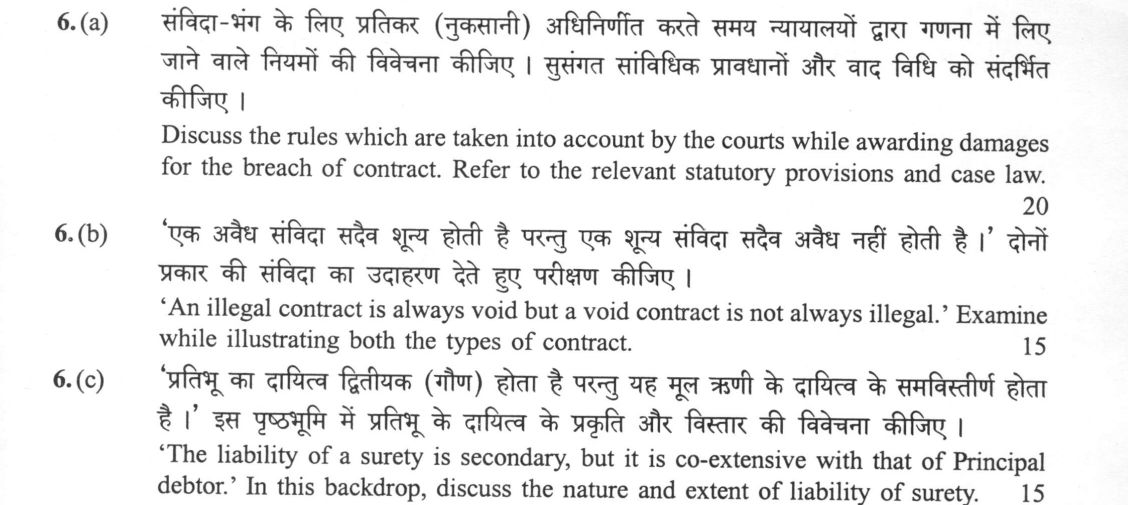
(a) Discuss the rules which are taken into account by the courts while awarding damages for the breach of contract. Refer to the…
Discuss the rules which are taken into account by the courts while awarding damages for the breach of contract. Refer to the relevant statutory provisions and case law. 20 marks
'An illegal contract is always void but a void contract is not always illegal.' Examine while illustrating both the types of contract. 15 marks
'The liability of a surety is secondary, but it is co-extensive with that of Principal debtor.' In this backdrop, discuss the nature and extent of liability of surety. 15 marks
हिंदी में प्रश्न पढ़ें
संविदा-भंग के लिए प्रतिकर (नुकसानी) अधिनिर्णीत करते समय न्यायालयों द्वारा गणना में लिए जाने वाले नियमों की विवेचना कीजिए । सुसंगत सांविधिक प्रावधानों और वाद विधि को संदर्भित कीजिए । 20
'एक अवैध संविदा सदैव शून्य होती है परन्तु एक शून्य संविदा सदैव अवैध नहीं होती है ।' दोनों प्रकार की संविदा का उदाहरण देते हुए परीक्षण कीजिए । 15
'प्रतिभू का दायित्व द्वितीयक (गौण) होता है परन्तु यह मूल ऋणी के दायित्व के समविस्तीर्ण होता है ।' इस पृष्ठभूमि में प्रतिभू के दायित्व के प्रकृति और विस्तार की विवेचना कीजिए । 15
Model answer
Written by UPSC Answer Check against this question's marking rubric, to the expected length. UPSC does not publish answers for Mains — this is one way to score well, not an official key.
Damages for breach Damages for breach of contract protect the expectation interest: the promisee is placed, so far as money can do, in the position he would have occupied had the contract been performed, not the position before it was made. Section 73, Indian Contract Act, 1872, compensates loss or damage which naturally arises in the usual course of things, or which the parties knew at contracting to be likely. This imports Hadley v. Baxendale: general damages flow naturally from breach; special damages require proof that the promisor knew of the special circumstances making the loss probable. Fateh Chand v. Balkirpal measures loss against the benefit expected from performance. The promisee must mitigate loss avoidable by reasonable steps. M. Lachia Setty & Sons Ltd. v. Coffee Board and M.L. Devender Singh v. State of Punjab show that failure to take reasonable alternative supply or other available steps reduces recovery. Section 74 provides that if liquidated damages are fixed, the court awards that sum, provided it is a genuine pre-estimate; if it is a penalty, the court awards reasonable compensation not exceeding the stipulated sum. Kailash Nath Associates v. Modern Construction Co. distinguishes liquidated damages from penalty by the nature of the contract and the parties’ intention.
Illegal and void contracts An illegal contract is always void because its object or consideration is forbidden by law, fraudulent, immoral, or otherwise unlawful under Sections 23 and 24; an agreement to pay for stealing goods is void ab initio. A void contract, however, need not be illegal. Section 2(g) defines a void agreement as an agreement not enforceable by law, while Section 2(j) defines a void contract as a contract that ceases to be enforceable when it becomes impossible to perform or unlawful. Thus a contract may become void under Section 56 by impossibility: if A contracts to sell and deliver a specific cargo of wheat and the cargo perishes before delivery, the contract becomes void without illegality. Similarly, an agreement with uncertain meaning under Section 29, or an agreement to do an impossible act under Section 32, is void but not necessarily illegal. Gherulal Parekh v. Mahadeo Das distinguishes voidability from illegality: a voidable contract remains enforceable until avoided and is not illegal merely because it may be set aside. Hence illegality is one ground of voidness, but voidness may also arise from uncertainty, impossibility, or change of law.
Surety’s liability A surety’s liability is secondary because it arises only from the principal debtor’s obligation and default; the surety is not the original obligor. Yet under Section 128 it is co-extensive with that of the principal debtor unless the guarantee provides otherwise. The creditor may proceed against the surety directly upon default, without exhausting remedies against the principal debtor, subject to the guarantee. The extent is limited by the guarantee: it covers the principal debt, and interest, costs or expenses only if expressly or impliedly included. The surety is discharged by material variance in the principal contract without consent (Section 133), by release of the principal debtor (Section 134), and by composition or settlement between creditor and principal debtor without the surety’s consent (Section 135). State Bank of India v. Indexport Registered and Lachhman Joharimal v. Bapu show that courts strictly preserve the surety’s position: any act that increases the risk or alters the principal obligation without consent may discharge the surety to that extent. In sum, these doctrines balance expectation, legality and security: damages compensate foreseeable loss, voidness removes unenforceable obligations, and the surety stands behind the principal debtor, but within the guarantee his liability is as wide as the principal’s.
What "Discuss" is asking you to do
Lay the issue out from more than one side — how it arose, what is claimed for it, what is held against it, and where it now stands. UPSC attaches discuss to broad topics with several live dimensions, so coverage of the dimensions earns more than the strength of your opinion.
Structure that answers it
Set the issue up → the case as it is made → the case against → the dimension both sides leave out → where the balance now lies
Where marks are lost
Listing facts with no thread between them, or arguing one side throughout and calling it a discussion.
How this answer will be evaluated
Approach
Framework: Issue > Rule: statute or Article > Authority > Application and conclusion. (a) discuss: intro > 3-4 dimensions > example > balanced close | (b) examine: intro > how/why with reasoning > evidence > conclusion | (c) discuss: intro > 3-4 dimensions > example > balanced close Full marks: Precise statutory and case law references, clear application to facts, balanced discussion.
Key points expected
- Cite Section 73 of the Indian Contract Act, 1872
- Explain the rule in Hadley v Baxendale (remoteness)
- Distinguish between direct and consequential damages
- Mention the rule of mitigation of damages
- Define illegal contract under Section 23
- Define void contract under Section 2(j)
- Provide an example of an illegal contract
- Provide an example of a void contract
Evaluation rubric
Each sub-part is marked on its own, against the marks and word limit printed on the paper.
- (a) Rules for awarding damages for breach of contract with statutory and case law references. 20 marks
discuss— intro → 3-4 dimensions → example → balanced close
Must cover
- Cite Section 73 of the Indian Contract Act, 1872
- Explain the rule in Hadley v Baxendale (remoteness)
- Distinguish between direct and consequential damages
- Mention the rule of mitigation of damages
Loses marks
- Outcome-only case citation without ratio
- Discussion without statutory provisions
- Confusing tort damages with contract damages
Earns more
- Reference to Section 74 (Liquidated Damages)
- Cite Jacob & Co v AT & T
- Mention the principle of 'restitutio in integrum'
- Reference to Section 75 (Restitution)
Extra mark
- Reference to recent Supreme Court judgment on damages
- Mention Law Commission report on contract law
- (b) Examine the relationship between illegal and void contracts with illustrations. 15 marks
examine— intro → how/why with reasoning → evidence → conclusion
Must cover
- Define illegal contract under Section 23
- Define void contract under Section 2(j)
- Provide an example of an illegal contract
- Provide an example of a void contract
Loses marks
- Confusing void and voidable contracts
- No illustrations provided
- Discussion without statutory provisions
Earns more
- Reference to Section 24 (Agreement without consideration)
- Mention Section 25 (Agreement without consideration)
- Cite a case law on illegal contracts
- Mention the distinction between void and voidable
Extra mark
- Reference to recent Supreme Court judgment on void contracts
- Mention Law Commission report on contract law
- (c) Discuss the nature and extent of liability of a surety. 15 marks
discuss— intro → 3-4 dimensions → example → balanced close
Must cover
- Define surety and principal debtor
- Explain the secondary nature of surety's liability
- Explain the co-extensive nature of liability
- Mention the extent of surety's liability
Loses marks
- Confusing surety with guarantor
- No discussion on co-extensive nature
- Discussion without statutory provisions
Earns more
- Reference to Section 128 of the Indian Contract Act
- Mention Section 133 (Effect of variance)
- Cite a case law on surety's liability
- Mention the right of surety to be exonerated
Extra mark
- Reference to recent Supreme Court judgment on surety's liability
- Mention Law Commission report on contract law
Practice this exact question
Write your answer and it is marked point by point against the model answer above — what you covered, what you missed, what you got wrong.
Evaluate my answer →More from Law 2024 Paper II
- Q3 (a) "It is the mode of acquiring possession of property of other party with/without his c…
- Q4 (a) 'If an enterprise is permitted to carry on any hazardous or inherently dangerous acti…
- Q5 Answer the following questions in about 150 words each. Support your answer with relevant…
- Q6 (a) Discuss the rules which are taken into account by the courts while awarding damages f…
- Q7 (a) "The principle of arbitral autonomy is an integral element of the ever evolving domai…
- Q8 (a) "There is, in recent years, a feeling which is not without any foundation that 'publi…