Paper I — Q1
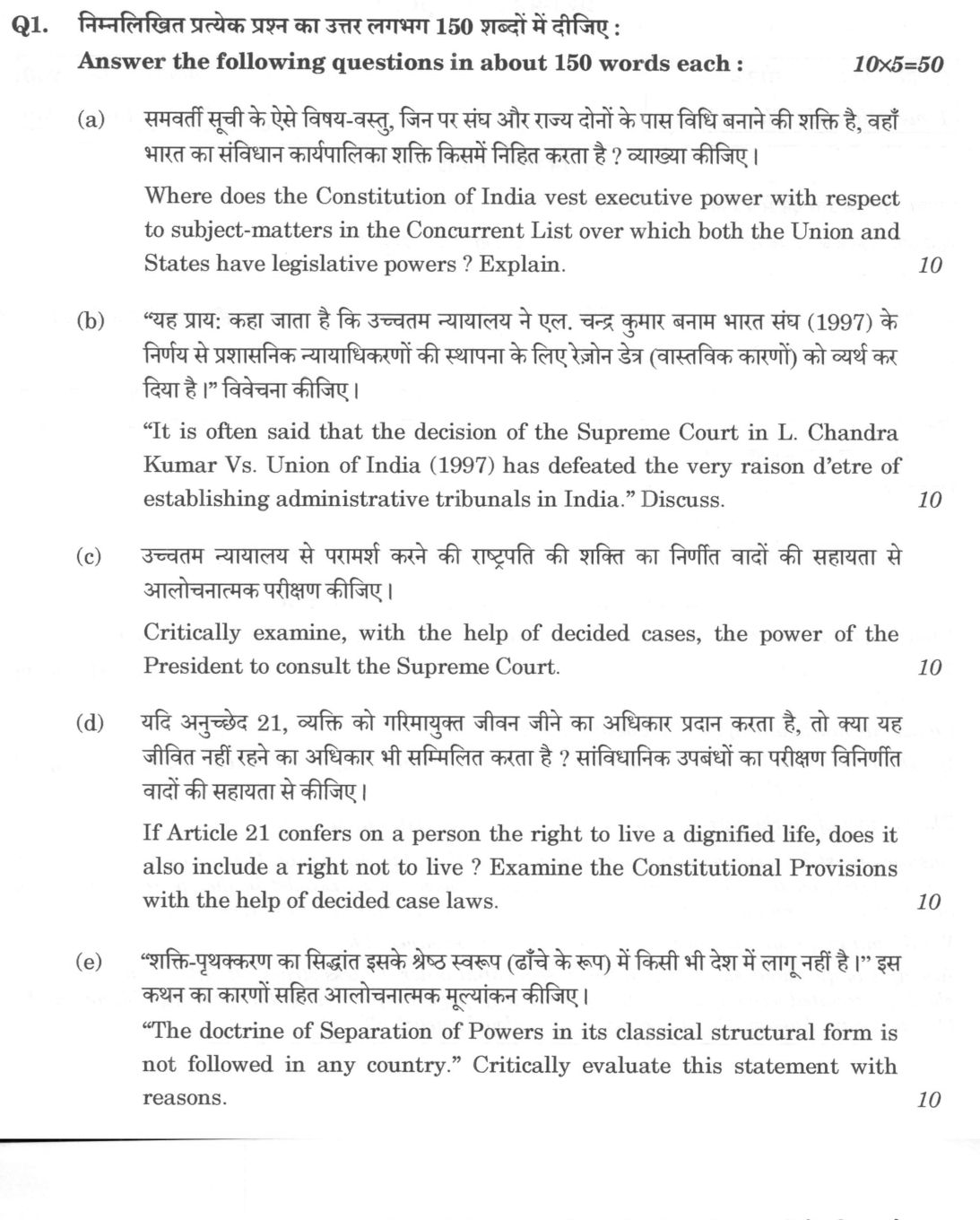
Answer the following questions in about 150 words each: (a) Where does the Constitution of India vest executive power with…
Answer the following questions in about 150 words each:
Where does the Constitution of India vest executive power with respect to subject-matters in the Concurrent List over which both the Union and States have legislative powers? Explain. 10 marks
"It is often said that the decision of the Supreme Court in L. Chandra Kumar Vs. Union of India (1997) has defeated the very raison d'être of establishing administrative tribunals in India." Discuss. 10 marks
Critically examine, with the help of decided cases, the power of the President to consult the Supreme Court. 10 marks
If Article 21 confers on a person the right to live a dignified life, does it also include a right not to live? Examine the Constitutional Provisions with the help of decided case laws. 10 marks
"The doctrine of Separation of Powers in its classical structural form is not followed in any country." Critically evaluate this statement with reasons. 10 marks
हिंदी में प्रश्न पढ़ें
निम्नलिखित प्रत्येक प्रश्न का उत्तर लगभग 150 शब्दों में दीजिए:
समवर्ती सूची के ऐसे विषय-वस्तु, जिन पर संघ और राज्य दोनों के पास विधि बनाने की शक्ति है, वहाँ भारत का संविधान कार्यपालिका शक्ति किसमें निहित करता है? व्याख्या कीजिए। (10 अंक)
"यह प्रायः कहा जाता है कि उच्चतम न्यायालय ने एल. चन्द्र कुमार बनाम भारत संघ (1997) के निर्णय से प्रशासनिक न्यायाधिकरणों की स्थापना के लिए रेज़ोन डेट्र (वास्तविक कारणों) को व्यर्थ कर दिया है।" विवेचना कीजिए। (10 अंक)
उच्चतम न्यायालय से परामर्श करने की राष्ट्रपति की शक्ति का निर्णीत वादों की सहायता से आलोचनात्मक परीक्षण कीजिए। (10 अंक)
यदि अनुच्छेद 21, व्यक्ति को गरिमायुक्त जीवन जीने का अधिकार प्रदान करता है, तो क्या यह जीवित नहीं रहने का अधिकार भी सम्मिलित करता है? संविधानिक उपबंधों का परीक्षण विभिन्नीत वादों की सहायता से कीजिए। (10 अंक)
"शक्ति-पृथक्करण का सिद्धांत इसके श्रेष्ठ स्वरूप (ढाँचे के रूप) में किसी भी देश में लागू नहीं है।" इस कथन का कारणों सहित आलोचनात्मक मूल्यांकन कीजिए। (10 अंक)
Model answer
Written by UPSC Answer Check against this question's marking rubric, to the 150-word length. UPSC does not publish answers for Mains — this is one way to score well, not an official key.
(a) Executive Power over Concurrent List Subjects
Under the Indian Constitution, executive power is co-extensive with legislative competence, but its allocation over Concurrent List (List III) subjects requires harmonizing Article 73(1) and Article 162. Under the proviso to Article 73(1)(a), the executive power of the Union over Concurrent subjects does not automatically extend to a State unless the Constitution or a law made by Parliament expressly confers it upon the Union. Complementarily, Article 162 establishes that the executive power of the State extends to Concurrent subjects, subject to and limited by any executive power expressly vested by parliamentary law in the Union.
In Ram Jawaya Kapur v. State of Punjab (1955), the Supreme Court clarified that while executive power mirrors legislative power, the primary executive authority in Concurrent matters rests ordinarily with the States. The Union exercises overriding supremacy only when Parliament specifically enacts a statute transferring the execution of such law to Union authorities. Thus, the constitutional scheme establishes a presumption in favour of State executive autonomy over Concurrent subjects, while reserving overriding paramountcy for the Union through express parliamentary mandate.
(b) L. Chandra Kumar and the Raison d'Être of Administrative Tribunals
In L. Chandra Kumar v. Union of India (1997), a seven-judge Constitution Bench held that the power of judicial review vested in the High Courts under Articles 226/227 and the Supreme Court under Article 32 is an inviolable feature of the Basic Structure. Consequently, it struck down the exclusion-of-jurisdiction clauses under Articles 323A(2)(d) and 323B(3)(d), ruling that tribunals act merely as supplemental courts of first instance whose decisions are compulsorily subject to scrutiny before a Division Bench of the High Court.
Critics argue this defeated the tribunals' primary *raison d'être*—providing expeditious, expert adjudication by eliminating intermediate appellate tiers and relieving High Courts of arrears, as originally envisioned in S.P. Sampath Kumar (1987). By inserting the High Court as an inevitable intermediary, it introduced another layer of litigation. However, critically assessed, L. Chandra Kumar saved tribunals from becoming bureaucratic enclaves lacking judicial independence. It successfully balanced specialized quasi-judicial efficacy with indispensable constitutional safeguards, subordinating institutional efficiency to the supremacy of the rule of law.
(c) Advisory Jurisdiction of the Supreme Court under Article 143
Article 143 empowers the President to consult the Supreme Court on questions of law or fact of public importance under Clause (1), and on pre-constitutional treaties under Clause (2). In In re Kerala Education Bill (1958) and In re Special Courts Bill (1978), the Court affirmed that while it has discretion to decline an opinion under Clause (1), it is obliged to answer references under Clause (2), provided they do not present vague or academic queries.
Crucially, an opinion rendered under Article 143 is advisory and lacks the binding character of a judgment under Article 141, as reaffirmed in In re Cauvery Water Disputes Tribunal (1992). Nevertheless, these opinions carry persuasive weight and establish authoritative constitutional guidance. However, the mechanism risks executive misuse when political controversies are referred to circumvent legislative deliberation, as seen in the Ayodhya Reference (1994), where the Court rightfully declined to answer. Thus, Article 143 remains a vital mechanism for constitutional clarification, provided the Court exercises self-restraint against politicized questions.
(d) Article 21 and the "Right to Die"
Article 21 guarantees the right to life and personal liberty, which encompasses the right to live with human dignity. The question whether this includes a "right not to live" witnessed major constitutional shifts. While P. Rathinam v. Union of India (1994) held that the right to live includes the right to die, a Constitution Bench in Gian Kaur v. State of Punjab (1996) overruled it, holding that Article 21 protects natural life and cannot be expanded to include the right to extinguish life, thereby upholding the validity of Section 306 and Section 309 of the Indian Penal Code.
The jurisprudence evolved in Aruna Ramchandra Shanbaug v. Union of India (2011), which distinguished active euthanasia from passive euthanasia and permitted the latter under strict judicial oversight. Finally, in Common Cause v. Union of India (2018), the Constitution Bench held that the right to die with dignity forms an integral part of Article 21, recognizing passive euthanasia and advance medical directives (living wills). Therefore, constitutional law does not recognize a positive "right to die" via suicide or active termination, but firmly recognizes the negative right to a dignified, unprolonged dying process.
(e) Doctrine of Separation of Powers in Classical vs. Modern Context
The classical structural doctrine propounded by Montesquieu mandates three strictly distinct organs of state with watertight functional and personnel boundaries. Historically and functionally, this pure model is not realized in any contemporary democracy. Even in the United States, which adopts the strictest structural separation, the system operates through institutional interlocks such as the presidential veto, Senate confirmation of judges, and judicial review. Conversely, the United Kingdom exhibits an institutional fusion of the executive and legislative branches.
India follows a nuanced, functional separation of powers rather than a rigid structural division. Under our parliamentary democracy, the executive is embedded in and collectively responsible to the legislature. The judiciary remains integrated and independent, exercising judicial review over legislative and executive acts, while Parliament exercises constituent and impeachment powers. As established in Kesavananda Bharati (1973) and Indira Nehru Gandhi (1975), separation of powers is part of the Basic Structure in India not as an unyielding structural compartmentalization, but as an operational system of constitutional checks and balances. The claim is entirely accurate: modern governance relies on functional differentiation and mutual accountability rather than classical structural isolation.
What "Critically examine" is asking you to do
Test the proposition the question puts to you and return a finding on how far it holds. Examine stems carry a claim, or ask whether something has happened, and expect evidence weighed both ways before the extent is stated — often with remedial measures attached. “Critically” is not a section added at the end: name the yardstick you are judging by — the evidence, the stated objective, a constitutional principle, a rival explanation — and let a verdict close each part of the body. Where the question quotes a claim, that verdict must land on the claim itself, accepted, qualified or rejected, and not on the theme in general.
Structure that answers it
Restate the claim as the question frames it → evidence that supports it → evidence that undercuts it → the conditions under which it holds → verdict on how far it stands
Where marks are lost
Merits in one paragraph, demerits in the next, and a conclusion calling for a balanced and holistic approach. That is a survey with the judgement left out and it holds the answer in the middle band. The opposite error is reading “critically” as permission to attack — and with the odd pairings, critically describe or critically explain, the exposition still carries most of the marks, the judgement being a layer on it rather than a substitute for it.
How this answer will be evaluated
Approach
Framework: Issue > Rule > Authority > Application. (a) explain: definition/context > points in order > small example > short close | (b) discuss: intro > 3-4 dimensions > example > balanced close | (c) examine: intro > how/why with reasoning > evidence > conclusion | (d) examine: intro > how/why with reasoning > evidence > conclusion | (e) critically evaluate: positives > negatives/limits > conditions/safeguards > conclusion Full marks: Precise Article/case citation, clear application, balanced conclusion
Key points expected
- Cite Article 246(1) and 246(2)
- Distinguish legislative vs executive power
- Reference Seventh Schedule List III
- Mention Article 73 and 162
- Cite L. Chandra Kumar v. UoI (1997)
- Explain 'raison d'être' of tribunals
- Discuss Article 323A and 323B
- Mention 42nd Amendment context
Evaluation rubric
Each sub-part is marked on its own, against the marks and word limit printed on the paper.
- (a) Identify the constitutional provision vesting executive power over Concurrent List subjects. 10 marks · 150 words
explain— definition/context → points in order → small example → short close
Must cover
- Cite Article 246(1) and 246(2)
- Distinguish legislative vs executive power
- Reference Seventh Schedule List III
- Mention Article 73 and 162
Loses marks
- Confusing legislative with executive power
- Ignoring Article 246(2) for State executive
- Failing to mention Concurrent List
Earns more
- Mention Article 257(1) delegation
- Reference Article 258(1) delegation
- Mention Article 258(2) special agreement
Extra mark
- Reference 7th Schedule List III specific entries
- Mention Article 248(1) and 248(2)
- (b) Analyze the impact of L. Chandra Kumar judgment on administrative tribunals. 10 marks · 150 words
discuss— intro → 3-4 dimensions → example → balanced close
Must cover
- Cite L. Chandra Kumar v. UoI (1997)
- Explain 'raison d'être' of tribunals
- Discuss Article 323A and 323B
- Mention 42nd Amendment context
Loses marks
- Ignoring the 'raison d'être' argument
- Failing to cite L. Chandra Kumar
- Not discussing the impact on tribunals
Earns more
- Reference Article 323A(2)(d) and 323B(3)(d)
- Mention Article 136 and 226
- Discuss judicial review power
Extra mark
- Reference 142nd Law Commission Report
- Mention Article 323A(2)(d) and 323B(3)(d) specific clauses
- (c) Critically examine the President's power to consult the Supreme Court under Article 143. 10 marks · 150 words
examine— intro → how/why with reasoning → evidence → conclusion
Must cover
- Cite Article 143(1) and 143(2)
- Distinguish advisory vs mandatory jurisdiction
- Cite In re: Berubari Union (1960)
- Cite In re: Presidential Reference (1975)
Loses marks
- Confusing advisory with mandatory jurisdiction
- Failing to cite Article 143
- Not mentioning any decided case
Earns more
- Mention Article 143(1) 'may' vs 143(2) 'shall'
- Discuss binding nature of opinion
- Reference In re: Special Reference (1978)
Extra mark
- Reference In re: Special Reference (1978) specific details
- Mention Article 143(1) 'may' vs 143(2) 'shall' distinction
- (d) Examine whether Article 21 includes the right not to live, citing case law. 10 marks · 150 words
examine— intro → how/why with reasoning → evidence → conclusion
Must cover
- Cite Article 21
- Cite P. Rathinam v. UoI (1994)
- Cite Gian Kaur v. State of Punjab (1996)
- Discuss 'right to die with dignity'
Loses marks
- Failing to cite P. Rathinam or Gian Kaur
- Not discussing the 'right not to live' aspect
- Ignoring the constitutional provisions
Earns more
- Mention Article 21 'right to life'
- Discuss 'dignified life' vs 'right not to live'
- Reference Article 21 'right to die with dignity'
Extra mark
- Reference Article 21 'right to die with dignity' specific phrasing
- Mention Article 21 'right to life' specific phrasing
- (e) Evaluate the statement that classical Separation of Powers is not followed in any country. 10 marks · 150 words
critically evaluate— positives → negatives/limits → conditions/safeguards → conclusion
Must cover
- Define 'classical structural form'
- Mention Montesquieu's theory
- Discuss functional overlap in India
- Reference Article 50
Loses marks
- Failing to define 'classical structural form'
- Not mentioning Montesquieu
- Ignoring the 'not followed in any country' claim
Earns more
- Mention 'separation of powers' vs 'checks and balances'
- Discuss judicial review power
- Reference Article 50 'separation of judiciary'
Extra mark
- Reference Article 50 'separation of judiciary' specific phrasing
- Mention 'separation of powers' vs 'checks and balances' distinction
Practice this exact question
Write your answer and it is marked point by point against the model answer above — what you covered, what you missed, what you got wrong.
Evaluate my answer →More from Law 2025 Paper I
- Q1 Answer the following questions in about 150 words each: (a) Where does the Constitution o…
- Q2 (a) What are the powers, privileges and immunities of Houses of Parliament in India? Do t…
- Q3 (a) "In any democratic society, judicial review of administrative action is the soul of t…
- Q4 (a) Examine the power of the Governor to grant pardons, reprieves, respites or remissions…