Paper I — Q3
(a) "In any democratic society, judicial review of administrative action is the soul of the system. Without it, democracy, and…
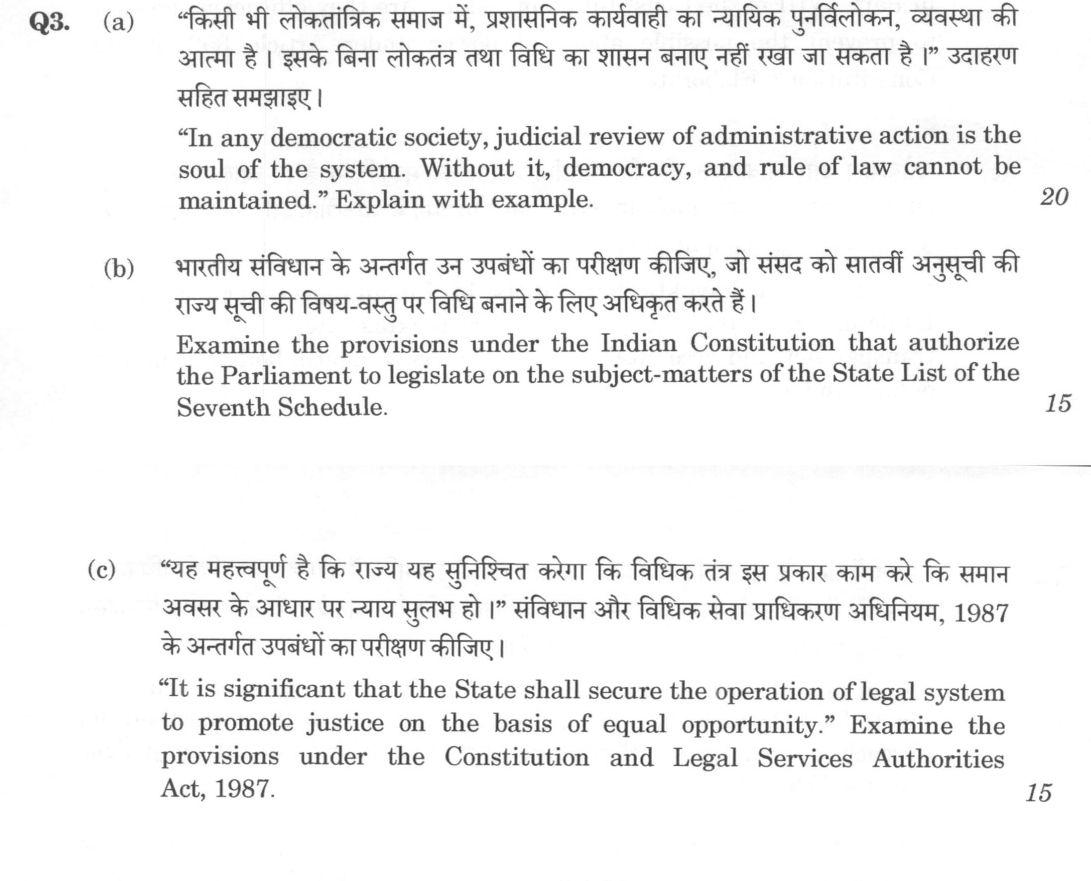
"In any democratic society, judicial review of administrative action is the soul of the system. Without it, democracy, and rule of law cannot be maintained." Explain with example. 20 marks
Examine the provisions under the Indian Constitution that authorize the Parliament to legislate on the subject-matters of the State List of the Seventh Schedule. 15 marks
"It is significant that the State shall secure the operation of legal system to promote justice on the basis of equal opportunity." Examine the provisions under the Constitution and Legal Services Authorities Act, 1987. 15 marks
हिंदी में प्रश्न पढ़ें
"किसी भी लोकतांत्रिक समाज में, प्रशासनिक कार्यवाही का न्यायिक पुनर्विलोकन, व्यवस्था की आत्मा है। इसके बिना लोकतंत्र तथा विधि का शासन बनाए नहीं रखा जा सकता है!" उदाहरण सहित समझाइए। (20 अंक)
भारतीय संविधान के अंतर्गत उन उपबंधों का परीक्षण कीजिए, जो संसद को सातवीं अनुसूची की राज्य सूची की विषय-वस्तु पर विधि बनाने के लिए अधिकृत करते हैं। (15 अंक)
"यह महत्वपूर्ण है कि राज्य यह सुनिश्चित करेगा कि विधिक तंत्र इस प्रकार काम करे कि समान अवसर के आधार पर न्याय सुलभ हो।" संविधान और विधिक सेवा प्राधिकरण अधिनियम, 1987 के अंतर्गत उपबंधों का परीक्षण कीजिए। (15 अंक)
Model answer
Written by UPSC Answer Check against this question's marking rubric, to the expected length. UPSC does not publish answers for Mains — this is one way to score well, not an official key.
In a constitutional democracy, courts check power, Parliament may temporarily enlarge its field for national unity, and legal aid makes rights real.
Judicial review as the soul of democracy Judicial review is the power of courts to examine whether executive or legislative action conforms to the Constitution. It is a basic-structure feature: in Kesavananda Bharati v. State of Kerala, amendment power cannot destroy basic structure; in L. Chandra Kumar v. Union of India, judicial review of amendments was affirmed as part of it. The mechanism is that when authority is exercised, the court asks whether it is lawful, rational and proportionate. Wednesbury unreasonableness bars action no reasonable authority could take; proportionality requires suitable, necessary and balanced means. In Maneka Gandhi v. Union of India, impounding a passport was challenged under Articles 14, 19 and 21. The Court held that any procedure depriving life or personal liberty must be fair, just and reasonable, not arbitrary. This prevented executive arbitrariness through facially valid rules. In Vineet Narain v. Union of India, the Court strengthened CBI autonomy by requiring consultation with the Central Vigilance Commission before withdrawal, protecting investigative independence from political interference. Thus judicial review sustains democracy by converting abstract rights into enforceable limits on power.
Parliamentary legislation on State List matters The Constitution is federal but contains exceptions. Article 249 authorises Parliament to legislate on a State List matter if the Rajya Sabha, by special majority, resolves it necessary in the national interest; the law operates for one year unless extended. Article 250 permits such legislation during national emergency, when Union competence expands to the whole territory. Article 252 allows legislation when two or more States agree to a common central law. Article 253 empowers Parliament to implement international treaties, even on State List subjects, without affecting State powers unless it could not otherwise legislate. Article 356, during President’s Rule, permits Parliament to legislate on State List matters for the affected State; Article 357 supplements this by allowing the President to make administrative rules, subject to parliamentary control. Article 246(4) extends Parliament’s competence to Union Territories, enabling State List legislation there. These powers are conditional, temporary or purpose-bound and must respect federal balance. In S.R. Bommai v. Union of India, the Supreme Court held that Article 356 requires satisfactory material showing failure of constitutional machinery and is subject to judicial review, showing courts police federal exceptions.
Legal aid and equal opportunity Article 39A directs the State to secure that the legal system promotes justice on the basis of equal opportunity and ensures free legal aid. The Legal Services Authorities Act, 1987 gives it statutory force. Sections 12 and 13 define entitled categories—women, children, persons with disabilities, industrial workmen, persons in custody—and prescribe services such as advice, drafting and representation. Sections 19 to 22 provide for Lok Adalats, which settle disputes speedily and cheaply; Permanent Lok Adalats for public utility services are established under Sections 22A to 22E, inserted by the 2002 Amendment. The Act creates NALSA, State Legal Services Authorities and District Legal Services Authorities, making legal aid institutional rather than merely aspirational. Judicial review enforces this scheme: where a State fails to provide legal aid, a person can approach the High Court under Article 226 or the Supreme Court under Article 32. Recent Supreme Court directions during the pandemic, requiring legal aid for detained persons and removal of access barriers, show how courts keep Article 39A alive.
Together, judicial review prevents arbitrariness, parliamentary powers allow national action without destroying federalism, and legal aid ensures the rule of law is not reserved for the privileged. The result is a living constitutionalism in which rights, federal balance and access to justice are continuously tested and strengthened.
What "Explain" is asking you to do
Make the working of something clear — what sets it off, what follows from what, and what it produces. Explain is the Commission's mechanism word: it dominates the technical papers and the “explain why” stems, where the marks sit in the causal chain and not in the label.
Structure that answers it
State what it is → the initiating condition → the chain of cause, step by step → an instance where it plays out → what the chain produces
Where marks are lost
Describing what something looks like instead of why it works that way. Naming the stages without linking them reads as description too.
How this answer will be evaluated
Approach
Framework: Issue > Rule: statute or Article > Authority > Application and conclusion. (a) explain: definition/context > points in order > small example > short close | (b) examine: intro > how/why with reasoning > evidence > conclusion | (c) examine: intro > how/why with reasoning > evidence > conclusion Full marks: Precise citation of Articles/Sections with relevant case law and clear application to the prompt.
Key points expected
- Define judicial review of administrative action
- Link review to maintenance of rule of law
- Provide a specific case example (e.g., Maneka Gandhi)
- Explain the check on executive power
- Cite Article 249 (National Interest)
- Cite Article 250 (Emergency)
- Cite Article 252 (Inter-state request)
- Cite Article 246(3) (Residuary powers)
Evaluation rubric
Each sub-part is marked on its own, against the marks and word limit printed on the paper.
- (a) Define judicial review and demonstrate its role as the 'soul' of democracy with a specific example. 20 marks
explain— definition/context → points in order → small example → short close
Must cover
- Define judicial review of administrative action
- Link review to maintenance of rule of law
- Provide a specific case example (e.g., Maneka Gandhi)
- Explain the check on executive power
Loses marks
- General discussion without specific case law
- Confusing judicial review with judicial activism
- Ignoring the 'administrative action' aspect
Earns more
- Mention Article 13 or 32
- Reference 'Basic Structure' doctrine
- Discuss 'arbitrary' or 'unreasonable' action
- Mention writ jurisdiction
Extra mark
- Cite a recent Supreme Court judgment
- Reference a Law Commission report
- (b) List and explain the constitutional provisions allowing Parliament to legislate on State List subjects. 15 marks
examine— intro → how/why with reasoning → evidence → conclusion
Must cover
- Cite Article 249 (National Interest)
- Cite Article 250 (Emergency)
- Cite Article 252 (Inter-state request)
- Cite Article 246(3) (Residuary powers)
Loses marks
- Listing provisions without explaining the mechanism
- Confusing State List with Concurrent List
- Missing the Emergency provisions
Earns more
- Mention Article 253 (International treaties)
- Reference Article 254 (Inconsistency)
- Mention Article 248 (Residuary)
- Discuss the 7th Schedule context
Extra mark
- Cite a case on Art 249
- Reference a specific treaty legislation
- (c) Analyze constitutional and statutory provisions ensuring justice through equal opportunity in the legal system. 15 marks
examine— intro → how/why with reasoning → evidence → conclusion
Must cover
- Cite Article 39A (Free Legal Aid)
- Cite Article 14 (Equality before law)
- Reference Legal Services Authorities Act, 1987
- Discuss the role of NALSA/State Commissions
Loses marks
- Ignoring the 1987 Act entirely
- Focusing only on Article 14 without 39A
- Vague discussion of 'equal opportunity'
Earns more
- Mention Article 21 (Right to life)
- Reference Article 38 (Welfare)
- Discuss 'Access to Justice' concept
- Mention specific schemes under LSA Act
Extra mark
- Cite a case on free legal aid
- Reference a specific NALSA scheme
Practice this exact question
Write your answer and it is marked point by point against the model answer above — what you covered, what you missed, what you got wrong.
Evaluate my answer →More from Law 2025 Paper I
- Q1 Answer the following questions in about 150 words each: (a) Where does the Constitution o…
- Q2 (a) What are the powers, privileges and immunities of Houses of Parliament in India? Do t…
- Q3 (a) "In any democratic society, judicial review of administrative action is the soul of t…
- Q4 (a) Examine the power of the Governor to grant pardons, reprieves, respites or remissions…
- Q5 Answer the following questions in about 150 words each: (a) Is anticipatory and pre-empti…
- Q6 (a) There may be various reasons for the failure of the Security Council of United Nation…