Paper I — Q2
(a) What are the powers, privileges and immunities of Houses of Parliament in India? Do they have the power to expel any of their…
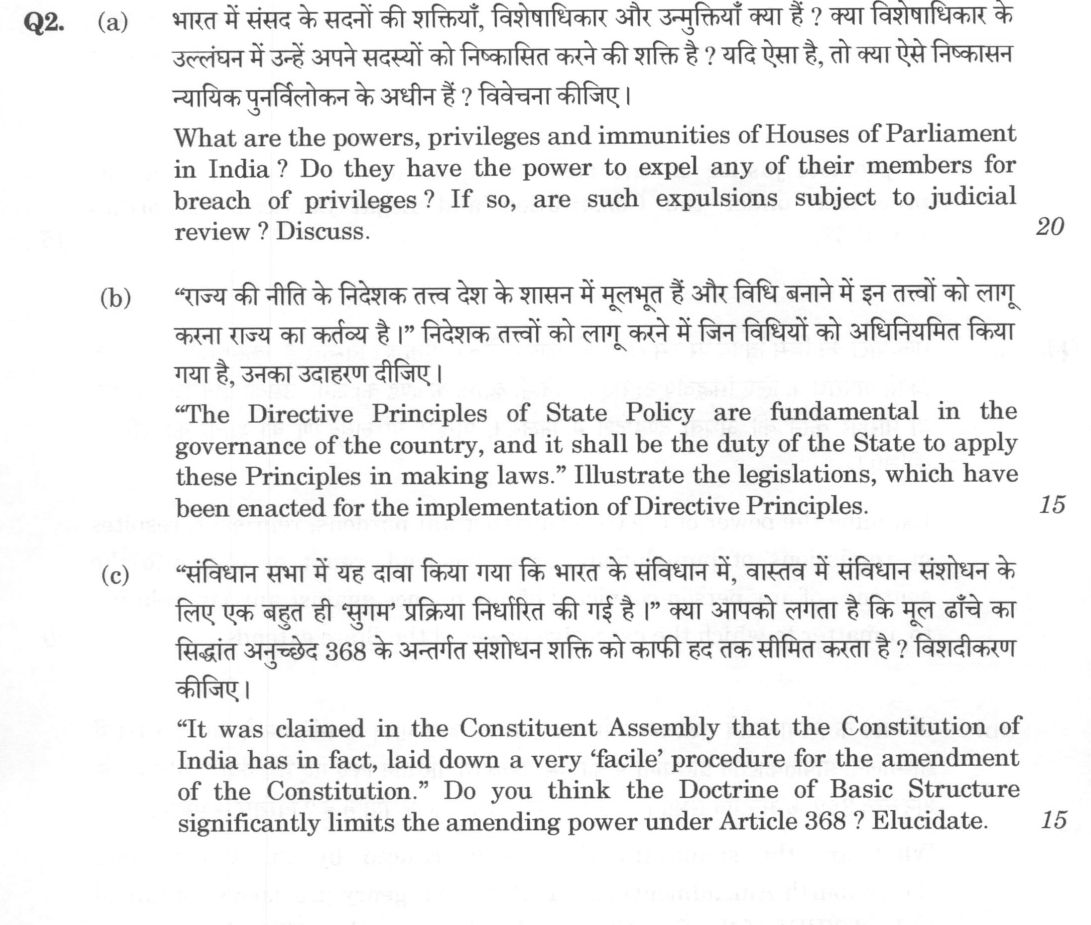
What are the powers, privileges and immunities of Houses of Parliament in India? Do they have the power to expel any of their members for breach of privileges? If so, are such expulsions subject to judicial review? Discuss. 20 marks
"The Directive Principles of State Policy are fundamental in the governance of the country, and it shall be the duty of the State to apply these Principles in making laws." Illustrate the legislations, which have been enacted for the implementation of Directive Principles. 15 marks
"It was claimed in the Constituent Assembly that the Constitution of India has in fact, laid down a very 'facile' procedure for the amendment of the Constitution." Do you think the Doctrine of Basic Structure significantly limits the amending power under Article 368? Elucidate. 15 marks
हिंदी में प्रश्न पढ़ें
भारत में संसद के सदनों की शक्तियाँ, विशेषाधिकार और उन्मुक्तियाँ क्या हैं? क्या विशेषाधिकार के उल्लंघन में उन्हें अपने सदस्यों को निष्कासित करने की शक्ति है? यदि ऐसा है, तो क्या ऐसे निष्कासन न्यायिक पुनर्विलोकन के अधीन हैं? विवेचना कीजिए। (20 अंक)
"राज्य की नीति के निदेशक तत्व देश के शासन में मूलभूत हैं और विधि बनाने में इन तत्वों को लागू करना राज्य का कर्तव्य है!" निदेशक तत्वों को लागू करने में जिन विधियों को अधिनियमित किया गया है, उनका उदाहरण दीजिए। (15 अंक)
"संविधान सभा में यह दावा किया गया कि भारत के संविधान में, वास्तव में संविधान संशोधन के लिए एक बहुत ही 'सुगम' प्रक्रिया निर्धारित की गई है!" क्या आपको लगता है कि मूल ढाँचे का सिद्धांत अनुच्छेद 368 के अंतर्गत संशोधन शक्ति को काफी हद तक सीमित करता है? विशदीकरण कीजिए। (15 अंक)
Model answer
Written by UPSC Answer Check against this question's marking rubric, to the expected length. UPSC does not publish answers for Mains — this is one way to score well, not an official key.
Parliamentary privileges and expulsion Article 105 gives Houses of Parliament freedom of speech (105(1)), protection for proceedings and publications made by or under parliamentary authority (105(2)), and provides that powers, privileges and immunities of Houses, members and committees are to be defined by Parliament by law (105(3)), continuing as under the Government of India Act, 1935. Privileges protect Parliament’s dignity and effective functioning, not personal immunity. They include freedom from arrest in civil matters during sessions and the power to punish contempt or breach of privilege.
A House may expel any member for gross misconduct or breach of privilege. In Raja Ram Pal v. Hon’ble Speaker, Lok Sabha (2007), the Supreme Court affirmed this power but required fair procedure, reasonable hearing and non-arbitrariness. It held Article 122 does not bar judicial review of whether the House acted within its competence; Kihoto Hollohan v. Zachillu supports such intra vires review. The counter-argument is that Article 122 bars courts from questioning internal proceedings; the accepted answer is that this bar does not extend to ultra vires acts. Jairam Das v. State is not the controlling authority; Raja Ram Pal and Kihoto Hollohan supply the procedural-fairness and intra vires limits. Review does not permit re-weighing evidence, but the basic structure applies to parliamentary power; Keshavananda Bharati v. State of Kerala shows constitutional limits cannot be destroyed by privilege. P.V. Narasimha Rao v. State (1998) had given wide immunity to parliamentary statements, but Sita Soren v. Union of India (2024) overruled that broad immunity, holding privilege does not shield criminal liability for bribery or corruption.
DPSP and legislation Article 37 makes the Directive Principles of State Policy (DPSP) non-justiciable but fundamental in governance, imposing a duty on the State to apply them in making laws. MGNREGA, 2005 implements Article 41 by guaranteeing public works and wage employment. The Right to Education Act, 2009 implements Article 21A and the pre-86th Amendment Article 45, providing free and compulsory education for children aged 6–14; after the 86th Amendment, Article 45 was recast for early childhood care below six, which RTE does not itself implement. The Forest Rights Act, 2006 gives effect to Article 46 by protecting weaker sections, including tribal communities, and their forest rights. The Equal Remuneration Act, 1976 implements Article 39(d) by prohibiting sex-based discrimination in pay. These enactments show DPSP as a normative guide to legislation.
Basic structure and amendment The Constituent Assembly’s “facile” remark reflected the original Article 368 procedure’s simplicity. Early decisions such as Sankari Prasad Singh Deo v. Union of India and Sajjan Singh v. State of Rajasthan treated amendment as plenary. Although A.K. Gopalan is associated with the early no-implied-limitations approach to fundamental rights, it did not decide Article 368; the relevant cases were Sankari Prasad and Sajjan Singh, and the plenary view was displaced by Kesavananda. Kesavananda Bharati v. State of Kerala held that Parliament cannot alter the basic structure, significantly limiting Article 368. Waman Rao v. Union of India affirmed that post-Kesavananda amendments, including the 24th Amendment, can be tested against the basic structure. Minerva Mills v. Union of India placed judicial review, rule of law and the FR-DPSP balance beyond amendment. S.R. Bommai v. Union of India recognised federalism and secularism as basic features. Indira Gandhi v. Raj Narain struck down Article 329A, inserted by the 39th Amendment, as violating the basic structure. In Supreme Court Advocates-on-Record Association v. Union of India (2015), the 2014 NJAC amendment was struck down as impairing judicial independence.
Thus, privilege protects Parliament but not abuse; DPSP guides legislation without direct enforceability; and the basic structure ensures amendment changes the Constitution without destroying its identity.
What "Discuss" is asking you to do
Lay the issue out from more than one side — how it arose, what is claimed for it, what is held against it, and where it now stands. UPSC attaches discuss to broad topics with several live dimensions, so coverage of the dimensions earns more than the strength of your opinion.
Structure that answers it
Set the issue up → the case as it is made → the case against → the dimension both sides leave out → where the balance now lies
Where marks are lost
Listing facts with no thread between them, or arguing one side throughout and calling it a discussion.
How this answer will be evaluated
Approach
Framework: Issue > Rule > Authority > Application. (a) discuss: intro > 3-4 dimensions > example > balanced close | (b) explain: definition/context > points in order > small example > short close | (c) comment: context > arguments both sides > judgment > close Full marks: Precise citations, clear application, and balanced analysis.
Key points expected
- Cite Article 105 for powers and privileges
- Cite Article 102(5) for expulsion power
- Cite Article 122 for non-interference in proceedings
- Cite Kihoto Hollohan v. Zachillu for judicial review
- Cite Article 37 for the duty to apply DPSP
- Mention the 44th Amendment (Article 39A)
- Mention the 73rd/74th Amendments (Panchayati Raj)
- Mention the 86th Amendment (Right to Education)
Evaluation rubric
Each sub-part is marked on its own, against the marks and word limit printed on the paper.
- (a) Explain powers, privileges, and the legal status of expulsion from Parliament. 20 marks
discuss— intro → 3-4 dimensions → example → balanced close
Must cover
- Cite Article 105 for powers and privileges
- Cite Article 102(5) for expulsion power
- Cite Article 122 for non-interference in proceedings
- Cite Kihoto Hollohan v. Zachillu for judicial review
Loses marks
- Confusing privileges with immunities
- Ignoring the judicial review aspect
- Failing to cite Article 102(5)
Earns more
- Mention Article 105(3) for freedom of speech
- Distinguish between expulsion and disqualification
- Reference the 103rd Constitutional Amendment Act
- Mention the 2023 expulsion of members
Extra mark
- Cite the 2023 Supreme Court judgment on expulsion
- Reference the Law Commission report on privileges
- (b) List and explain specific laws enacted to implement Directive Principles. 15 marks
explain— definition/context → points in order → small example → short close
Must cover
- Cite Article 37 for the duty to apply DPSP
- Mention the 44th Amendment (Article 39A)
- Mention the 73rd/74th Amendments (Panchayati Raj)
- Mention the 86th Amendment (Right to Education)
Loses marks
- Listing DPSPs without corresponding legislation
- Confusing Fundamental Rights with DPSPs
- Failing to cite Article 37
Earns more
- Reference the 91st Amendment (Article 39B)
- Mention the 97th Amendment (Cooperatives)
- Cite the 101st Amendment (Women's Reservation)
- Reference the 103rd Amendment (OBC Reservation)
Extra mark
- Mention the 104th Amendment (SC/ST Reservation)
- Reference the 105th Amendment (EWS Reservation)
- (c) Evaluate the impact of the Basic Structure Doctrine on Article 368. 15 marks
comment— context → arguments both sides → judgment → close
Must cover
- Cite Kesavananda Bharati v. State of Kerala
- Explain the 'Basic Structure' concept
- Mention the 42nd Amendment (1976)
- Discuss the 'facile' procedure claim
Loses marks
- Ignoring the 'facile' procedure claim
- Failing to cite Kesavananda Bharati
- Confusing Basic Structure with Fundamental Rights
Earns more
- Reference the 24th Amendment (1971)
- Mention the 44th Amendment (1978)
- Cite the 99th Amendment (NJAC)
- Reference the 101st Amendment (Women's Reservation)
Extra mark
- Mention the 104th Amendment (SC/ST Reservation)
- Reference the 105th Amendment (EWS Reservation)
Practice this exact question
Write your answer and it is marked point by point against the model answer above — what you covered, what you missed, what you got wrong.
Evaluate my answer →More from Law 2025 Paper I
- Q1 Answer the following questions in about 150 words each: (a) Where does the Constitution o…
- Q2 (a) What are the powers, privileges and immunities of Houses of Parliament in India? Do t…
- Q3 (a) "In any democratic society, judicial review of administrative action is the soul of t…
- Q4 (a) Examine the power of the Governor to grant pardons, reprieves, respites or remissions…
- Q5 Answer the following questions in about 150 words each: (a) Is anticipatory and pre-empti…