Paper I — Q7
(a) Examine the definition, meaning of 'Nationality' and modes of acquisition of nationality. Also, make a distinction between…
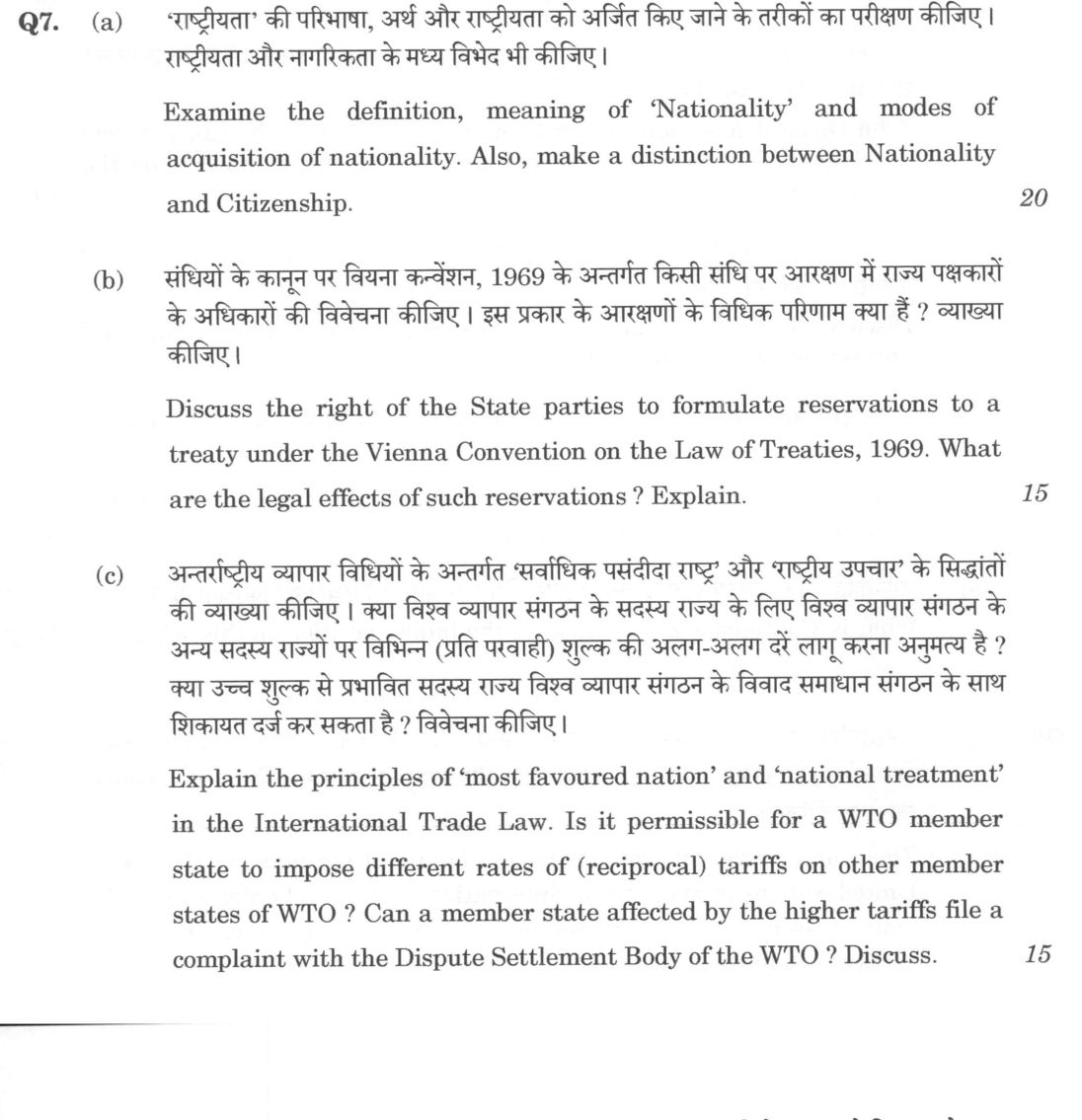
Examine the definition, meaning of 'Nationality' and modes of acquisition of nationality. Also, make a distinction between Nationality and Citizenship. 20 marks
Discuss the right of the State parties to formulate reservations to a treaty under the Vienna Convention on the Law of Treaties, 1969. What are the legal effects of such reservations? Explain. 15 marks
Explain the principles of 'most favoured nation' and 'national treatment' in the International Trade Law. Is it permissible for a WTO member state to impose different rates of (reciprocal) tariffs on other member states of WTO? Can a member state affected by the higher tariffs file a complaint with the Dispute Settlement Body of the WTO? Discuss. 15 marks
हिंदी में प्रश्न पढ़ें
'राष्ट्रीयता' की परिभाषा, अर्थ और राष्ट्रीयता को अर्जित किए जाने के तरीकों का परीक्षण कीजिए। राष्ट्रीयता और नागरिकता के मध्य विभेद भी कीजिए। (20 अंक)
संधियों के कानून पर वियना कन्वेंशन, 1969 के अंतर्गत किसी संधि पर आरक्षण में राज्य पक्षकारों के अधिकारों की विवेचना कीजिए। इस प्रकार के आरक्षणों के विधिक परिणाम क्या हैं? व्याख्या कीजिए। (15 अंक)
अंतर्राष्ट्रीय व्यापार विधियों के अंतर्गत 'सर्वाधिक पसंदीदा राष्ट्र' और 'राष्ट्रीय उपचार' के सिद्धांतों की व्याख्या कीजिए। क्या विश्व व्यापार संगठन के सदस्य राज्य के लिए विश्व व्यापार संगठन के अन्य सदस्य राज्यों पर विभिन्न (प्रति परवाही) शुल्क की अलग-अलग दरें लागू करना अनुमत्य है? क्या उच्च शुल्क से प्रभावित सदस्य राज्य विश्व व्यापार संगठन के विवाद समाधान संगठन के साथ शिकायत दर्ज कर सकता है? विवेचना कीजिए। (15 अंक)
Model answer
Written by UPSC Answer Check against this question's marking rubric, to the expected length. UPSC does not publish answers for Mains — this is one way to score well, not an official key.
Nationality: Concept, Modes of Acquisition, and Citizenship
Under international law, nationality represents the juridical bond between an individual and a sovereign state. In the Nottebohm Case (1955), the International Court of Justice (ICJ) defined nationality as a legal bond having as its basis a social fact of attachment, a genuine connection of existence, interests, and sentiments, giving rise to reciprocal rights and duties. It operates externally as the primary condition enabling a state to exercise diplomatic protection on behalf of its nationals.
International law recognizes five primary modes of acquiring nationality:
- Birth: through jus soli (place of birth) or jus sanguinis (bloodline/descent).
- Naturalization: an act of formal grant upon fulfillment of municipal statutory criteria.
- Cession: where inhabitants of a transferred territory acquire the nationality of the acquiring state.
- Subjugation (annexation): incorporation of territory through conquest resulting in imposed nationality.
- Resumption or Option: reinstatement of original nationality by declaration.
Nationality differs fundamentally from citizenship. Nationality is a status governed by international law determining an individual’s international allegiance and entitlement to protection against foreign states. Citizenship is a creature of domestic municipal law, governing civil and political rights (such as voting and holding public office). All citizens are nationals, but not all nationals are necessarily citizens with full political franchise. In India, the Constitution (Articles 5–11) and the Citizenship Act, 1955 regulate citizenship, not nationality. The Supreme Court affirmed this conceptual divide in State Trading Corporation of India v. CTO (1963), holding that nationality denotes international status whereas citizenship confers municipal constitutional entitlements.
Reservations under the Vienna Convention on the Law of Treaties, 1969
Under Article 2(1)(d) of the VCLT, 1969, a reservation is a unilateral statement made by a state when signing, ratifying, or acceding to a treaty, purporting to exclude or modify the legal effect of certain provisions. Articles 19 to 23 codify the balance between sovereign consent and treaty integrity, embodying the standard articulated in the Genocide Convention Advisory Opinion (1951).
Under Article 19, a state may formulate a reservation unless: (a) it is prohibited by the treaty, (b) the treaty provides that only specified reservations may be made, or (c) the reservation is incompatible with the object and purpose of the treaty. Reservations differ from interpretative declarations, which merely clarify a state’s understanding without excluding treaty obligations.
The legal effects under Articles 20 and 21 depend on the reactions of other contracting states:
- Acceptance: Modifies the reserved provisions reciprocally between the reserving and accepting states (Article 21(1)).
- Objection without opposing entry into force: The provisions to which the reservation relates do not apply between the two states to the extent of the reservation (Article 21(3)).
- Objection with opposition: The entire treaty fails to enter into force between the two states (Article 20(4)(b)). In human rights treaties, international monitoring bodies increasingly assert that invalid reservations are severable, preserving the treaty’s application.
Non-Discrimination in International Trade Law and WTO Dispute Settlement
The core of multilateral trade rests on two non-discrimination pillars:
- Most Favoured Nation (MFN, GATT Article I): Any advantage, favour, or privilege granted to products originating in or destined for any country must be accorded immediately and unconditionally to the like products of all other WTO members.
- National Treatment (GATT Article III): Imported products, once they have cleared customs, cannot be subjected to internal taxes or regulations less favourable than those applied to like domestic products.
A WTO member cannot unilaterally impose different reciprocal tariffs on other members, as Article I mandates unconditional MFN treatment, and Article II binds maximum tariff concessions. However, differential tariffs are permissible under recognized exceptions:
- Regional Trade Agreements and Customs Unions satisfying GATT Article XXIV.
- Preferential tariffs for developing and least-developed nations under the 1979 Enabling Clause (Generalized System of Preferences).
- Tariff renegotiations conducted pursuant to GATT Article XXVIII.
An affected member state can file a complaint with the Dispute Settlement Body (DSB) under Article 23 of the Dispute Settlement Understanding (DSU) and GATT Article XXIII for violation of MFN or tariff bindings. The mechanism provides for consultations, panel establishment, Appellate Body review (subject to current institutional blockages), and authorization of retaliatory countermeasures (as illustrated in disputes like India–Solar Cells and EU–Sugar).
Conclusion
Contemporary international law navigates a continuous dialogue between state sovereignty—expressed through nationality laws and treaty reservations—and multilateral rule-based obligations governed by pacta sunt servanda (VCLT Article 26) and WTO disciplines. While states retain sovereign latitude in defining their body politic and scoping treaty commitments, this discretion remains bounded by the overarching imperatives of non-discrimination and international accountability.
What "Examine" is asking you to do
Test the proposition the question puts to you and return a finding on how far it holds. Examine stems carry a claim, or ask whether something has happened, and expect evidence weighed both ways before the extent is stated — often with remedial measures attached.
Structure that answers it
Restate the claim as the question frames it → evidence that supports it → evidence that undercuts it → the conditions under which it holds → verdict on how far it stands
Where marks are lost
Stopping at description. An examination has to reach a finding, and “examine with justification” means the extent must be stated, not implied.
How this answer will be evaluated
Approach
Framework: Issue > Rule > Authority > Application. (a) examine: intro > how/why with reasoning > evidence > conclusion | (b) discuss: intro > 3-4 dimensions > example > balanced close | (c) explain: definition/context > points in order > small example > short close Full marks: Precise legal citations, clear distinctions, balanced analysis, specific examples.
Key points expected
- Define nationality as legal bond between state and individual
- List modes: birth, descent, marriage, naturalization
- Distinguish nationality (international) from citizenship (domestic)
- Cite specific constitutional provisions (e.g., Art 5-11)
- Cite Vienna Convention on Law of Treaties 1969
- Explain right to formulate reservations (Art 19)
- Detail legal effects of reservations (Art 21)
- Mention objection to reservations (Art 20)
Evaluation rubric
Each sub-part is marked on its own, against the marks and word limit printed on the paper.
- (a) Definition, meaning, modes of acquisition, and distinction between Nationality and Citizenship. 20 marks
examine— intro → how/why with reasoning → evidence → conclusion
Must cover
- Define nationality as legal bond between state and individual
- List modes: birth, descent, marriage, naturalization
- Distinguish nationality (international) from citizenship (domestic)
- Cite specific constitutional provisions (e.g., Art 5-11)
Loses marks
- Confusing nationality with mere residence
- Failing to distinguish from citizenship
- Listing modes without legal basis
Earns more
- Reference to Jus soli vs Jus sanguinis
- Mention of dual nationality issues
- Cite relevant case law on citizenship
- Reference to Law Commission reports
Extra mark
- Recent Supreme Court judgment on citizenship
- Specific statutory citation (e.g., Citizenship Act 1955)
- (b) Right to formulate reservations and their legal effects under VCLT 1969. 15 marks
discuss— intro → 3-4 dimensions → example → balanced close
Must cover
- Cite Vienna Convention on Law of Treaties 1969
- Explain right to formulate reservations (Art 19)
- Detail legal effects of reservations (Art 21)
- Mention objection to reservations (Art 20)
Loses marks
- Confusing reservations with interpretative declarations
- Ignoring the 1969 Convention context
- Failing to explain legal effects
Earns more
- Reference to ILC commentary
- Example of a specific treaty reservation
- Discussion of 'incompatibility' with object/purpose
- Mention of practice of states
Extra mark
- Cite specific ICJ advisory opinion
- Reference to specific state practice
- (c) Principles of MFN and National Treatment; permissibility of different tariffs; DSB complaint. 15 marks
explain— definition/context → points in order → small example → short close
Must cover
- Define Most Favoured Nation (MFN) principle
- Define National Treatment principle
- Address permissibility of different reciprocal tariffs
- Confirm right to file DSB complaint
Loses marks
- Confusing MFN with National Treatment
- Failing to address the DSB question
- Ignoring the 'reciprocal' aspect of tariffs
Earns more
- Reference to GATT Article I (MFN)
- Reference to GATT Article III (National Treatment)
- Mention of exceptions (e.g., GSP, RTAs)
- Cite specific WTO dispute case
Extra mark
- Reference to specific WTO panel report
- Mention of specific tariff schedule
Practice this exact question
Write your answer and it is marked point by point against the model answer above — what you covered, what you missed, what you got wrong.
Evaluate my answer →More from Law 2025 Paper I
- Q4 (a) Examine the power of the Governor to grant pardons, reprieves, respites or remissions…
- Q5 Answer the following questions in about 150 words each: (a) Is anticipatory and pre-empti…
- Q6 (a) There may be various reasons for the failure of the Security Council of United Nation…
- Q7 (a) Examine the definition, meaning of 'Nationality' and modes of acquisition of national…
- Q8 (a) Critically examine the International Law relating to development and use of nuclear w…