Paper I — Q5
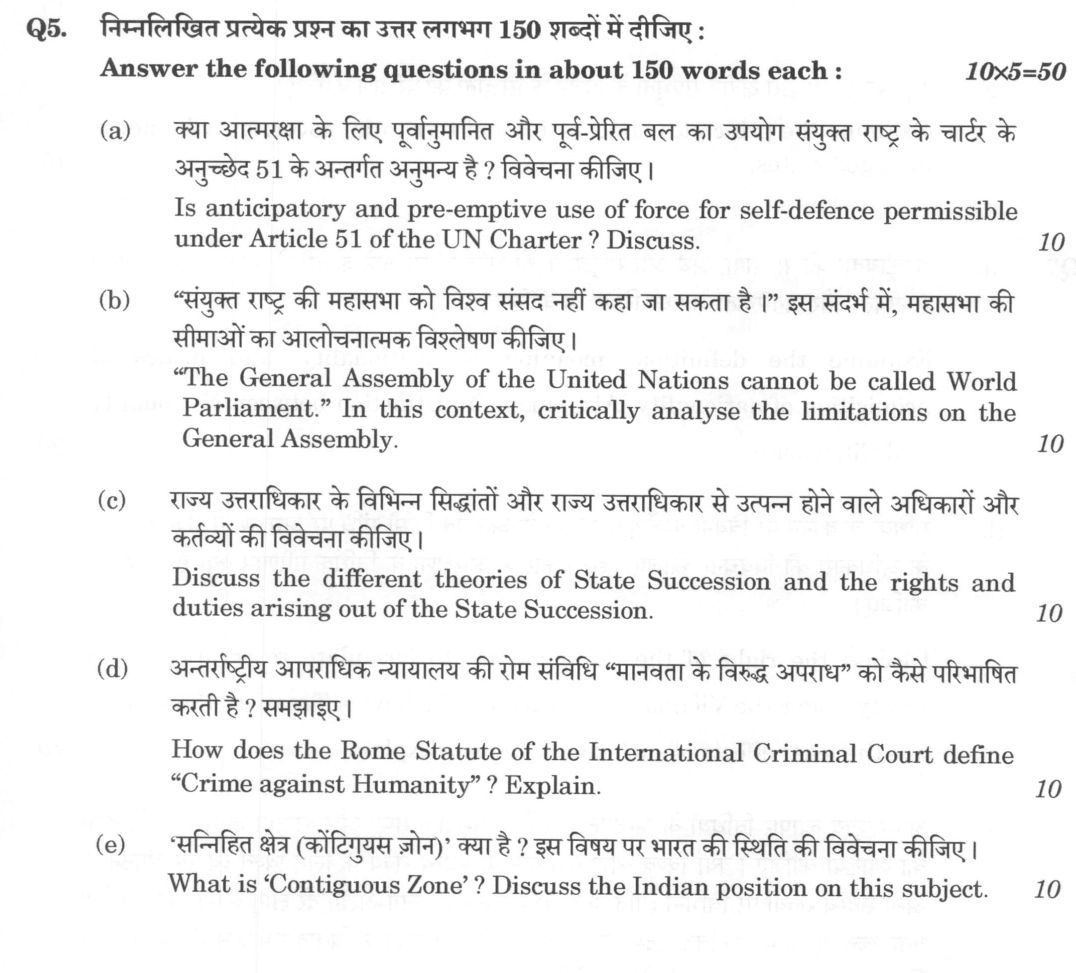
Answer the following questions in about 150 words each: (a) Is anticipatory and pre-emptive use of force for self-defence…
Answer the following questions in about 150 words each:
Is anticipatory and pre-emptive use of force for self-defence permissible under Article 51 of the UN Charter? Discuss. 10 marks
"The General Assembly of the United Nations cannot be called World Parliament." In this context, critically analyse the limitations on the General Assembly. 10 marks
Discuss the different theories of State Succession and the rights and duties arising out of the State Succession. 10 marks
How does the Rome Statute of the International Criminal Court define "Crime against Humanity"? Explain. 10 marks
What is 'Contiguous Zone'? Discuss the Indian position on this subject. 10 marks
हिंदी में प्रश्न पढ़ें
निम्नलिखित प्रत्येक प्रश्न का उत्तर लगभग 150 शब्दों में दीजिए:
क्या आत्मरक्षा के लिए पूर्वानुमानित और पूर्व-प्रेरित बल का उपयोग संयुक्त राष्ट्र के चार्टर के अनुच्छेद 51 के अंतर्गत अनुमन्य है? विवेचना कीजिए। (10 अंक)
"संयुक्त राष्ट्र की महासभा को विश्व संसद नहीं कहा जा सकता है।" इस संदर्भ में, महासभा की सीमाओं का आलोचनात्मक विर्लेषण कीजिए। (10 अंक)
राज्य उत्तराधिकार के विभिन्न सिद्धांतों और राज्य उत्तराधिकार से उत्पन्न होने वाले अधिकारों और कर्तव्यों की विवेचना कीजिए। (10 अंक)
अंतर्राष्ट्रीय आपराधिक न्यायालय की रोम संविधि "मानवता के विरुद्ध अपराध" को कैसे परिभाषित करती है? समझाइए। (10 अंक)
'सन्निहित क्षेत्र (कॉटिगुअस जोन)' क्या है? इस विषय पर भारत की स्थिति की विवेचना कीजिए। (10 अंक)
Model answer
Written by UPSC Answer Check against this question's marking rubric, to the 150-word length. UPSC does not publish answers for Mains — this is one way to score well, not an official key.
(a) Article 51 preserves the inherent right of individual or collective self-defence if an armed attack occurs, pending Security Council action. The phrase “inherent right” is ambiguous: some read it as preserving customary law, including anticipatory force; others confine it to response after an armed attack. Anticipatory self-defence, rooted in the Caroline doctrine, permits force only where necessity is instant, overwhelming, leaving no choice of means or moment for deliberation. Pre-emptive self-defence, associated with the Bush doctrine, targets threats that are imminent but not yet materialised. The ICJ in Nicaragua (1986) required an armed attack or at least the most grave use of force, and in Oil Platforms (2003) stressed that self-defence must be necessary and proportionate to an armed attack. Thus, while anticipatory force may be defensible in extreme cases, pre-emptive force is generally impermissible under Article 51 unless the threat is so imminent as to amount to an armed attack.
(b) The General Assembly is not a World Parliament because its principal powers under Articles 10 to 14 are recommendatory, not legislative. It may discuss and make recommendations on international peace and security, budgetary matters, admission of members, and the Charter, but it cannot bind member states. Parliament-like law-making presupposes compulsory legislative authority, whereas the GA operates on sovereign equality and consensus. The “Uniting for Peace” resolution of 1950 allowed the GA to recommend collective measures when the Security Council was blocked, giving it a functional substitute for Security Council action, but this did not convert recommendations into binding law. The tension is sharper because the GA uses one-state-one-vote, while the Security Council reflects weighted voting and great-power responsibility. Thus, the GA’s legitimacy is deliberative and representative, but its legal effect remains limited to persuasion, moral authority, and treaty-making impetus rather than coercive legislation, especially in human rights and development.
(c) State succession concerns the transfer of rights and duties when a new state replaces or emerges from an existing one. The continuity theory, or universal succession, treats the successor as the same legal person, so treaties, property, debts and obligations pass automatically. The personality theory, or clean-slate doctrine, treats the successor as a new legal person, so it is not automatically bound by predecessor treaties. The 1978 Vienna Convention on Succession to State Treaties reflects this balance: multilateral treaties may continue for new independent states, while bilateral treaties generally do not, unless agreed. Succession to state property and debts is governed by equity, with assets and liabilities allocated according to the part of the territory concerned. Thus, succession is not a single rule but a compromise: continuity preserves stability, while clean slate protects sovereignty, and treaty, property and debt outcomes depend on the type of succession and the applicable convention.
(d) The Rome Statute defines crimes against humanity in Article 7 as acts committed as part of a widespread or systematic attack directed against any civilian population, with knowledge of the attack. This contextual element distinguishes them from isolated crimes and from war crimes, which are linked to armed conflict. The enumerated acts include murder, extermination, enslavement, deportation or forcible transfer of population, imprisonment or severe deprivation of liberty, torture, rape and other sexual violence, persecution, enforced disappearance, apartheid and other inhumane acts. The definition is not limited to international conflict; it applies in peacetime or wartime, provided the attack is widespread or systematic and directed at civilians. India, as a signatory but not a party, has not accepted the Court’s jurisdiction, yet the definition reflects emerging international norms that India has engaged with in its domestic criminal law and treaty practice, especially in debates over the ICC and national jurisdiction.
(e) The contiguous zone is a maritime belt beyond the territorial sea, extending to 24 nautical miles from the baseline under Article 33 of UNCLOS. It is not a zone of sovereignty; foreign vessels enjoy freedom of navigation, while the coastal state may exercise limited control to prevent or punish infringement of its customs, fiscal, immigration or sanitary laws. India’s position is governed by the Territorial Waters, Continental Shelf, Exclusive Economic Zone and Other Maritime Zones Act, 1976, particularly Section 5, which gives India jurisdiction in the contiguous zone for enforcing those four categories of regulations. The 2005 Amendment Act aligned India’s contiguous-zone claim with UNCLOS by extending it to 24 nautical miles, replacing the earlier 12-nautical-mile limit. Thus, India’s contiguous-zone power is regulatory and preventive, not territorial: it safeguards customs, fiscal, immigration and sanitary administration without restricting navigation, and it must be exercised in accordance with UNCLOS and the Act.
What "Discuss" is asking you to do
Lay the issue out from more than one side — how it arose, what is claimed for it, what is held against it, and where it now stands. UPSC attaches discuss to broad topics with several live dimensions, so coverage of the dimensions earns more than the strength of your opinion.
Structure that answers it
Set the issue up → the case as it is made → the case against → the dimension both sides leave out → where the balance now lies
Where marks are lost
Listing facts with no thread between them, or arguing one side throughout and calling it a discussion.
How this answer will be evaluated
Approach
Framework: Issue > Rule > Authority > Application. (a) discuss: intro > 3-4 dimensions > example > balanced close | (b) analyse: intro > causes > effects > stakeholders/linkages > way forward | (c) discuss: intro > 3-4 dimensions > example > balanced close | (d) explain: definition/context > points in order > small example > short close | (e) discuss: intro > 3-4 dimensions > example > balanced close Full marks: Precise legal citations, clear distinction of concepts, and balanced analysis.
Key points expected
- Cite Article 51 of the UN Charter
- Distinguish anticipatory from pre-emptive self-defence
- Reference the Caroline test (imminence)
- Mention the Nicaragua v. USA case
- Cite Article 10 of the UN Charter
- Mention the non-binding nature of resolutions
- Reference the 'one state, one vote' principle
- Mention the lack of legislative power
Evaluation rubric
Each sub-part is marked on its own, against the marks and word limit printed on the paper.
- (a) Evaluate the legality of anticipatory and pre-emptive force under Article 51. 10 marks · 150 words
discuss— intro → 3-4 dimensions → example → balanced close
Must cover
- Cite Article 51 of the UN Charter
- Distinguish anticipatory from pre-emptive self-defence
- Reference the Caroline test (imminence)
- Mention the Nicaragua v. USA case
Loses marks
- Confusing anticipatory with pre-emptive
- Ignoring the 'imminence' requirement
- Failing to cite Article 51
Earns more
- Reference the 2004 ICJ Advisory Opinion
- Mention the 'Caroline' standard
- Reference the 'Necessity and Proportionality' test
- Mention the 'Dunbar' or 'Acheson' doctrine
Extra mark
- Reference the 'Acheson' doctrine
- Reference the 'Dunbar' doctrine
- (b) Critically analyse why the UN General Assembly is not a World Parliament. 10 marks · 150 words
analyse— intro → causes → effects → stakeholders/linkages → way forward
Must cover
- Cite Article 10 of the UN Charter
- Mention the non-binding nature of resolutions
- Reference the 'one state, one vote' principle
- Mention the lack of legislative power
Loses marks
- Treating GA resolutions as binding
- Ignoring the 'one state, one vote' principle
- Failing to cite Article 10
Earns more
- Reference the 'Uniting for Peace' resolution
- Mention the 'recommendatory' nature of GA
- Reference the 'subsidiary' role to the Security Council
- Mention the 'non-legislative' character
Extra mark
- Reference the 'Uniting for Peace' resolution
- Reference the 'subsidiary' role to the Security Council
- (c) Discuss theories of State Succession and the resulting rights and duties. 10 marks · 150 words
discuss— intro → 3-4 dimensions → example → balanced close
Must cover
- Mention the 'Continuity' theory
- Mention the 'Transformation' theory
- Reference the 'Clean Slate' doctrine
- Mention the 'Stability' principle
Loses marks
- Confusing continuity with transformation
- Ignoring the 'Clean Slate' doctrine
- Failing to mention the 'Stability' principle
Earns more
- Reference the 'Vienna Convention on Succession of States'
- Mention the 'Clean Slate' doctrine
- Reference the 'Stability' principle
- Mention the 'Continuity' theory
Extra mark
- Reference the 'Vienna Convention on Succession of States'
- Reference the 'Clean Slate' doctrine
- (d) Explain the definition of 'Crime against Humanity' under the Rome Statute. 10 marks · 150 words
explain— definition/context → points in order → small example → short close
Must cover
- Cite Article 7 of the Rome Statute
- Mention the 'widespread or systematic' attack
- Reference the 'directed against any civilian population'
- Mention the 'knowledge' requirement
Loses marks
- Confusing 'Crime against Humanity' with 'Genocide'
- Ignoring the 'widespread or systematic' requirement
- Failing to cite Article 7
Earns more
- Reference the 'Nuremberg' definition
- Mention the 'widespread or systematic' attack
- Reference the 'directed against any civilian population'
- Mention the 'knowledge' requirement
Extra mark
- Reference the 'Nuremberg' definition
- Reference the 'widespread or systematic' attack
- (e) Define 'Contiguous Zone' and discuss the Indian position on it. 10 marks · 150 words
discuss— intro → 3-4 dimensions → example → balanced close
Must cover
- Cite Article 33 of UNCLOS
- Mention the 24 nautical mile limit
- Reference the 'customs, fiscal, immigration, sanitary' laws
- Mention the 'Indian Maritime Zones Act, 1976'
Loses marks
- Confusing 'Contiguous Zone' with 'Territorial Sea'
- Ignoring the 24 nautical mile limit
- Failing to cite Article 33
Earns more
- Reference the 'Indian Maritime Zones Act, 1976'
- Mention the 24 nautical mile limit
- Reference the 'customs, fiscal, immigration, sanitary' laws
- Mention the 'Indian position' on the Contiguous Zone
Extra mark
- Reference the 'Indian Maritime Zones Act, 1976'
- Reference the 24 nautical mile limit
Practice this exact question
Write your answer and it is marked point by point against the model answer above — what you covered, what you missed, what you got wrong.
Evaluate my answer →More from Law 2025 Paper I
- Q2 (a) What are the powers, privileges and immunities of Houses of Parliament in India? Do t…
- Q3 (a) "In any democratic society, judicial review of administrative action is the soul of t…
- Q4 (a) Examine the power of the Governor to grant pardons, reprieves, respites or remissions…
- Q5 Answer the following questions in about 150 words each: (a) Is anticipatory and pre-empti…
- Q6 (a) There may be various reasons for the failure of the Security Council of United Nation…
- Q7 (a) Examine the definition, meaning of 'Nationality' and modes of acquisition of national…
- Q8 (a) Critically examine the International Law relating to development and use of nuclear w…