Paper I — Q8
(a) Critically examine the International Law relating to development and use of nuclear weapons with special focus on the Treaty…
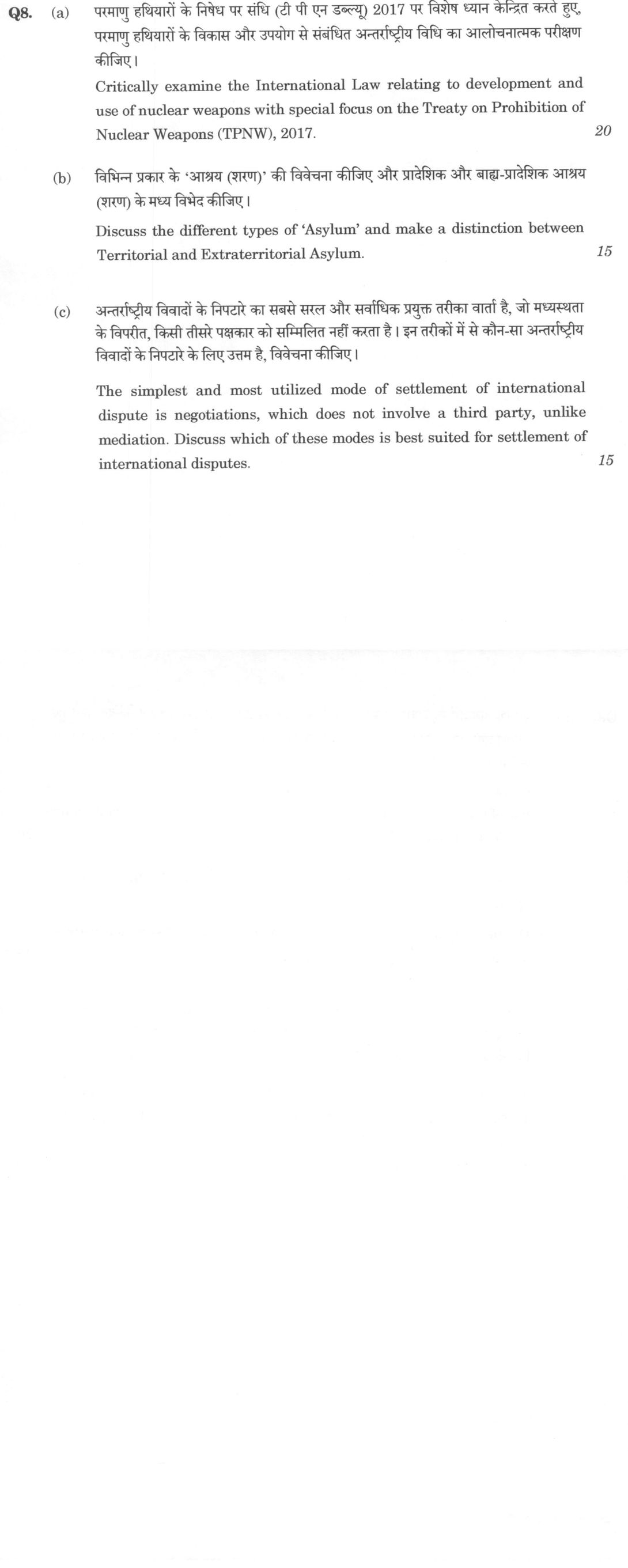
Critically examine the International Law relating to development and use of nuclear weapons with special focus on the Treaty on Prohibition of Nuclear Weapons (TPNW), 2017. 20 marks
Discuss the different types of 'Asylum' and make a distinction between Territorial and Extraterritorial Asylum. 15 marks
The simplest and most utilized mode of settlement of international dispute is negotiations, which does not involve a third party, unlike mediation. Discuss which of these modes is best suited for settlement of international disputes. 15 marks
हिंदी में प्रश्न पढ़ें
परमाणु हथियारों के निषेध पर संधि (टी पी एन डब्ल्यू) 2017 पर विशेष ध्यान केंद्रित करते हुए, परमाणु हथियारों के विकास और उपयोग से संबंधित अंतर्राष्ट्रीय विधि का आलोचनात्मक परीक्षण कीजिए। (20 अंक)
विभिन्न प्रकार के 'आश्रय (शरण)' की विवेचना कीजिए और प्रादेशिक और बाह्य-प्रादेशिक आश्रय (शरण) के मध्य विभेद कीजिए। (15 अंक)
अंतर्राष्ट्रीय विवादों के निपटारे का सबसे सरल और सर्वाधिक प्रयुक्त तरीका वार्ता है, जो मध्यस्थता के विपरीत, किसी तीसरे पक्षकार को सम्मिलित नहीं करता है। इन तरीकों में से कौन-सा अंतर्राष्ट्रीय विवादों के निपटारे के लिए उत्तम है, विवेचना कीजिए। (15 अंक)
Model answer
Written by UPSC Answer Check against this question's marking rubric, to the expected length. UPSC does not publish answers for Mains — this is one way to score well, not an official key.
Nuclear weapons and the TPNW International law on nuclear weapons is divided between disarmament norms and security realities. The NPT, 1968, remains the central framework: non-nuclear states forgo acquisition, nuclear states undertake disarmament, and all states may use nuclear energy peacefully. The TPNW, 2017, goes further by creating an absolute prohibition. Article 1 bars developing, testing, producing, acquiring, possessing, using or threatening to use nuclear weapons. Article 4 requires each State Party to eliminate its nuclear weapons through a verified, time-bound plan submitted to the IAEA; Article 6 obliges assistance to victims and remediation of contaminated areas; Article 7 provides cooperation and assistance. Unlike the NPT, the TPNW is not linked to the status of nuclear-weapon states and has not been joined by any nuclear state. India has not participated, arguing that the treaty does not address the security environment, does not engage nuclear-weapon states, and may fragment the NPT-based order. The ICJ Advisory Opinion of 1996 held that the threat or use of nuclear weapons would generally be contrary to the principles of international humanitarian law, but in an extreme circumstance of self-defence where survival of a state is at stake, it could not definitively determine legality. Thus, nuclear weapons remain governed by customary law, the law of armed conflict, and treaty obligations, but no universal prohibition exists. The TPNW strengthens the humanitarian norm and may influence customary law, yet its legal force is limited by the non-participation of nuclear states. Its humanitarian focus is significant because it frames nuclear weapons as incompatible with IHL, but its exclusion of nuclear states means it cannot by itself end arsenals. India’s support for the CTBT and NPT reflects a preference for inclusive, security-sensitive disarmament.
Types of asylum Asylum is protection from prosecution or persecution. Territorial asylum is granted within the granting state’s own territory, usually to a person already present, and rests on sovereignty; it is not automatic and must respect extradition and human-rights obligations. It may be denied where the claimant is a war criminal or threat to public order. Extraterritorial asylum is granted outside the state’s territory, such as in embassies, consulates, or warships. Diplomatic asylum is only one form of extraterritorial asylum, as is naval asylum on a warship in a foreign port. The distinction turns on locus and consent: territorial asylum occurs in the state’s sovereign space, while extraterritorial asylum depends on the territorial state’s consent, treaty, or exceptional custom. The ICJ in the Asylum Case, Colombia v. Peru, 1950, treated diplomatic asylum as exceptional and not generally recognized absent treaty.
Negotiation and mediation Negotiation is the simplest mode: the disputing states communicate directly, may be bilateral or multilateral, and control the outcome. It may be assisted by technical or facilitative bodies, but no third party formally directs the process. Mediation adds a neutral third party who facilitates dialogue and may propose solutions. The Indus Waters Treaty, 1960, arose from prolonged negotiations, with the World Bank acting as a facilitator, showing that negotiation can be assisted without becoming mediation. The Tashkent Declaration, 1966, after the India-Pakistan war, was mediated by the Soviet Union, showing mediation’s value when parties cannot negotiate directly. Negotiation is best where parties can communicate, want sovereignty over the result, and seek to preserve relations. Mediation is better where urgency, power asymmetry, complexity, or broken trust makes direct talks difficult. Mediation can also help preserve bilateral relations by providing a face-saving third-party channel, but its success depends on the parties’ willingness to accept proposals. On balance, negotiation is the most generally suited mode because it preserves party control and is least intrusive, but mediation is the better choice when direct negotiation is blocked or the dispute is too acute to manage alone.
What "Critically examine" is asking you to do
Test the proposition the question puts to you and return a finding on how far it holds. Examine stems carry a claim, or ask whether something has happened, and expect evidence weighed both ways before the extent is stated — often with remedial measures attached. “Critically” is not a section added at the end: name the yardstick you are judging by — the evidence, the stated objective, a constitutional principle, a rival explanation — and let a verdict close each part of the body. Where the question quotes a claim, that verdict must land on the claim itself, accepted, qualified or rejected, and not on the theme in general.
Structure that answers it
Restate the claim as the question frames it → evidence that supports it → evidence that undercuts it → the conditions under which it holds → verdict on how far it stands
Where marks are lost
Merits in one paragraph, demerits in the next, and a conclusion calling for a balanced and holistic approach. That is a survey with the judgement left out and it holds the answer in the middle band. The opposite error is reading “critically” as permission to attack — and with the odd pairings, critically describe or critically explain, the exposition still carries most of the marks, the judgement being a layer on it rather than a substitute for it.
How this answer will be evaluated
Approach
Framework: Issue > Rule: statute or Article > Authority > Application and conclusion. (a) examine: intro > how/why with reasoning > evidence > conclusion | (b) discuss: intro > 3-4 dimensions > example > balanced close | (c) discuss: intro > 3-4 dimensions > example > balanced close Full marks: Precise legal citations, clear distinctions, and balanced critical analysis.
Key points expected
- Cite NPT 1968 and TPNW 2017 Articles
- Explain TPNW prohibitions (development, stockpiling, use)
- Analyze TPNW's relationship with NPT
- Discuss non-participation by nuclear-weapon states
- Define Territorial Asylum (within state territory)
- Define Extraterritorial Asylum (embassies, warships)
- Distinguish legal status of both types
- Mention limits on granting asylum (e.g., war criminals)
Evaluation rubric
Each sub-part is marked on its own, against the marks and word limit printed on the paper.
- (a) Critical analysis of nuclear weapons law focusing on TPNW 2017. 20 marks
examine— intro → how/why with reasoning → evidence → conclusion
Must cover
- Cite NPT 1968 and TPNW 2017 Articles
- Explain TPNW prohibitions (development, stockpiling, use)
- Analyze TPNW's relationship with NPT
- Discuss non-participation by nuclear-weapon states
Loses marks
- Ignoring the 2017 TPNW focus
- Confusing NPT and TPNW obligations
- No critical evaluation of effectiveness
Earns more
- Mention ICJ 1996 Advisory Opinion
- Reference CTBTO or IAEA role
- Discuss 'humanitarian initiative' context
- Mention specific TPNW entry into force date
Extra mark
- Cite specific TPNW Article numbers (e.g., Art 1, 6)
- Reference specific state positions (e.g., US/UK/Russia)
- (b) Types of asylum and distinction between Territorial and Extraterritorial. 15 marks
discuss— intro → 3-4 dimensions → example → balanced close
Must cover
- Define Territorial Asylum (within state territory)
- Define Extraterritorial Asylum (embassies, warships)
- Distinguish legal status of both types
- Mention limits on granting asylum (e.g., war criminals)
Loses marks
- Confusing asylum with refugee status
- Failing to distinguish the two types clearly
- Ignoring the legal basis for refusal
Earns more
- Reference 1954 Geneva Convention on Territorial Asylum
- Mention 'diplomatic asylum' in Latin America
- Discuss 'asylum of the flag' (warships)
- Mention non-refoulement principle
Extra mark
- Cite specific ICJ case on asylum (e.g., Asylum Case 1950)
- Reference specific regional conventions
- (c) Compare negotiations and mediation to determine suitability for disputes. 15 marks
discuss— intro → 3-4 dimensions → example → balanced close
Must cover
- Define Negotiations (bilateral, no third party)
- Define Mediation (third-party facilitation)
- Compare advantages of each (sovereignty vs. impasse)
- Conclude on suitability based on dispute nature
Loses marks
- Treating them as identical
- Ignoring the 'third party' distinction
- No conclusion on which is 'best suited'
Earns more
- Mention 'good offices' as a related mode
- Reference specific historical examples (e.g., Camp David)
- Discuss the role of the UN Secretary-General
- Mention 'cooling off' periods
Extra mark
- Cite specific ICJ or UN Charter Article (Art 33)
- Reference a specific recent mediation success
Practice this exact question
Write your answer and it is marked point by point against the model answer above — what you covered, what you missed, what you got wrong.
Evaluate my answer →More from Law 2025 Paper I
- Q5 Answer the following questions in about 150 words each: (a) Is anticipatory and pre-empti…
- Q6 (a) There may be various reasons for the failure of the Security Council of United Nation…
- Q7 (a) Examine the definition, meaning of 'Nationality' and modes of acquisition of national…
- Q8 (a) Critically examine the International Law relating to development and use of nuclear w…