Paper I — Q6
(a) There may be various reasons for the failure of the Security Council of United Nations in maintaining international peace and…
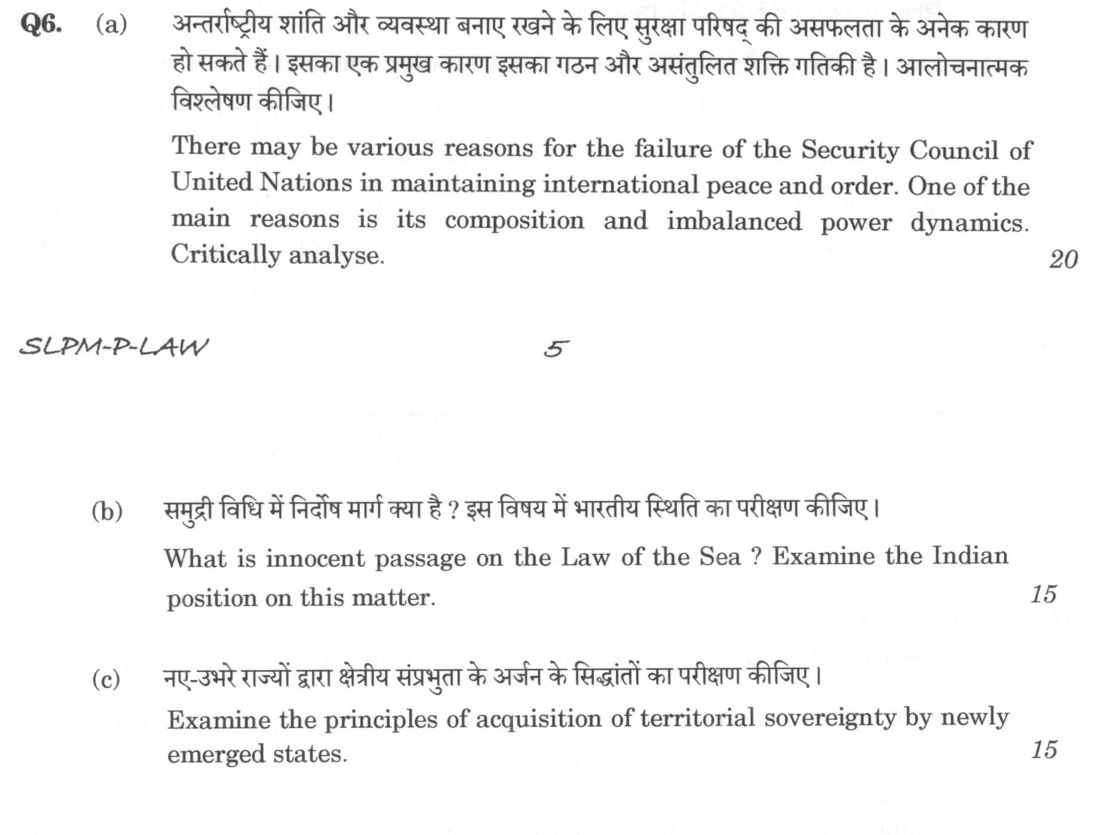
There may be various reasons for the failure of the Security Council of United Nations in maintaining international peace and order. One of the main reasons is its composition and imbalanced power dynamics. Critically analyse. 20 marks
What is innocent passage on the Law of the Sea? Examine the Indian position on this matter. 15 marks
Examine the principles of acquisition of territorial sovereignty by newly emerged states. 15 marks
हिंदी में प्रश्न पढ़ें
अंतर्राष्ट्रीय शांति और व्यवस्था बनाए रखने के लिए सुरक्षा परिषद की असफलता के अनेक कारण हो सकते हैं। इसका एक प्रमुख कारण इसका गठन और असंतुलित शक्ति गतिकी है। आलोचनात्मक विर्लेषण कीजिए। (20 अंक)
समुद्री विधि में निर्दोष मार्ग क्या है? इस विषय में भारतीय स्थिति का परीक्षण कीजिए। (15 अंक)
नए-उभरे राज्यों द्वारा क्षेत्रीय संप्रभुता के अर्जन के सिद्धांतों का परीक्षण कीजिए। (15 अंक)
Model answer
Written by UPSC Answer Check against this question's marking rubric, to the expected length. UPSC does not publish answers for Mains — this is one way to score well, not an official key.
These issues show how inherited international structures can lag behind political reality.
(a) UNSC composition and power imbalance The Council's failure is not one-dimensional, but composition and voting are central. Article 23, amended in 1965, gives five permanent and ten non-permanent members; the amendment raised non-permanent seats from six to ten but left the P5 unchanged. Article 27 requires nine affirmative votes for substantive decisions, including all P5 concurring votes, so each P5 member has a veto. This 1945 bargain secured great-power participation, yet it has become a structural weakness. In Syria and Ukraine, repeated vetoes blocked resolutions, humanitarian access and accountability, allowing conflict to harden. The veto turns legal decisions into political calculations. G4 reform proposals (India, Japan, Germany, Brazil) and the African Group's demand for more permanent seats expose the same fault line: the Council reflects 1945 power, not present-day demographic, economic or security realities. Africa and Asia remain underrepresented, and regional inequities weaken the legitimacy of Council decisions. Uniting for Peace Resolution 377A (1950) lets the General Assembly recommend collective measures when the Council is paralysed, but it cannot replace binding Chapter VII action. On balance, composition is not the sole cause of failure, but it is a principal one: the veto can protect great-power interests at the cost of collective legitimacy.
(b) Innocent passage and India's position Under UNCLOS Part II, Section 3, Article 17 grants all ships innocent passage through the territorial sea. Articles 18-19 make passage continuous, expeditious and not prejudicial to the coastal state's peace, good order or security. Submarines must surface and show their flag. Prejudicial acts include weapons exercises, spying, propaganda, pollution, fishing, boarding or serious crimes. India's position is in the Territorial Waters, Continental Shelf, Exclusive Economic Zone and Other Maritime Zones Act, 1976. Section 4(2) requires foreign warships to give prior notice to the Central Government before entering or passing through Indian territorial waters; it does not itself require prior authorisation, though a separate notification may regulate or suspend innocent passage for security. India thus accepts the UNCLOS right while preserving sovereign control. The MV Enrica Lexie incident of 2012, though not squarely an innocent-passage case because it arose in the contiguous zone, not the territorial sea, shows India's insistence on jurisdiction over foreign vessels and refusal to accept blanket immunity. In Union of India v. Republic of Italy (2014), the Supreme Court upheld India's jurisdiction to prosecute the marines, reinforcing coastal-state authority.
(c) Acquisition of territorial sovereignty by newly emerged states Newly emerged states usually acquire territory through succession, not fresh occupation. Uti possidetis juris, applied in the Frontier Dispute (Burkina Faso/Mali) (1986), stabilises colonial boundaries at independence; it prevents border wars but can freeze arbitrary lines. Effective occupation, per Island of Palmas, requires continuous and peaceful display of sovereign authority, but for new states it often evidences inherited title rather than free-standing acquisition. Self-determination can create states, yet it does not automatically confer territorial sovereignty. The Kosovo Advisory Opinion (2010) held that a unilateral declaration of independence did not violate international law, but did not decide statehood or title; recognition is declaratory, not a legal prerequisite. India and Pakistan inherited the Radcliffe Line and treated it as the sovereignty baseline, even where disputes persist. Post-Soviet states largely accepted former Soviet borders, again reflecting uti possidetis. The 2014 Bangladesh-India Bay of Bengal arbitration is not a title case; it shows newly emerged states' inherited baselines and maritime zones must later be delimitated, so land sovereignty precedes maritime entitlement.
The common thread is structural inertia across all three: the veto, coastal-state control and inherited borders are defensible for stability, but must be reformed or interpreted flexibly to avoid inequality.
What "Critically analyse" is asking you to do
Break the subject into its working parts and show how they act on each other. The marks are in the interconnections — which factor drives which, and what the resulting structure explains — not in the inventory of factors. “Critically” is not a section added at the end: name the yardstick you are judging by — the evidence, the stated objective, a constitutional principle, a rival explanation — and let a verdict close each part of the body. Where the question quotes a claim, that verdict must land on the claim itself, accepted, qualified or rejected, and not on the theme in general.
Structure that answers it
Define the whole → separate it into its parts → show which part drives which → what that interaction produces → what the structure implies
Where marks are lost
Merits in one paragraph, demerits in the next, and a conclusion calling for a balanced and holistic approach. That is a survey with the judgement left out and it holds the answer in the middle band. The opposite error is reading “critically” as permission to attack — and with the odd pairings, critically describe or critically explain, the exposition still carries most of the marks, the judgement being a layer on it rather than a substitute for it.
How this answer will be evaluated
Approach
Framework: Issue > Rule > Authority > Application. (a) analyse: intro > causes > effects > stakeholders/linkages > way forward | (b) examine: intro > how/why with reasoning > evidence > conclusion | (c) examine: intro > how/why with reasoning > evidence > conclusion Full marks: Precise legal citations, specific examples, clear structure, critical analysis.
Key points expected
- Identify P5 veto power as primary structural flaw
- Link composition to Cold War power dynamics
- Cite specific instances of UNSC paralysis (e.g., Syria, Ukraine)
- Discuss the 'imbalanced' nature of permanent vs non-permanent seats
- Define innocent passage under UNCLOS (Art 17-19)
- Distinguish innocent passage from transit passage
- State India's position on archipelagic sea lanes
- Mention India's domestic legislation (Merchant Shipping Act)
Evaluation rubric
Each sub-part is marked on its own, against the marks and word limit printed on the paper.
- (a) Critical analysis of UNSC composition and power dynamics as causes of failure. 20 marks
analyse— intro → causes → effects → stakeholders/linkages → way forward
Must cover
- Identify P5 veto power as primary structural flaw
- Link composition to Cold War power dynamics
- Cite specific instances of UNSC paralysis (e.g., Syria, Ukraine)
- Discuss the 'imbalanced' nature of permanent vs non-permanent seats
Loses marks
- Generic criticism of UN without specific UNSC focus
- Ignoring the 'composition' aspect of the prompt
- No specific examples of failure
Earns more
- Reference to UNSC reform proposals (e.g., G4)
- Mention of 'deadlock' in Security Council resolutions
- Comparison of UNSC effectiveness in peacekeeping vs conflict resolution
Extra mark
- Citation of specific UN Charter Articles (Art 23, 27)
- Reference to recent specific Security Council deadlock
- (b) Definition of innocent passage and analysis of India's legal position. 15 marks
examine— intro → how/why with reasoning → evidence → conclusion
Must cover
- Define innocent passage under UNCLOS (Art 17-19)
- Distinguish innocent passage from transit passage
- State India's position on archipelagic sea lanes
- Mention India's domestic legislation (Merchant Shipping Act)
Loses marks
- Confusing innocent passage with freedom of navigation
- No specific reference to Indian position
- Vague definition without legal basis
Earns more
- Reference to India's stance on foreign military vessels
- Discussion of 'non-innocent' acts (e.g., weapons drills)
- Mention of India's role in UNCLOS negotiations
Extra mark
- Citation of specific UNCLOS Articles (Art 17-19)
- Reference to specific Indian maritime policy documents
- (c) Principles of territorial sovereignty acquisition for new states. 15 marks
examine— intro → how/why with reasoning → evidence → conclusion
Must cover
- List traditional modes of acquisition (occupation, cession, etc.)
- Explain 'uti possidetis juris' principle
- Discuss self-determination as a basis for new states
- Mention effective control and administration
Loses marks
- Ignoring the 'newly emerged' state context
- No mention of 'uti possidetis juris'
- Confusing sovereignty with mere control
Earns more
- Reference to decolonization and new state formation
- Discussion of 'effective occupation' requirements
- Mention of international recognition's role
Extra mark
- Citation of specific ICJ cases (e.g., Western Sahara)
- Reference to specific historical examples of new states
Practice this exact question
Write your answer and it is marked point by point against the model answer above — what you covered, what you missed, what you got wrong.
Evaluate my answer →More from Law 2025 Paper I
- Q3 (a) "In any democratic society, judicial review of administrative action is the soul of t…
- Q4 (a) Examine the power of the Governor to grant pardons, reprieves, respites or remissions…
- Q5 Answer the following questions in about 150 words each: (a) Is anticipatory and pre-empti…
- Q6 (a) There may be various reasons for the failure of the Security Council of United Nation…
- Q7 (a) Examine the definition, meaning of 'Nationality' and modes of acquisition of national…
- Q8 (a) Critically examine the International Law relating to development and use of nuclear w…