Paper I — Q4
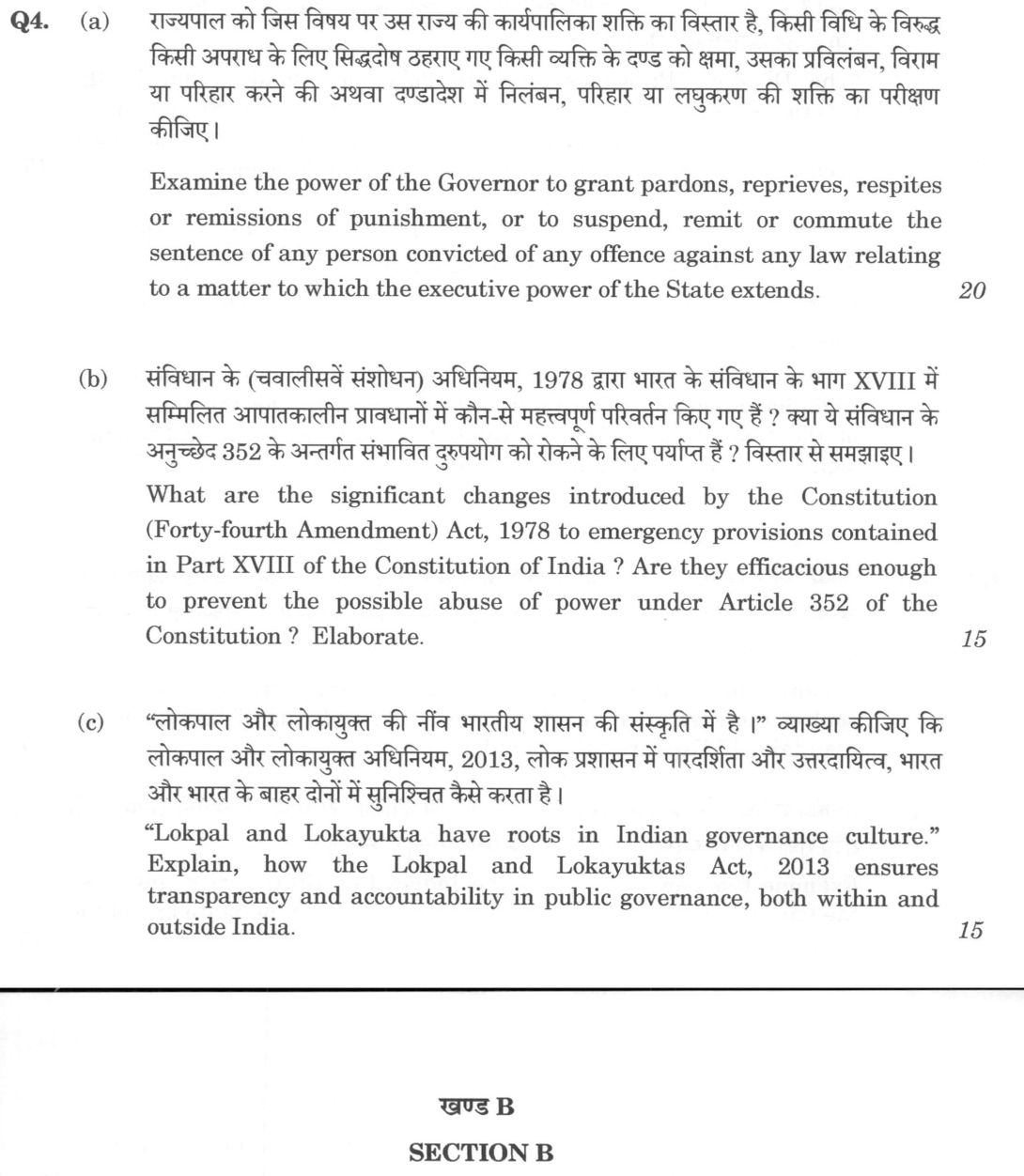
(a) Examine the power of the Governor to grant pardons, reprieves, respites or remissions of punishment, or to suspend, remit or…
Examine the power of the Governor to grant pardons, reprieves, respites or remissions of punishment, or to suspend, remit or commute the sentence of any person convicted of any offence against any law relating to a matter to which the executive power of the State extends. 20 marks
What are the significant changes introduced by the Constitution (Forty-fourth Amendment) Act, 1978 to emergency provisions contained in Part XVIII of the Constitution of India? Are they efficacious enough to prevent the possible abuse of power under Article 352 of the Constitution? Elaborate. 15 marks
"Lokpal and Lokayukta have roots in Indian governance culture." Explain, how the Lokpal and Lokayuktas Act, 2013 ensures transparency and accountability in public governance, both within and outside India. 15 marks
हिंदी में प्रश्न पढ़ें
राज्यपाल को जिस विषय पर उस राज्य की कार्यपालिका शक्ति का विस्तार है, किसी विधि के विरुद्ध किसी अपराध के लिए सिद्धदोष ठहराए गए किसी व्यक्ति के दंड को क्षमा, उसका प्रतिबंधन, विराम या परिहार करने की अथवा दंडादेश में निलंबन, परिहार या लघुकरण की शक्ति का परीक्षण कीजिए। (20 अंक)
संविधान के (चवालीसवें संशोधन) अधिनियम, 1978 द्वारा भारत के संविधान के भाग XVIII में सम्मिलित आपातकालीन प्रावधानों में कौन-से महत्वपूर्ण परिवर्तन किए गए हैं? क्या ये संविधान के अनुच्छेद 352 के अंतर्गत संभावित दुरुपयोग को रोकने के लिए पर्याप्त हैं? विस्तार से समझाइए। (15 अंक)
"लोकपाल और लोकायुक्त की नींव भारतीय शासन की संस्कृति में है।" व्याख्या कीजिए कि लोकपाल और लोकायुक्त अधिनियम, 2013, लोक प्रशासन में पारदर्शिता और उत्तरदायित्व, भारत और भारत के बाहर दोनों में सुनिश्चित कैसे करता है। (15 अंक)
Model answer
Written by UPSC Answer Check against this question's marking rubric, to the expected length. UPSC does not publish answers for Mains — this is one way to score well, not an official key.
Governor’s clemency power Article 161 lets the Governor grant pardons, reprieves, respites or remissions, or suspend, remit or commute sentences for offences against laws relating to matters to which State executive extends. A pardon extinguishes conviction and sentence; a reprieve delays execution; a respite gives temporary relief; a remission shortens sentence; suspension stays execution; commutation substitutes a lesser punishment. The power is limited by State executive competence and is distinct from the President’s Article 72 power over Union matters and courts-martial. Maru Ram v. Union of India held the Governor’s power independent; Epuru Sudhakar clarified that in concurrent-list matters no presidential assent is needed, but once either executive has validly exercised its clemency power, the other cannot ordinarily reopen the matter, and disputes go to the Supreme Court. Judicial review is narrow: mala fide, irrelevant considerations, arbitrariness or violation of law. In death-penalty cases, the Governor must consider relevant factors, and the 2015 Supreme Court guidelines require mercy petitions to be disposed of within a reasonable time, with delay explained. Thus, the power is wide but constitutionally bounded.
44th Amendment and emergency safeguards The Forty-fourth Amendment Act, 1978, responded to the 1975-77 Emergency. Article 352 replaced “internal disturbance” with “armed rebellion”; the proclamation requires the written recommendation of the Council of Ministers, not merely the Prime Minister, ceases after one month unless approved by special-majority resolution, and may be revoked at any time. Article 358 permits suspension only of Articles 14, 19 and 22; Articles 20 and 21 are protected. Article 359 cannot suspend the right to move court for enforcement of Articles 20 and 21. These changes are substantially efficacious: they raise the threshold, add collective Cabinet responsibility, parliamentary approval and revocation, and protect life and liberty. Yet they are not absolute. The President’s satisfaction remains political; “armed rebellion” can be stretched; a dominant-party Parliament may grant special majority; there is no independent pre-declaration review; and Articles 358 and 359 still permit suspension of other rights. Judicial review can check abuse but cannot replace political restraint.
Lokpal and Lokayuktas The idea has roots in Indian governance culture: the Arthashastra and Rigveda contemplated public accountability; the First Administrative Reforms Commission in 1966 recommended Lokayuktas; the Second ARC in 2004 recommended a Lokpal. The Lokpal and Lokayuktas Act, 2013, creates the Lokpal and State Lokayuktas. The Lokpal has jurisdiction over public functionaries, including the Prime Minister, Ministers, MPs and Group A/B/C officers, and over corruption connected with public office, including by public functionaries outside India. The Selection Committee appoints the Lokpal and Lokayuktas; it includes the Prime Minister, Leader of Opposition, Chief Justice of India, Union and State legislators and an eminent person, while the State committee includes the Chief Minister, Leader of Opposition, High Court Chief Justice, State legislators and an eminent person. The Lokpal, not the Selection Committee, directs the Inquiry Wing, Prosecution Wing and CBI referrals. Transparency comes from any person’s right to file a complaint, acceptance or rejection disclosed to the complainant, reasoned orders, annual reports to Parliament and State Legislatures, and the multi-party, judicially represented Selection Committee; though the Act creates no public registry of complaints, annual reports and reasoned decisions provide public accountability. The Act aligns India with the UN Convention Against Corruption and has strengthened the anti-corruption architecture, consistent with improved Transparency International CPI rankings in the mid-2010s, though later slippage shows limits. The 2014 amendment clarified CBI referral, but delay in constituting the Lokpal and uneven State Lokayuktas remain weaknesses.
In sum, these mechanisms collectively strengthen constitutional governance by adding procedural checks, protecting fundamental rights and creating an independent anti-corruption mechanism. Reforms should ensure timely mercy-petition disposal, vigilant judicial review of emergencies, prompt constitution of Lokpal and Lokayuktas, and more transparent annual reporting.
What "Examine" is asking you to do
Test the proposition the question puts to you and return a finding on how far it holds. Examine stems carry a claim, or ask whether something has happened, and expect evidence weighed both ways before the extent is stated — often with remedial measures attached.
Structure that answers it
Restate the claim as the question frames it → evidence that supports it → evidence that undercuts it → the conditions under which it holds → verdict on how far it stands
Where marks are lost
Stopping at description. An examination has to reach a finding, and “examine with justification” means the extent must be stated, not implied.
How this answer will be evaluated
Approach
Framework: Issue > Rule: statute or Article > Authority > Application and conclusion. (a) examine: intro > how/why with reasoning > evidence > conclusion | (b) examine: intro > how/why with reasoning > evidence > conclusion | (c) explain: definition/context > points in order > small example > short close Full marks: Comprehensive, precise, and well-structured with accurate legal citations and critical analysis.
Key points expected
- Cite Article 161 and its specific wording
- Distinguish between pardon, reprieve, respite, remission, and commutation
- Limit scope to State executive power matters
- Discuss judicial review and limitations (e.g., K.M. Nanavati case)
- List key changes: written recommendation, President's satisfaction, parliamentary approval
- Mention the 4-month limit for parliamentary approval
- Discuss the restriction on revocation of fundamental rights
- Evaluate the efficacy of these safeguards against abuse
Evaluation rubric
Each sub-part is marked on its own, against the marks and word limit printed on the paper.
- (a) Analyze the scope, nature, and limitations of the Governor's clemency powers under Article 161. 20 marks
examine— intro → how/why with reasoning → evidence → conclusion
Must cover
- Cite Article 161 and its specific wording
- Distinguish between pardon, reprieve, respite, remission, and commutation
- Limit scope to State executive power matters
- Discuss judicial review and limitations (e.g., K.M. Nanavati case)
Loses marks
- Confusing Governor's powers with President's powers under Article 72
- Failing to distinguish between the five types of clemency
- Ignoring the limitation to State executive matters
Earns more
- Mention the 42nd Amendment changes to Article 161
- Reference the 2015 Law Commission report on clemency powers
- Discuss the 'wholly arbitrary' test for judicial review
- Mention the role of the State Cabinet in advising the Governor
Extra mark
- Cite the Supreme Court judgment in Maru Ram v. Union of India
- Reference the 1978 44th Amendment Act's impact on clemency powers
- (b) Detail the 44th Amendment changes to emergency provisions and evaluate their effectiveness in preventing abuse. 15 marks
examine— intro → how/why with reasoning → evidence → conclusion
Must cover
- List key changes: written recommendation, President's satisfaction, parliamentary approval
- Mention the 4-month limit for parliamentary approval
- Discuss the restriction on revocation of fundamental rights
- Evaluate the efficacy of these safeguards against abuse
Loses marks
- Failing to mention the 4-month parliamentary approval limit
- Ignoring the restriction on revocation of fundamental rights
- Not evaluating the efficacy of the safeguards
Earns more
- Reference the 1975 Emergency as a historical context
- Mention the role of the Supreme Court in Kesavananda Bharati case
- Discuss the 'grave emergency' threshold
- Reference the 44th Amendment's impact on Article 352
Extra mark
- Cite the Supreme Court judgment in Minerva Mills v. Union of India
- Reference the 1978 44th Amendment Act's specific provisions
- (c) Explain how the Lokpal and Lokayuktas Act, 2013 ensures transparency and accountability in public governance. 15 marks
explain— definition/context → points in order → small example → short close
Must cover
- Define the roles of Lokpal and Lokayuktas
- Explain the jurisdiction and powers of the Lokpal
- Discuss the mechanism for ensuring transparency and accountability
- Mention the applicability to public servants within and outside India
Loses marks
- Failing to distinguish between Lokpal and Lokayuktas
- Ignoring the applicability to public servants outside India
- Not explaining the mechanism for ensuring transparency
Earns more
- Reference the 2013 Act's specific provisions
- Mention the role of the Lokpal in investigating corruption
- Discuss the Lokayuktas' role at the State level
- Reference the Act's impact on public governance
Extra mark
- Cite the Supreme Court judgment in Lokpal and Lokayuktas Act, 2013
- Reference the 2013 Act's specific provisions on transparency
Practice this exact question
Write your answer and it is marked point by point against the model answer above — what you covered, what you missed, what you got wrong.
Evaluate my answer →More from Law 2025 Paper I
- Q1 Answer the following questions in about 150 words each: (a) Where does the Constitution o…
- Q2 (a) What are the powers, privileges and immunities of Houses of Parliament in India? Do t…
- Q3 (a) "In any democratic society, judicial review of administrative action is the soul of t…
- Q4 (a) Examine the power of the Governor to grant pardons, reprieves, respites or remissions…
- Q5 Answer the following questions in about 150 words each: (a) Is anticipatory and pre-empti…
- Q6 (a) There may be various reasons for the failure of the Security Council of United Nation…
- Q7 (a) Examine the definition, meaning of 'Nationality' and modes of acquisition of national…