Paper II — Q1
Answer the following questions in about 150 words each. Support your answer with relevant legal provisions and judicial…
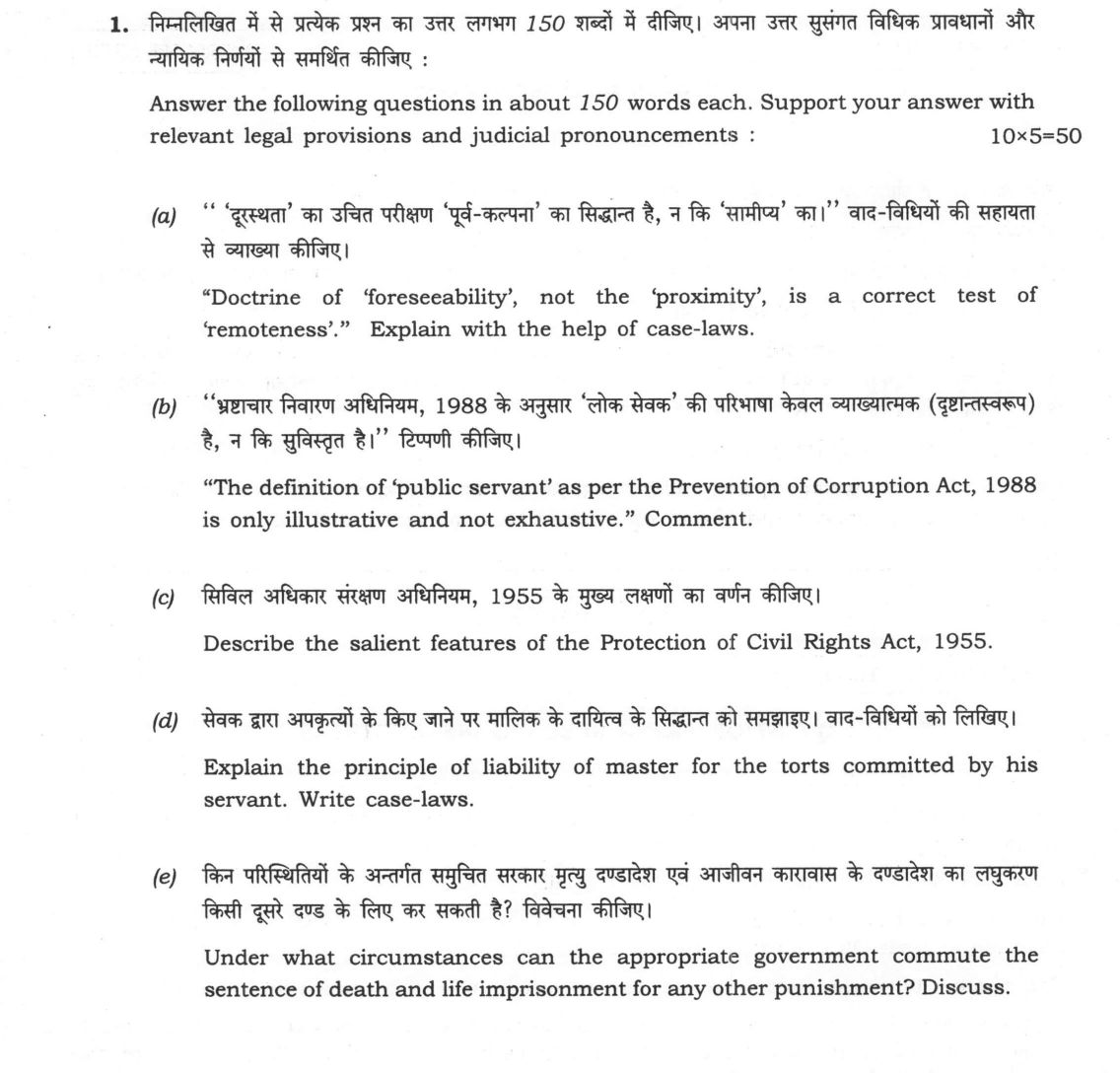
Answer the following questions in about 150 words each. Support your answer with relevant legal provisions and judicial pronouncements:
"Doctrine of 'foreseeability', not the 'proximity', is a correct test of 'remoteness'." Explain with the help of case-laws. 10 marks
"The definition of 'public servant' as per the Prevention of Corruption Act, 1988 is only illustrative and not exhaustive." Comment. 10 marks
Describe the salient features of the Protection of Civil Rights Act, 1955. 10 marks
Explain the principle of liability of master for the torts committed by his servant. Write case-laws. 10 marks
Under what circumstances can the appropriate government commute the sentence of death and life imprisonment for any other punishment? Discuss. 10 marks
हिंदी में प्रश्न पढ़ें
निम्नलिखित में से प्रत्येक प्रश्न का उत्तर लगभग 150 शब्दों में दीजिए। अपना उत्तर सुसंगत विधिक प्रावधानों और न्यायिक निर्णयों से समर्थित कीजिए :
"'दूरस्थता' का उचित परीक्षण 'पूर्व-कल्पना' का सिद्धांत है, न कि 'सामीप्य' का।" वाद-विधियों की सहायता से व्याख्या कीजिए। (10 अंक)
"भ्रष्टाचार निवारण अधिनियम, 1988 के अनुसार 'लोक सेवक' की परिभाषा केवल व्याख्यात्मक (दृष्टान्तस्वरूप) है, न कि सुविस्तृत है।" टिप्पणी कीजिए। (10 अंक)
सिविल अधिकार संरक्षण अधिनियम, 1955 के मुख्य लक्षणों का वर्णन कीजिए। (10 अंक)
सेवक द्वारा अपकृत्यों के किए जाने पर मालिक के दायित्व के सिद्धांत को समझाइए। वाद-विधियों को लिखिए। (10 अंक)
किन परिस्थितियों के अंतर्गत समुचित सरकार मृत्यु दण्डदेश एवं आजीवन कारावास के दण्डदेश का लघुकरण किसी दूसरे दण्ड के लिए कर सकती है? विवेचना कीजिए। (10 अंक)
Model answer
Written by UPSC Answer Check against this question's marking rubric, to the 150-word length. UPSC does not publish answers for Mains — this is one way to score well, not an official key.
(a) Doctrine of Foreseeability vs. Proximity in Remoteness
Under the law of torts, liability is circumscribed by the doctrine of remoteness of damage to prevent infinite and indeterminate liability. Historically, the direct consequences test laid down in Re Polemis (1921) held a tortfeasor liable for all direct physical consequences of a negligent act, regardless of whether they were foreseeable. However, this approach was overruled by the Privy Council in Overseas Tankship (U.K.) Ltd. v. Morts Dock and Engineering Co. Ltd. (Wagon Mound No. 1, 1961), which firmly established reasonable foreseeability as the correct test.
Proximity operates at the primary stage to establish the existence of a duty of care between the parties, whereas reasonable foreseeability governs remoteness to determine the extent of compensable injury. As reiterated in Wagon Mound (No. 2, 1967), a defendant is liable only for damage of such a kind as a reasonable person would have foreseen as the natural and probable result of their breach.
(b) Definition of 'Public Servant' under the PC Act, 1988
The definition of 'public servant' under Section 2(c) of the Prevention of Corruption Act, 1988 is intentionally inclusive and functional, shifting the focus from the formal status of the office to the nature of the public duty performed. Unlike Section 21 of the Indian Penal Code, Section 2(c) employs expansive language embracing persons in the service or pay of the government, statutory corporations, universities receiving state aid, and cooperative societies engaged in public duties and receiving financial assistance.
In R.S. Nayak v. A.R. Antulay (1984), the Supreme Court underscored the necessity of a purposive interpretation to capture holders of public offices who perform public duties. This principle was further broadened in State of Gujarat v. Mansukhbhai Kanjibhai Shah (2020), where the apex court held that the definition is not exhaustive, bringing officials of deemed universities within its ambit. Thus, the statutory scheme prioritizes substantive public functions over traditional sovereign employment.
(c) Salient Features of the Protection of Civil Rights Act, 1955
Enacted to operationalize the mandate of Article 17 of the Constitution, the Protection of Civil Rights Act, 1955 penalizes the enforcement of any disability arising out of untouchability. The Act defines specific offences, including religious disabilities under Section 3 (denial of entry into places of public worship) and social disabilities under Section 4 (denial of access to shops, public conveyances, and water sources). Section 6 penalizes the refusal to sell goods or render services, while Section 7 penalizes boycotting or insulting members of Scheduled Castes on the ground of untouchability.
Section 11 prescribes enhanced punishments for repeat offenders. Significantly, Section 12 establishes a statutory presumption that acts were committed on the ground of untouchability unless the contrary is proved. The Act also empowers State Governments to set up Special Courts, conduct summary trials, and impose collective fines, rendering all offences cognizable and non-compoundable.
(d) Principle of Vicarious Liability of Master for Servant's Torts
The vicarious liability of a master for the torts of his servant is rooted in the maxims respondeat superior (let the superior answer) and qui facit per alium facit per se (he who acts through another acts himself). To establish liability, there must exist a master-servant relationship and the wrongful act must occur within the course of employment. In situations involving the dual control problem of lent employees, Mersey Docks and Harbour Board v. Coggins & Griffith Ltd. (1947) established that the permanent employer retains liability unless complete control has been transferred to the hirer.
Where an authorized act is done in an unauthorized or negligent manner, the master remains liable, as affirmed in Century Insurance Co. v. Northern Ireland Road Transport Board (1942). Conversely, in State Bank of India v. Shyama Devi (1978), the Supreme Court held that if the servant acts completely outside the course of employment for private gain, the master is exonerated.
(e) Commutation of Sentence of Death and Life Imprisonment
Under Section 433 of the Code of Criminal Procedure, 1973 (corresponding to Section 474 of the Bharatiya Nagarik Suraksha Sanhita, 2023), the appropriate Government may, without the consent of the convict, commute a sentence of death to any other punishment provided by law, and a sentence of imprisonment for life to imprisonment for a term not exceeding fourteen years or a fine. This statutory power is governed by Section 432 CrPC for suspension and remission.
However, Section 433A CrPC imposes a statutory restriction: where a life sentence is imposed for an offence carrying death as an alternative penalty, or where a death sentence is commuted to life, the convict cannot be released before serving at least fourteen years of actual imprisonment. In Maru Ram v. Union of India (1980), the Supreme Court upheld the constitutional validity of Section 433A. While statutory commutation under the CrPC is fettered by Section 433A, the constitutional clemency powers under Articles 72 and 161 remain unfettered, subject only to limited judicial review against arbitrariness.
What "Explain" is asking you to do
Make the working of something clear — what sets it off, what follows from what, and what it produces. Explain is the Commission's mechanism word: it dominates the technical papers and the “explain why” stems, where the marks sit in the causal chain and not in the label.
Structure that answers it
State what it is → the initiating condition → the chain of cause, step by step → an instance where it plays out → what the chain produces
Where marks are lost
Describing what something looks like instead of why it works that way. Naming the stages without linking them reads as description too.
How this answer will be evaluated
Approach
Framework: Issue > Rule > Authority > Application. (a) explain: definition/context > points in order > small example > short close | (b) comment: context > arguments both sides > judgment > close | (c) describe: define > structure or process in order > labelled diagram > significance | (d) explain: definition/context > points in order > small example > short close | (e) discuss: intro > 3-4 dimensions > example > balanced close Full marks: Precise legal provisions, relevant case laws with ratios, clear application to the question, and balanced analysis.
Key points expected
- Define remoteness of damage in tort law
- Explain the 'reasonable foreseeability' test
- Cite The Wagon Mound (No 1) case
- Contrast with the 'proximity' test
- Cite Section 2(c) of the Prevention of Corruption Act, 1988
- Explain the 'illustrative' nature of the definition
- Distinguish between 'illustrative' and 'exhaustive' definitions
- Provide examples of persons covered beyond the list
Evaluation rubric
Each sub-part is marked on its own, against the marks and word limit printed on the paper.
- (a) Explain the 'foreseeability' test for remoteness of damage using case laws. · 150 words
explain— definition/context → points in order → small example → short close
Must cover
- Define remoteness of damage in tort law
- Explain the 'reasonable foreseeability' test
- Cite The Wagon Mound (No 1) case
- Contrast with the 'proximity' test
Loses marks
- Confusing remoteness with causation (but-for test)
- Citing cases without stating their ratio
- Failing to distinguish foreseeability from proximity
Earns more
- Mention The Wagon Mound (No 2) for multiple heads of damage
- Reference the 'thin skull' rule (Page v Smith)
- Discuss the 'type of harm' vs 'manner of harm' distinction
Extra mark
- Reference the Law Commission report on remoteness
- Cite a recent Supreme Court judgment on causation
- (b) Comment on the definition of 'public servant' under the Prevention of Corruption Act, 1988. · 150 words
comment— context → arguments both sides → judgment → close
Must cover
- Cite Section 2(c) of the Prevention of Corruption Act, 1988
- Explain the 'illustrative' nature of the definition
- Distinguish between 'illustrative' and 'exhaustive' definitions
- Provide examples of persons covered beyond the list
Loses marks
- Treating the definition as exhaustive
- Failing to cite the specific section (2(c))
- Ignoring the 2018 Amendment's impact on the definition
Earns more
- Reference the 2018 Amendment Act expanding the definition
- Cite a case interpreting the scope of 'public servant'
- Mention the inclusion of private sector employees in specific contexts
Extra mark
- Reference the Law Commission report on corruption laws
- Cite a recent Supreme Court judgment on the definition
- (c) Describe the salient features of the Protection of Civil Rights Act, 1955. · 150 words
describe— define → structure or process in order → labelled diagram → significance
Must cover
- Define the Act's purpose (preventing untouchability)
- List key offences under the Act (Sections 3-7)
- Mention the punishment provisions (Section 8)
- Note the special provisions for trial (Section 10)
Loses marks
- Confusing the Act with the SC/ST (Prevention of Atrocities) Act
- Failing to mention specific sections
- Ignoring the 2017 Amendment's changes
Earns more
- Reference the 2017 Amendment Act
- Mention the role of the National Commission for SC/ST
- Cite a case interpreting the Act's scope
Extra mark
- Reference the Law Commission report on untouchability
- Cite a recent Supreme Court judgment on the Act
- (d) Explain the principle of vicarious liability of a master for a servant's torts with case laws. · 150 words
explain— definition/context → points in order → small example → short close
Must cover
- Define vicarious liability (respondeat superior)
- Explain the 'course of employment' requirement
- Cite a leading case (e.g., Lister v Romford Ice & Snow)
- Mention the 'scope of employment' test
Loses marks
- Confusing vicarious liability with direct liability
- Failing to explain the 'course of employment' requirement
- Citing cases without stating their ratio
Earns more
- Reference the 'Salmond test' for course of employment
- Cite a case on 'unauthorized acts' within scope
- Mention the 'independent contractor' exception
Extra mark
- Reference the Law Commission report on vicarious liability
- Cite a recent Supreme Court judgment on the principle
- (e) Discuss the circumstances under which the government can commute death or life imprisonment. · 150 words
discuss— intro → 3-4 dimensions → example → balanced close
Must cover
- Cite Article 72 (President) and Article 161 (Governor)
- Explain the power of 'commutation' under these Articles
- Mention the 'clemency power' and its limits
- Cite a case on the exercise of this power
Loses marks
- Confusing 'pardon' with 'commutation'
- Failing to cite the specific Articles (72/161)
- Ignoring the 'arbitrary' exercise of clemency
Earns more
- Reference the 'triple test' for clemency (Swamy Shraddha case)
- Mention the role of the 'Executive' in clemency
- Cite a case on 'arbitrary' exercise of clemency
Extra mark
- Reference the Law Commission report on clemency
- Cite a recent Supreme Court judgment on the power
Practice this exact question
Write your answer and it is marked point by point against the model answer above — what you covered, what you missed, what you got wrong.
Evaluate my answer →More from Law 2025 Paper II
- Q1 Answer the following questions in about 150 words each. Support your answer with relevant…
- Q2 (a) "Homicide means killing of a human being by a human being." Explain the statement and…
- Q3 (a) Discuss the law of defamation. Is this correct to say that law of defamation gives to…
- Q4 (a) "Dacoity is an aggravated form of theft and robbery." Explain with relevant provision…