Paper II — Q3
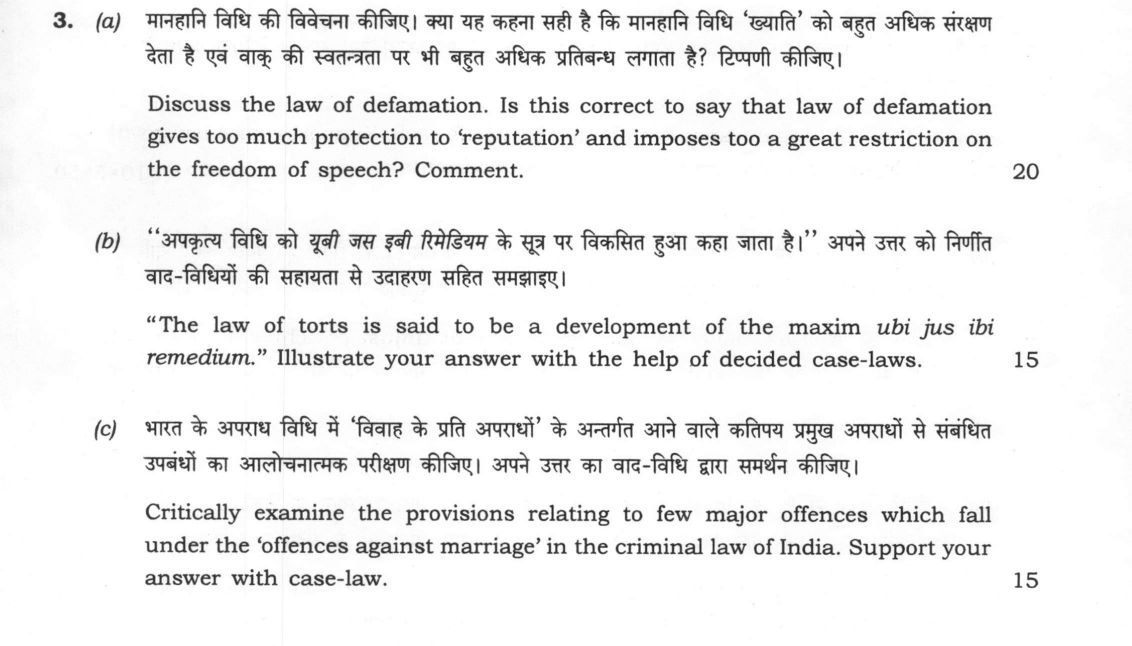
(a) Discuss the law of defamation. Is this correct to say that law of defamation gives too much protection to 'reputation' and…
Discuss the law of defamation. Is this correct to say that law of defamation gives too much protection to 'reputation' and imposes too a great restriction on the freedom of speech? Comment. 20 marks
"The law of torts is said to be a development of the maxim ubi jus ibi remedium." Illustrate your answer with the help of decided case-laws. 15 marks
Critically examine the provisions relating to few major offences which fall under the 'offences against marriage' in the criminal law of India. Support your answer with case-law. 15 marks
हिंदी में प्रश्न पढ़ें
मानहानि विधि की विवेचना कीजिए। क्या यह कहना सही है कि मानहानि विधि 'ख्याति' को बहुत अधिक संरक्षण देता है एवं वाक् की स्वतंत्रता पर भी बहुत अधिक प्रतिबंध लगाता है? टिप्पणी कीजिए। (20 अंक)
"अपकृत्य विधि को यूली जस इबी रिमेडियम के सूत्र पर विकसित हुआ कहा जाता है।" अपने उत्तर को निर्णीत वाद-विधियों की सहायता से उदाहरण सहित समझाइए। (15 अंक)
भारत के अपराध विधि में 'विवाह के प्रति अपराधों' के अंतर्गत आने वाले कतिपय प्रमुख अपराधों से संबंधित उपबंधों का आलोचनात्मक परीक्षण कीजिए। अपने उत्तर का वाद-विधि द्वारा समर्थन कीजिए। (15 अंक)
Model answer
Written by UPSC Answer Check against this question's marking rubric, to the expected length. UPSC does not publish answers for Mains — this is one way to score well, not an official key.
Defamation and free speech. Defamation is a false, harmful imputation, oral (slander) or fixed (libel), that lowers reputation in the estimation of right-thinking society. Sections 499-502 IPC make it criminal where a false statement is made or published with knowledge or reason to believe it will harm reputation; exceptions include truth for public good, fair criticism and privilege. In tort, it is a civil claim requiring falsity, publication, identification and damage, governed by justification, fair comment and privilege. The tension is between Article 19(1)(a) and Article 21, reputation being part of dignity. In R. Rajagopal v. State of Tamil Nadu, publication of public affairs cannot be restrained unless the statement is false, malicious and made with reckless disregard for truth; M.N. Roy J dissented on the scope of prior restraint but accepted that such statements are unprotected. Subramanian Swamy v. Union of India upheld criminal defamation as a reasonable restriction, but it must be narrowly applied. The criticism is therefore not wholly correct: reputation is a legitimate interest, protected only against false and harmful statements. Yet criminal defamation can chill speech, especially against public officials, so it should be used sparingly and civil remedies preferred.
Ubi jus ibi remedium. The maxim means that where a legal right exists, the law affords a remedy. It is the foundational principle of tort law, which developed as a body of remedies for violations of legal rights, and is broader than injuria sine damno, which is a specific case of a right violated without material damage. In Ashby v. White, wrongful exclusion from voting violated the right to vote and damages were awarded, showing a remedy follows a right even without pecuniary loss. In Marzetti v. Williams, a banker’s refusal to pay a cheque was held not actionable where no legal right was infringed, illustrating the converse: no remedy without a right. In Bhim Singh v. State of Jammu & Kashmir, false arrest and detention violated personal liberty and damages were awarded, confirming tort law protects rights through remedies.
Offences against marriage. Chapter XX of the IPC, Sections 493-498, covers offences against marriage. Section 493 punishes carnal intercourse with a woman known or believed to be pregnant; Section 494 punishes bigamy; Section 497, adultery, was struck down in Joseph Shine v. Union of India as unconstitutional, gender-biased and violative of Articles 14, 15 and 21. In Budansaheb v. Fatima, a second marriage by a Muslim man was held not void under Muslim personal law and therefore not bigamy under Section 494; by contrast, Sarla Mudgal v. Union of India held that conversion to Islam for a second marriage does not dissolve the first marriage and may amount to bigamy. Section 498 punishes enticing, taking away or detaining a wife or a person under eighteen with criminal intent; in State of Haryana v. Sukhbir Singh, criminal intent must be proved, so mere elopement is insufficient. Although Section 498A, cruelty, is in Chapter XXA and not technically an offence against marriage, it is a major marital offence. In State of Karnataka v. Krishnan, cruelty includes mental cruelty, such as persistent dowry demands and harassment, not only physical violence. These provisions show a trend towards decriminalising or narrowing gender-unequal marital offences while retaining protection against genuine harm.
Conclusion. Defamation law is not inherently excessive if confined to false, malicious and harmful statements, but criminal defamation must be applied cautiously to protect speech. Tort law remains rooted in the right-remedy nexus. The way forward is to preserve reputation without over-criminalising speech, keep tort remedies tied to rights, and reform marital offences to ensure gender justice, balancing liberty, dignity and family welfare.
What "Discuss" is asking you to do
Lay the issue out from more than one side — how it arose, what is claimed for it, what is held against it, and where it now stands. UPSC attaches discuss to broad topics with several live dimensions, so coverage of the dimensions earns more than the strength of your opinion.
Structure that answers it
Set the issue up → the case as it is made → the case against → the dimension both sides leave out → where the balance now lies
Where marks are lost
Listing facts with no thread between them, or arguing one side throughout and calling it a discussion.
How this answer will be evaluated
Approach
Framework: Issue > Rule > Authority > Application. (a) comment: context > arguments both sides > judgment > close | (b) explain: definition/context > points in order > small example > short close | (c) critique: the claim > its strengths > its weaknesses > your judgment Full marks: Precise legal analysis with strong case-law support and balanced arguments.
Key points expected
- Define defamation (libel/slander) under law of torts
- Cite Article 19(1)(a) and 19(2) of the Constitution
- Discuss the 'fair comment' and 'justification' defenses
- Weigh the 'too much protection' argument against free speech
- Define the maxim 'ubi jus ibi remedium'
- Explain how torts developed from this maxim
- Cite at least one decided case-law illustrating the principle
- Link the maxim to the evolution of civil remedies
Evaluation rubric
Each sub-part is marked on its own, against the marks and word limit printed on the paper.
- (a) Balanced assessment of defamation law's impact on reputation vs. free speech. 20 marks
comment— context → arguments both sides → judgment → close
Must cover
- Define defamation (libel/slander) under law of torts
- Cite Article 19(1)(a) and 19(2) of the Constitution
- Discuss the 'fair comment' and 'justification' defenses
- Weigh the 'too much protection' argument against free speech
Loses marks
- One-sided argument without balancing free speech
- Failure to cite specific constitutional articles
- Restating facts without legal application
Earns more
- Reference to the Defamation Act, 2013
- Mention of 'substantial truth' as a defense
- Distinction between public and private figures
- Reference to the 'actual malice' standard
Extra mark
- Cite a recent Supreme Court judgment on defamation
- Reference to Law Commission report on defamation
- (b) Explain the maxim 'ubi jus ibi remedium' in the context of tort law development. 15 marks
explain— definition/context → points in order → small example → short close
Must cover
- Define the maxim 'ubi jus ibi remedium'
- Explain how torts developed from this maxim
- Cite at least one decided case-law illustrating the principle
- Link the maxim to the evolution of civil remedies
Loses marks
- Defining the maxim without linking to torts
- Citing cases without explaining their ratio
- Failing to illustrate with decided case-laws
Earns more
- Mention the role of the writ of trespass
- Reference to the development of negligence
- Cite a case where a new right created a new tort
- Discuss the 'right to remedy' connection
Extra mark
- Cite a specific historical case (e.g., Donoghue v Stevenson)
- Reference to the role of the King's Bench
- (c) Critically examine major offences against marriage in Indian criminal law. 15 marks
critique— the claim → its strengths → its weaknesses → your judgment
Must cover
- Identify specific offences (e.g., bigamy, adultery)
- Cite relevant sections of the Indian Penal Code (IPC)
- Critically evaluate the provisions (e.g., gender bias)
- Support the critique with at least one case-law
Loses marks
- Listing offences without critical examination
- Failing to cite specific IPC sections
- Citing cases without supporting the critique
Earns more
- Reference to the Criminal Law (Amendment) Act, 2013
- Mention the decriminalization of adultery (Section 497)
- Discuss the 'offences against marriage' chapter of IPC
- Reference to the Supreme Court's view on bigamy
Extra mark
- Cite a recent Supreme Court judgment on marriage offences
- Reference to the Law Commission's recommendations
Practice this exact question
Write your answer and it is marked point by point against the model answer above — what you covered, what you missed, what you got wrong.
Evaluate my answer →More from Law 2025 Paper II
- Q1 Answer the following questions in about 150 words each. Support your answer with relevant…
- Q2 (a) "Homicide means killing of a human being by a human being." Explain the statement and…
- Q3 (a) Discuss the law of defamation. Is this correct to say that law of defamation gives to…
- Q4 (a) "Dacoity is an aggravated form of theft and robbery." Explain with relevant provision…
- Q5 Answer the following questions in about 150 words each. Support your answer with relevant…
- Q6 (a) "Every agreement by which anyone is restrained from exercising a lawful profession, t…