Paper II — Q4
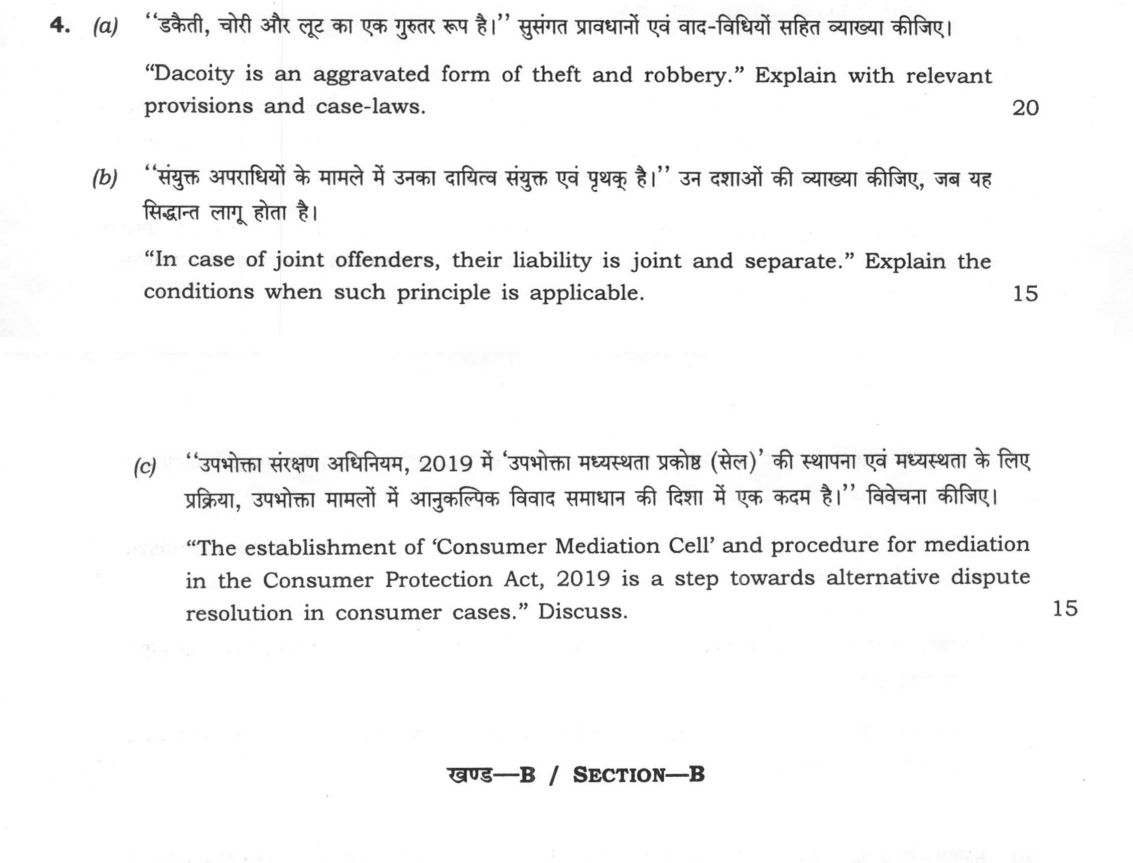
(a) "Dacoity is an aggravated form of theft and robbery." Explain with relevant provisions and case-laws. (20 marks) (b) "In…
"Dacoity is an aggravated form of theft and robbery." Explain with relevant provisions and case-laws. 20 marks
"In case of joint offenders, their liability is joint and separate." Explain the conditions when such principle is applicable. 15 marks
"The establishment of 'Consumer Mediation Cell' and procedure for mediation in the Consumer Protection Act, 2019 is a step towards alternative dispute resolution in consumer cases." Discuss. 15 marks
हिंदी में प्रश्न पढ़ें
"डकैती, चोरी और लूट का एक गुरुतर रूप है।" सुसंगत प्रावधानों एवं वाद-विधियों सहित व्याख्या कीजिए। (20 अंक)
"संयुक्त अपराधियों के मामले में उनका दायित्व संयुक्त एवं पृथक् है।" उन दशाओं की व्याख्या कीजिए, जब यह सिद्धांत लागू होता है। (15 अंक)
"उपभोक्ता संरक्षण अधिनियम, 2019 में 'उपभोक्ता मध्यस्थता प्रकोष्ठ (सेल)' की स्थापना एवं मध्यस्थता के लिए प्रक्रिया, उपभोक्ता मामलों में अनुकूलित विवाद समाधान की दिशा में एक कदम है।" विवेचना कीजिए। (15 अंक)
Model answer
Written by UPSC Answer Check against this question's marking rubric, to the expected length. UPSC does not publish answers for Mains — this is one way to score well, not an official key.
Dacoity as aggravated theft and robbery Dacoity is an aggravated form of theft and robbery because it combines the dishonest taking of property with collective violence. Under Section 378 IPC, theft is the dishonest taking of movable property without consent; under Section 390, robbery is theft or extortion followed by violence or intimidation. Section 391 elevates this to dacoity when robbery is committed or attempted by not less than five persons conjointly. Theft may be non-violent; robbery adds violence or intimidation; dacoity adds collective force, making resistance difficult and increasing the risk to life. Numbers multiply force and make organised violence a public danger. Sections 392 to 396 IPC provide graded punishments: Section 392 punishes dacoity with ten years or life; Sections 393 to 395 intensify punishment where murder or hurt is caused; Section 396 punishes attempt. This gradation shows that dacoity is robbery plus collective agency and heightened violence.
Case law fixes the statutory ingredients. In State of M.P. v. Mehrgarh, the court emphasised that the minimum of five persons is a strict condition and must be proved with certainty. In Ram Shankar Singh v. State of Bihar, the assembly of five persons was held essential; if only four participate, the offence may be robbery but not dacoity. In State of Maharashtra v. Bharat Chaganlal Raghani, the court distinguished preparation from attempt, holding that mere planning or gathering is not dacoity unless there is an overt act towards robbery. Thus, dacoity requires five or more persons, conjoint action, and either completed robbery or a real attempt.
Joint and separate liability Joint and separate liability means each participant is answerable for the common act, yet each may be prosecuted and punished individually. The offence is joint because it is one common act; the liability is separate because each accused can be tried and sentenced. Section 34 IPC makes each person liable for a criminal act done by several persons with common intention and participation. No prior meeting of minds is required; common intention may be pre-planned or may develop on the spot, as held in Pandurang v. State of Hyderabad. Barendra Kumar Ghosh v. Emperor established constructive liability: an act done by one in pursuance of the common intention is attributable to all. Section 149 IPC is a constructive/vicarious liability provision: where an unlawful assembly has a common object and any member commits an offence in prosecution of it, every member is liable. Mahbub Shah v. King-Emperor held that common object is wider than common intention; it is the assembly’s object, not necessarily a pre-arranged plan. The principle applies only where the act is connected to the common design, not merely coincidental; if a participant withdraws or acts outside the common object, liability may fail. The conditions are an unlawful assembly or common intention, a common object or intention, an act in furtherance or prosecution of it, and participation or knowledge making the act attributable to the accused. This makes liability joint as to the offence and separate as to punishment.
Consumer mediation as ADR The Consumer Protection Act, 2019 institutionalises mediation through the Consumer Mediation Cell under Section 74, constituted at national, state and district levels, with functions under Section 75 and procedure under Sections 78 to 81. Under Section 78, the Commission may, at any stage, refer a complaint to a mediator when it finds elements of settlement that are not unacceptable to the parties. Section 81 fixes the time limit for the mediator’s best efforts. If settlement is reached, the mediator submits a report under Section 79, and the Commission disposes of the complaint under Section 80, making the settlement enforceable as a Commission order. If no settlement is reached, the Commission proceeds with the case, retaining jurisdiction if mediation fails. This resembles Section 89 CPC and Lok Adalats under the Legal Services Authority Act, but is specialised for consumer disputes. It promotes speed, lower cost, party autonomy and preservation of relationships, while Article 39A supports access to justice by reducing delay and pendency.
Thus, Indian law moves from purely punitive criminal liability to restorative and efficient dispute resolution. Dacoity and joint liability protect society from collective crime by making each participant answerable, while consumer mediation channels disputes into enforceable settlement.
What "Explain" is asking you to do
Make the working of something clear — what sets it off, what follows from what, and what it produces. Explain is the Commission's mechanism word: it dominates the technical papers and the “explain why” stems, where the marks sit in the causal chain and not in the label.
Structure that answers it
State what it is → the initiating condition → the chain of cause, step by step → an instance where it plays out → what the chain produces
Where marks are lost
Describing what something looks like instead of why it works that way. Naming the stages without linking them reads as description too.
How this answer will be evaluated
Approach
Framework: Issue > Rule > Authority > Application. (a) explain: definition/context > points in order > small example > short close | (b) explain: definition/context > points in order > small example > short close | (c) discuss: intro > 3-4 dimensions > example > balanced close Full marks: Precise statutory citations, case law ratios, and clear application to the specific legal concepts.
Key points expected
- Define theft (Sec 378) and robbery (Sec 392) IPC
- Define dacoity (Sec 391) IPC
- Cite relevant case law (e.g., State of U.P. v. Kishan Lal)
- Explain the 'aggravated' nature (5 persons, force/fear)
- Define joint offenders (Sec 34 IPC)
- Explain 'joint and several' liability concept
- Cite relevant case law (e.g., Keshav Singh v. State of M.P.)
- Explain conditions for applicability (common intention, act)
Evaluation rubric
Each sub-part is marked on its own, against the marks and word limit printed on the paper.
- (a) Define dacoity as aggravated theft/robbery using IPC sections and case law. 20 marks
explain— definition/context → points in order → small example → short close
Must cover
- Define theft (Sec 378) and robbery (Sec 392) IPC
- Define dacoity (Sec 391) IPC
- Cite relevant case law (e.g., State of U.P. v. Kishan Lal)
- Explain the 'aggravated' nature (5 persons, force/fear)
Loses marks
- Defining dacoity without reference to theft/robbery
- Citing case law without stating the ratio
- Failing to mention the 'five persons' requirement
Earns more
- Mention punishment under Sec 395 IPC
- Reference to 'common intention' (Sec 34 IPC)
- Distinction between robbery and dacoity
- Reference to 'joint enterprise' concept
Extra mark
- Cite Law Commission report on dacoity
- Reference to recent Supreme Court judgment on dacoity
- (b) Explain conditions for joint and separate liability of joint offenders. 15 marks
explain— definition/context → points in order → small example → short close
Must cover
- Define joint offenders (Sec 34 IPC)
- Explain 'joint and several' liability concept
- Cite relevant case law (e.g., Keshav Singh v. State of M.P.)
- Explain conditions for applicability (common intention, act)
Loses marks
- Explaining joint liability without reference to Sec 34 IPC
- Citing case law without stating the ratio
- Failing to explain the 'conditions' for applicability
Earns more
- Mention Sec 149 IPC (criminal conspiracy)
- Reference to 'active participation' requirement
- Distinction between joint and several liability
- Reference to 'mens rea' in joint offenses
Extra mark
- Cite Law Commission report on joint liability
- Reference to recent Supreme Court judgment on joint liability
- (c) Discuss Consumer Mediation Cell as ADR in Consumer Protection Act 2019. 15 marks
discuss— intro → 3-4 dimensions → example → balanced close
Must cover
- Define Consumer Mediation Cell (Sec 22 CPA 2019)
- Explain procedure for mediation (Sec 22(2) CPA 2019)
- Discuss ADR benefits in consumer cases
- Cite relevant case law or example
Loses marks
- Discussing mediation without reference to CPA 2019
- Citing case law without stating the ratio
- Failing to explain the 'procedure' for mediation
Earns more
- Mention Sec 22(1) CPA 2019 (establishment)
- Reference to 'voluntary' nature of mediation
- Distinction between mediation and arbitration
- Reference to 'speedy disposal' of consumer cases
Extra mark
- Cite Law Commission report on consumer protection
- Reference to recent Supreme Court judgment on consumer mediation
Practice this exact question
Write your answer and it is marked point by point against the model answer above — what you covered, what you missed, what you got wrong.
Evaluate my answer →More from Law 2025 Paper II
- Q1 Answer the following questions in about 150 words each. Support your answer with relevant…
- Q2 (a) "Homicide means killing of a human being by a human being." Explain the statement and…
- Q3 (a) Discuss the law of defamation. Is this correct to say that law of defamation gives to…
- Q4 (a) "Dacoity is an aggravated form of theft and robbery." Explain with relevant provision…
- Q5 Answer the following questions in about 150 words each. Support your answer with relevant…
- Q6 (a) "Every agreement by which anyone is restrained from exercising a lawful profession, t…
- Q7 (a) "The parties to a contract must either perform or offer to perform their respective p…