Paper II — Q5
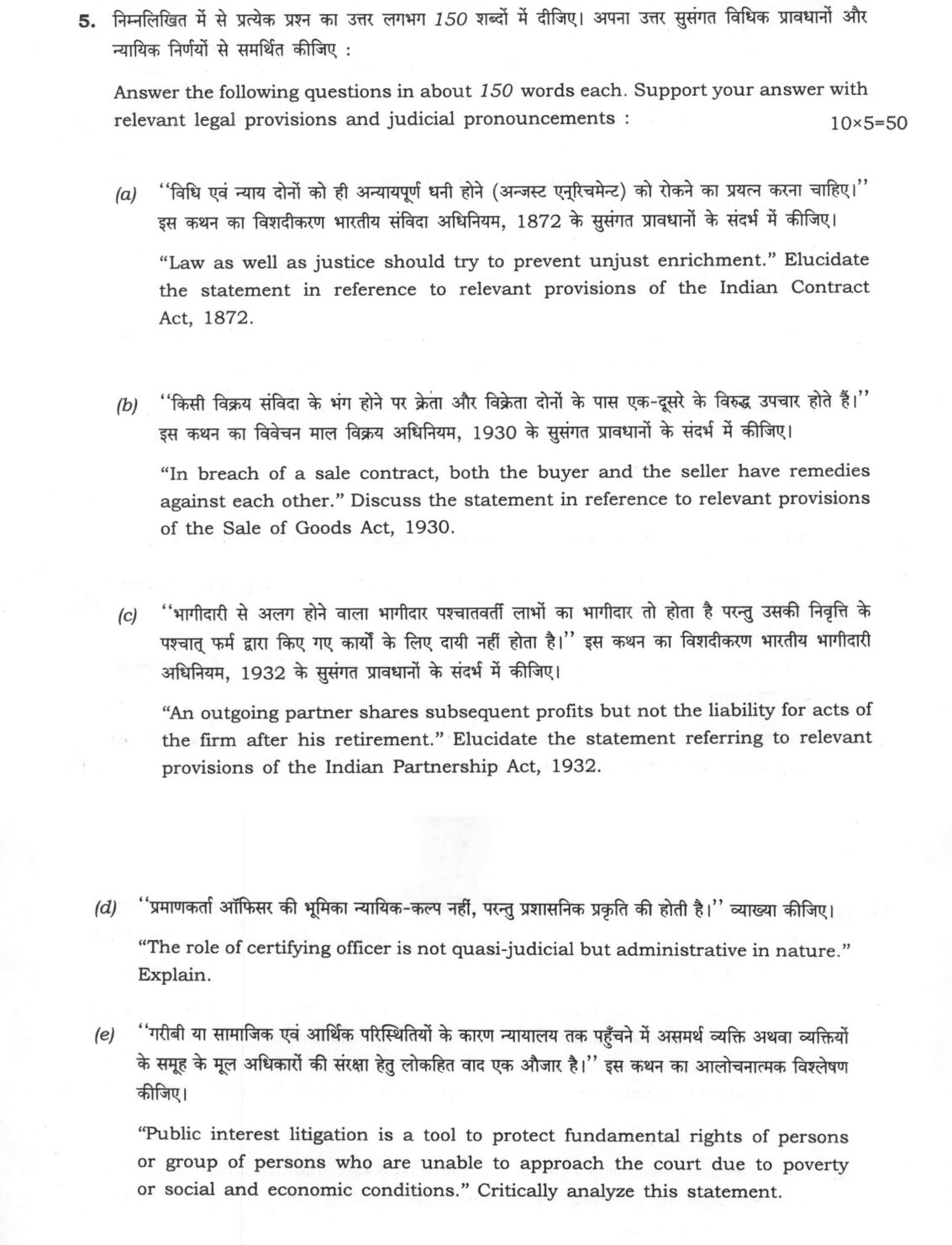
Answer the following questions in about 150 words each. Support your answer with relevant legal provisions and judicial…
Answer the following questions in about 150 words each. Support your answer with relevant legal provisions and judicial pronouncements:
"Law as well as justice should try to prevent unjust enrichment." Elucidate the statement in reference to relevant provisions of the Indian Contract Act, 1872. 10 marks
"In breach of a sale contract, both the buyer and the seller have remedies against each other." Discuss the statement in reference to relevant provisions of the Sale of Goods Act, 1930. 10 marks
"An outgoing partner shares subsequent profits but not the liability for acts of the firm after his retirement." Elucidate the statement referring to relevant provisions of the Indian Partnership Act, 1932. 10 marks
"The role of certifying officer is not quasi-judicial but administrative in nature." Explain. 10 marks
"Public interest litigation is a tool to protect fundamental rights of persons or group of persons who are unable to approach the court due to poverty or social and economic conditions." Critically analyze this statement. 10 marks
हिंदी में प्रश्न पढ़ें
निम्नलिखित में से प्रत्येक प्रश्न का उत्तर लगभग 150 शब्दों में दीजिए। अपना उत्तर सुसंगत विधिक प्रावधानों और न्यायिक निर्णयों से समर्थित कीजिए :
"विधि एवं न्याय दोनों को ही अन्यायपूर्ण धनी होने (अनजस्ट एनरिचमेंट) को रोकने का प्रयत्न करना चाहिए।" इस कथन का विशदीकरण भारतीय संविदा अधिनियम, 1872 के सुसंगत प्रावधानों के संदर्भ में कीजिए। (10 अंक)
"किसी विक्रय संविदा के भंग होने पर क्रेता और विक्रेता दोनों के पास एक-दूसरे के विरुद्ध उपचार होते हैं।" इस कथन का विवेचन माल विक्रय अधिनियम, 1930 के सुसंगत प्रावधानों के संदर्भ में कीजिए। (10 अंक)
"भागीदारी से अलग होने वाला भागीदार पश्चातवर्ती लाभों का भागीदार तो होता है परन्तु उसकी निवृत्ति के पश्चात फर्म द्वारा किए गए कार्यों के लिए दायी नहीं होता है।" इस कथन का विशदीकरण भारतीय भागीदारी अधिनियम, 1932 के सुसंगत प्रावधानों के संदर्भ में कीजिए। (10 अंक)
"प्रमाणकता अधिकारी की भूमिका न्यायिक-कल्प नहीं, परंतु प्रशासनिक प्रकृति की होती है।" व्याख्या कीजिए। (10 अंक)
"गरीबी या सामाजिक एवं आर्थिक परिस्थितियों के कारण न्यायालय तक पहुँचने में असमर्थ व्यक्ति अथवा व्यक्तियों के समूह के मूल अधिकारों की संरक्षण हेतु लोकहित वाद एक औजार है।" इस कथन का आलोचनात्मक विश्लेषण कीजिए। (10 अंक)
Model answer
Written by UPSC Answer Check against this question's marking rubric, to the 150-word length. UPSC does not publish answers for Mains — this is one way to score well, not an official key.
Unjust Enrichment and Contractual Obligations The principle that law must prevent unjust enrichment is codified in the Indian Contract Act, 1872, primarily through Section 70. This provision mandates that any person who lawfully receives a benefit, intended to be paid for and not given gratuitously, must compensate the provider or return the benefit. This prevents one party from retaining advantages without consideration. Section 65 further reinforces this by requiring the restoration of advantages received under voidable contracts that are subsequently rescinded. Judicially, State of West Bengal v. B.K. Mondal illustrates the application of Section 70, where the court held that the state could not retain benefits conferred without legal authority. Thus, these sections collectively ensure that equity prevails over strict contractual silence, preventing one party from profiting at the expense of another without legal justification.
Mutual Remedies in Sale of Goods Under the Sale of Goods Act, 1930, breach of contract triggers reciprocal remedies for both buyer and seller. The seller, upon the buyer’s failure to accept or pay, may sue for the price under Section 55 or for damages for non-acceptance under Section 56. Conversely, the buyer, if the seller fails to deliver, can claim damages for non-delivery under Section 57 or seek specific performance under Section 58. This symmetry ensures that neither party is left without recourse. For instance, if a seller wrongfully withholds goods, the buyer is not limited to damages but may compel delivery if the goods are unique. This dual structure balances the interests of both parties, ensuring that the contractual obligation to exchange goods for money is enforced fairly, regardless of which party defaults.
Outgoing Partner’s Rights and Liabilities Upon retirement, a partner’s relationship with the firm undergoes a specific legal transformation. Section 37 of the Indian Partnership Act, 1932, stipulates that an outgoing partner remains entitled to a share in the profits accrued after their retirement, provided they have not agreed otherwise. This ensures they benefit from the firm’s continued success. However, their liability is strictly limited. Under Section 35, an outgoing partner is not liable for acts done by the firm after their retirement, unless they have given public notice of their retirement. This distinction is crucial: while they share in future gains, they are shielded from future debts. Cases like Garware Wall Ropes Ltd. v. A.I. Chopra reinforce that liability ceases upon retirement, protecting the outgoing partner from the firm’s subsequent financial obligations, thereby balancing their economic interest with legal protection.
Nature of Certifying Officer’s Role The Certifying Officer under the Industrial Employment (Standing Orders) Act, 1946, performs an administrative, not quasi-judicial, function. Their role is to certify draft standing orders submitted by employers, ensuring they comply with statutory requirements. This is a regulatory check, not a judicial adjudication of disputes. In Associated Cement Companies Ltd. v. P.N. Sharma, the Supreme Court clarified that the Officer’s power to certify is administrative, involving verification of compliance rather than hearing evidence or resolving conflicts between parties. Unlike quasi-judicial bodies that determine rights and liabilities through due process, the Certifying Officer acts as a gatekeeper for statutory adherence. This distinction is vital for understanding the limits of judicial review, as the Officer’s decisions are subject to review only for jurisdictional errors, not for merits-based judicial interference.
Public Interest Litigation and Fundamental Rights Public Interest Litigation (PIL) has evolved from a strict procedural tool to a vital mechanism for protecting the fundamental rights of marginalized groups. Originating in S.P. Gupta v. Union of India (1981), PIL relaxed the traditional locus standi requirement, allowing any public-spirited individual to approach the court on behalf of those unable to do so due to poverty or social barriers. This expansion, seen in Bandhua Mukti Morcha, enabled the judiciary to address systemic violations of Articles 21 and 32. However, critics argue that PIL can lead to judicial overreach, where courts encroach upon executive functions. Despite this, PIL remains indispensable in India’s democratic framework, ensuring that the Constitution’s promise of justice is accessible to the voiceless, thereby strengthening the rule of law through proactive judicial intervention.
What "Elucidate" is asking you to do
Make a stated proposition plain and then prove it with instances. Elucidate stems almost always carry a claim or a named concept, and very often the words “with examples” or “with suitable diagrams” — the illustration is part of the directive, not decoration.
Structure that answers it
Plain-language statement of what the proposition means → the part that is obscure, resolved → first illustration → second illustration → why the proposition holds
Where marks are lost
Adding terminology; elucidate rewards removing it. The commoner loss is a clean explanation with no example, when the stem asked for examples.
How this answer will be evaluated
Approach
Framework: Issue > Rule > Authority > Application. (a) explain: definition/context > points in order > small example > short close | (b) discuss: intro > 3-4 dimensions > example > balanced close | (c) explain: definition/context > points in order > small example > short close | (d) explain: definition/context > points in order > small example > short close | (e) analyse: intro > causes > effects > stakeholders/linkages > way forward Full marks: Precise statutory citations, relevant case law ratios, clear application to the specific legal issue, and critical analysis where required.
Key points expected
- Cite Section 70 of the Indian Contract Act, 1872
- Define the concept of 'unjust enrichment' in legal terms
- Explain the obligation to compensate for non-contractual benefits
- Reference a relevant judicial pronouncement on Section 70
- Identify remedies available to the buyer (e.g., damages, specific performance)
- Identify remedies available to the seller (e.g., suit for price, damages)
- Cite relevant sections of the Sale of Goods Act, 1930
- Explain the reciprocal nature of these remedies
Evaluation rubric
Each sub-part is marked on its own, against the marks and word limit printed on the paper.
- (a) Explain the legal basis for preventing unjust enrichment under the Indian Contract Act. · 150 words
explain— definition/context → points in order → small example → short close
Must cover
- Cite Section 70 of the Indian Contract Act, 1872
- Define the concept of 'unjust enrichment' in legal terms
- Explain the obligation to compensate for non-contractual benefits
- Reference a relevant judicial pronouncement on Section 70
Loses marks
- Failing to cite Section 70 specifically
- Restating the question without legal analysis
- Citing cases without explaining their ratio
Earns more
- Mention the equitable nature of the provision
- Distinguish between contractual and quasi-contractual obligations
- Cite a specific case law ratio regarding Section 70
- Discuss the 'necessity' or 'request' element of the benefit
Extra mark
- Reference a recent Supreme Court judgment on Section 70
- Mention a Law Commission report on contract law
- (b) Analyze the mutual remedies available to buyer and seller upon breach of sale contract. · 150 words
discuss— intro → 3-4 dimensions → example → balanced close
Must cover
- Identify remedies available to the buyer (e.g., damages, specific performance)
- Identify remedies available to the seller (e.g., suit for price, damages)
- Cite relevant sections of the Sale of Goods Act, 1930
- Explain the reciprocal nature of these remedies
Loses marks
- Failing to mention specific sections of the Act
- Discussing only one party's remedies
- Citing cases without explaining their relevance
Earns more
- Mention Section 51 (Buyer's remedies) and Section 54 (Seller's remedies)
- Discuss the concept of 'suit for price' vs 'damages'
- Reference a case law illustrating mutual remedies
- Explain the conditions for specific performance
Extra mark
- Cite a recent Supreme Court judgment on sale contract remedies
- Mention a Law Commission report on sale of goods
- (c) Explain the liability and profit-sharing position of an outgoing partner under the Partnership Act. · 150 words
explain— definition/context → points in order → small example → short close
Must cover
- Cite Section 37 of the Indian Partnership Act, 1932
- Explain that outgoing partners are not liable for post-retirement acts
- Clarify that outgoing partners do not share subsequent profits
- Reference a relevant judicial pronouncement on partner liability
Loses marks
- Failing to cite Section 37 specifically
- Confusing retirement with dissolution of the firm
- Citing cases without explaining their ratio
Earns more
- Mention the concept of 'dissolution' vs 'retirement'
- Discuss the 'notice' requirement for third parties
- Cite a specific case law ratio on outgoing partner liability
- Explain the 'joint and several' liability of remaining partners
Extra mark
- Reference a recent Supreme Court judgment on partnership liability
- Mention a Law Commission report on partnership law
- (d) Explain why the role of a certifying officer is administrative rather than quasi-judicial. · 150 words
explain— definition/context → points in order → small example → short close
Must cover
- Define 'quasi-judicial' and 'administrative' functions
- Explain the nature of certification as an administrative act
- Cite a relevant judicial pronouncement on the nature of certification
- Distinguish between adjudicatory and executive functions
Loses marks
- Failing to distinguish between quasi-judicial and administrative
- Citing cases without explaining their relevance
- Restating the question without legal analysis
Earns more
- Mention the 'duty' vs 'discretion' aspect of certification
- Discuss the 'pre-liminary' nature of certification
- Cite a specific case law ratio on administrative functions
- Explain the 'ministerial' character of the officer's role
Extra mark
- Reference a recent Supreme Court judgment on administrative functions
- Mention a Law Commission report on administrative law
- (e) Critically analyze the role of Public Interest Litigation in protecting fundamental rights. · 150 words
analyse— intro → causes → effects → stakeholders/linkages → way forward
Must cover
- Define Public Interest Litigation (PIL) and its purpose
- Explain how PIL protects fundamental rights of disadvantaged groups
- Cite a relevant judicial pronouncement on PIL
- Discuss the limitations or criticisms of PIL
Loses marks
- Failing to mention the 'relaxation of locus standi'
- Citing cases without explaining their relevance
- Restating the question without critical analysis
Earns more
- Mention the 'relaxation of locus standi' in PIL
- Discuss the 'abuse' of PIL and judicial safeguards
- Cite a specific case law ratio on PIL
- Explain the 'access to justice' aspect of PIL
Extra mark
- Reference a recent Supreme Court judgment on PIL
- Mention a Law Commission report on access to justice
Practice this exact question
Write your answer and it is marked point by point against the model answer above — what you covered, what you missed, what you got wrong.
Evaluate my answer →More from Law 2025 Paper II
- Q2 (a) "Homicide means killing of a human being by a human being." Explain the statement and…
- Q3 (a) Discuss the law of defamation. Is this correct to say that law of defamation gives to…
- Q4 (a) "Dacoity is an aggravated form of theft and robbery." Explain with relevant provision…
- Q5 Answer the following questions in about 150 words each. Support your answer with relevant…
- Q6 (a) "Every agreement by which anyone is restrained from exercising a lawful profession, t…
- Q7 (a) "The parties to a contract must either perform or offer to perform their respective p…
- Q8 (a) "Right to Information, for citizens to secure access to information under the control…