Paper II — Q2
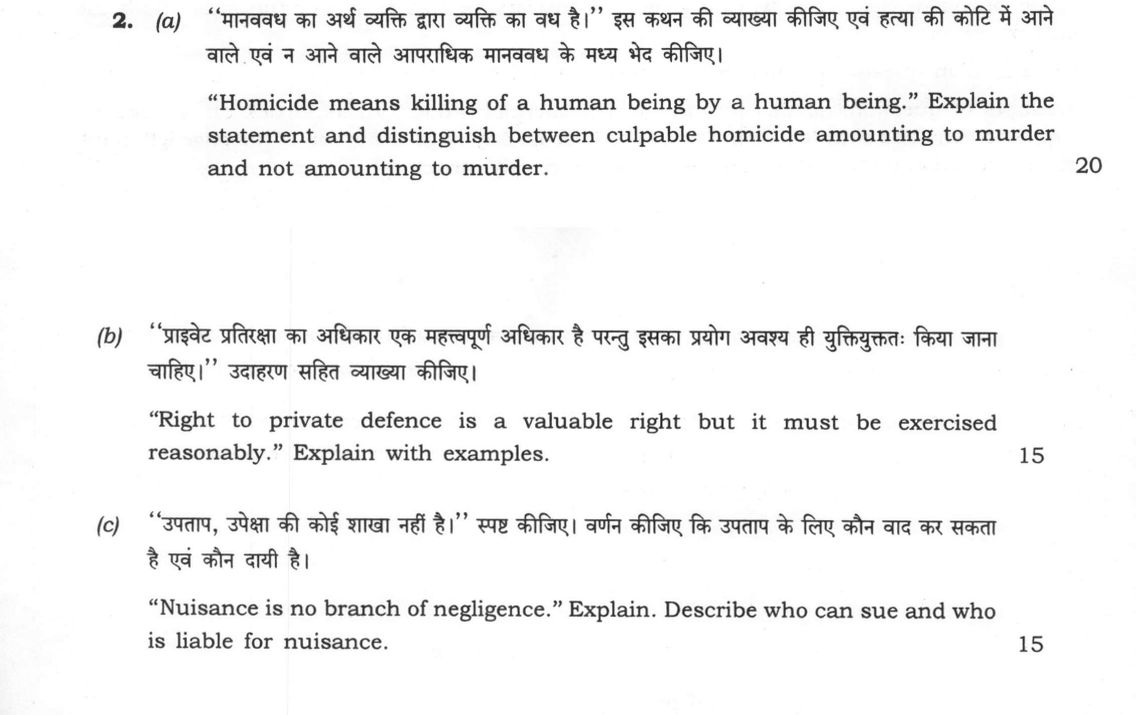
(a) "Homicide means killing of a human being by a human being." Explain the statement and distinguish between culpable homicide…
"Homicide means killing of a human being by a human being." Explain the statement and distinguish between culpable homicide amounting to murder and not amounting to murder. 20 marks
"Right to private defence is a valuable right but it must be exercised reasonably." Explain with examples. 15 marks
"Nuisance is no branch of negligence." Explain. Describe who can sue and who is liable for nuisance. 15 marks
हिंदी में प्रश्न पढ़ें
"मानववध का अर्थ व्यक्ति द्वारा व्यक्ति का वध है।" इस कथन की व्याख्या कीजिए एवं हत्या की कोटि में आने वाले एवं न आने वाले आपराधिक मानववध के मध्य भेद कीजिए। (20 अंक)
"प्राइवेट प्रतिरक्षा का अधिकार एक महत्वपूर्ण अधिकार है परंतु इसका प्रयोग अवश्य ही युक्तियुक्तः किया जाना चाहिए।" उदाहरण सहित व्याख्या कीजिए। (15 अंक)
"उपताप, उपेक्षा की कोई शाखा नहीं है।" स्पष्ट कीजिए। वर्णन कीजिए कि उपताप के लिए कौन वाद कर सकता है एवं कौन दायी है। (15 अंक)
Model answer
Written by UPSC Answer Check against this question's marking rubric, to the expected length. UPSC does not publish answers for Mains — this is one way to score well, not an official key.
Homicide and murder
Homicide (homo + cida) is killing of a human being by a human being. It is a genus; culpable homicide under S299 IPC is a species where death is caused by an act done with intention to cause death, with intention to cause bodily injury known to be likely to cause death, or with knowledge that the act is likely to cause death. Murder under S300 is culpable homicide with a graver mental element: (1) intention to cause death; (2) intention to cause such bodily injury as the actor knows is likely to cause death; (3) intention to cause such bodily injury as is sufficient in the ordinary course of human affairs to cause death; (4) intention to commit an offence or cause bodily injury likely to cause death, without any excuse, and death ensues; or (5) knowledge that the act is likely to cause death, and death ensues. Culpable homicide is not murder either when the act does not satisfy any clause of S300, or when it falls within the exceptions, becoming culpable homicide not amounting to murder under S304.
| Exception | Illustration | |---|---| | Grave and sudden provocation | A kills B in heat of passion after insult. | | Excessive private defence | A kills a thief though only force was needed. | | Consent | A causes B’s death at B’s request, without intention to kill. | | Unsound mind | A, not knowing the act’s nature, kills B. | | Diminished responsibility | A kills B while substantially impaired by mental disturbance. |
Private defence
S96 IPC gives a right to private defence of body and property. It is a temporary shield, not retaliation. S99 denies the right against an act by a public servant acting in good faith under colour of office, or under his direction, only if the act does not reasonably cause apprehension of death or grievous hurt; if such apprehension is reasonably caused, the right exists. S100 permits causing death or injury to an assailant when the assault gives rise to reasonable apprehension of death or grievous hurt, or is an assault with intention to commit rape or to kidnap/abduct. S103-S104 extend property defence against theft, robbery, mischief, criminal trespass; death may be caused only in specified cases such as robbery, house-breaking by night, mischief by fire, or theft where there is reasonable ground to apprehend death/grievous hurt if resisted. S106 requires that the harm caused not exceed what is reasonably necessary; the test is reasonable apprehension and proportionality. In Kishan Singh v. State of Haryana (2005) 11 SCC 646, the court examined whether force was proportionate to the threat. A householder may repel a thief by day with non-lethal force, but not kill him; against an armed robber, lethal force may be justified if necessary.
Nuisance
Nuisance is not a branch of negligence. In Sedleigh-Denfield v. O’Callaghan [1940] AC 880, nuisance was treated as an independent tort: liability may arise from creating or continuing an unreasonable interference with use and enjoyment of land or a public right, without proof of negligence. Negligence requires duty, breach and damage. Private nuisance is available to an occupier or person with exclusive use of land; public nuisance affects the public, and any member suffering special damage may sue, while the Advocate General may sue on behalf of the public. Liability may fall on the creator, occupier, predecessor in title, a landlord who authorises the nuisance, and, where relevant, a landlord bound by repair covenants. Statutory authority can be a defence if the nuisance is reasonably necessary and precautions are taken. Indian examples include industrial effluent polluting a river, construction noise, encroachment on a public road, and sewage overflowing into a neighbourhood.
Thus, these doctrines balance individual rights and social order.
What "Explain" is asking you to do
Make the working of something clear — what sets it off, what follows from what, and what it produces. Explain is the Commission's mechanism word: it dominates the technical papers and the “explain why” stems, where the marks sit in the causal chain and not in the label.
Structure that answers it
State what it is → the initiating condition → the chain of cause, step by step → an instance where it plays out → what the chain produces
Where marks are lost
Describing what something looks like instead of why it works that way. Naming the stages without linking them reads as description too.
How this answer will be evaluated
Approach
Framework: Issue > Rule: statute or Article > Authority > Application and conclusion. (a) explain: definition/context > points in order > small example > short close | (b) explain: definition/context > points in order > small example > short close | (c) explain: definition/context > points in order > small example > short close Full marks: Precise statutory citations, clear distinctions, and relevant case law with ratio.
Key points expected
- Define homicide under Section 299/300 IPC
- Distinguish murder (Sec 300) from culpable homicide (Sec 299)
- Cite specific exceptions to murder (e.g., provocation, private defence)
- Apply legal tests to distinguish the two categories
- Define right to private defence (Sections 96-106 IPC)
- Explain the 'reasonableness' or 'proportionality' test
- Provide a concrete example of reasonable vs. excessive force
- Distinguish defence of body from defence of property
Evaluation rubric
Each sub-part is marked on its own, against the marks and word limit printed on the paper.
- (a) Define homicide and distinguish culpable homicide amounting to murder from that not amounting to murder. 20 marks
explain— definition/context → points in order → small example → short close
Must cover
- Define homicide under Section 299/300 IPC
- Distinguish murder (Sec 300) from culpable homicide (Sec 299)
- Cite specific exceptions to murder (e.g., provocation, private defence)
- Apply legal tests to distinguish the two categories
Loses marks
- Confusing 'culpable homicide' with 'homicide' generally
- Failing to cite specific sections of IPC
- Listing differences without legal authority
Earns more
- Reference to 'Mens Rea' and 'Actus Reus'
- Citing landmark cases like Rameshwar v. State of UP
- Mentioning the 'intention' vs 'knowledge' distinction
- Discussion of 'grave and sudden provocation'
Extra mark
- Reference to Law Commission Report on IPC
- Citing a recent Supreme Court judgment on intent
- (b) Explain the right to private defence and the requirement of reasonableness with examples. 15 marks
explain— definition/context → points in order → small example → short close
Must cover
- Define right to private defence (Sections 96-106 IPC)
- Explain the 'reasonableness' or 'proportionality' test
- Provide a concrete example of reasonable vs. excessive force
- Distinguish defence of body from defence of property
Loses marks
- Treating private defence as a right to retaliate
- Failing to distinguish body vs. property defence
- Ignoring the 'reasonableness' constraint
Earns more
- Citing 'Keshav Singh v. State of MP' or similar
- Discussing the 'imminent threat' requirement
- Mentioning the right to cause death in specific cases
- Reference to 'reasonable apprehension' of danger
Extra mark
- Reference to Law Commission Report on IPC
- Citing a recent Supreme Court judgment on proportionality
- (c) Explain why nuisance is distinct from negligence and identify who can sue and who is liable. 15 marks
explain— definition/context → points in order → small example → short close
Must cover
- Define nuisance as a tort distinct from negligence
- Explain the 'interference with use and enjoyment' element
- Identify who can sue (occupier, owner, etc.)
- Identify who is liable (occupier, owner, user)
Loses marks
- Conflating nuisance with negligence or trespass
- Failing to distinguish 'who can sue' from 'who is liable'
- Ignoring the 'unreasonable' nature of the interference
Earns more
- Citing 'Hollywood Silver Fox Farm v. Emmett' for standing
- Citing 'Sturges v. Bridgman' for liability
- Distinguishing 'absolute' vs. 'non-absolute' nuisance
- Mentioning 'statutory nuisance' vs. 'common law nuisance'
Extra mark
- Reference to Law Commission Report on Torts
- Citing a recent Supreme Court judgment on environmental nuisance
Practice this exact question
Write your answer and it is marked point by point against the model answer above — what you covered, what you missed, what you got wrong.
Evaluate my answer →More from Law 2025 Paper II
- Q1 Answer the following questions in about 150 words each. Support your answer with relevant…
- Q2 (a) "Homicide means killing of a human being by a human being." Explain the statement and…
- Q3 (a) Discuss the law of defamation. Is this correct to say that law of defamation gives to…
- Q4 (a) "Dacoity is an aggravated form of theft and robbery." Explain with relevant provision…
- Q5 Answer the following questions in about 150 words each. Support your answer with relevant…