Paper II — Q7
(a) "The parties to a contract must either perform or offer to perform their respective promises unless the performance is…
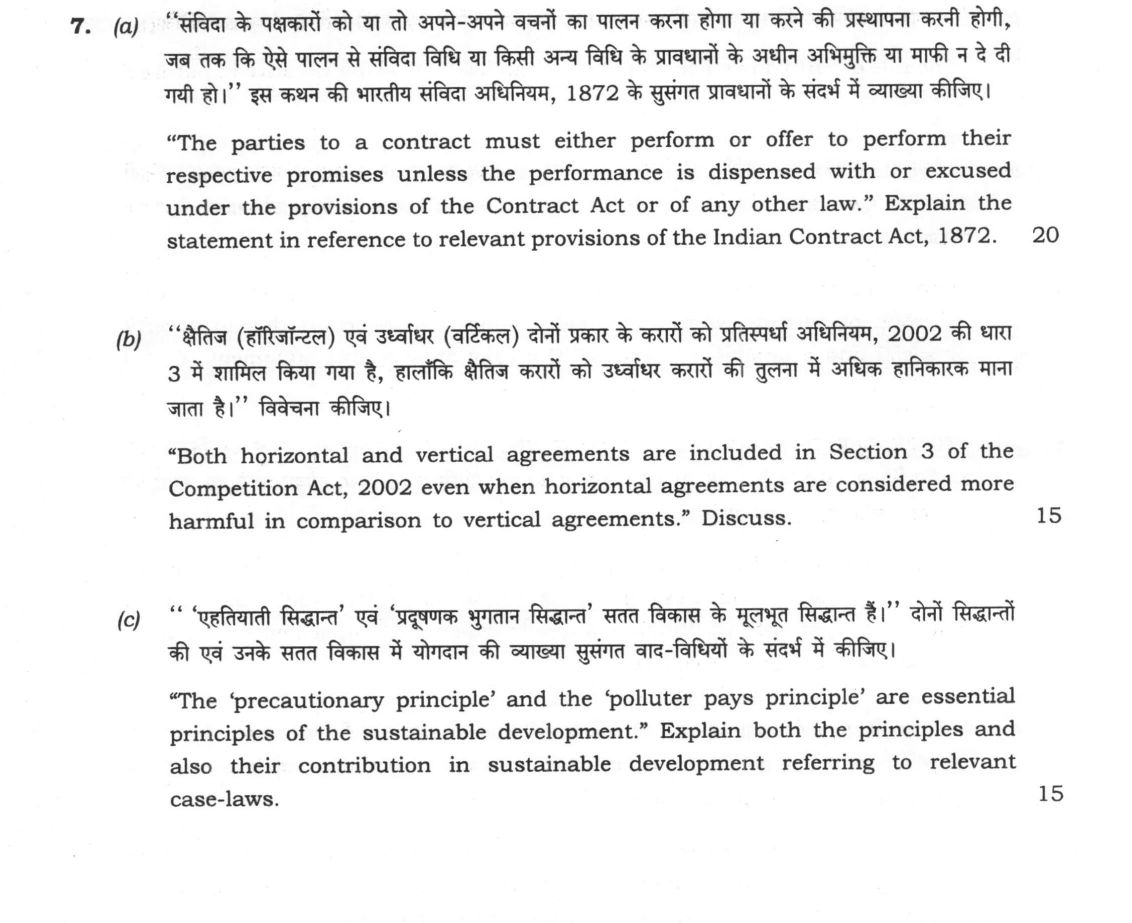
"The parties to a contract must either perform or offer to perform their respective promises unless the performance is dispensed with or excused under the provisions of the Contract Act or of any other law." Explain the statement in reference to relevant provisions of the Indian Contract Act, 1872. 20 marks
"Both horizontal and vertical agreements are included in Section 3 of the Competition Act, 2002 even when horizontal agreements are considered more harmful in comparison to vertical agreements." Discuss. 15 marks
"The 'precautionary principle' and the 'polluter pays principle' are essential principles of the sustainable development." Explain both the principles and also their contribution in sustainable development referring to relevant case-laws. 15 marks
हिंदी में प्रश्न पढ़ें
"संविदा के पक्षकारों को या तो अपने-अपने वचनों का पालन करना होगा या करने की प्रस्थापना करनी होगी, जब तक कि ऐसे पालन से संविदा विधि या किसी अन्य विधि के प्रावधानों के अधीन अभिमुक्ति या माफी न दे दी गयी हो।" इस कथन की भारतीय संविदा अधिनियम, 1872 के सुसंगत प्रावधानों के संदर्भ में व्याख्या कीजिए। (20 अंक)
"क्षैतिज (हॉरिजॉन्टल) एवं उद्वधिर (वर्टिकल) दोनों प्रकार के करारों को प्रतिस्पर्धा अधिनियम, 2002 की धारा 3 में शामिल किया गया है, हालांकि क्षैतिज करारों को उद्वधिर करारों की तुलना में अधिक हानिकारक माना जाता है।" विवेचना कीजिए। (15 अंक)
"'एहतियाती सिद्धांत' एवं 'प्रदूषणक भुगतान सिद्धांत' सतत विकास के मूलभूत सिद्धांत हैं।" दोनों सिद्धांतों की एवं उनके सतत विकास में योगदान की व्याख्या सुसंगत बाद-विधियों के संदर्भ में कीजिए। (15 अंक)
Model answer
Written by UPSC Answer Check against this question's marking rubric, to the expected length. UPSC does not publish answers for Mains — this is one way to score well, not an official key.
(a) Performance and tender under the Contract Act Section 37 of the Indian Contract Act, 1872, makes performance the default position: a promisor must perform or offer to perform unless dispensed with or excused. Section 38 requires actual performance on the due date, in the required manner and place; if the promisee refuses a reasonable facility, the promisor is not responsible for non-performance but retains his rights, not that the contract is discharged. Where the promisee’s cooperation is needed, Sections 46–50 govern tender: a valid offer of performance at the proper time, place and person; if refused, Section 50 protects the promisor from default and preserves his remedies. The “unless” clause covers statutory excuses: voidness under Section 23 for unlawful object or consideration, and Section 24 where part is unlawful and not severable; supervening impossibility under Section 56; novation, alteration or rescission under Section 62; remission under Section 63; and mutual rescission. Thus the statement is an absolute duty qualified only by legal excuses.
(b) Horizontal and vertical agreements under Section 3 Section 3(1) of the Competition Act, 2002, prohibits agreements causing appreciable adverse effect on competition (AAEC). Section 3(3) covers horizontal agreements between competitors—price fixing, bid rigging, market allocation, cartels—and presumes AAEC, subject to Section 19, unless the contrary is proved. This is a statutory presumption, not classical per se illegality, but it makes such agreements hard to defend. Section 3(4) covers vertical agreements—tie-in sales, exclusive supply, resale price maintenance—and applies a rule-of-reason test: the CCI weighs anti-competitive effects against efficiencies. The distinction is rational: horizontal agreements eliminate competition at the source, while vertical restraints may foreclose markets but can also improve distribution, protect brands and prevent free-riding. Excel Corp. v. CCI reflects the hostility to cartels; CCI v. Eicher Motors illustrates the more nuanced vertical analysis. The US treats horizontal price fixing as per se illegal and many vertical restraints under rule of reason; the EU prohibits restrictive agreements under Article 101(1) TFEU but allows pro-competitive exemptions. Both are included in Section 3 because both can distort markets, but horizontal agreements attract stronger scrutiny.
(c) Environmental principles and sustainable development The precautionary principle holds that scientific uncertainty cannot justify delaying preventive action where an activity may cause serious or irreversible environmental harm. Vellore Citizens’ Welfare Forum v. Union of India (1996) adopted it in India, linking it to Article 21 and the environmental duties in Articles 48A and 51A(g). Narmada Bachao Andolan v. Union of India (2000) confirms its constitutional place but also limits it: it is not invoked where serious or irreversible damage is not established. The polluter pays principle makes those causing pollution bear the cost of prevention, remediation and compensation, internalising environmental externalities. Indian Council for Enviro-Legal Action v. Union of India (1996) applied it to environmental damage; M.C. Mehta v. Union of India (Oleum gas leak) connected it with absolute liability for hazardous activity; Deepak Nitrite Ltd. v. State of Gujarat applied it to restoration; and A.P. Pollution Control Board II v. Nayudu integrated both with sustainable development, requiring growth without degrading the ecological base. Their contribution is causal: precaution shifts the burden of proof toward the proponent of risky activity, while polluter pays makes the polluter finance harm, deterring damage and ensuring development does not exhaust natural capital.
Taken together, the three areas show how Indian law balances freedom with regulation. Contractual performance secures private autonomy; Section 3 disciplines market power; environmental principles impose ecological limits. Sustainable development is therefore not mere growth, but performance, fair competition and preventive responsibility within constitutional and statutory limits.
What "Explain" is asking you to do
Make the working of something clear — what sets it off, what follows from what, and what it produces. Explain is the Commission's mechanism word: it dominates the technical papers and the “explain why” stems, where the marks sit in the causal chain and not in the label.
Structure that answers it
State what it is → the initiating condition → the chain of cause, step by step → an instance where it plays out → what the chain produces
Where marks are lost
Describing what something looks like instead of why it works that way. Naming the stages without linking them reads as description too.
How this answer will be evaluated
Approach
Framework: Issue > Rule > Authority > Application. (a) explain: definition/context > points in order > small example > short close | (b) discuss: intro > 3-4 dimensions > example > balanced close | (c) explain: definition/context > points in order > small example > short close Full marks: Precise statutory citations, clear distinction between concepts, relevant case law with ratio, and balanced analysis.
Key points expected
- Cite Section 37 of the Indian Contract Act, 1872
- Define 'offer to perform' under Section 37
- Explain 'dispensed with' performance (e.g., Section 62)
- Explain 'excused' performance (e.g., Section 56, 65)
- Cite Section 3 of the Competition Act, 2002
- Define horizontal agreements (Section 3(3))
- Define vertical agreements (Section 3(4))
- Explain why horizontal agreements are considered more harmful
Evaluation rubric
Each sub-part is marked on its own, against the marks and word limit printed on the paper.
- (a) Explain the duty to perform or offer to perform promises under the Indian Contract Act, 1872. 20 marks
explain— definition/context → points in order → small example → short close
Must cover
- Cite Section 37 of the Indian Contract Act, 1872
- Define 'offer to perform' under Section 37
- Explain 'dispensed with' performance (e.g., Section 62)
- Explain 'excused' performance (e.g., Section 56, 65)
Loses marks
- Restating the question without legal analysis
- Citing cases without stating the ratio
- Confusing 'dispensed with' and 'excused' performance
Earns more
- Reference to Section 38 (time of performance)
- Reference to Section 40 (performance without direction)
- Distinction between absolute and conditional promises
- Reference to Section 53 (joint promises)
Extra mark
- Citation of a recent Supreme Court judgment on performance
- Reference to Law Commission report on Contract Act
- (b) Discuss the inclusion of horizontal and vertical agreements in Section 3 of the Competition Act, 2002. 15 marks
discuss— intro → 3-4 dimensions → example → balanced close
Must cover
- Cite Section 3 of the Competition Act, 2002
- Define horizontal agreements (Section 3(3))
- Define vertical agreements (Section 3(4))
- Explain why horizontal agreements are considered more harmful
Loses marks
- Failing to distinguish between horizontal and vertical agreements
- Citing cases without stating the ratio
- Ignoring the 'more harmful' aspect of horizontal agreements
Earns more
- Reference to Section 4 (abuse of dominant position)
- Distinction between per se illegal and rule of reason
- Reference to CCI guidelines on vertical agreements
- Example of a horizontal agreement case
Extra mark
- Citation of a recent CCI order on vertical agreements
- Reference to Law Commission report on Competition Act
- (c) Explain the precautionary principle and polluter pays principle in the context of sustainable development. 15 marks
explain— definition/context → points in order → small example → short close
Must cover
- Define the precautionary principle
- Define the polluter pays principle
- Explain their contribution to sustainable development
- Cite relevant case-laws for both principles
Loses marks
- Failing to distinguish between the two principles
- Citing cases without stating the ratio
- Ignoring the 'sustainable development' context
Earns more
- Reference to Vellore Citizens Welfare Forum v. Union of India
- Reference to M.C. Mehta v. Union of India
- Reference to Indian Council for Enviro-Legal Action v. Union of India
- Distinction between the two principles
Extra mark
- Citation of a recent Supreme Court judgment on environmental principles
- Reference to Law Commission report on environmental law
Practice this exact question
Write your answer and it is marked point by point against the model answer above — what you covered, what you missed, what you got wrong.
Evaluate my answer →More from Law 2025 Paper II
- Q4 (a) "Dacoity is an aggravated form of theft and robbery." Explain with relevant provision…
- Q5 Answer the following questions in about 150 words each. Support your answer with relevant…
- Q6 (a) "Every agreement by which anyone is restrained from exercising a lawful profession, t…
- Q7 (a) "The parties to a contract must either perform or offer to perform their respective p…
- Q8 (a) "Right to Information, for citizens to secure access to information under the control…