Paper II — Q8
(a) "Right to Information, for citizens to secure access to information under the control of public authorities, is an important…
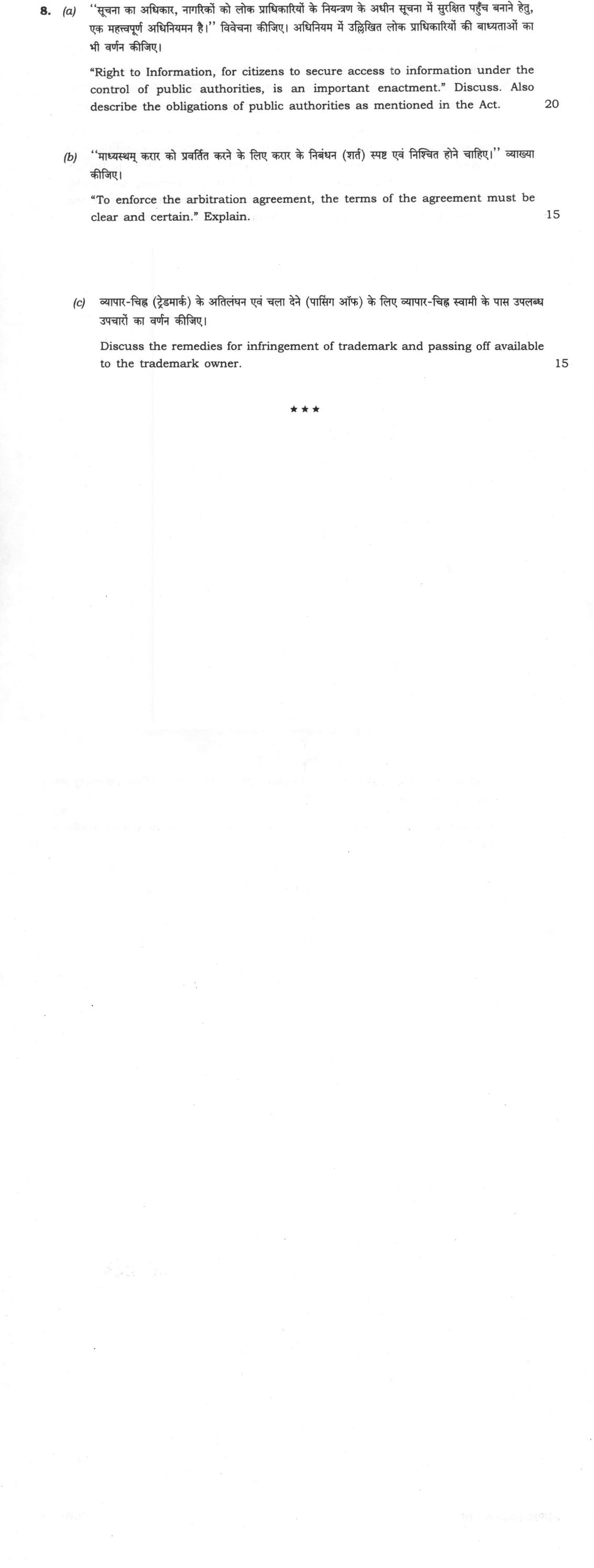
"Right to Information, for citizens to secure access to information under the control of public authorities, is an important enactment." Discuss. Also describe the obligations of public authorities as mentioned in the Act. 20 marks
"To enforce the arbitration agreement, the terms of the agreement must be clear and certain." Explain. 15 marks
Discuss the remedies for infringement of trademark and passing off available to the trademark owner. 15 marks
हिंदी में प्रश्न पढ़ें
"सूचना का अधिकार, नागरिकों को लोक प्राधिकारियों के नियंत्रण के अधीन सूचना में सुरक्षित पहुंच बनाने हेतु, एक महत्वपूर्ण अधिनियमन है।" विवेचना कीजिए। अधिनियम में उल्लिखित लोक प्राधिकारियों की बाध्यताओं का भी वर्णन कीजिए। (20 अंक)
"मध्यस्थम करार को प्रवर्तित करने के लिए करार के निबंधन (शर्तें) स्पष्ट एवं निश्चित होने चाहिए।" व्याख्या कीजिए। (15 अंक)
व्यापार-चिह्न (ट्रेडमार्क) के अतिलंघन एवं चला देने (पासिंग ऑफ) के लिए व्यापार-चिह्न स्वामी के पास उपलब्ध उपचारों का वर्णन कीजिए। (15 अंक)
Model answer
Written by UPSC Answer Check against this question's marking rubric, to the expected length. UPSC does not publish answers for Mains — this is one way to score well, not an official key.
Constitutional Basis and Obligations under the RTI Act, 2005
The Right to Information is grounded in Article 19(1)(a) of the Constitution, as affirmed in PUCL v. Union of India (2002), where transparency was recognized as an essential facet of freedom of speech and democratic accountability. While the fundamental right establishes the constitutional guarantee, the Right to Information Act, 2005 operationalizes it into an actionable statutory regime with defined procedural safeguards.
The Act imposes comprehensive affirmative obligations on public authorities:
Section 4 mandates proactive (suo motu) disclosure, requiring authorities to systematically catalog, digitize, and publish their organizational structure, powers, operational norms, decision-making channels, and budget allocations to minimize citizens' need for formal applications.
Section 7 prescribes strict timelines for information disposal: thirty days under normal circumstances, and forty-eight hours where the information concerns the life or liberty of a person.
Section 8 enumerates specific exemptions, including national security, cabinet papers, and commercial confidences. However, Section 8(2) introduces a public interest override, directing disclosure if public interest outweighs the harm to protected interests.
Section 10 applies the doctrine of severability, requiring authorities to supply non-exempt portions of a document if exempt information can be safely redacted.
Certainty in Arbitration Agreements
Under Section 7 of the Arbitration and Conciliation Act, 1996, an arbitration agreement must be in writing and reflect a clear, unequivocal mutual intention to submit disputes to binding determination. The doctrine of separability and the principle of kompetenz-kompetenz (codified in Section 16) treat the arbitration clause as independent of the substantive contract and empower the tribunal to determine its own jurisdiction, but this rests on the existence of certain terms.
As held in Jagdish Chander v. Ramesh Chander (2007), terms expressing a mere tentative intention or a future contingency (e.g., "parties may refer to arbitration if agreed") lack consensus ad idem and are unenforceable. Where ambiguity is curable, courts facilitate dispute resolution through reference under Section 8 or the appointment of arbitrators under Section 11. Conversely, "pathological clauses"—such as those specifying non-existent arbitral institutions, conflicting dispute resolution pathways, or optional arbitration—render the agreement void for uncertainty under Section 29 of the Indian Contract Act, 1872.
Remedies for Trademark Infringement and Passing Off
A trademark owner possesses distinct statutory and common law avenues of redress.
For registered marks, Section 135 of the Trade Marks Act, 1999 provides civil remedies, including temporary and permanent injunctions, damages or an account of profits, and orders for delivery-up and destruction of infringing materials. Section 134 provides a plaintiff-friendly jurisdictional forum based on the place of business or residence. Additionally, Sections 103 and 104 establish criminal remedies, prescribing imprisonment and fines for falsifying or falsely applying a trademark.
Passing off is a common law tort that protects unregistered commercial goodwill against deceitful misrepresentation. It requires proof of the "classical trinity": the plaintiff’s prior goodwill, misrepresentation by the defendant causing confusion, and resultant likelihood of damage. In Cadila Health Care v. Cadila Pharmaceuticals (2001), the Supreme Court affirmed that passing off actions do not depend on statutory registration; deceptive similarity is judged strictly, particularly in pharmaceutical goods where confusion endangers public health.
Way Forward
Strengthening these legal protections requires improving institutional capacity: upgrading Public Information Officers' infrastructure to meet Section 4 proactive disclosure mandates, adopting standardized drafting in commercial contracts to eliminate pathological arbitration clauses, and establishing specialized IP courts to expedite both civil injunctions and criminal enforcement against counterfeiting.
What "Discuss" is asking you to do
Lay the issue out from more than one side — how it arose, what is claimed for it, what is held against it, and where it now stands. UPSC attaches discuss to broad topics with several live dimensions, so coverage of the dimensions earns more than the strength of your opinion.
Structure that answers it
Set the issue up → the case as it is made → the case against → the dimension both sides leave out → where the balance now lies
Where marks are lost
Listing facts with no thread between them, or arguing one side throughout and calling it a discussion.
How this answer will be evaluated
Approach
Framework: Issue > Rule > Authority > Application. (a) discuss: intro > 3-4 dimensions > example > balanced close | (b) explain: definition/context > points in order > small example > short close | (c) discuss: intro > 3-4 dimensions > example > balanced close Full marks: Precise statutory citations, clear distinction between concepts, and relevant case law.
Key points expected
- Cite Section 4 (Proactive disclosure) and Section 6 (Right to request).
- Define 'Public Authority' under Section 2(h).
- List specific duties: designating PIOs, maintaining records, publishing info.
- Mention the 30-day time limit for response.
- Cite Section 7 of the Arbitration and Conciliation Act, 1996.
- Explain the 'separability' or 'severability' doctrine.
- Discuss the requirement of a valid 'agreement to arbitrate'.
- Mention the consequence of an invalid or unclear clause.
Evaluation rubric
Each sub-part is marked on its own, against the marks and word limit printed on the paper.
- (a) Discuss the RTI Act's significance and detail the specific obligations of public authorities. 20 marks
discuss— intro → 3-4 dimensions → example → balanced close
Must cover
- Cite Section 4 (Proactive disclosure) and Section 6 (Right to request).
- Define 'Public Authority' under Section 2(h).
- List specific duties: designating PIOs, maintaining records, publishing info.
- Mention the 30-day time limit for response.
Loses marks
- Failing to distinguish between PIO and SPIO duties.
- Listing only the right to information without the authority's duties.
- Ignoring the 'proactive disclosure' obligation.
Earns more
- Reference to Article 19(1)(a) of the Constitution.
- Mention of the Central Information Commission (CIC).
- Discussion of the 'proactive disclosure' mandate.
- Reference to the 2019 amendment regarding Section 8(1)(d).
Extra mark
- Citing a recent Supreme Court judgment on RTI scope.
- Reference to the Law Commission report on RTI.
- (b) Explain the legal requirement for arbitration agreements to be clear and certain for enforcement. 15 marks
explain— definition/context → points in order → small example → short close
Must cover
- Cite Section 7 of the Arbitration and Conciliation Act, 1996.
- Explain the 'separability' or 'severability' doctrine.
- Discuss the requirement of a valid 'agreement to arbitrate'.
- Mention the consequence of an invalid or unclear clause.
Loses marks
- Confusing arbitration with litigation or mediation.
- Failing to mention the statutory basis (Section 7).
- Discussing the merits of the dispute rather than the agreement.
Earns more
- Reference to the 'competence-competence' principle.
- Citing a case on the validity of arbitration clauses.
- Mentioning the distinction between a valid and invalid contract.
- Reference to the 2015 Amendment Act changes.
Extra mark
- Citing a specific Supreme Court case on 'clear and certain' terms.
- Reference to the UNCITRAL Model Law.
- (c) Discuss the legal remedies available to a trademark owner for infringement and passing off. 15 marks
discuss— intro → 3-4 dimensions → example → balanced close
Must cover
- Distinguish between 'infringement' (statutory) and 'passing off' (common law).
- List civil remedies: injunction, damages, account of profits.
- List criminal remedies: Section 103 of the Trade Marks Act.
- Mention the requirement of 'goodwill' for passing off.
Loses marks
- Failing to distinguish between infringement and passing off.
- Listing only civil remedies and ignoring criminal ones.
- Confusing trademark with copyright or patent.
Earns more
- Citing the 'Fryer v. Barker' test for passing off.
- Mentioning the 'likelihood of confusion' test for infringement.
- Reference to the Trade Marks Act, 1999.
- Mentioning the role of the Registrar of Trade Marks.
Extra mark
- Citing a recent Supreme Court case on trademark infringement.
- Reference to the 'Honest Wholesome' case.
Practice this exact question
Write your answer and it is marked point by point against the model answer above — what you covered, what you missed, what you got wrong.
Evaluate my answer →More from Law 2025 Paper II
- Q5 Answer the following questions in about 150 words each. Support your answer with relevant…
- Q6 (a) "Every agreement by which anyone is restrained from exercising a lawful profession, t…
- Q7 (a) "The parties to a contract must either perform or offer to perform their respective p…
- Q8 (a) "Right to Information, for citizens to secure access to information under the control…