Paper II — Q6
(a) "Every agreement by which anyone is restrained from exercising a lawful profession, trade or business of any kind is to that…
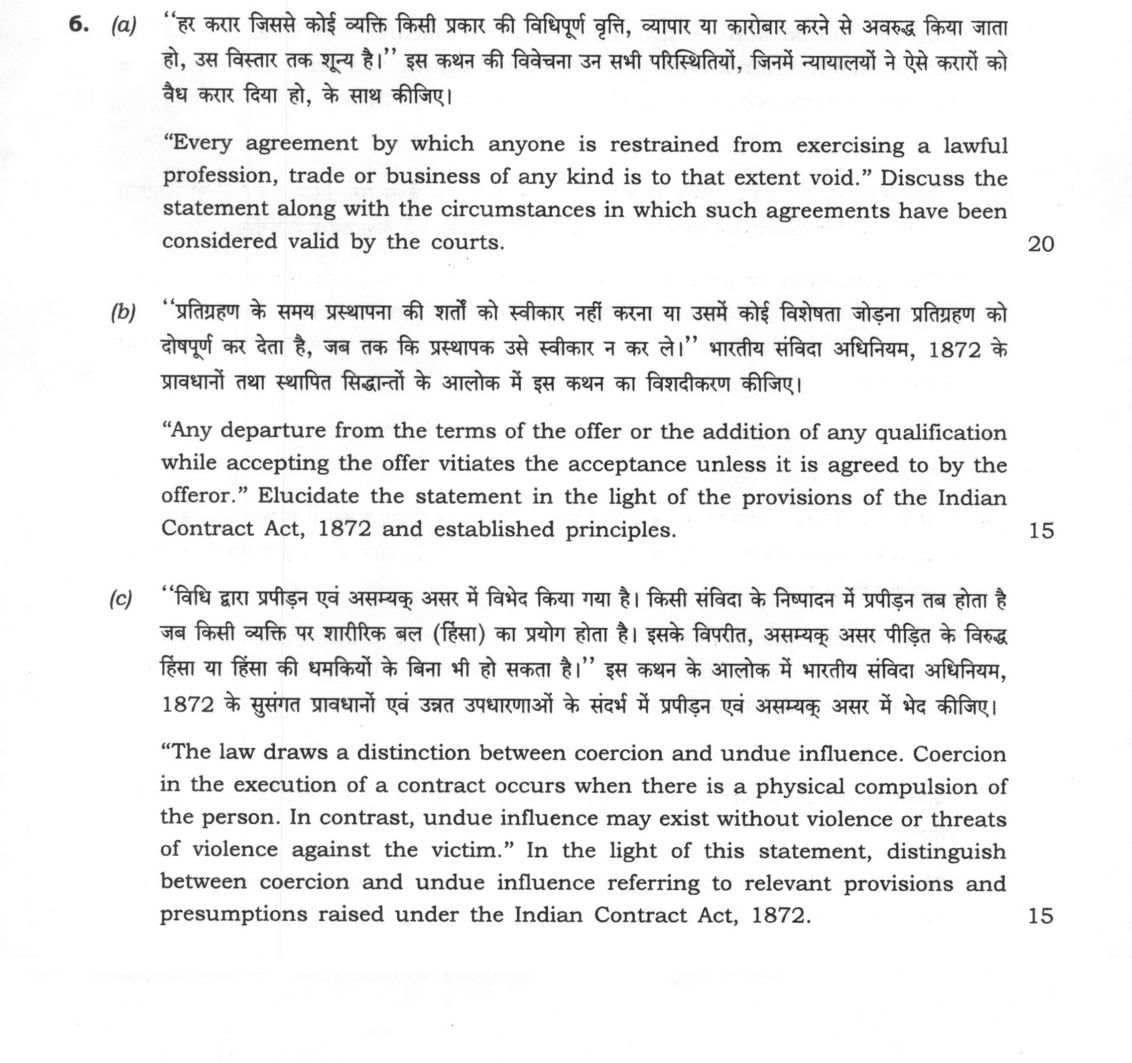
"Every agreement by which anyone is restrained from exercising a lawful profession, trade or business of any kind is to that extent void." Discuss the statement along with the circumstances in which such agreements have been considered valid by the courts. 20 marks
"Any departure from the terms of the offer or the addition of any qualification while accepting the offer vitiates the acceptance unless it is agreed to by the offeror." Elucidate the statement in the light of the provisions of the Indian Contract Act, 1872 and established principles. 15 marks
"The law draws a distinction between coercion and undue influence. Coercion in the execution of a contract occurs when there is a physical compulsion of the person. In contrast, undue influence may exist without violence or threats of violence against the victim." In the light of this statement, distinguish between coercion and undue influence referring to relevant provisions and presumptions raised under the Indian Contract Act, 1872. 15 marks
हिंदी में प्रश्न पढ़ें
"हर करार जिससे कोई व्यक्ति किसी प्रकार की विधिपूर्ण बृति, व्यापार या कारोबार करने से अवरुद्ध किया जाता हो, उस विस्तार तक शून्य है।" इस कथन की विवेचना उन सभी परिस्थितियों, जिनमें न्यायालयों ने ऐसे करारों को वैध करार दिया हो, के साथ कीजिए। (20 अंक)
"प्रतिग्रहण के समय प्रस्थापना की शर्तों को स्वीकार नहीं करना या उसमें कोई विशेषता जोड़ना प्रतिग्रहण को दोषपूर्ण कर देता है, जब तक कि प्रस्थापक उसे स्वीकार न कर ले।" भारतीय संविदा अधिनियम, 1872 के प्रावधानों तथा स्थापित सिद्धांतों के आलोक में इस कथन का विशदीकरण कीजिए। (15 अंक)
"विधि द्वारा प्रपीड़न एवं असम्यक् असर में विभेद किया गया है। किसी संविदा के निष्पादन में प्रपीड़न तब होता है जब किसी व्यक्ति पर शारीरिक बल (हिंसा) का प्रयोग होता है। इसके विपरीत, असम्यक् असर पीड़ित के विरुद्ध हिंसा या हिंसा की धमकियों के बिना भी हो सकता है।" इस कथन के आलोक में भारतीय संविदा अधिनियम, 1872 के सुसंगत प्रावधानों एवं उक्त उपधारणाओं के संदर्भ में प्रपीड़न एवं असम्यक् असर में भेद कीजिए। (15 अंक)
Model answer
Written by UPSC Answer Check against this question's marking rubric, to the expected length. UPSC does not publish answers for Mains — this is one way to score well, not an official key.
Restraint of trade Section 27 voids agreements restraining lawful profession, trade or business, to that extent, on public policy: free competition and livelihood. It is not absolute. Statutory exceptions are sale of goodwill, partnership restraints under Sections 54 and 55 of the Partnership Act, 1932, and trade combinations. Courts also permit reasonable, partial restraints incidental to employment or sale of business, protecting legitimate interests such as goodwill or trade secrets. Nordenfelt held a restraint need not be void merely because wide; it must be reasonable between parties and not injurious to public. Brahmo Samaj v. Keshub Chunder Sen tested a restraint on preaching by necessity and public interest. Madhub Chander v. Raj Coomar shows total restraints are more suspect than partial ones limited in time, area and scope. Niranjan Shankar Golikari v. Century Spinning Mills confirms post-employment restraints are valid if reasonable and not oppressive. The tests are reasonableness and public policy: total, indefinite or excessive restraints fail; fair, limited partial restraints may be upheld.
Acceptance and variation Section 2(b) makes acceptance the assent of the person to whom the proposal is made. Section 7 requires it to be absolute and unqualified; the second rule in Section 7 makes a qualified acceptance a counter-proposal. This is the mirror-image rule, adopted from English law: acceptance must match the offer. A material variation—price, quantity, time, place or subject matter—vitiates acceptance and creates a new offer; an immaterial or clerical variation may not prevent formation if the offeror does not object. Union of India v. Bhim Sen Walaiti Ram and Tarsem Singh v. Sukhminder Singh show that conditional or modified assent does not bind the offeror. In the battle of forms, the last shot rule treats the last set of terms before performance as decisive, while the knock-out rule cancels conflicting terms and leaves common terms. Section 4 governs communication: acceptance is complete against the offeror when it reaches his knowledge, and against the acceptor when it is in course of transmission.
Coercion and undue influence Section 15 defines coercion as committing or threatening an act forbidden by the IPC, or unlawfully detaining property, to induce consent. It is overt, physical or quasi-physical compulsion. Ranganayakamma v. Alwar Setti and Chikham Amiraju v. Seshamma treat threats of suicide or harm as coercion when used to obtain agreement. Section 16 defines undue influence: a person in a position to dominate another’s will uses it to obtain unfair advantage. It is mental pressure through confidence, dependence or vulnerability, without violence. In fiduciary or authority relations—guardian-ward, parent-child, doctor-patient, spiritual adviser—the court may presume undue influence under Section 16(2), shifting the burden to the dominant party to prove fairness. Mannu Singh v. Umadat Pandey, Subhas Chandra v. Ganga Prasad and Allcard v. Skinner examine whether the weaker party had independent advice and whether the bargain was fair. Both make contracts voidable, not void, under Section 19; the aggrieved party may affirm or avoid. Section 19A reinforces the equitable approach to impaired consent, even where the defect is not fraud. The distinction is proof: coercion requires the complainant to prove threat; undue influence in specified relationships shifts the burden, and independent advice can rebut it.
Way forward The law should balance freedom of contract with protection of the weaker party. Restraints must be reasonable and limited; acceptance must be clear and unqualified; consent must be free from overt compulsion or hidden domination. Courts should apply proportionality, public policy and equitable safeguards, ensuring contracts reflect genuine, informed and voluntary assent while preserving legitimate commercial and personal interests. This preserves competition, commercial certainty and fairness, and prevents abuse of bargaining power in both employment and fiduciary settings.
What "Discuss" is asking you to do
Lay the issue out from more than one side — how it arose, what is claimed for it, what is held against it, and where it now stands. UPSC attaches discuss to broad topics with several live dimensions, so coverage of the dimensions earns more than the strength of your opinion.
Structure that answers it
Set the issue up → the case as it is made → the case against → the dimension both sides leave out → where the balance now lies
Where marks are lost
Listing facts with no thread between them, or arguing one side throughout and calling it a discussion.
How this answer will be evaluated
Approach
Framework: Issue > Rule > Authority > Application. (a) discuss: intro > 3-4 dimensions > example > balanced close | (b) explain: definition/context > points in order > small example > short close | (c) compare: paired headings or table > key differences > significance > conclusion Full marks: Precise statutory citations, correct case ratios, and clear application to the specific legal principles.
Key points expected
- Cite Section 27 of Indian Contract Act, 1872
- Explain the 'reasonable' limitation exception
- Cite Nirmadha Gopal v. State of Mysore
- Cite A. Satyanarayan Rao v. R. Nagappa
- Cite Section 20 of Indian Contract Act, 1872
- Define 'absolute and unqualified' acceptance
- Explain that a counter-offer terminates the original offer
- Cite Hyde v. Wrench
Evaluation rubric
Each sub-part is marked on its own, against the marks and word limit printed on the paper.
- (a) Analyze Section 27 voidness and exceptions for valid restraints. 20 marks
discuss— intro → 3-4 dimensions → example → balanced close
Must cover
- Cite Section 27 of Indian Contract Act, 1872
- Explain the 'reasonable' limitation exception
- Cite Nirmadha Gopal v. State of Mysore
- Cite A. Satyanarayan Rao v. R. Nagappa
Loses marks
- Treating all restraints as absolutely void
- Citing case outcomes without stating the legal ratio
- Ignoring the 'to that extent' qualifier in Section 27
Earns more
- Distinguish sale of goodwill from mere restraint
- Mention 'partial restraint' validity
- Reference to 'public interest' as a limiting factor
- Cite Modi v. Nagorbhushan
Extra mark
- Reference to Law Commission Report on restraint of trade
- Cite a post-2010 Supreme Court judgment on Section 27
- (b) Elucidate the rule of absolute and unqualified acceptance. 15 marks
explain— definition/context → points in order → small example → short close
Must cover
- Cite Section 20 of Indian Contract Act, 1872
- Define 'absolute and unqualified' acceptance
- Explain that a counter-offer terminates the original offer
- Cite Hyde v. Wrench
Loses marks
- Confusing acceptance with mere inquiry
- Failing to mention that a counter-offer kills the original offer
- Discussing revocation of offer instead of acceptance
Earns more
- Cite Entwhistle v. Harrison
- Distinguish between a request for information and a counter-offer
- Mention the 'mirror image' rule
- Reference to 'material' vs 'immaterial' terms
Extra mark
- Reference to the UN Convention on Contracts for International Sale of Goods
- Cite a modern Indian case on electronic acceptance
- (c) Distinguish coercion and undue influence via Sections 15 and 16. 15 marks
compare— paired headings or table → key differences → significance → conclusion
Must cover
- Cite Section 15 (Coercion) and Section 16 (Undue Influence)
- Highlight 'physical compulsion' vs 'mental pressure'
- Explain the presumption of undue influence in Section 16(2)
- Cite a case on undue influence (e.g., Goddard v. Dearsley)
Loses marks
- Treating undue influence as requiring physical violence
- Failing to mention the specific relationships in Section 16(2)
- Confusing 'coercion' with 'fraud' or 'misrepresentation'
Earns more
- Mention 'threat to file a criminal case' as coercion
- List relationships creating presumption (e.g., doctor-patient)
- Note that undue influence can be 'actual' or 'presumed'
- Cite a case on coercion (e.g., Muthuswami v. State of Madras)
Extra mark
- Reference to the distinction in the Law Commission Report
- Cite a recent Supreme Court judgment on undue influence
Practice this exact question
Write your answer and it is marked point by point against the model answer above — what you covered, what you missed, what you got wrong.
Evaluate my answer →More from Law 2025 Paper II
- Q3 (a) Discuss the law of defamation. Is this correct to say that law of defamation gives to…
- Q4 (a) "Dacoity is an aggravated form of theft and robbery." Explain with relevant provision…
- Q5 Answer the following questions in about 150 words each. Support your answer with relevant…
- Q6 (a) "Every agreement by which anyone is restrained from exercising a lawful profession, t…
- Q7 (a) "The parties to a contract must either perform or offer to perform their respective p…
- Q8 (a) "Right to Information, for citizens to secure access to information under the control…