Paper I — Q1
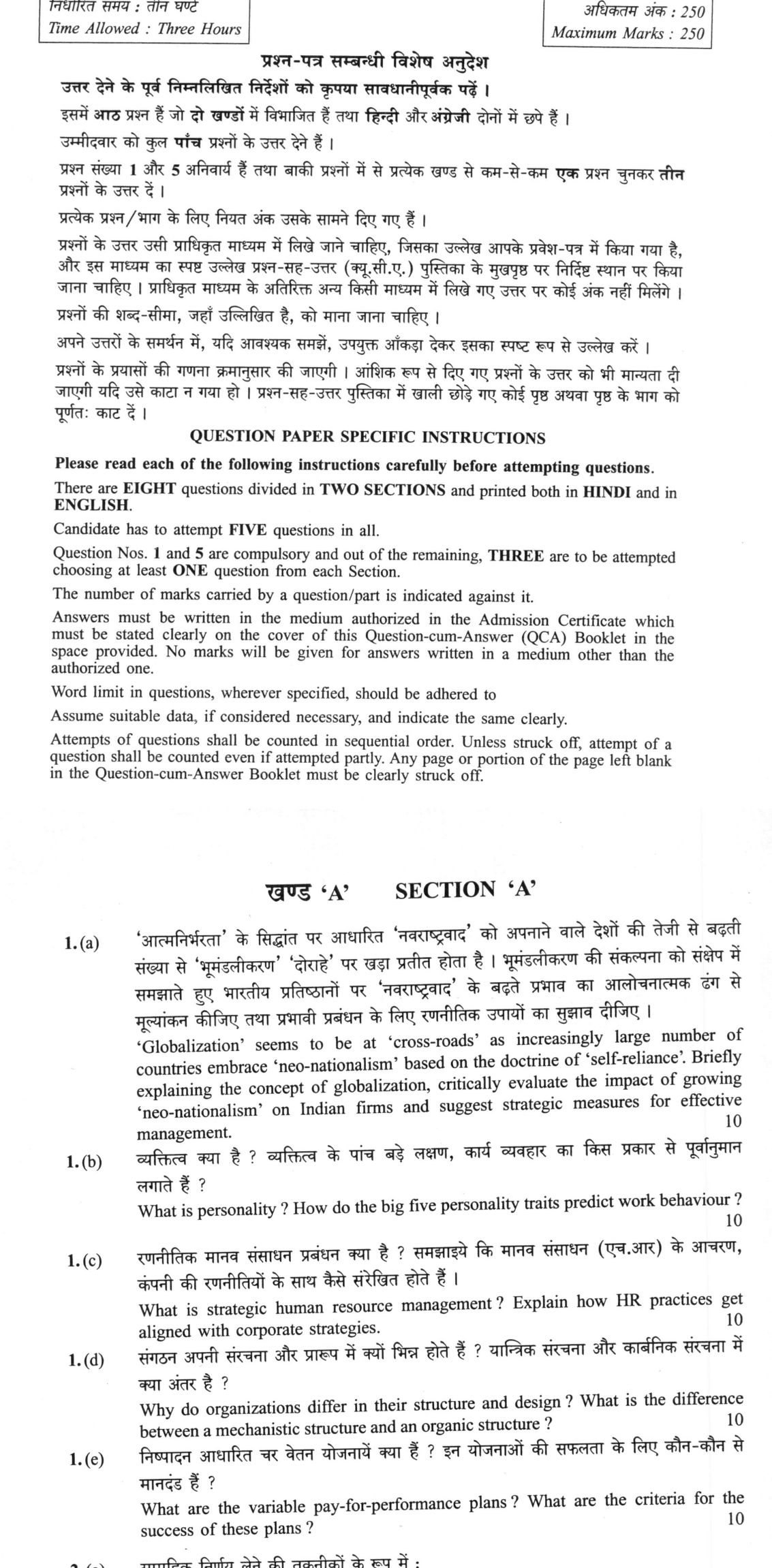
(a) 'Globalization' seems to be at 'cross-roads' as increasingly large number of countries embrace 'neo-nationalism' based on the…
'Globalization' seems to be at 'cross-roads' as increasingly large number of countries embrace 'neo-nationalism' based on the doctrine of 'self-reliance'. Briefly explaining the concept of globalization, critically evaluate the impact of growing 'neo-nationalism' on Indian firms and suggest strategic measures for effective management. 10 marks
What is personality ? How do the big five personality traits predict work behaviour ? 10 marks
What is strategic human resource management ? Explain how HR practices get aligned with corporate strategies. 10 marks
Why do organizations differ in their structure and design ? What is the difference between a mechanistic structure and an organic structure ? 10 marks
What are the variable pay-for-performance plans ? What are the criteria for the success of these plans ? 10 marks
हिंदी में प्रश्न पढ़ें
'आत्मनिर्भरता' के सिद्धांत पर आधारित 'नवराष्ट्रवाद' को अपनाने वाले देशों की तेजी से बढ़ती संख्या से 'भूमंडलीकरण' 'दोराहे' पर खड़ा प्रतीत होता है । भूमंडलीकरण की संकल्पना को संक्षेप में समझाते हुए भारतीय प्रतिष्ठानों पर 'नवराष्ट्रवाद' के बढ़ते प्रभाव का आलोचनात्मक ढंग से मूल्यांकन कीजिए तथा प्रभावी प्रबंधन के लिए रणनीतिक उपायों का सुझाव दीजिए । 10
व्यक्तित्व क्या है ? व्यक्तित्व के पांच बड़े लक्षण, कार्य व्यवहार का किस प्रकार से पूर्वानुमान लगाते हैं ? 10 marks
रणनीतिक मानव संसाधन प्रबंधन क्या है ? समझाइये कि मानव संसाधन (एच.आर) के आचरण, कंपनी की रणनीतियों के साथ कैसे संरेखित होते हैं । 10
संगठन अपनी संरचना और प्रारूप में क्यों भिन्न होते हैं ? यांत्रिक संरचना और कार्बनिक संरचना में क्या अंतर है ? 10 marks
निष्पादन आधारित चर वेतन योजनाएं क्या हैं ? इन योजनाओं की सफलता के लिए कौन-कौन से मानदंड हैं ? 10 marks
Model answer
Written by UPSC Answer Check against this question's marking rubric, to the expected length. UPSC does not publish answers for Mains — this is one way to score well, not an official key.
(a) Globalization and Neo-Nationalism: Strategic Management
Globalization refers to the cross-border integration of economies through the free flow of goods, services, capital, technology, and labor. In recent years, this integration has encountered friction as neo-nationalism—a political-economic posture emphasizing domestic sovereignty, protectionism, and self-reliance—has surged across advanced and emerging economies alike. In India, this shift is manifested through the Atmanirbhar Bharat vision, accompanied by tariff adjustments, local content mandates, and non-tariff barriers.
For Indian firms, neo-nationalism exerts a dual impact. On the adverse side, it brings supply chain disruptions, input cost inflation due to import tariffs, export market vulnerability amid retaliatory trade barriers, and foreign direct investment (FDI) volatility driven by geopolitical realignment. Conversely, it creates protected domestic market space, incentivizes local value addition through schemes like the Production Linked Incentive (PLI), and reduces vulnerability to asymmetric external shocks.
To manage this transition effectively, Indian firms must adopt robust strategic measures:
- Diversify supply networks by capitalizing on the "China Plus One" paradigm and creating regional sourcing hubs.
- Invest aggressively in domestic supplier development, backward integration, and local vendor ecosystems.
- Drive innovation-led self-reliance by allocating capital to indigenous research and development (R&D) rather than relying on imported core technologies.
Ultimately, neo-nationalism does not signal the death of globalization, but its structural reconfiguration into "reglobalization" or regionalized integration. Indian firms that treat self-reliance as an imperative for building globally competitive domestic capabilities—rather than an excuse for insular inefficiency—will capture long-term strategic advantage.
(b) Personality and the Big Five Framework in Work Behaviour
Personality refers to the dynamic and organized set of enduring psychological traits, predispositions, and behavioral patterns that uniquely influence an individual's interaction with their environment.
The Big Five Personality Framework (Five-Factor Model) identifies five broad dimensions of human personality, each serving as a significant predictor of workplace behavior:
- Conscientiousness: Characterized by high levels of discipline, dependability, and goal-directed orientation. It is the single most consistent and robust predictor of overall task performance, organizational citizenship behavior (OCB), and low counterproductive work behavior across all occupational groups.
- Extraversion: Characterized by assertiveness, sociability, and positive emotionality. It strongly predicts leadership emergence, interpersonal effectiveness, and performance in roles requiring extensive social interaction, such as sales and client management.
- Openness to Experience: Characterized by intellectual curiosity, creative imagination, and cognitive flexibility. It predicts adaptability to organizational change, creativity in problem-solving, and positive performance in training and cross-cultural environments.
- Agreeableness: Characterized by cooperativeness, empathy, and trust. It is a critical predictor of successful teamwork, conflict resolution, and customer service performance, though individuals with exceptionally high agreeableness may struggle in tough bargaining or competitive negotiations.
- Neuroticism (Emotional Stability): Reflects emotional instability, anxiety, and vulnerability to stress. High neuroticism predicts elevated job burnout, turnover intentions, and erratic decision-making under pressure, whereas emotional stability fosters resilience, consistency, and effective crisis management.
(c) Strategic Human Resource Management (SHRM) and Corporate Alignment
Strategic Human Resource Management (SHRM) is the systematic governance of human capital through the design and implementation of internally consistent and externally aligned HR policies and practices that directly support an organization's competitive strategy. SHRM mandates two levels of integration: vertical fit (alignment of HR practices with the overarching corporate strategy) and horizontal fit (coherence and mutual reinforcement among the HR practices themselves).
The alignment of HR practices with corporate strategies operates through distinct structural mechanisms:
- HR Architecture and Systems: As conceptualized by Fombrun, Tichy, and Devanna, the HR architecture integrates recruitment, appraisal, rewards, and development into a continuous cycle driven by strategic objectives. Schuler and Jackson's role-behavior perspective further posits that distinct competitive strategies require specific employee role behaviors, which HR systems must elicit and sustain.
- Strategic Typologies (Miles and Snow Framework):
- Defender Strategy (Operational efficiency, cost leadership): HR focuses on internal talent development, narrow functional specialization, centralized training, standardized process-based performance appraisals, and fixed compensation structures to maximize stability and efficiency.
- Prospector Strategy (Innovation, market creation): HR prioritizes external recruitment of diverse talent, broad and flexible job descriptions, continuous learning, decentralized decision-making, and risk-tolerant, outcome-based incentive pay to foster innovation.
- Analyzer Strategy (Dual emphasis on efficiency and innovation): HR constructs a hybrid model, maintaining standardized practices for stable core units while deploying agile, flexible HR mechanisms for dynamic growth units.
(d) Determinants of Organizational Design: Mechanistic versus Organic Structures
Organizations differ in their structure and design because structural configurations are contingent upon internal and external variables. Contingency theory demonstrates that organizational effectiveness depends on the fit between structural design and four fundamental determinants: corporate strategy (Alfred Chandler's thesis that structure follows strategy), organization size (larger scale demands greater formalization and division of labor), technology (as demonstrated by Joan Woodward, where unit, mass, or continuous process technologies dictate structural complexity), and environmental uncertainty (as analyzed by Lawrence and Lorsch, where turbulent environments necessitate greater organizational differentiation and integration).
Burns and Stalker categorized organizational designs into two polar types based on their structural characteristics:
- Mechanistic Structure: Defined by high formalization, clear functional specialization, a rigid vertical hierarchy, centralized decision-making authority, standardized operating procedures, and top-down, command-and-control communication. This design is highly effective in stable, predictable environments with routine technologies, where efficiency and consistency are paramount.
- Organic Structure: Defined by low formalization, flexible and fluid job boundaries, decentralized authority, reliance on cross-functional and self-managed teams, and lateral, consultation-based communication networks. This design is optimal for dynamic, uncertain, and rapidly changing environments where speed, innovation, and organizational learning are essential for survival.
(e) Variable Pay-for-Performance Plans and Criteria for Success
Variable pay-for-performance plans are compensation models where a portion of an employee's earnings is contingent on achieving predetermined individual, group, or organizational performance metrics. These plans fall into three structural tiers:
- Individual-Level Plans: Piece-rate pay (compensation tied directly to units produced) and merit pay (salary increments linked to individual performance ratings).
- Group-Level Plans: Team incentives (bonuses tied to collective team outputs) and gain-sharing plans (e.g., Scanlon or Rucker plans, which distribute monetary shares of operational cost-savings and productivity gains to the group).
- Organization-Wide Plans: Profit-sharing (distributing a set percentage of corporate profits to employees) and Employee Stock Ownership Plans (ESOPs, granting equity shares to align employee interests with long-term shareholder value).
The successful implementation of variable pay plans requires meeting five foundational criteria:
- Line-of-Sight: Employees must perceive a direct, unambiguous link between their effort, their performance output, and the resulting financial reward.
- Performance Measurability: Metrics must be objective, quantifiable, verifiable, and free from administrative manipulation or subjective supervisor bias.
- Employee Involvement and Trust: The workforce must participate in metric formulation and possess high trust in the integrity and fairness of the evaluation system.
- Organizational Cultural Fit: The plan must align with cultural norms; for example, group incentives succeed in collaborative, team-based environments, whereas individual plans suit competitive, standalone roles.
- Financial Viability and Funding Base: The reward pool must be backed by an adequate and sustainable funding mechanism, ensuring payouts are meaningful enough to motivate behavior without jeopardizing the firm's financial health.
What "Critically evaluate" is asking you to do
Judge how well something has performed against the standard it set for itself — its stated aim, mandate or promise — and commit to a verdict. Name the yardstick before you judge; an unanchored judgement reads as opinion. “Critically” is not a section added at the end: name the yardstick you are judging by — the evidence, the stated objective, a constitutional principle, a rival explanation — and let a verdict close each part of the body. Where the question quotes a claim, that verdict must land on the claim itself, accepted, qualified or rejected, and not on the theme in general.
Structure that answers it
Name the yardstick — stated aim, mandate or benchmark → performance against it → shortfall against it → why the gap exists → verdict
Where marks are lost
Merits in one paragraph, demerits in the next, and a conclusion calling for a balanced and holistic approach. That is a survey with the judgement left out and it holds the answer in the middle band. The opposite error is reading “critically” as permission to attack — and with the odd pairings, critically describe or critically explain, the exposition still carries most of the marks, the judgement being a layer on it rather than a substitute for it.
How this answer will be evaluated
Approach
Framework: Big Five Personality Traits (OCEAN). (a) critically evaluate: positives > negatives/limits > conditions/safeguards > conclusion | (b) explain: definition/context > points in order > small example > short close | (c) explain: definition/context > points in order > small example > short close | (d) compare: paired headings or table > key differences > significance > conclusion | (e) explain: definition/context > points in order > small example > short close Full marks: Applies named frameworks with concrete examples, shows critical analysis, provides strategic recommendations, demonstrates real-world application
Key points expected
- Define globalization concept briefly
- Critically evaluate impact of neo-nationalism on Indian firms
- Suggest strategic measures for effective management
- Link self-reliance doctrine to neo-nationalism
- Define personality concept
- List all five Big Five traits
- Explain how each trait predicts work behaviour
- Provide concrete organisational examples
Evaluation rubric
Each sub-part is marked on its own, against the marks and word limit printed on the paper.
- (a) Explain globalization, evaluate neo-nationalism's impact on Indian firms, and suggest strategic measures. 10 marks
critically evaluate— positives → negatives/limits → conditions/safeguards → conclusion
Must cover
- Define globalization concept briefly
- Critically evaluate impact of neo-nationalism on Indian firms
- Suggest strategic measures for effective management
- Link self-reliance doctrine to neo-nationalism
Loses marks
- Textbook definition without application
- No strategic measures suggested
- Ignoring neo-nationalism aspect
Earns more
- Mention specific Indian firm examples
- Reference recent regulatory changes
- Discuss trade policy shifts
- Analyze supply chain implications
Extra mark
- Cite specific government policy
- Reference recent trade data
- (b) Define personality and explain how Big Five traits predict work behaviour. 10 marks
explain— definition/context → points in order → small example → short close
Must cover
- Define personality concept
- List all five Big Five traits
- Explain how each trait predicts work behaviour
- Provide concrete organisational examples
Loses marks
- Listing traits without work behaviour link
- No definition of personality
- Ignoring 'predict' aspect
Earns more
- Mention specific job roles
- Reference personality assessment tools
- Discuss trait-job fit
- Note cultural variations
Extra mark
- Cite specific research study
- Mention named assessment instrument
- (c) Define strategic HRM and explain alignment of HR practices with corporate strategies. 10 marks
explain— definition/context → points in order → small example → short close
Must cover
- Define strategic human resource management
- Explain alignment mechanism between HR and corporate strategy
- Give examples of aligned HR practices
- Show how HR supports business objectives
Loses marks
- Generic HR definition without strategy link
- No alignment explanation
- Ignoring corporate strategy aspect
Earns more
- Mention specific HR practices
- Reference strategic frameworks
- Discuss HR-business partnership
- Note competitive advantage link
Extra mark
- Cite specific company example
- Reference named HR strategy model
- (d) Explain why organizations differ in structure and compare mechanistic vs organic structures. 10 marks
compare— paired headings or table → key differences → significance → conclusion
Must cover
- Explain reasons for organizational structure differences
- Define mechanistic structure
- Define organic structure
- Compare key differences between both
Loses marks
- No comparison between structures
- Ignoring 'why' organizations differ
- Definitions without contrast
Earns more
- Mention contingency factors
- Reference specific organizational examples
- Discuss environmental influences
- Note technology impact
Extra mark
- Cite specific organizational theory
- Reference named structure model
- (e) Define variable pay-for-performance plans and explain criteria for their success. 10 marks
explain— definition/context → points in order → small example → short close
Must cover
- Define variable pay-for-performance plans
- List types of variable pay plans
- Explain criteria for success of these plans
- Provide examples of implementation
Loses marks
- No success criteria explained
- Generic pay definition
- Ignoring 'variable' aspect
Earns more
- Mention specific plan types
- Reference performance metrics
- Discuss incentive design
- Note behavioural outcomes
Extra mark
- Cite specific company example
- Reference named compensation model
Practice this exact question
Write your answer and it is marked point by point against the model answer above — what you covered, what you missed, what you got wrong.
Evaluate my answer →More from Management 2021 Paper I
- Q1 (a) 'Globalization' seems to be at 'cross-roads' as increasingly large number of countrie…
- Q2 (a) Compare the process and effectiveness of : (i) Interacting (ii) Brainstorming (iii) N…
- Q3 (a) Briefly explain the concept of Corporate Social Responsibility (CSR) with industry il…
- Q4 (a) List the various types of conceptual blocks that come in the way of thinking creative…