Paper I — Q2
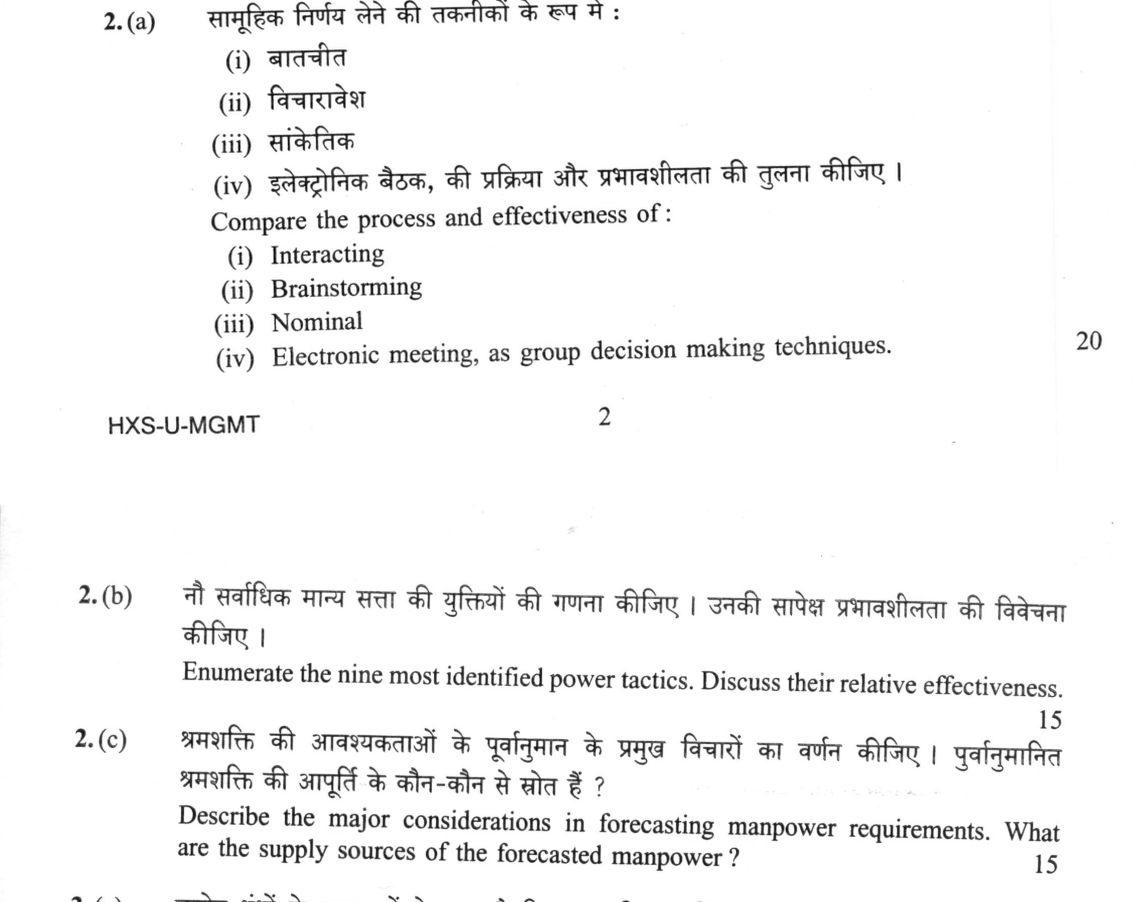
(a) Compare the process and effectiveness of : (i) Interacting (ii) Brainstorming (iii) Nominal (iv) Electronic meeting, as group…
Compare the process and effectiveness of : Interacting
Brainstorming
Nominal
Electronic meeting, as group decision making techniques. 20 marks
Enumerate the nine most identified power tactics. Discuss their relative effectiveness. 15 marks
Describe the major considerations in forecasting manpower requirements. What are the supply sources of the forecasted manpower ? 15 marks
हिंदी में प्रश्न पढ़ें
सामूहिक निर्णय लेने की तकनीकों के रूप में : बातचीत
विचारावेश
सांकेतिक
इलेक्ट्रॉनिक बैठक, की प्रक्रिया और प्रभावशीलता की तुलना कीजिए । 20
नौ सर्वाधिक मान्य सत्ता की युक्तियों की गणना कीजिए । उनकी सापेक्ष प्रभावशीलता की विवेचना कीजिए । 15
श्रमशक्ति की आवश्यकताओं के पूर्वानुमान के प्रमुख विचारों का वर्णन कीजिए । पूर्वानुमानित श्रमशक्ति की आपूर्ति के कौन-कौन से स्रोत हैं ? 15 marks
Model answer
Written by UPSC Answer Check against this question's marking rubric, to the expected length. UPSC does not publish answers for Mains — this is one way to score well, not an official key.
Group decision-making, interpersonal influence, and manpower planning constitute core pillars of organizational effectiveness.
Process and Effectiveness of Group Decision-Making Techniques
The process and effectiveness of interacting groups, brainstorming, nominal group technique (NGT), and electronic meetings vary significantly across procedural mechanics and operational outcomes:
Process Comparison: Interacting groups rely on unstructured, face-to-face verbal dialogue where members debate freely. Brainstorming, formulated on Alex Osborn’s rules, uses deferred judgment and spontaneous idea generation while strictly prohibiting criticism during the ideation phase. The Nominal Group Technique (NGT) restricts verbal communication initially through silent, independent generation of written ideas, followed by systematic round-robin recording, structured clarification, and silent, independent mathematical ranking. Electronic meetings combine the NGT format with computer-mediated communication, enabling anonymous, simultaneous input and instant data aggregation.
Effectiveness across Dimensions:
- Decision Quality and Cognitive Biases: Interacting groups are highly vulnerable to conformity pressures, evaluation apprehension, and groupthink. Brainstorming enhances idea volume but suffers from production blocking (members waiting for their turn to speak). NGT mitigates dominance by vocal members, making it superior for complex, conflict-laden decisions (e.g., ISRO’s mission-critical design reviews). Electronic meetings eliminate interpersonal inhibition through anonymity, optimizing inputs across large, globally dispersed teams (e.g., Indian IT enterprises post-pandemic).
- Member Satisfaction and Social Dynamics: Interacting groups and NGT generate high participant commitment, though interacting groups exhibit high social pressure. Brainstorming fosters high creative morale. Electronic meetings reduce social pressure entirely via anonymity, but can lower interpersonal cohesion and closure satisfaction.
- Time and Resource Efficiency: Interacting groups and brainstorming are fast and inexpensive. NGT requires moderate time for structured voting. Electronic meetings process data instantaneously but incur higher technological costs.
Nine Power Tactics and Their Relative Effectiveness
David Kipnis and Gary Yukl identified nine primary influence tactics used in organizations:
- Rational Persuasion: Using logical arguments, data, and factual evidence.
- Inspirational Appeals: Appealing to target values, ideals, and emotional aspirations.
- Consultation: Involving the target in planning how to implement a change.
- Ingratiation: Using flattery, praise, or friendly behavior prior to making a request.
- Personal Appeals: Asking for compliance based on friendship or personal loyalty.
- Exchange: Offering explicit benefits, favors, or reciprocal rewards.
- Coalition: Enlisting the active support of other people to persuade the target.
- Pressure: Utilizing demands, threats, frequent monitoring, or intimidation.
- Legitimacy: Grounding requests in positional authority, rules, or official policies.
Relative Effectiveness: Tactics are contingency-dependent based on direction and organizational culture. Rational persuasion is the most consistently effective tactic across upward, lateral, and downward directions. Downward influence is most effective when deploying "soft" tactics—inspirational appeals and consultation—which generate psychological commitment. Ingratiation and exchange are moderately effective, primarily in lateral peer interactions. Conversely, "hard" tactics like coalition, legitimacy, and pressure are the least effective; pressure often causes active resistance or superficial compliance and fails entirely in upward influence. In professional and decentralized cultures, soft tactics combined with rational evidence outperform authoritarian levers.
Manpower Forecasting: Considerations and Supply Sources
Major Considerations in Forecasting Manpower Demand:
- Organizational Objectives and Strategy: Projected production volumes, expansion, diversification, and divestments.
- Workload and Work-Study Analysis: Calculating standard person-hours required per unit of output based on empirical time-and-motion studies.
- Productivity Norms and Learning Curve: Expected gains in workforce efficiency over time.
- Technological Transformations: Automation and digitization that alter skill requirements (e.g., Indian Railways modernizing signaling systems and shifting workforce requirements from manual track maintainers to specialized technicians).
- Attrition and Absenteeism Rates: Historical turnover, retirement schedules, and leave trends.
- Environmental Scanning: Labour legislation, economic cycles, and competitive market conditions.
Supply Sources for Forecasted Manpower: Internal Sources: Skills inventories, succession planning charts, vertical promotions, lateral transfers, upskilling/reskilling programs, and recall of retired or retrenched personnel. Internal sourcing protects organizational culture and boosts employee retention. External Sources: Campus placements at educational institutions, lateral recruitment from competitors, public and private employment exchanges, staffing agencies, the gig labour pool, and talent acquired via mergers and acquisitions.
A situational contingency approach is indispensable: group decision methods, influence strategies, and human resource forecasting models must remain dynamically aligned with task complexity, power distribution, and the operating environment.
What "Compare" is asking you to do
Set the items against each other on named dimensions. In UPSC practice compare already carries both halves — likeness and difference — and where the stem names the dimensions, as in region, nature and climatic impact, those are the headings the examiner expects to see.
Structure that answers it
Dimensions named → both items on dimension 1 → dimension 2 → dimension 3 → where they converge and where they part
Where marks are lost
Two self-contained descriptive blocks with the comparison left for the reader to make. Marks here sit on the dimensions, so an answer that names none of them gives the examiner nothing to award.
How this answer will be evaluated
Approach
Framework: Group Decision Making Techniques (Interacting, Brainstorming, Nominal, Electronic). (a) compare: paired headings or table > key differences > significance > conclusion | (b) enumerate: list the items in order > one line each > no commentary | (c) describe: define > structure or process in order > labelled diagram > significance Full marks: Comprehensive comparison with clear structure, specific examples, and balanced analysis across all parts.
Key points expected
- Define process for Interacting, Brainstorming, Nominal, Electronic meeting
- Compare effectiveness of all four techniques
- Identify key differences in process
- State significance of each technique
- List nine identified power tactics
- Discuss relative effectiveness of each
- Provide one line description per tactic
- Order tactics logically
Evaluation rubric
Each sub-part is marked on its own, against the marks and word limit printed on the paper.
- (a) Compare process and effectiveness of four group decision-making techniques. 20 marks
compare— paired headings or table → key differences → significance → conclusion
Must cover
- Define process for Interacting, Brainstorming, Nominal, Electronic meeting
- Compare effectiveness of all four techniques
- Identify key differences in process
- State significance of each technique
Loses marks
- Textbook definitions without comparison
- Missing effectiveness analysis
- No conclusion or significance statement
Earns more
- Use table or paired headings for comparison
- Mention specific organizational applications
- Discuss limitations of each technique
- Provide balanced conclusion
Extra mark
- Real company example of technique use
- Recent regulatory or technological change affecting methods
- (b) List nine power tactics and discuss their relative effectiveness. 15 marks
enumerate— list the items in order → one line each → no commentary
Must cover
- List nine identified power tactics
- Discuss relative effectiveness of each
- Provide one line description per tactic
- Order tactics logically
Loses marks
- List without effectiveness discussion
- Missing tactics or incorrect count
- No logical ordering or structure
Earns more
- Cite specific power tactics (e.g., rational, coercive, referent)
- Compare effectiveness across tactics
- Mention situational factors affecting effectiveness
- Provide brief example for key tactics
Extra mark
- Reference to specific management study or case
- Mention recent organizational power dynamics
- (c) Describe major considerations in forecasting manpower requirements and supply sources. 15 marks
describe— define → structure or process in order → labelled diagram → significance
Must cover
- Define manpower forecasting considerations
- List major considerations in order
- Identify supply sources of forecasted manpower
- Explain significance of forecasting
Loses marks
- Missing supply sources discussion
- No structure or order in considerations
- Textbook definitions without application
Earns more
- Mention specific forecasting methods (e.g., trend analysis, ratio analysis)
- List internal and external supply sources
- Provide labelled diagram of forecasting process
- Discuss challenges in manpower forecasting
Extra mark
- Real company manpower planning example
- Reference to recent labor market changes
Practice this exact question
Write your answer and it is marked point by point against the model answer above — what you covered, what you missed, what you got wrong.
Evaluate my answer →More from Management 2021 Paper I
- Q1 (a) 'Globalization' seems to be at 'cross-roads' as increasingly large number of countrie…
- Q2 (a) Compare the process and effectiveness of : (i) Interacting (ii) Brainstorming (iii) N…
- Q3 (a) Briefly explain the concept of Corporate Social Responsibility (CSR) with industry il…
- Q4 (a) List the various types of conceptual blocks that come in the way of thinking creative…
- Q5 (a) Elucidate the basic process of marketing communication. What makes international mark…