Paper I — Q4
(a) List the various types of conceptual blocks that come in the way of thinking creatively. What is the process of innovation…
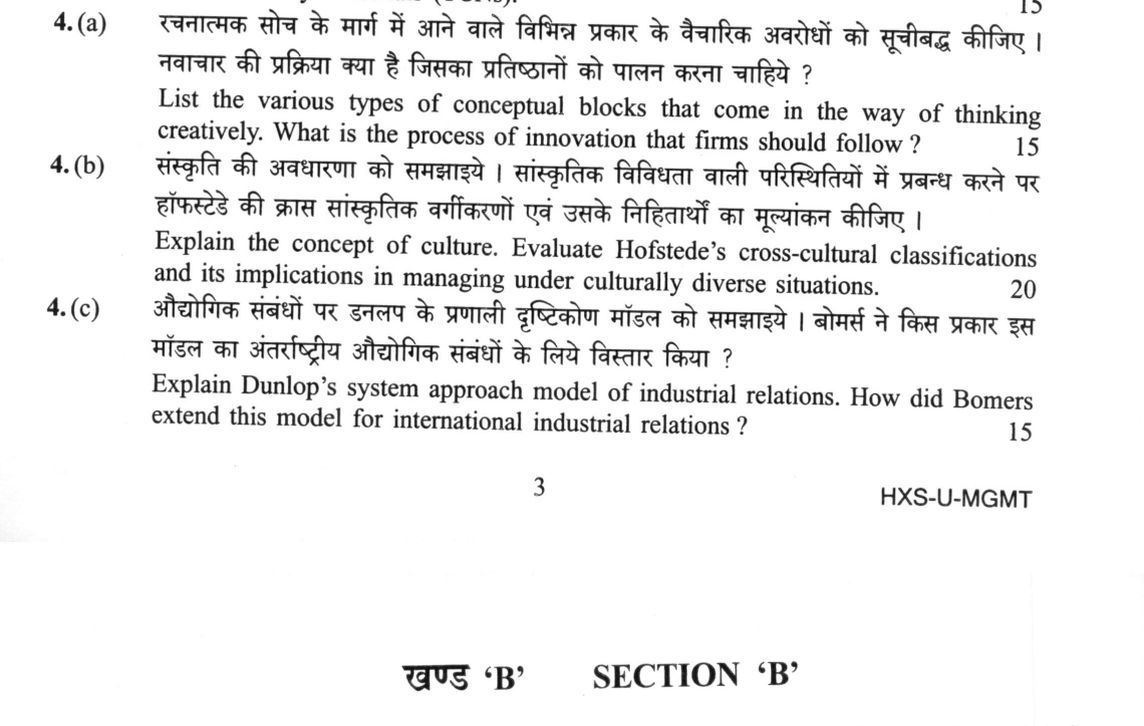
List the various types of conceptual blocks that come in the way of thinking creatively. What is the process of innovation that firms should follow ? 15 marks
Explain the concept of culture. Evaluate Hofstede's cross-cultural classifications and its implications in managing under culturally diverse situations. 20 marks
Explain Dunlop's system approach model of industrial relations. How did Bomers extend this model for international industrial relations ? 15 marks
हिंदी में प्रश्न पढ़ें
रचनात्मक सोच के मार्ग में आने विभिन्न प्रकार के वैचारिक अवरोधों को सूचीबद्ध कीजिए । नवाचार की प्रक्रिया क्या है जिसका प्रतिष्ठानों को पालन करना चाहिए ? 15 marks
संस्कृति की अवधारणा को समझाइये । सांस्कृतिक विविधता वाली परिस्थितियों में प्रबंध करने पर हॉफस्टेड की क्रॉस सांस्कृतिक वर्गीकरणों एवं उसके निहितार्थों का मूल्यांकन कीजिए । 20
औद्योगिक संबंधों पर डनलप के प्रणाली दृष्टिकोण मॉडल को समझाइये । बोमर्स ने किस प्रकार इस मॉडल का अंतर्राष्ट्रीय औद्योगिक संबंधों के लिए विस्तार किया ? 15 marks
Model answer
Written by UPSC Answer Check against this question's marking rubric, to the expected length. UPSC does not publish answers for Mains — this is one way to score well, not an official key.
Conceptual Blocks to Creativity and the Innovation Process
Conceptual blocks are psychological and systemic barriers that impede creative problem-solving. These encompass:
- Perceptual blocks, such as stereotyping and defining problems too narrowly;
- Emotional blocks, including fear of failure, risk aversion, and intolerance of ambiguity;
- Cultural blocks, arising from rigid adherence to established social norms and taboos;
- Environmental blocks, caused by autocratic leadership, lack of organizational support, and physical distractions;
- Intellectual blocks, rooted in inadequate knowledge or reliance on inappropriate heuristics; and
- Expressive blocks, stemming from an inability to articulate ideas across quantitative or verbal mediums.
To overcome these blocks, firms must institutionalize a systematic innovation process comprising six distinct stages:
- Idea Generation (Ideation): Leveraging open innovation, design thinking, and cross-functional brainstorming;
- Idea Screening: Filtering viable concepts against strategic fit and resource feasibility;
- Concept Testing: Validating user acceptance and value propositions with target segments;
- Business Analysis: Estimating cash flows, payback periods, and ROI;
- Product Development: Building functional prototypes through agile iterations; and
- Commercialization and Diffusion: Launching into the target market and scaling operations through aligned marketing channels.
Culture, Hofstede’s Framework, and Cross-Cultural Management
Culture is defined as the learned, shared, and enduring set of values, beliefs, symbols, and behavioral norms that distinguish one human group from another. Geert Hofstede operationalized national culture through six dimensions: Power Distance (PDI), Individualism versus Collectivism (IDV), Masculinity versus Femininity (MAS), Uncertainty Avoidance (UAI), Long-Term versus Short-Term Orientation (LTO), and Indulgence versus Restraint (IND).
Evaluating Hofstede’s framework reveals significant structural merits alongside critical limitations. On standard criteria of empirical utility, Hofstede provided a pioneering, quantitative benchmark that operationalized abstract values for international business strategy. However, evaluated on methodological rigor and construct validity, the framework exhibits major flaws: reliance on a monolithic IBM sample between 1967 and 1973, vulnerability to ecological fallacy (attributing national averages to individuals), neglect of within-nation heterogeneity and regional subcultures, and an overly static conceptualization that underplays cultural convergence driven by globalization. The verdict on Hofstede is that while it remains a foundational heuristic for cross-cultural orientation, it must not be treated as a deterministic guide.
In managing culturally diverse situations—such as cross-border mergers, international joint ventures, and global virtual teams—Hofstede’s dimensions offer actionable implications for human resource management and leadership. In high-PDI environments (e.g., India), leadership requires hierarchical clarity and benevolent paternalism, whereas low-PDI contexts demand participative decision-making. Collectivist societies (e.g., Japan, India) respond effectively to group-based incentives and relational psychological contracts, whereas individualistic cultures (e.g., the United States) necessitate performance-linked individual bonuses and objective merit appraisals. High-UAI workforces require standardized operating procedures, while low-UAI teams thrive under flexible, outcome-oriented mandates.
Dunlop’s Industrial Relations System and Bomers’ International Extension
John T. Dunlop conceptualized industrial relations (IR) as an open sub-system of society expressed through the model: IR = f(A, T, M, P, I) Where:
- Actors (A) comprise workers and their trade unions, hierarchical management, and specialized government agencies;
- Contextual Influences include technological characteristics of the workplace (T), market and budgetary constraints (M), and the locus and distribution of power in the wider society (P); and
- Ideology (I) is the shared set of beliefs binding the actors together. The core output of this interaction is a web of substantive and procedural rules governing the workplace.
Gerard Bomers extended Dunlop’s model to international industrial relations to address the complexities introduced by Multinational Enterprises (MNEs). Bomers incorporated three international variables:
- MNE Strategic Orientations (ethnocentric, polycentric, or geocentric structures), which dictate headquarters centralization versus subsidiary autonomy in collective bargaining;
- Dual Environmental Contexts, reconciling conflicts between home-country labor legislation and host-country industrial relations norms (e.g., codetermination vs. voluntary arbitration); and
- Supranational Actors and Institutions, such as the International Labour Organization (ILO), European Works Councils (EWCs), and International Trade Secretariats, which impose transnational regulatory standards and enable cross-border collective solidarity.
Synthesis
Global competitiveness requires organizations to integrate these domains. Breaking conceptual blocks demands cultural intelligence (CQ) to leverage cognitive diversity within multicultural teams. Simultaneously, managing international operations requires harmonizing diverse cultural expectations with resilient industrial relations architectures—balancing local regulatory compliance, such as India's Industrial Relations Code 2020, with global labor standards to sustain continuous organizational innovation.
What "Evaluate" is asking you to do
Judge how well something has performed against the standard it set for itself — its stated aim, mandate or promise — and commit to a verdict. Name the yardstick before you judge; an unanchored judgement reads as opinion.
Structure that answers it
Name the yardstick — stated aim, mandate or benchmark → performance against it → shortfall against it → why the gap exists → verdict
Where marks are lost
Presenting both sides and then declining to decide, or delivering a verdict against a standard you never stated, which makes it look arbitrary.
How this answer will be evaluated
Approach
Framework: Hofstede's Cultural Dimensions; Dunlop's System Approach. (a) explain: definition/context > points in order > small example > short close | (b) evaluate: criteria > evidence > balanced judgment | (c) explain: definition/context > points in order > small example > short close Full marks: Comprehensive coverage of all parts with specific examples and critical evaluation.
Key points expected
- List at least 4 conceptual blocks (e.g., perceptual, emotional, intellectual).
- Define the process of innovation (e.g., idea generation to implementation).
- Link blocks to specific barriers in the innovation process.
- Provide a brief example of a firm overcoming these blocks.
- Define culture in a management context.
- List and explain Hofstede's 4-6 dimensions (e.g., Power Distance, Individualism).
- Evaluate the utility of these dimensions in cross-cultural management.
- Discuss implications for managing culturally diverse teams.
Evaluation rubric
Each sub-part is marked on its own, against the marks and word limit printed on the paper.
- (a) List conceptual blocks to creativity and describe the innovation process. 15 marks
explain— definition/context → points in order → small example → short close
Must cover
- List at least 4 conceptual blocks (e.g., perceptual, emotional, intellectual).
- Define the process of innovation (e.g., idea generation to implementation).
- Link blocks to specific barriers in the innovation process.
- Provide a brief example of a firm overcoming these blocks.
Loses marks
- Listing blocks without explaining their impact on thinking.
- Describing innovation as only 'new product' without process.
- Textbook definitions without application to a firm.
Earns more
- Mention specific models like Pugh's or Osborn's.
- Distinguish between invention and innovation.
- Reference a specific company's R&D failure/success.
Extra mark
- Cite a specific recent regulatory change affecting innovation.
- Name a specific creative thinking framework (e.g., TRIZ).
- (b) Explain culture and evaluate Hofstede's dimensions for managing diversity. 20 marks
evaluate— criteria → evidence → balanced judgment
Must cover
- Define culture in a management context.
- List and explain Hofstede's 4-6 dimensions (e.g., Power Distance, Individualism).
- Evaluate the utility of these dimensions in cross-cultural management.
- Discuss implications for managing culturally diverse teams.
Loses marks
- Listing dimensions without explaining their management implications.
- Treating culture as a fixed, unchangeable trait.
- Ignoring the 'evaluation' aspect (critique/limitations).
Earns more
- Critique Hofstede's model (e.g., based on IBM data, static view).
- Mention alternative models (e.g., Trompenaars, GLOBE).
Extra mark
- Provide a specific case study of a multinational's cultural clash.
- Reference specific country scores on Hofstede's dimensions.
- (c) Explain Dunlop's model and Bomers' extension for international IR. 15 marks
explain— definition/context → points in order → small example → short close
Must cover
- Identify the four actors in Dunlop's model (Management, Workers, Govt, Context).
- Describe the interaction between actors (rules, behavior).
- Explain Bomers' extension (adding international actors/context).
- Discuss the significance of the international dimension.
Loses marks
- Confusing Dunlop's model with other IR theories.
- Failing to distinguish between national and international context.
- Describing the model without explaining the 'system' nature.
Earns more
- Mention the 'context' elements (technology, market, power).
- Discuss the role of MNCs in international IR.
Extra mark
- Draw a simple diagram of the Dunlop system.
- Cite a specific international labor dispute or treaty.
Practice this exact question
Write your answer and it is marked point by point against the model answer above — what you covered, what you missed, what you got wrong.
Evaluate my answer →More from Management 2021 Paper I
- Q1 (a) 'Globalization' seems to be at 'cross-roads' as increasingly large number of countrie…
- Q2 (a) Compare the process and effectiveness of : (i) Interacting (ii) Brainstorming (iii) N…
- Q3 (a) Briefly explain the concept of Corporate Social Responsibility (CSR) with industry il…
- Q4 (a) List the various types of conceptual blocks that come in the way of thinking creative…
- Q5 (a) Elucidate the basic process of marketing communication. What makes international mark…
- Q6 (a) What is Variance Analysis ? What are the possible reasons for different Cost Variance…
- Q7 (a) During the current financial year, XYZ Ltd. generated a profit of ₹5,00,000/- on a sa…