Paper I — Q6
(a) What is Variance Analysis ? What are the possible reasons for different Cost Variances ? 15 marks (b) Explain in brief the…
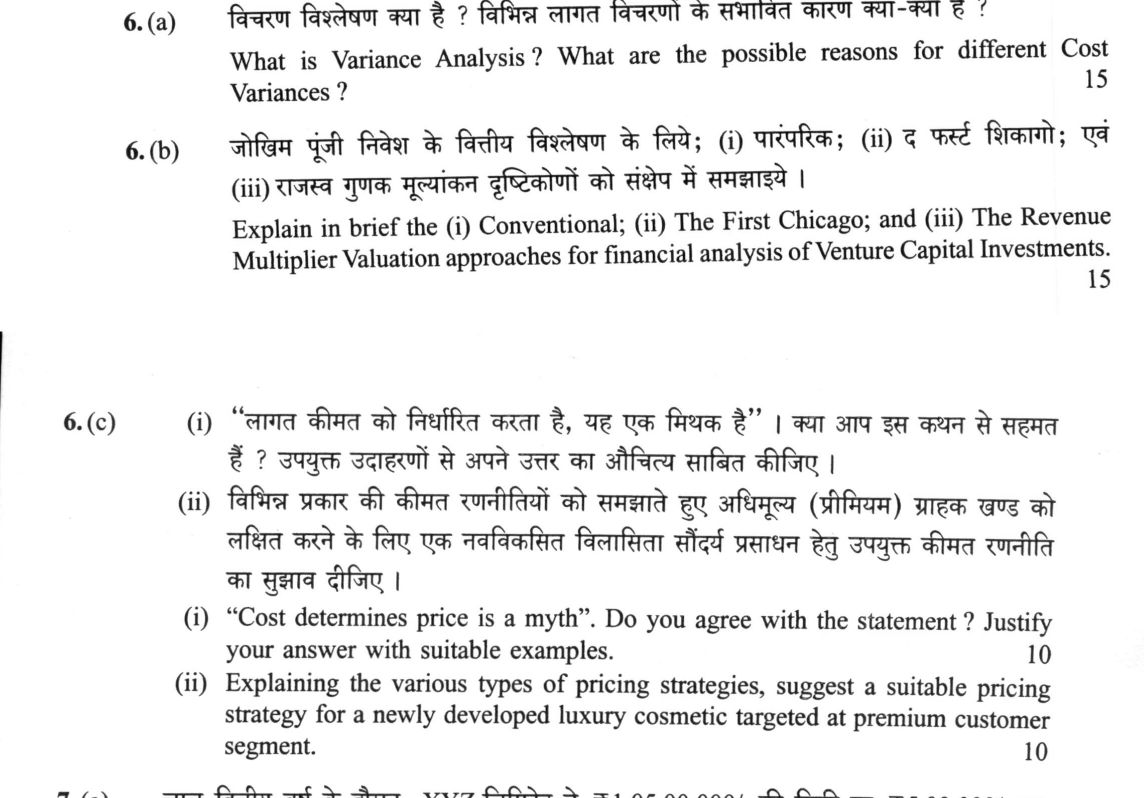
What is Variance Analysis ? What are the possible reasons for different Cost Variances ? 15 marks
Explain in brief the (i) Conventional; (ii) The First Chicago; and (iii) The Revenue Multiplier Valuation approaches for financial analysis of Venture Capital Investments. 15 marks
"Cost determines price is a myth". Do you agree with the statement ? Justify your answer with suitable examples. 10 marks
Explaining the various types of pricing strategies, suggest a suitable pricing strategy for a newly developed luxury cosmetic targeted at premium customer segment. 10 marks
हिंदी में प्रश्न पढ़ें
विचरण विश्लेषण क्या है ? विभिन्न लागत विचरणों के संभावित कारण क्या-क्या हैं ? 15 marks
जोखिम पूँजी निवेश के वित्तीय विश्लेषण के लिये; (i) पारम्परिक; (ii) द फर्स्ट शिकागो; एवं (iii) राजस्व गुणक मूल्यांकन दृष्टिकोणों को संक्षेप में समझाइये। 15
"लागत कीमत को निर्धारित करता है, यह एक मिथक है" । क्या आप इस कथन से सहमत हैं ? उपयुक्त उदाहरणों से अपने उत्तर का औचित्य साबित कीजिए । 10
विभिन्न प्रकार की कीमत रणनीतियों को समझाते हुए अधिमूल्य (प्रीमियम) ग्राहक खंड को लक्षित करने के लिए एक नवविकसित विलासिता सौंदर्य प्रसाधन हेतु उपयुक्त कीमत रणनीति का सुझाव दीजिए । 10
Model answer
Written by UPSC Answer Check against this question's marking rubric, to the expected length. UPSC does not publish answers for Mains — this is one way to score well, not an official key.
Variance Analysis and Causes of Cost Variances
Variance analysis is a core managerial control technique that quantitatively decomposes the difference between actual financial outcomes and predetermined standard costs, enabling management by exception. The root causes of cost variances operate across three primary categories:
Direct Material Variances: The Material Price Variance (Actual Quantity × [Standard Price - Actual Price]) arises from market price fluctuations, loss of bulk purchase discounts, or emergency procurement at higher freight rates. The Material Usage Variance (Standard Price × [Standard Quantity - Actual Quantity]) occurs due to substandard raw material quality, operator mishandling, machinery wear leading to excessive scrap, or changes in product design.
Direct Labour Variances: The Labour Rate Variance arises from unplanned wage revisions, higher overtime premiums, or deploying highly-skilled workers for low-grade tasks. The Labour Efficiency Variance results from inadequate training, poor shop-floor supervision, defective tooling, or machine breakdowns leading to idle time.
Overhead Variances: Variable overhead variances stem from fluctuations in utility tariffs and machine run-time efficiency. Fixed overhead variances comprise spending deviations (unanticipated changes in fixed costs like rent) and volume variances, caused by deviations from budgeted capacity utilisation due to demand shifts or operational bottlenecks.
Venture Capital Valuation Approaches
Conventional Approach (DCF/Venture Capital Method): This method estimates terminal value at the exit horizon (typically 3–7 years) based on target price-to-earnings ratios, discounting it back to the present using high venture hurdle rates (30–50%) to reflect extreme risk. Its major limitation is the unreliability of long-term cash flow forecasting in early-stage startups lacking operating history.
First Chicago Method: This technique addresses venture risk through scenario analysis, constructing three discrete operational pathways: Success (best-case IPO), Survival (base-case trade sale), and Failure (liquidation). Cash flows and terminal values are computed for each scenario, discounted to present value, and combined using assigned probability weights. This captures non-linear payoffs and downside risks systematically.
Revenue Multiplier Approach: Widely used when early-stage firms exhibit negative earnings or EBITDA, this market-based approach derives enterprise value by multiplying forward revenue by an industry-specific multiple (Enterprise Value/Revenue) benchmarked against comparable public or acquired private firms, adjusted for relative growth and market share differentials.
The Myth of Cost-Determined Pricing
The assertion that "cost determines price" is fundamentally flawed. In modern market economics, price is determined by the customer's perceived value and willingness-to-pay (WTP), mediated by competitive intensity and demand elasticity. Cost merely establishes the lower boundary (price floor) below which a firm cannot operate sustainably in the long run, while customer value sets the price ceiling.
In research-intensive sectors like pharmaceuticals, the marginal cost of producing a life-saving drug (e.g., Remdesivir) is negligible, yet its market price reflects economic value and therapeutic utility. Similarly, in premium consumer spaces, brands like Apple or Forest Essentials command prices multiple times their Bill of Materials (BOM) because consumer utility is anchored in status, branding, and proprietary experience rather than cost absorption.
Pricing Strategies and Strategy for Luxury Cosmetics
Firms deploy several pricing frameworks: Market Penetration (low initial prices to capture rapid market share); Price Skimming (high launch prices systematically lowered across market tiers); Psychological Pricing (e.g., charm pricing at ₹999); and Bundle Pricing (discounted complementary product packages).
Recommended Strategy for a New Luxury Cosmetic: A Prestige/Premium Skimming Strategy is recommended. Luxury cosmetics function as Veblen goods, where demand is positively correlated with high price signals that convey purity, exclusivity, and social prestige. A low cost-plus price would dilute brand equity, whereas premium skimming captures high consumer surplus from early-adopting affluent consumers, builds luxury brand positioning, and funds ongoing research, development, and high-end retail merchandising.
Strategic pricing must ultimately align with market willingness-to-pay, while rigorous variance analysis ensures internal cost discipline to maximise profitability.
What "Explain" is asking you to do
Make the working of something clear — what sets it off, what follows from what, and what it produces. Explain is the Commission's mechanism word: it dominates the technical papers and the “explain why” stems, where the marks sit in the causal chain and not in the label.
Structure that answers it
State what it is → the initiating condition → the chain of cause, step by step → an instance where it plays out → what the chain produces
Where marks are lost
Describing what something looks like instead of why it works that way. Naming the stages without linking them reads as description too.
How this answer will be evaluated
Approach
Framework: Variance Analysis, Venture Capital Valuation Models, Pricing Strategies. (a) explain: definition/context > points in order > small example > short close | (b) explain: definition/context > points in order > small example > short close | (c(i)) justify: claim > 3-4 reasons > evidence > conclusion | (c(ii)) suggest: the problem in one line > implementable measures > who acts > conclusion Full marks: Precise definitions, clear distinction between VC models, strong justification with examples, and a well-reasoned pricing strategy.
Key points expected
- Definition of Variance Analysis
- Distinction between Favourable and Adverse variances
- Reasons for Material Price Variance
- Reasons for Material Usage/Labour Efficiency Variance
- Explanation of Conventional (DCF) approach
- Explanation of First Chicago (Scenario-based) approach
- Explanation of Revenue Multiplier approach
- Context of Venture Capital investment analysis
Evaluation rubric
Each sub-part is marked on its own, against the marks and word limit printed on the paper.
- (a) Define Variance Analysis and list reasons for cost variances. 15 marks
explain— definition/context → points in order → small example → short close
Must cover
- Definition of Variance Analysis
- Distinction between Favourable and Adverse variances
- Reasons for Material Price Variance
- Reasons for Material Usage/Labour Efficiency Variance
Loses marks
- Confusing variance with budgeting
- Listing reasons without categorization (price vs usage)
Earns more
- Mention of Standard Costing context
- Example of a specific variance calculation
- Reference to control limits
Extra mark
- Reference to a specific industry standard (e.g., ISO)
- (b) Explain Conventional, First Chicago, and Revenue Multiplier VC valuation approaches. 15 marks
explain— definition/context → points in order → small example → short close
Must cover
- Explanation of Conventional (DCF) approach
- Explanation of First Chicago (Scenario-based) approach
- Explanation of Revenue Multiplier approach
- Context of Venture Capital investment analysis
Loses marks
- Treating them as identical methods
- Omitting the specific logic of 'First Chicago'
Earns more
- Mention of risk-adjusted discount rates
- Reference to 'upside/downside' scenarios in First Chicago
- Comparison of the three methods
Extra mark
- Reference to specific VC firms or famous deals
- (c(i)) Justify the statement 'Cost determines price is a myth' with examples. 10 marks
justify— claim → 3-4 reasons → evidence → conclusion
Must cover
- Clear stance on the statement (Agree/Disagree)
- Argument for Value-Based Pricing
- Argument for Market/Competitor-Based Pricing
- Suitable real-world example
Loses marks
- Defining cost-plus pricing without refuting it
- Lack of concrete examples
Earns more
- Mention of Price Elasticity of Demand
- Reference to luxury goods vs commodities
- Discussion of perceived value
Extra mark
- Reference to a specific brand's pricing strategy (e.g., Apple)
- (c(ii)) Suggest a pricing strategy for a new luxury cosmetic for premium segment. 10 marks
suggest— the problem in one line → implementable measures → who acts → conclusion
Must cover
- Explanation of relevant pricing strategies (e.g., Skimming)
- Selection of a specific strategy (e.g., Skimming/Prestige)
- Justification based on 'luxury' and 'premium' nature
- Consideration of target customer segment
Loses marks
- Suggesting penetration pricing for a luxury good
- Ignoring the 'newly developed' aspect
Earns more
- Mention of psychological pricing
- Reference to brand positioning
- Discussion of price-quality relationship
Extra mark
- Reference to a specific luxury brand (e.g., Chanel, Estee Lauder)
Practice this exact question
Write your answer and it is marked point by point against the model answer above — what you covered, what you missed, what you got wrong.
Evaluate my answer →More from Management 2021 Paper I
- Q3 (a) Briefly explain the concept of Corporate Social Responsibility (CSR) with industry il…
- Q4 (a) List the various types of conceptual blocks that come in the way of thinking creative…
- Q5 (a) Elucidate the basic process of marketing communication. What makes international mark…
- Q6 (a) What is Variance Analysis ? What are the possible reasons for different Cost Variance…
- Q7 (a) During the current financial year, XYZ Ltd. generated a profit of ₹5,00,000/- on a sa…
- Q8 (a) How is the income summary of the last accounting period connected with the balance sh…