Paper I — Q7
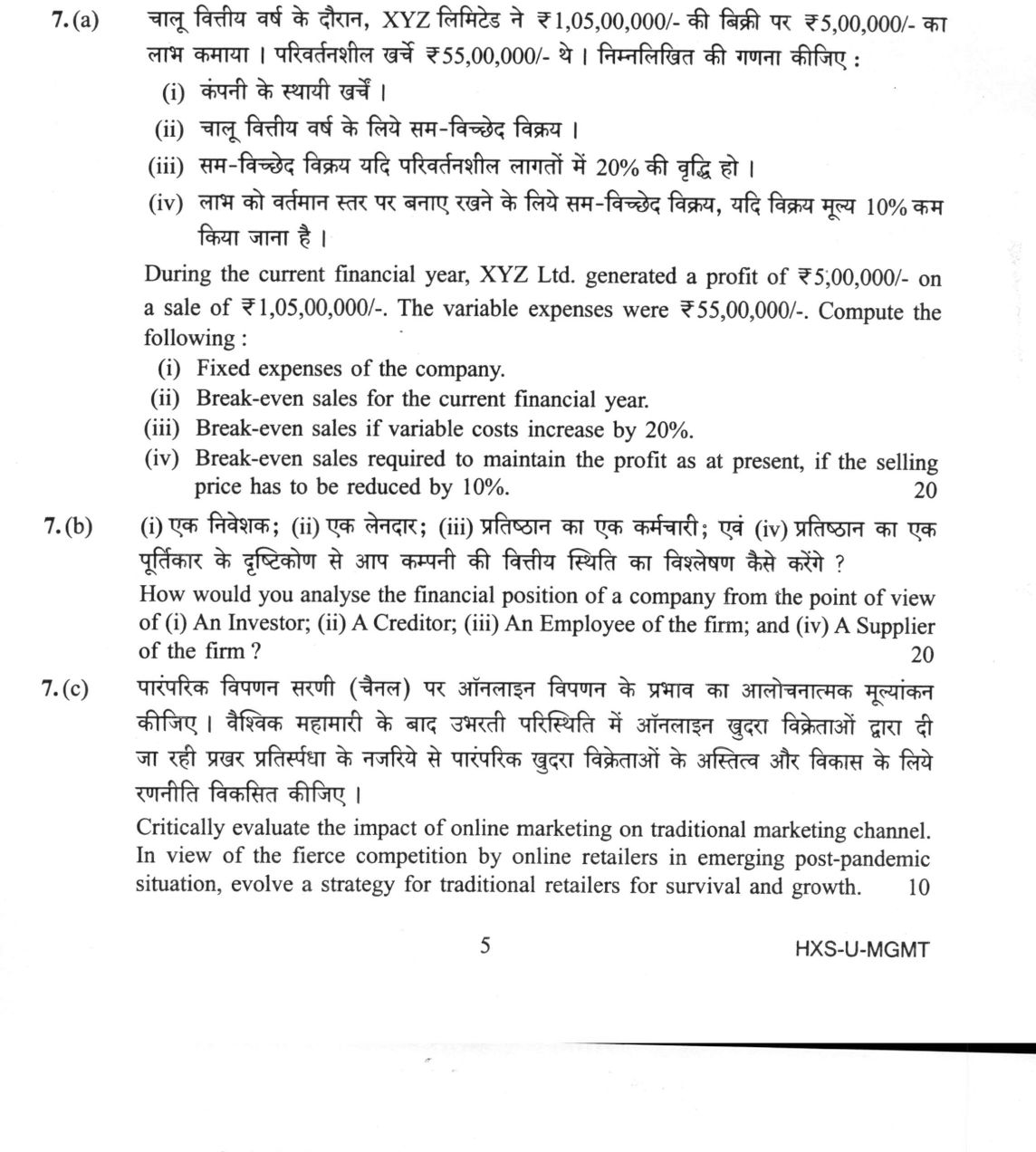
(a) During the current financial year, XYZ Ltd. generated a profit of ₹5,00,000/- on a sale of ₹1,05,00,000/-. The variable…
During the current financial year, XYZ Ltd. generated a profit of ₹5,00,000/- on a sale of ₹1,05,00,000/-. The variable expenses were ₹55,00,000/-. Compute the following : Fixed expenses of the company.
Break-even sales for the current financial year.
Break-even sales if variable costs increase by 20%.
Break-even sales required to maintain the profit as at present, if the selling price has to be reduced by 10%. 20 marks
How would you analyse the financial position of a company from the point of view of (i) An Investor; (ii) A Creditor; (iii) An Employee of the firm; and (iv) A Supplier of the firm ? 20 marks
Critically evaluate the impact of online marketing on traditional marketing channel. In view of the fierce competition by online retailers in emerging post-pandemic situation, evolve a strategy for traditional retailers for survival and growth. 10 marks
हिंदी में प्रश्न पढ़ें
चालू वित्तीय वर्ष के दौरान, XYZ लिमिटेड ने ₹1,05,00,000/- की बिक्री पर ₹5,00,000/- का लाभ कमाया । परिवर्तनशील खर्चे ₹55,00,000/- थे । निम्नलिखित की गणना कीजिए : कंपनी के स्थायी खर्चे ।
चालू वित्तीय वर्ष के लिये सम-विच्छेद बिक्रय ।
सम-विच्छेद बिक्रय यदि परिवर्तनशील लागतों में 20% की वृद्धि हो ।
लाभ को वर्तमान स्तर पर बनाए रखने के लिये सम-विच्छेद बिक्रय, यदि बिक्रय मूल्य 10% कम किया जाना है । 20
एक निवेशक; (ii) एक लेनदार; (iii) प्रतिष्ठान का एक कर्मचारी; एवं (iv) प्रतिष्ठान का एक पूर्तिकार के दृष्टिकोण से आप कंपनी की वित्तीय स्थिति का विश्लेषण कैसे करेंगे ? 20 marks
पारंपरिक विपणन सरनी (चैनल) पर ऑनलाइन विपणन के प्रभाव का आलोचनात्मक मूल्यांकन कीजिए । वैश्विक महामारी के बाद उभरती परिस्थिति में ऑनलाइन खुदरा विक्रेताओं द्वारा दी जा रही प्रखर प्रतिस्पर्धा के नजरिये से पारंपरिक खुदरा विक्रेताओं के अस्तित्व और विकास के लिये रणनीति विकसित कीजिए । 10
Model answer
Written by UPSC Answer Check against this question's marking rubric, to the expected length. UPSC does not publish answers for Mains — this is one way to score well, not an official key.
(a) Marginal costing is used. Contribution = Sales − Variable expenses = ₹1,05,00,000 − ₹55,00,000 = ₹50,00,000. P/V ratio = Contribution/Sales = ₹50,00,000/₹1,05,00,000 = 10/21.
(i) Profit = Contribution − Fixed expenses. Hence Fixed expenses = ₹50,00,000 − ₹5,00,000 = ₹45,00,000.
(ii) Break-even sales = Fixed expenses/P/V ratio = ₹45,00,000 ÷ (10/21) = ₹45,00,000 × 21/10 = ₹94,50,000.
(iii) New variable expenses = ₹55,00,000 × 1.20 = ₹66,00,000. At current sales, new contribution = ₹1,05,00,000 − ₹66,00,000 = ₹39,00,000. New P/V ratio = ₹39,00,000/₹1,05,00,000 = 13/35. New break-even sales = ₹45,00,000 ÷ (13/35) = ₹45,00,000 × 35/13 = ₹15,75,00,000/13 = ₹1,21,15,384.62 (approx.). This exceeds current sales, indicating a loss at current volume.
(iv) A 10% cut in selling price makes new price = 0.90 × old price; variable cost per unit is assumed unchanged. Original variable-cost ratio = ₹55,00,000/₹1,05,00,000 = 11/21. New variable-cost ratio = (11/21) ÷ 0.90 = (11/21) × (10/9) = 110/189. New P/V ratio = 1 − 110/189 = 79/189. Sales required to maintain present profit = (Fixed expenses + Desired profit)/New P/V ratio = (₹45,00,000 + ₹5,00,000) ÷ (79/189) = ₹50,00,000 × 189/79 = ₹94,50,00,000/79 = ₹1,19,62,025.32 (approx.). Condition: fixed expenses and variable cost per unit remain unchanged.
(b) Financial position is analysed by combining balance sheet, profit and loss account, cash-flow statement, ratios, trend and peer comparison. Each stakeholder uses a different lens.
- (i) An Investor: Focuses on return, risk and wealth creation. Key measures: net profit margin, operating margin, return on equity, return on capital employed, earnings per share, dividend payout, P/E ratio, sales and profit growth, debt-equity, interest coverage, free cash flow, governance and sustainability. A high, stable ROE with manageable debt and positive cash flow is attractive; volatile profit and negative cash flow are warning signs.
- (ii) A Creditor: Focuses on safety of principal and timely interest. Short-term creditors examine current ratio, quick ratio, working capital, cash conversion cycle, receivables and inventory turnover. Long-term creditors examine debt-equity, interest coverage, debt-service coverage, cash-flow stability, collateral, covenants and credit rating. Adequate liquidity and stable cash flow reduce default risk.
- (iii) An Employee: Focuses on job security, wages, bonus, pension/gratuity and career growth. Relevant aspects: going-concern strength, profitability, liquidity, productivity, value added per employee, employee cost to sales, order book, capacity utilisation, industrial relations and retirement-fund solvency. Sustained profits and cash flows support pay, benefits and employment continuity.
- (iv) A Supplier: Focuses on prompt payment and continuing orders. Key measures: current ratio, quick ratio, creditors turnover, average payment period, cash flow, creditworthiness, order size and growth prospects. A firm with good liquidity, growing sales and a fair payment record is a safer customer; a rising payment period signals cash stress.
(c) Online marketing has reshaped traditional channels through wider reach, 24×7 access, price transparency, data-driven targeting, personalised recommendations and disintermediation. It has also caused channel conflict, logistics and return costs, digital divide, trust deficits for touch-and-feel goods, and pressure on margins. Traditional channels retain strengths: physical inspection, personal selling, immediate delivery, after-sales service, local trust and community relationships. The impact is therefore reconfiguration, not simple replacement; some intermediaries lose, while others become last-mile, service or experience partners.
For survival and growth after the pandemic, traditional retailers need an omnichannel strategy. Use the store as an experience, pickup, return and service hub; add own e-commerce, social commerce and WhatsApp ordering; adopt local SEO, geo-targeted ads and loyalty/CRM; provide click-and-collect and home delivery; partner with delivery platforms and aggregators; build niche/customised products; train staff in digital selling; use data for demand forecasting and inventory efficiency; control costs and avoid pure price wars. Growth comes from hybrid value: online convenience plus offline touch, trust, personal service and community embeddedness.
What "Calculate" is asking you to do
Apply the standard formula or schedule to data the question has already supplied — a table of readings, cost records, a balance sheet — and produce the number. The method is rarely in doubt; the marks sit in the named intermediate quantities, each of which has to appear as a labelled line.
Structure that answers it
Data as given → formula or standard treatment, named → substitution → each intermediate, labelled → result with units
Where marks are lost
Omitting an intermediate the marking scheme pays for separately, or rounding at an intermediate line so the final figure drifts. In commerce and accountancy, any figure in a statement that no numbered working note supports is treated as unearned.
How this answer will be evaluated
Approach
Framework: CVP Analysis (Cost-Volume-Profit). (a) calculate: given > formula > substitution > result with units > interpretation | (b) analyse: intro > causes > effects > stakeholders/linkages > way forward | (c) critically evaluate: positives > negatives/limits > conditions/safeguards > conclusion Full marks: Accurate CVP calculations; distinct stakeholder analysis with specific ratios; actionable, context-aware retail strategy.
Key points expected
- Derive fixed expenses from given profit and sales data
- Calculate base break-even sales using P/V ratio
- Recalculate break-even with 20% increase in variable costs
- Recalculate break-even with 10% reduction in selling price
- Identify specific financial ratios for investors (e.g., EPS, ROE)
- Identify specific financial ratios for creditors (e.g., Current Ratio, Debt-Equity)
- Address employee concerns (e.g., stability, dividend capacity)
- Address supplier concerns (e.g., liquidity, payment terms)
Evaluation rubric
Each sub-part is marked on its own, against the marks and word limit printed on the paper.
- (a) Compute fixed expenses and break-even sales under three specific scenarios. 20 marks
calculate— given → formula → substitution → result with units → interpretation
Must cover
- Derive fixed expenses from given profit and sales data
- Calculate base break-even sales using P/V ratio
- Recalculate break-even with 20% increase in variable costs
- Recalculate break-even with 10% reduction in selling price
Loses marks
- Arithmetic errors in P/V ratio calculation
- Failure to adjust variable costs in part (iii)
- Ignoring the price reduction impact in part (iv)
Earns more
- Explicit calculation of P/V ratio
- Clear labeling of each sub-part (i) to (iv)
- Correct handling of currency units (₹)
Extra mark
- Verification of results using contribution margin approach
- (b) Analyze financial position from the perspectives of four distinct stakeholders. 20 marks
analyse— intro → causes → effects → stakeholders/linkages → way forward
Must cover
- Identify specific financial ratios for investors (e.g., EPS, ROE)
- Identify specific financial ratios for creditors (e.g., Current Ratio, Debt-Equity)
- Address employee concerns (e.g., stability, dividend capacity)
- Address supplier concerns (e.g., liquidity, payment terms)
Loses marks
- Generic definitions of ratios without stakeholder context
- Treating all stakeholders with the same metrics
- Lack of distinction between solvency and liquidity
Earns more
- Linking specific ratios to specific stakeholder interests
- Mentioning qualitative factors like management quality
- Balanced view of short-term vs long-term health
Extra mark
- Reference to specific regulatory reporting requirements (e.g., MCA)
- (c) Evaluate online marketing impact and propose a survival strategy for traditional retailers. 10 marks
critically evaluate— positives → negatives/limits → conditions/safeguards → conclusion
Must cover
- Critique of online marketing's impact on traditional channels
- Strategy addressing post-pandemic competitive landscape
- Specific measures for survival and growth
- Balanced assessment of opportunities and threats
Loses marks
- Vague generalities without actionable strategy
- Ignoring the 'post-pandemic' context
- One-sided view (only threats or only opportunities)
Earns more
- Mention of omnichannel strategies
- Reference to customer experience (CX) improvements
- Discussion of digital integration (e.g., click-and-collect)
Extra mark
- Citing a specific successful retailer's pivot (e.g., D-Mart, Reliance)
Practice this exact question
Write your answer and it is marked point by point against the model answer above — what you covered, what you missed, what you got wrong.
Evaluate my answer →More from Management 2021 Paper I
- Q4 (a) List the various types of conceptual blocks that come in the way of thinking creative…
- Q5 (a) Elucidate the basic process of marketing communication. What makes international mark…
- Q6 (a) What is Variance Analysis ? What are the possible reasons for different Cost Variance…
- Q7 (a) During the current financial year, XYZ Ltd. generated a profit of ₹5,00,000/- on a sa…
- Q8 (a) How is the income summary of the last accounting period connected with the balance sh…