Paper I — Q5
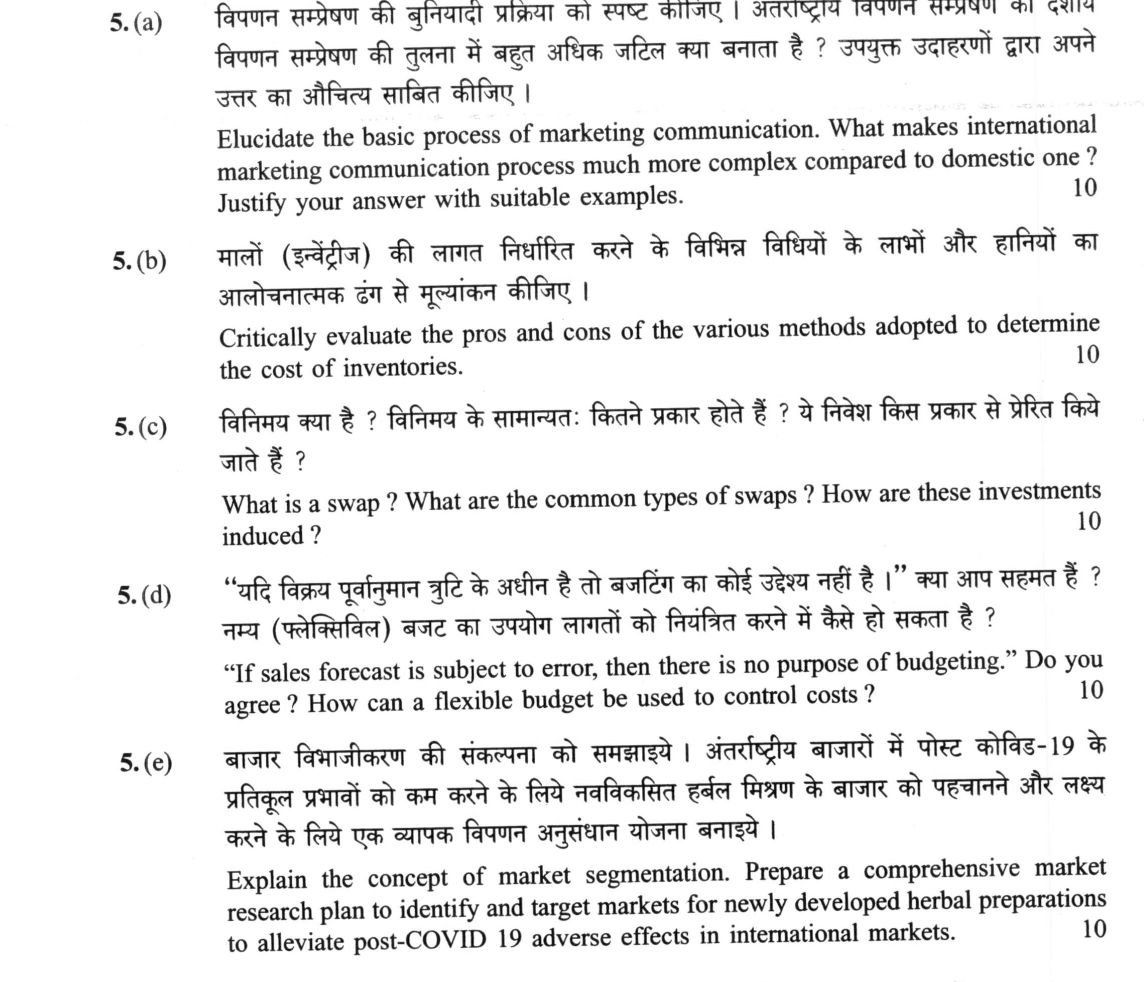
(a) Elucidate the basic process of marketing communication. What makes international marketing communication process much more…
Elucidate the basic process of marketing communication. What makes international marketing communication process much more complex compared to domestic one ? Justify your answer with suitable examples. 10 marks
Critically evaluate the pros and cons of the various methods adopted to determine the cost of inventories. 10 marks
What is a swap ? What are the common types of swaps ? How are these investments induced ? 10 marks
"If sales forecast is subject to error, then there is no purpose of budgeting." Do you agree ? How can a flexible budget be used to control costs ? 10 marks
Explain the concept of market segmentation. Prepare a comprehensive market research plan to identify and target markets for newly developed herbal preparations to alleviate post-COVID 19 adverse effects in international markets. 10 marks
हिंदी में प्रश्न पढ़ें
विपणन सम्प्रेषण की बुनियादी प्रक्रिया को स्पष्ट कीजिए। अन्तर्राष्ट्रीय विपणन सम्प्रेषण को देशीय विपणन सम्प्रेषण की तुलना में बहुत अधिक जटिल क्या बनाता है ? उपयुक्त उदाहरणों द्वारा अपने उत्तर का औचित्य साबित कीजिए। 10
मालों (इन्वेंट्रीज) की लागत निर्धारित करने के विभिन्न विधियों के लाभों और हानियों का आलोचनात्मक ढंग से मूल्यांकन कीजिए। 10
विनिमय क्या है ? विनिमय के सामान्यतः कितने प्रकार होते हैं ? ये निवेश किस प्रकार से प्रेरित किये जाते हैं ? 10 marks
"यदि विक्रय पूर्वानुमान त्रुटि के अधीन है तो बजटिंग का कोई उद्देश्य नहीं है।" क्या आप सहमत हैं ? नम्य (फ्लेक्सिबिल) बजट का उपयोग लागतों को नियंत्रित करने में कैसे हो सकता है ? 10 marks
बाजार विभाजीकरण की संकल्पना को समझाइये। अन्तर्राष्ट्रीय बाजारों में पोस्ट कोविड-19 के प्रतिकूल प्रभावों को कम करने के लिये नवविकसित हर्बल मिश्रण के बाजार को पहचानने और लक्ष्य करने के लिये एक व्यापक विपणन अनुसंधान योजना बनाइये। 10
Model answer
Written by UPSC Answer Check against this question's marking rubric, to the expected length. UPSC does not publish answers for Mains — this is one way to score well, not an official key.
(a) Marketing Communication Process and International Complexity
The basic process of marketing communication is a dynamic, transactional model rooted in the Shannon-Weaver transmission framework. It initiates with the Sender (the marketer), who conceives the communication objective and undergoes Encoding—translating ideas into symbolic forms such as words, visuals, or sounds. This produces the Message, transmitted through chosen Channels/Media (print, digital, broadcast, or personal selling). The Receiver (target consumer) undertakes Decoding, interpreting the symbols based on personal cognitive frameworks. The process completes when the receiver generates Feedback (inquiry, purchase, or brand attitude shift) back to the sender. Throughout this flow, systemic Noise (competitive advertising, cognitive bias, or poor media reception) can distort message fidelity.
The international marketing communication process is considerably more complex due to several compounding macro-environmental variables. First, cultural nuances and linguistic barriers introduce severe encoding and decoding distortions. Idioms, symbols, and color psychology vary drastically across borders; for instance, white signifies purity in Western markets but mourning in East Asia. Second, regulatory and legal constraints differ fundamentally, ranging from restrictions on comparative advertising to bans on specific health claims and digital data privacy mandates. Third, media infrastructure and availability are heterogeneous across developed and emerging economies.
To overcome these complexities, multinational enterprises adopt "glocalization" strategies. For instance, McDonald’s in India re-engineered its entire communication and product portfolio (introducing McAloo Tikki and Maharaja Mac while eliminating beef and pork) to respect religious sentiments and local dietary preferences, whereas its domestic US communication relies heavily on classic beef burger positioning. Similarly, Unilever adapts its brand narratives across markets, shifting from functional anti-bacterial hygiene cues in South Asia to sustainability and ethical sourcing themes in Western Europe.
(b) Critical Evaluation of Inventory Costing Methods
Determining the cost of inventories is critical for accurate income measurement and balance sheet valuation. Four primary methods are utilized in financial and management accounting:
First-In, First-Out (FIFO): Under FIFO, the oldest inventory items are assumed to be sold first. Pros: It provides a highly realistic balance sheet valuation, as ending inventory reflects recent purchase costs. It also follows the actual physical movement of perishable goods. Cons: During inflationary periods, FIFO mismatches current revenues with older, lower costs, resulting in paper profits (inventory holding gains), inflated net income, and a higher corporate tax liability.
Last-In, First-Out (LIFO): LIFO assumes the most recently acquired items are sold first. Pros: In inflationary environments, it matches current costs against current revenues, suppressing reported profits and providing a valuable tax shield while generating higher operating cash flows. Cons: It distorts the balance sheet by valuing ending inventory at outdated historical prices. Furthermore, it enables profit manipulation via LIFO liquidation. Significantly, Ind AS 2 (Inventories) and the Income Computation and Disclosure Standards (ICDS II) in India prohibit LIFO, permitting only FIFO or Weighted Average.
Weighted Average Cost (WAC): WAC computes cost by dividing total cost of goods available for sale by total units available. Pros: It smooths out price volatility caused by market fluctuations, minimizing profit swings. It is administratively simple to apply for homogeneous bulk commodities. Cons: It lags behind current replacement costs, making balance sheet and income statement figures slightly outdated during rapid price inflation or deflation.
Specific Identification Method: Costs are assigned directly to individually identified units. Pros: It provides exact matching of actual costs with revenues, offering ultimate accounting accuracy. Cons: It is administratively unviable for high-volume, interchangeable inventory, and allows managers to manipulate earnings by selectively delivering specific higher- or lower-cost batches.
(c) Concept, Types, and Investment Inducement of Swaps
A Swap is an over-the-counter (OTC) derivative contract between two counterparties to exchange a stream of future cash flows over a specified horizon, calculated against an underlying notional principal.
The primary types of swaps include:
- Interest Rate Swaps (IRS): Counterparties exchange interest rate cash flows on the same currency, most commonly a "plain vanilla" swap exchanging a fixed interest rate for a floating benchmark (such as SOFR or Mumbai Interbank Forward Outright Rate - MIFOR).
- Currency Swaps: Involves the exchange of principal and fixed/floating interest payments in one currency for equivalent streams in another currency, with a re-exchange of principal at maturity.
- Commodity Swaps: Counterparties exchange cash flows based on a fixed price of an underlying commodity (e.g., crude oil, metals) against a fluctuating spot market price.
- Equity Swaps: One party pays cash flows based on the total return of an equity index or stock, receiving fixed/floating interest payments in return.
Swaps are induced through three distinct economic drivers:
- Hedging and Risk Management: Corporates and financial institutions enter swaps to insulate their balance sheets from adverse movements in interest rates, foreign exchange, or commodity prices. For example, an Indian firm with foreign currency debt uses currency swaps to neutralize exchange rate risk.
- Exploiting Comparative Advantage and Arbitrage: Driven by differing credit ratings, one party may have a relative advantage in fixed-rate borrowing while another has an advantage in floating-rate markets. By borrowing in their respective advantageous markets and swapping cash flows, both parties achieve lower overall financing costs.
- Regulatory and Market Facilitation: Institutional swaps are induced by central bank frameworks. In India, the Reserve Bank of India (RBI) conducts USD/INR buy/sell forex swap auctions to regulate domestic liquidity and stabilize foreign exchange reserves without permanent balance sheet expansion.
(d) Budgeting Under Uncertainty and Cost Control Through Flexible Budgets
The proposition that sales forecasting errors render budgeting purposeless is fundamentally flawed. While sales forecasts are probabilistic estimates subject to macroeconomic shifts, budgeting serves broader organizational imperatives: aligning strategic goals, coordinating cross-functional activities, rationing capital, establishing performance baselines, and maintaining fiscal discipline. Discarding budgeting due to forecast uncertainty leads to operational chaos and loss of accountability.
To manage uncertainty effectively, organizations deploy Flexible Budgets rather than rigid static budgets. A flexible budget recognizes cost behavior patterns—classifying costs into fixed, variable, and semi-variable components—and dynamically adjusts budgeted cost allowances to the actual level of activity achieved.
Cost control via flexible budgeting operates through rigorous variance decomposition:
- Sales Volume Variance: Represents the difference between the master (static) budget and the flexible budget, isolating the marketing department's performance in achieving target sales volume.
- Flexible Budget Variance: Compares actual costs incurred against the flexible budget cost allowance for the actual level of output. By neutralizing volume discrepancies, this variance isolates true operational efficiency, further splitting into input price variances (procurement efficiency) and input usage/efficiency variances (shop-floor operational control).
In Indian manufacturing environments (such as an automotive component plant), if actual vehicle component production drops from a forecasted 100,000 units to 80,000 units, evaluating costs against the static 100,000-unit budget yields misleading favorable variances. A flexible budget recalculates direct material and labor allowances for precisely 80,000 units, exposing underlying shop-floor wastages and enabling management by exception.
(e) Market Segmentation and International Research Plan for Post-COVID Herbal Formulations
Market Segmentation is the strategic process of dividing a heterogeneous market into distinct, homogeneous clusters of consumers exhibiting similar needs, characteristics, or buying behaviors, enabling targeted marketing mixes. Segmentation bases include geographic (climate, region), demographic (age, income), psychographic (lifestyle, health-consciousness), and behavioral (usage rate, benefit sought, brand loyalty).
Comprehensive Market Research Plan for Post-COVID Herbal Formulations:
Step 1: Problem and Objective Definition. Define specific research parameters to assess global demand, regulatory feasibility, and consumer acceptance for herbal remedies addressing post-COVID symptoms (chronic fatigue, respiratory distress, immune dysregulation), aligning with the WHO Traditional Medicine Strategy.
Step 2: Research Design Formulation. Adopt a mixed-method design. Conduct Exploratory Research (expert interviews with phytotherapy practitioners, Ayush trade bodies, and international health regulators) to understand therapeutic benchmarks, followed by Descriptive Research (cross-national consumer surveys) to quantify market potential and purchase intent.
Step 3: Data Collection Strategy. Gather Secondary Data from the Ministry of Ayush export databases, WHO traditional medicine monitors, and import regulations across target regions (such as EFSA in the European Union and US-FDA dietary supplement guidelines). Gather Primary Data via computer-assisted web interviewing (CAWI) and focus group discussions focusing on health-conscious urban cohorts in high-incidence post-COVID markets (e.g., North America, Western Europe).
Step 4: Sampling Plan. Employ stratified random sampling across metropolitan areas in selected destination countries, segmenting adults aged 25–65 based on post-viral recovery status, disposable income, and propensity to consume organic/herbal wellness products.
Step 5: Data Analysis and Targeting Strategy. Utilize multivariate statistical tools, including factor and cluster analysis, to profile distinct consumer segments (such as "Holistic Wellness Seekers" and "Clinical Symptom Managers").
Targeting and Positioning Formulation: Target affluent, preventive-health-oriented consumers in developed markets by positioning the formulations as clinically validated, standardized Ayurvedic interventions with certified purity, tapping into India's Ayush export facilitation mechanisms.
Conclusion
Navigating modern management across these domains requires integrated analytical frameworks. Whether mitigating international marketing noise, optimizing inventory reporting under Ind AS standards, managing financial risk via derivative swaps, controlling variances through flexible budgeting, or systematically segmenting global wellness markets, operational success rests on aligning sound analytical theory with adaptive execution in volatile environments.
What "Elucidate" is asking you to do
Make a stated proposition plain and then prove it with instances. Elucidate stems almost always carry a claim or a named concept, and very often the words “with examples” or “with suitable diagrams” — the illustration is part of the directive, not decoration.
Structure that answers it
Plain-language statement of what the proposition means → the part that is obscure, resolved → first illustration → second illustration → why the proposition holds
Where marks are lost
Adding terminology; elucidate rewards removing it. The commoner loss is a clean explanation with no example, when the stem asked for examples.
How this answer will be evaluated
Approach
Framework: Marketing Communication Process (S-M-C-R), Inventory Valuation Methods (FIFO/LIFO/Weighted Average), Derivative Instruments (Swaps), Flexible Budgeting, Market Segmentation (STP). (a) explain: definition/context > points in order > small example > short close | (b) critically evaluate: positives > negatives/limits > conditions/safeguards > conclusion | (c) explain: definition/context > points in order > small example > short close | (d) comment: context > arguments both sides > judgment > close | (e) explain: definition/context > points in order > small example > short close Full marks: Applies named frameworks with real examples, critical judgment, and specific regulatory references
Key points expected
- Outline the basic marketing communication process steps
- Identify factors making international communication complex
- Provide suitable examples to justify the complexity
- Compare domestic vs international communication challenges
- Identify main inventory costing methods (FIFO, LIFO, Weighted Average)
- State advantages of each method
- State disadvantages/limitations of each method
- Provide critical judgment on method selection
Evaluation rubric
Each sub-part is marked on its own, against the marks and word limit printed on the paper.
- (a) Explain the marketing communication process and justify why international communication is more complex. 10 marks
explain— definition/context → points in order → small example → short close
Must cover
- Outline the basic marketing communication process steps
- Identify factors making international communication complex
- Provide suitable examples to justify the complexity
- Compare domestic vs international communication challenges
Loses marks
- Textbook definition without international application
- No examples to justify complexity claim
- Confusing domestic and international processes
Earns more
- Mention specific cultural or regulatory barriers
- Reference real international marketing case
- Discuss language and media differences
- Note legal compliance variations across markets
Extra mark
- Cite specific international marketing failure/success case
- Reference recent global communication regulation change
- (b) Critically evaluate pros and cons of inventory cost determination methods. 10 marks
critically evaluate— positives → negatives/limits → conditions/safeguards → conclusion
Must cover
- Identify main inventory costing methods (FIFO, LIFO, Weighted Average)
- State advantages of each method
- State disadvantages/limitations of each method
- Provide critical judgment on method selection
Loses marks
- Listing methods without critical evaluation
- No comparison between methods
- Ignoring impact on profit/financial position
Earns more
- Compare methods under inflation/deflation scenarios
- Mention impact on financial statements
- Note tax implications of different methods
- Reference accounting standards (IAS 2/AS 2)
Extra mark
- Cite specific company using particular method
- Reference recent accounting standard change
- (c) Define swap, list common types, and explain how these investments are induced. 10 marks
explain— definition/context → points in order → small example → short close
Must cover
- Provide precise definition of swap
- List common types (interest rate, currency, commodity)
- Explain how swap investments are induced/structured
- Describe the mechanism of swap transactions
Loses marks
- Definition without types or mechanism
- Confusing swap with forward/futures
- No explanation of how swaps are induced
Earns more
- Mention specific swap structures (plain vanilla, exotic)
- Explain risk management purpose
- Note regulatory framework for swaps
- Reference real swap transaction example
Extra mark
- Cite specific swap market size statistic
- Reference recent swap regulation change
- (d) Comment on the statement about sales forecast errors and budgeting purpose; explain flexible budget cost control. 10 marks
comment— context → arguments both sides → judgment → close
Must cover
- State position on the given statement (agree/disagree)
- Provide arguments supporting the position
- Explain how flexible budget controls costs
- Describe flexible budget mechanism/application
Loses marks
- No clear position on the statement
- Confusing flexible with static budget
- No explanation of cost control mechanism
Earns more
- Mention variance analysis with flexible budget
- Note limitations of static budgeting
- Reference real budgeting practice
- Discuss management by exception principle
Extra mark
- Cite specific company budgeting practice
- Reference recent budgeting software/tool
- (e) Explain market segmentation and prepare a comprehensive market research plan for herbal preparations in international markets. 10 marks
explain— definition/context → points in order → small example → short close
Must cover
- Define market segmentation concept
- Identify segmentation bases (geographic, demographic, psychographic)
- Prepare comprehensive market research plan
- Specify target markets for herbal preparations
Loses marks
- Definition without research plan
- No specific target market identification
- Ignoring international market complexities
Earns more
- Mention specific research methods (surveys, focus groups)
- Note international market entry considerations
- Reference regulatory requirements for herbal products
- Discuss post-COVID health concerns as market driver
Extra mark
- Cite specific international herbal market data
- Reference recent herbal product regulation change
Practice this exact question
Write your answer and it is marked point by point against the model answer above — what you covered, what you missed, what you got wrong.
Evaluate my answer →More from Management 2021 Paper I
- Q2 (a) Compare the process and effectiveness of : (i) Interacting (ii) Brainstorming (iii) N…
- Q3 (a) Briefly explain the concept of Corporate Social Responsibility (CSR) with industry il…
- Q4 (a) List the various types of conceptual blocks that come in the way of thinking creative…
- Q5 (a) Elucidate the basic process of marketing communication. What makes international mark…
- Q6 (a) What is Variance Analysis ? What are the possible reasons for different Cost Variance…
- Q7 (a) During the current financial year, XYZ Ltd. generated a profit of ₹5,00,000/- on a sa…
- Q8 (a) How is the income summary of the last accounting period connected with the balance sh…