Paper I — Q3
(a) Briefly explain the concept of Corporate Social Responsibility (CSR) with industry illustrations. Critically evaluate major…
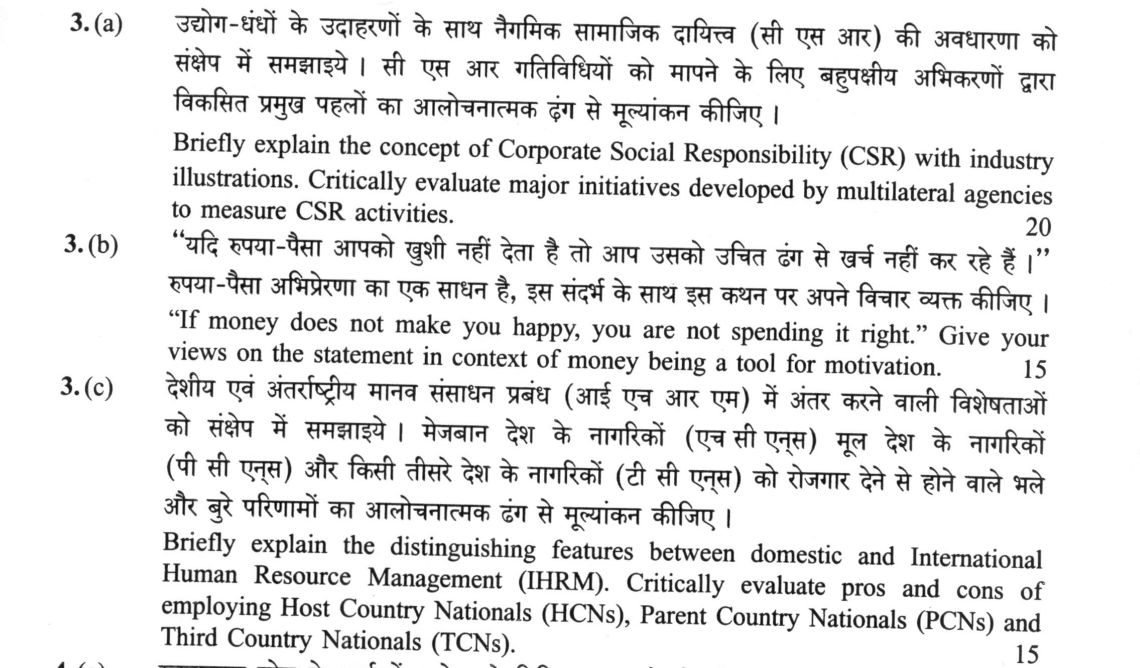
Briefly explain the concept of Corporate Social Responsibility (CSR) with industry illustrations. Critically evaluate major initiatives developed by multilateral agencies to measure CSR activities. 20 marks
"If money does not make you happy, you are not spending it right." Give your views on the statement in context of money being a tool for motivation. 15 marks
Briefly explain the distinguishing features between domestic and International Human Resource Management (IHRM). Critically evaluate pros and cons of employing Host Country Nationals (HCNs), Parent Country Nationals (PCNs) and Third Country Nationals (TCNs). 15 marks
हिंदी में प्रश्न पढ़ें
उद्योग-धंधों के उदाहरणों के साथ नैगमिक सामाजिक दायित्व (सी एस आर) की अवधारणा को संक्षेप में समझाइये । सी एस आर गतिविधियों को मापने के लिए बहुपक्षीय अभिकरणों द्वारा विकसित प्रमुख पहलों का आलोचनात्मक ढंग से मूल्यांकन कीजिए । 20
"यदि रुपया-पैसा आपको खुशी नहीं देता है तो आप उसको उचित ढंग से खर्च नहीं कर रहे हैं ।" रुपया-पैसा अभिप्रेरणा का एक साधन है, इस संदर्भ के साथ इस कथन पर अपने विचार व्यक्त कीजिए । 15
देशीय एवं अंतर्राष्ट्रीय मानव संसाधन प्रबंध (आई एच आर एम) में अंतर करने वाली विशेषताओं को संक्षेप में समझाइये । मेजबान देश के नागरिकों (एच सी एनएस) मूल देश के नागरिकों (पी सी एनएस) और किसी तीसरे देश के नागरिकों (टी सी एनएस) को रोजगार देने से होने वाले भले और बुरे परिणामों का आलोचनात्मक ढंग से मूल्यांकन कीजिए । 15
Model answer
Written by UPSC Answer Check against this question's marking rubric, to the expected length. UPSC does not publish answers for Mains — this is one way to score well, not an official key.
CSR, motivation and IHRM are linked: responsible conduct shapes employee meaning, pay shapes effort, and global staffing shapes how responsibility is delivered.
(a) CSR and measurement CSR is a firm’s duty to manage impacts on stakeholders, not only shareholders. Carroll’s pyramid (economic, legal, ethical, philanthropic) and the triple bottom line (profit, people, planet) capture this. Tata Steel’s tribal development programmes and ITC’s e-Choupal show CSR as market access, livelihood and risk management. Multilateral and multistakeholder initiatives, however, mix measurement tools with guidance. GRI Standards provide comparable indicators for economic, environmental and social performance; their strengths are standardisation and investor relevance, but limits are voluntary use, complexity, box-ticking, and weak coverage of informal value chains. The UN Global Compact is a voluntary initiative; its ten principles are not legally binding, and its Communication on Progress is a self-assessment, not rigorous measurement. ISO 26000 is guidance on social responsibility, explicitly not certifiable or a measurement standard. ILO labour conventions and the Tripartite Declaration of Principles concerning Multinational Enterprises and Social Policy set normative benchmarks, not CSR metrics. These instruments are useful but Western-centric, assuming formal firms, stable labour markets and disclosure capacity; for Indian MSMEs and the informal sector, simpler, costed, locally anchored indicators—linked to Section 135 CSR and SEBI BRSR—are more relevant. BRSR increases disclosure discipline, but much data remain self-reported. Verdict: they improve comparability but remain incomplete unless made context-sensitive and partly mandatory.
(b) Money and motivation The statement is partly true. Behavioural economics shows happiness rises when money is spent pro-socially, on experiences, or on reducing future stress, while hedonic adaptation dulls the effect of larger pay packets. In motivation theory, money is not one factor: Maslow treats it as satisfying safety and esteem; McClelland links it to achievement and power; Herzberg makes pay a hygiene factor—its absence causes dissatisfaction, but its presence does not automatically motivate. Thus money motivates when it is fair, transparent, performance-linked and tied to meaningful spending or security. In India, salary satisfaction surveys show pay remains central, especially for gig workers and low-income employees, yet Gen Z increasingly values purpose, learning, flexibility and recognition. A firm that raises pay without improving autonomy, fairness or career growth may buy compliance, not commitment. The verdict is that money is a necessary but insufficient motivator; “spending it right” means designing pay, benefits and non-monetary rewards that meet both material and psychological needs.
(c) Domestic HRM and IHRM Domestic HRM operates within one legal, cultural and labour-market context. IHRM adds cross-border complexity: different labour laws, tax and immigration rules, cultural norms, expatriate risk, diversity management and global strategy. It also requires cross-cultural training, global compensation and repatriation management. Staffing choices trade off control, cost and legitimacy. Host Country Nationals bring local language, networks and lower cost, as in HUL’s local sales teams; but they may face limited global mobility and career ceilings. Parent Country Nationals provide control, transfer of headquarters culture and career development, as in Maruti Suzuki’s early Japanese managers; but they are costly, may suffer cultural myopia and can create resentment. Third Country Nationals offer global perspective and flexibility, useful for regional hubs, but complicate compensation, taxation and loyalty. Ethnocentric staffing fits early expansion needing control; polycentric fits local responsiveness; regiocentric fits regional integration; geocentric fits mature global firms seeking best talent. The best approach is geocentric in intent, adapted to local law and strategy.
Together, ethical CSR, well-designed monetary motivation and strategic IHRM staffing build sustainable advantage: responsibility gives legitimacy, fair pay gives effort, and global talent gives adaptability.
What "Critically evaluate" is asking you to do
Judge how well something has performed against the standard it set for itself — its stated aim, mandate or promise — and commit to a verdict. Name the yardstick before you judge; an unanchored judgement reads as opinion. “Critically” is not a section added at the end: name the yardstick you are judging by — the evidence, the stated objective, a constitutional principle, a rival explanation — and let a verdict close each part of the body. Where the question quotes a claim, that verdict must land on the claim itself, accepted, qualified or rejected, and not on the theme in general.
Structure that answers it
Name the yardstick — stated aim, mandate or benchmark → performance against it → shortfall against it → why the gap exists → verdict
Where marks are lost
Merits in one paragraph, demerits in the next, and a conclusion calling for a balanced and holistic approach. That is a survey with the judgement left out and it holds the answer in the middle band. The opposite error is reading “critically” as permission to attack — and with the odd pairings, critically describe or critically explain, the exposition still carries most of the marks, the judgement being a layer on it rather than a substitute for it.
How this answer will be evaluated
Approach
Framework: Stakeholder Theory / CSR Frameworks (e.g., Carroll's Pyramid). (a) critically evaluate: positives > negatives/limits > conditions/safeguards > conclusion | (b) comment: context > arguments both sides > judgment > close | (c) critically evaluate: positives > negatives/limits > conditions/safeguards > conclusion Full marks: Comprehensive coverage of all parts with specific examples, critical analysis, and clear structure.
Key points expected
- Define CSR concept with industry illustrations
- Identify major multilateral agencies (e.g., UN, IFC)
- Explain specific measurement initiatives (e.g., GRI, SA8000)
- Critically evaluate strengths and limitations of these initiatives
- Interpret the quote in the context of motivation
- Discuss money as a hygiene factor (Herzberg)
- Analyze the link between spending and satisfaction
- Provide a balanced judgment on the statement
Evaluation rubric
Each sub-part is marked on its own, against the marks and word limit printed on the paper.
- (a) Define CSR with industry examples and evaluate multilateral measurement initiatives. 20 marks
critically evaluate— positives → negatives/limits → conditions/safeguards → conclusion
Must cover
- Define CSR concept with industry illustrations
- Identify major multilateral agencies (e.g., UN, IFC)
- Explain specific measurement initiatives (e.g., GRI, SA8000)
- Critically evaluate strengths and limitations of these initiatives
Loses marks
- Textbook definitions without industry application
- Listing initiatives without critical evaluation
- Ignoring the 'multilateral' aspect of the question
Earns more
- Mention specific industry examples (e.g., Tata, Infosys)
- Reference specific frameworks (e.g., Carroll's Pyramid)
- Discuss the role of ESG in measurement
- Compare different multilateral standards
Extra mark
- Cite specific recent regulatory changes (e.g., SEBI BRSR)
- Reference specific case studies of CSR failure/success
- (b) Analyze the quote regarding money and happiness in the context of motivation. 15 marks
comment— context → arguments both sides → judgment → close
Must cover
- Interpret the quote in the context of motivation
- Discuss money as a hygiene factor (Herzberg)
- Analyze the link between spending and satisfaction
- Provide a balanced judgment on the statement
Loses marks
- General philosophical discussion without management context
- Ignoring the 'spending' aspect of the quote
- Failing to link to motivation theories
Earns more
- Reference Maslow's hierarchy of needs
- Discuss intrinsic vs extrinsic motivation
- Mention the concept of 'hedonic adaptation'
- Use examples of employee compensation structures
Extra mark
- Cite specific studies on money and happiness
- Reference specific management theories on reward systems
- (c) Distinguish domestic vs IHRM and evaluate pros/cons of HCN, PCN, TCN. 15 marks
critically evaluate— positives → negatives/limits → conditions/safeguards → conclusion
Must cover
- Explain distinguishing features of domestic vs IHRM
- Define HCN, PCN, and TCN
- Evaluate pros and cons of each nationality type
- Provide a critical assessment of the trade-offs
Loses marks
- Confusing domestic and international HR concepts
- Listing pros/cons without critical evaluation
- Ignoring the 'distinguishing features' part of the question
Earns more
- Use a table to compare HCN, PCN, TCN
- Discuss cultural intelligence in IHRM
- Mention specific challenges of expatriate management
- Reference specific IHRM models (e.g., EPRG)
Extra mark
- Cite specific examples of multinational companies' HR strategies
- Reference specific legal frameworks for international employment
Practice this exact question
Write your answer and it is marked point by point against the model answer above — what you covered, what you missed, what you got wrong.
Evaluate my answer →More from Management 2021 Paper I
- Q1 (a) 'Globalization' seems to be at 'cross-roads' as increasingly large number of countrie…
- Q2 (a) Compare the process and effectiveness of : (i) Interacting (ii) Brainstorming (iii) N…
- Q3 (a) Briefly explain the concept of Corporate Social Responsibility (CSR) with industry il…
- Q4 (a) List the various types of conceptual blocks that come in the way of thinking creative…
- Q5 (a) Elucidate the basic process of marketing communication. What makes international mark…
- Q6 (a) What is Variance Analysis ? What are the possible reasons for different Cost Variance…