Paper I — Q8
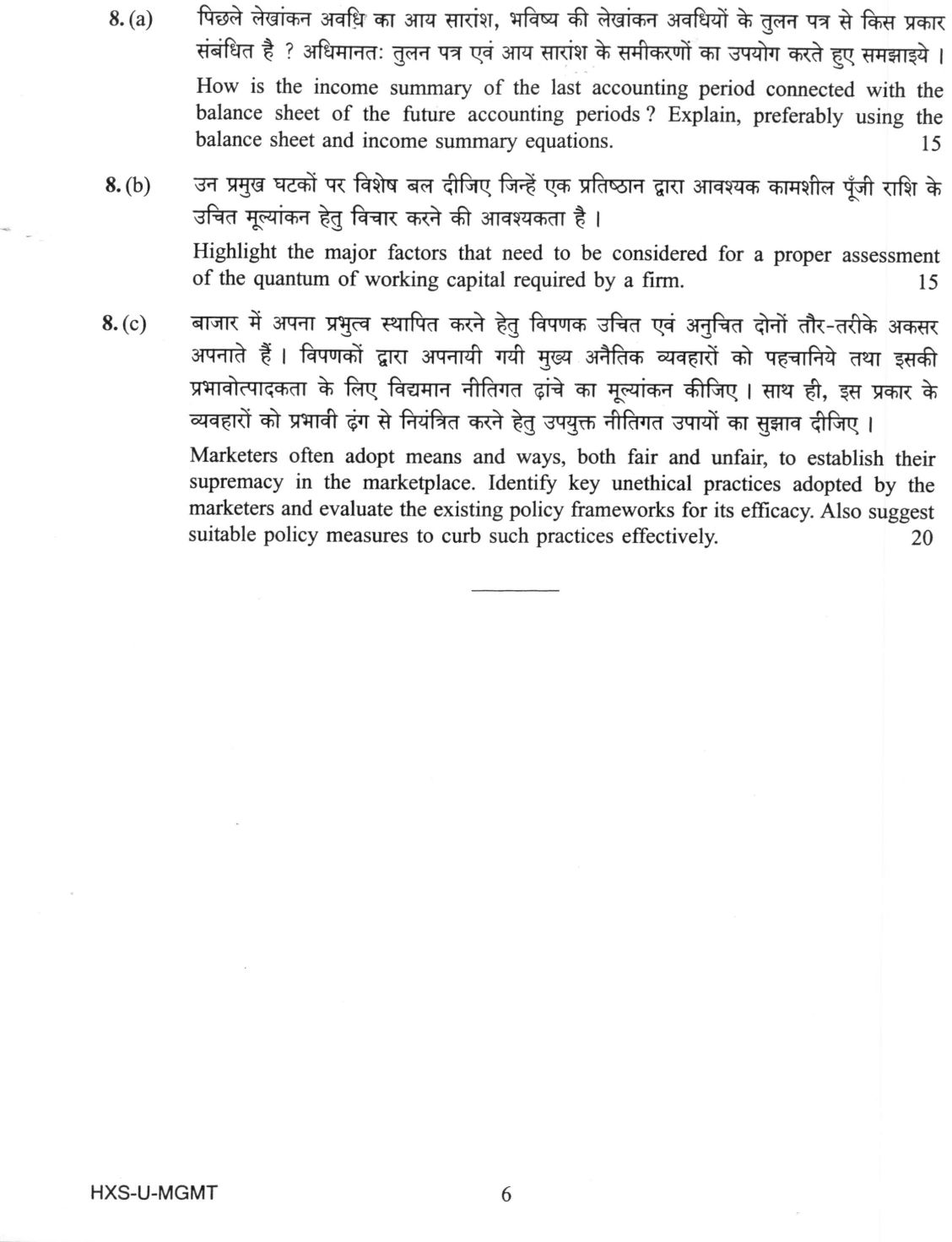
(a) How is the income summary of the last accounting period connected with the balance sheet of the future accounting periods ?…
How is the income summary of the last accounting period connected with the balance sheet of the future accounting periods ? Explain, preferably using the balance sheet and income summary equations. 15 marks
Highlight the major factors that need to be considered for a proper assessment of the quantum of working capital required by a firm. 15 marks
Marketers often adopt means and ways, both fair and unfair, to establish their supremacy in the marketplace. Identify key unethical practices adopted by the marketers and evaluate the existing policy frameworks for its efficacy. Also suggest suitable policy measures to curb such practices effectively. 20 marks
हिंदी में प्रश्न पढ़ें
पिछले लेखांकन अवधि का आय सारांश, भविष्य की लेखांकन अवधियों के तुलन पत्र से किस प्रकार संबंधित है ? अधिमानतः तुलन पत्र एवं आय सारांश के समीकरणों का उपयोग करते हुए समझाइये । 15
उन प्रमुख घटकों पर विशेष बल दीजिए जिन्हें एक प्रतिष्ठान द्वारा आवश्यक कार्यशील पूँजी राशि के उचित मूल्यांकन हेतु विचार करने की आवश्यकता है । 15
बाजार में अपना प्रभुत्व स्थापित करने हेतु विपणक उचित एवं अनुचित दोनों तौर-तरीके अक्सर अपनाते हैं । विपणकों द्वारा अपनायी गयी मुख्य अनैतिक व्यवहारों को पहचानिये तथा इसकी प्रभावोत्पादकता के लिए विद्यमान नीतिगत ढाँचे का मूल्यांकन कीजिए । साथ ही, इस प्रकार के व्यवहारों को प्रभावी ढंग से नियंत्रित करने हेतु उपयुक्त नीतिगत उपायों का सुझाव दीजिए । 20
Model answer
Written by UPSC Answer Check against this question's marking rubric, to the expected length. UPSC does not publish answers for Mains — this is one way to score well, not an official key.
Financial management, operational planning, and market conduct collectively determine an enterprise's long-term solvency, liquidity, and stakeholder trust.
Linkage between Income Summary and Future Balance Sheet
The income summary aggregates operational results over a specific accounting period, yielding net income or loss:
Net Incomeₜ = Total Revenuesₜ - Total Expensesₜ
The nominal balances in the income summary do not appear directly on future balance sheets; instead, they are closed out to the Retained Earnings account within Shareholders’ Equity:
Ending Retained Earningsₜ = Beginning Retained Earningsₜ + Net Incomeₜ - Dividends Declaredₜ
The fundamental balance sheet equation for the subsequent period (t+1) incorporates this carry-forward mechanism:
Assetsₜ₊₁ = Liabilitiesₜ₊₁ + (Contributed Capitalₜ₊₁ + Ending Retained Earningsₜ + Δ Equityₜ₊₁)
Past net income directly dictates opening internal equity, altering the firm's debt-equity structure, dividend-paying capacity, and asset-funding leverage in future balance sheets.
Determinants of Quantum of Working Capital
Assessing the appropriate quantum of working capital involves analyzing structural and operating variables:
- Operating Cycle Length: A prolonged Cash Conversion Cycle (holding period of raw materials, work-in-progress, finished goods, and collection of receivables minus payables) proportionately raises working capital requirements.
- Nature of Business: Service and public utility firms with high cash sales operate on minimal working capital, whereas manufacturing and trading firms demand substantial inventory and debtor reserves.
- Seasonality and Production Policy: Seasonal demand managed through steady, year-round production creates large finished-goods inventory peaks, necessitating elevated working capital.
- Credit Policy: Liberal credit terms to customers expand accounts receivable, whereas favorable credit terms from suppliers compress net working capital needs.
- Supply Chain and Raw Material Availability: Long lead times or volatile input supplies compel enterprises to maintain higher safety stocks.
- Growth and Sales Turnover: Rapid top-line growth absorbs capital in expanded inventories and trade debts ahead of realized cash flows.
Unethical Marketing: Evaluation of Frameworks and Policy Remedies
Firms frequently deploy anti-competitive and deceptive strategies to secure market power. Key unethical practices include:
- Predatory pricing to eliminate competitors via deep discounting;
- Deceptive and surrogate advertising, such as disguised liquor promotions or unverified health claims;
- Greenwashing, where environmental credentials are misstated;
- Counterfeiting and adulteration, undermining product safety;
- Data privacy violations and dark patterns, which leverage manipulative user interfaces and unauthorized consumer data harvesting.
Evaluation of Existing Policy Frameworks: The regulatory framework provides partial deterrence but exhibits critical operational gaps when evaluated against the standard of market fairness:
- Consumer Protection Act (CPA) 2019: The Central Consumer Protection Authority (CCPA) successfully investigates misleading advertisements and imposes penalties, but post-facto redressal remains slow.
- Advertising Standards Council of India (ASCI): ASCI's self-regulatory code offers industry-specific monitoring, but its non-statutory nature restricts its coercive penal efficacy against recalcitrant non-members.
- Competition Commission of India (CCI): The Competition Act 2002 effectively targets abuse of dominance, yet probing complex, algorithmic predatory pricing in e-commerce markets involves prolonged litigation cycles.
- BIS and FSSAI: Standard-setting under FSSAI and BIS protects basic safety, though enforcement bandwidth is stretched across fragmented, unorganized supply chains.
Policy Recommendations:
- Confer statutory co-regulatory powers upon ASCI through formal integration with the CCPA.
- Expand CCI’s algorithmic monitoring and suo motu powers to check digital cartels and dynamic predatory pricing.
- Establish mandatory, verifiable ESG disclosure standards with third-party audits to penalize greenwashing.
- Enforce stringent financial penalties under the Digital Personal Data Protection (DPDP) Act 2023 for behavioral profiling and dark patterns.
Conclusion
India's consumer protection architecture is transitioning from caveat emptor to caveat venditor. However, existing frameworks remain largely reactive. Achieving genuine market equity requires institutional synergy, real-time digital surveillance, and non-discretionary punitive enforcement against manipulative market practices.
What "Evaluate" is asking you to do
Judge how well something has performed against the standard it set for itself — its stated aim, mandate or promise — and commit to a verdict. Name the yardstick before you judge; an unanchored judgement reads as opinion.
Structure that answers it
Name the yardstick — stated aim, mandate or benchmark → performance against it → shortfall against it → why the gap exists → verdict
Where marks are lost
Presenting both sides and then declining to decide, or delivering a verdict against a standard you never stated, which makes it look arbitrary.
How this answer will be evaluated
Approach
Framework: Accounting Equation (Assets = Liabilities + Capital) and Working Capital Determinants. (a) explain: definition/context > points in order > small example > short close | (b) highlight: name the salient points > one line of substance each > close | (c) evaluate: criteria > evidence > balanced judgment Full marks: Rigorous application of accounting equations; comprehensive list of working capital factors with context; critical evaluation of legal frameworks with specific statutory references.
Key points expected
- State the Balance Sheet equation (A = L + C)
- State the Income Summary equation (C = C0 + P - D)
- Substitute Income Summary into Balance Sheet equation
- Explain the role of Retained Earnings in the linkage
- Nature of business (manufacturing vs. service)
- Scale of operations (size of the firm)
- Nature of trade (credit terms of purchase/sale)
- Seasonal variations in demand
Evaluation rubric
Each sub-part is marked on its own, against the marks and word limit printed on the paper.
- (a) Linkage between Income Summary and Balance Sheet via accounting equations. 15 marks
explain— definition/context → points in order → small example → short close
Must cover
- State the Balance Sheet equation (A = L + C)
- State the Income Summary equation (C = C0 + P - D)
- Substitute Income Summary into Balance Sheet equation
- Explain the role of Retained Earnings in the linkage
Loses marks
- Defining terms without showing the mathematical link
- Confusing Income Statement with Balance Sheet items
Earns more
- Mention the closing of temporary accounts
- Distinguish between current and future periods
- Use a simple numerical example
Extra mark
- Reference to specific accounting standards (e.g., Ind AS 1)
- (b) Key factors determining the quantum of working capital required. 15 marks
highlight— name the salient points → one line of substance each → close
Must cover
- Nature of business (manufacturing vs. service)
- Scale of operations (size of the firm)
- Nature of trade (credit terms of purchase/sale)
- Seasonal variations in demand
Loses marks
- Listing factors without explaining their impact on quantum
- Confusing working capital with fixed capital
Earns more
- Availability of raw materials
- Financial structure of the firm
- Growth and expansion plans
- Inflationary trends
Extra mark
- Reference to specific industry examples (e.g., FMCG vs. Steel)
- (c) Unethical marketing practices, policy efficacy, and suggested measures. 20 marks
evaluate— criteria → evidence → balanced judgment
Must cover
- Identify specific unethical practices (e.g., false advertising, price rigging)
- Evaluate existing policy frameworks (e.g., Consumer Protection Act)
- Suggest specific policy measures to curb these practices
- Provide a balanced judgment on the efficacy of current laws
Loses marks
- Vague generalities without naming specific laws or practices
- Failing to link the suggested measures to the identified problems
Earns more
- Mention specific legal acts (e.g., CPA 2019, Competition Act)
- Discuss the role of self-regulatory bodies (e.g., ASCI)
- Suggest digital-age specific measures (e.g., data privacy laws)
- Reference to recent high-profile cases
Extra mark
- Citing specific sections of the Consumer Protection Act
- Reference to international frameworks (e.g., UCC)
Practice this exact question
Write your answer and it is marked point by point against the model answer above — what you covered, what you missed, what you got wrong.
Evaluate my answer →More from Management 2021 Paper I
- Q5 (a) Elucidate the basic process of marketing communication. What makes international mark…
- Q6 (a) What is Variance Analysis ? What are the possible reasons for different Cost Variance…
- Q7 (a) During the current financial year, XYZ Ltd. generated a profit of ₹5,00,000/- on a sa…
- Q8 (a) How is the income summary of the last accounting period connected with the balance sh…