Paper II — Q2
(a) (i) 'A' can hit a target 4 times in 5 shots, 'B' 3 times in 4 shots and 'C' twice in 3 shots. Calculate the probability…
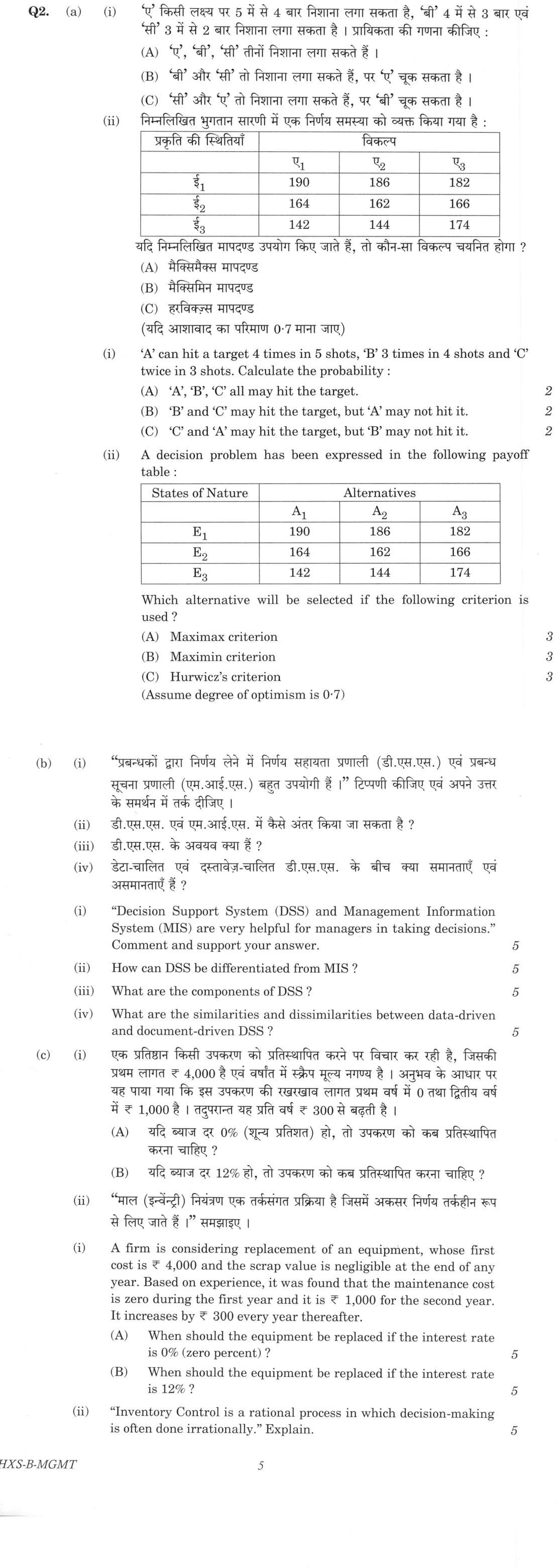
'A' can hit a target 4 times in 5 shots, 'B' 3 times in 4 shots and 'C' twice in 3 shots. Calculate the probability :
(A) 'A', 'B', 'C' all may hit the target. 2 marks
(B) 'B' and 'C' may hit the target, but 'A' may not hit it. 2 marks
(C) 'C' and 'A' may hit the target, but 'B' may not hit it. 2 marks
A decision problem has been expressed in the following payoff table :
| States of Nature | Alternatives | ||
|---|---|---|---|
| A₁ | A₂ | A₃ | |
| E₁ | 190 | 186 | 182 |
| E₂ | 164 | 162 | 166 |
| E₃ | 142 | 144 | 174 |
Which alternative will be selected if the following criterion is used ?
(A) Maximax criterion 3 marks
(B) Maximin criterion 3 marks
(C) Hurwicz's criterion 3 marks
(Assume degree of optimism is 0·7)
"Decision Support System (DSS) and Management Information System (MIS) are very helpful for managers in taking decisions." Comment and support your answer. 5 marks
How can DSS be differentiated from MIS ? 5 marks
What are the components of DSS ? 5 marks
What are the similarities and dissimilarities between data-driven and document-driven DSS ? 5 marks
A firm is considering replacement of an equipment, whose first cost is ₹ 4,000 and the scrap value is negligible at the end of any year. Based on experience, it was found that the maintenance cost is zero during the first year and it is ₹ 1,000 for the second year. It increases by ₹ 300 every year thereafter.
(A) When should the equipment be replaced if the interest rate is 0% (zero percent) ? 5 marks
(B) When should the equipment be replaced if the interest rate is 12% ? 5 marks
"Inventory Control is a rational process in which decision-making is often done irrationally." Explain. 5 marks
हिंदी में प्रश्न पढ़ें
'ए' किसी लक्ष्य पर 5 में से 4 बार निशाना लगा सकता है, 'बी' 4 में से 3 बार एवं 'सी' 3 में से 2 बार निशाना लगा सकता है । प्रायिकता की गणना कीजिए :
(A) 'ए', 'बी', 'सी' तीनों निशाना लगा सकते हैं । 2 अंक
(B) 'बी' और 'सी' तो निशाना लगा सकते हैं, पर 'ए' चूक सकता है । 2 अंक
(C) 'सी' और 'ए' तो निशाना लगा सकते हैं, पर 'बी' चूक सकता है । 2 अंक
निम्नलिखित भुगतान सारणी में एक निर्णय समस्या को व्यक्त किया गया है :
| प्रकृति की स्थितियाँ | विकल्प | ||
|---|---|---|---|
| ए₁ | ए₂ | ए₃ | |
| ई₁ | 190 | 186 | 182 |
| ई₂ | 164 | 162 | 166 |
| ई₃ | 142 | 144 | 174 |
यदि निम्नलिखित मापदण्ड उपयोग किए जाते हैं, तो कौन-सा विकल्प चयनित होगा ?
(A) मैक्सिमैक्स मापदण्ड 3 अंक
(B) मैक्सिमिन मापदण्ड 3 अंक
(C) हरविक्ज़ मापदण्ड 3 अंक
(यदि आशावाद का परिमाण 0·7 माना जाए)
"प्रबन्धकों द्वारा निर्णय लेने में निर्णय सहायता प्रणाली (डी.एस.एस.) एवं प्रबन्ध सूचना प्रणाली (एम.आई.एस.) बहुत उपयोगी है।" टिप्पणी कीजिए एवं अपने उत्तर के समर्थन में तर्क दीजिए । 5 अंक
डी.एस.एस. एवं एम.आई.एस. में कैसे अंतर किया जा सकता है ? 5 अंक
डी.एस.एस. के अवयव क्या हैं ? 5 अंक
डेटा-चालित एवं दस्तावेज़-चालित डी.एस.एस. के बीच क्या समानताएँ एवं असमानताएँ हैं ? 5 अंक
एक प्रतिष्ठान किसी उपकरण को प्रतिस्थापित करने पर विचार कर रही है, जिसकी प्रथम लागत ₹ 4,000 है एवं वर्षांत में स्क्रैप मूल्य नगण्य है । अनुभव के आधार पर यह पाया गया कि इस उपकरण की रखरखाव लागत प्रथम वर्ष में 0 तथा द्वितीय वर्ष में ₹ 1,000 है । तदुपरान्त यह प्रति वर्ष ₹ 300 से बढ़ती है ।
(A) यदि ब्याज दर 0% (शून्य प्रतिशत) हो, तो उपकरण को कब प्रतिस्थापित करना चाहिए ? 5 अंक
(B) यदि ब्याज दर 12% हो, तो उपकरण को कब प्रतिस्थापित करना चाहिए ? 5 अंक
"माल (इन्वेंट्री) नियंत्रण एक तर्कसंगत प्रक्रिया है जिसमें अक्सर निर्णय तर्कहीन रूप से लिए जाते हैं।" समझाइए । 5 अंक
Model answer
Written by UPSC Answer Check against this question's marking rubric, to the expected length. UPSC does not publish answers for Mains — this is one way to score well, not an official key.
(a)(i)(A) P(A)=4/5, P(B)=3/4, P(C)=2/3. Assuming independence, P(A∩B∩C)=4/5×3/4×2/3=24/60=2/5=0.4.
(a)(i)(B) P(A′∩B∩C)=1/5×3/4×2/3=6/60=1/10=0.1.
(a)(i)(C) P(A∩B′∩C)=4/5×1/4×2/3=8/60=2/15≈0.1333.
(a)(ii) For A₁ max=190, min=142; A₂ max=186, min=144; A₃ max=182, min=166.
(a)(ii)(A) Maximax: max{190,186,182}=190, so select A₁.
(a)(ii)(B) Maximin: max{142,144,166}=166, so select A₃.
(a)(ii)(C) Hurwicz, α=0.7: H=0.7(max)+0.3(min). A₁: 0.7×190+0.3×142=175.6. A₂: 0.7×186+0.3×144=173.4. A₃: 0.7×182+0.3×166=177.2. Select A₃ with 177.2.
(b)(i) Yes, MIS and DSS are helpful, but in different ways. MIS gives routine, structured, periodic reports for planning, control and monitoring; it improves speed, accuracy and consistency of operational decisions. DSS supports semi-structured and unstructured decisions through models, what-if analysis, sensitivity analysis and data retrieval; it helps managers compare alternatives in pricing, capacity, inventory, investment and risk. Their usefulness depends on data quality, model validity, user skill and managerial judgement. They are decision aids, not substitutes for responsibility.
(b)(ii) MIS is report-oriented, regular, past-and-control oriented, structured, stable, broad and efficiency-focused. DSS is model-oriented, ad hoc/interactive, future-and-decision oriented, semi-structured, flexible, user-driven and focused on specific decisions. MIS answers “what happened?”, while DSS answers “what if?” and “which option is better?”.
(b)(iii) Components of DSS: database or data management subsystem; model management subsystem; user interface/dialogue subsystem; knowledge management or knowledge engine; and the decision-maker/user. Some systems also include external data sources, report generators and group-support tools.
(b)(iv) Similarities: both are DSS types, support decision-makers, use computer interfaces, store and retrieve information, allow querying, and can be used for managerial problem-solving. Differences: data-driven DSS uses structured numerical databases and tools such as OLAP, data mining, SQL, time-series and statistical analysis; document-driven DSS uses unstructured documents such as text, images, audio, video, e-mails and web pages, with search, retrieval and content-management tools. Data-driven DSS is quantitative and trend/pattern oriented; document-driven DSS is qualitative and content oriented.
(c)(i)(A) Maintenance: M₁=0, M₂=₹1000, M₃=₹1300, M₄=₹1600, M₅=₹1900, M₆=₹2200. Average annual cost A(n)=[4000+∑Mₜ]/n at 0% interest. n=1: 4000/1=₹4000. n=2: 5000/2=₹2500. n=3: 6300/3=₹2100. n=4: 7900/4=₹1975. n=5: 9800/5=₹1960. n=6: 12000/6=₹2000. Minimum is at n=5. Replace after 5 years.
(c)(i)(B) At 12%, use equivalent annual cost: EAC(n)=[4000+∑Mₜ/(1.12)ᵗ]×[0.12(1.12)ⁿ÷((1.12)ⁿ−1)]. Discounted total and EAC: n=1: ₹4000.00, EAC=₹4480.00. n=2: ₹4797.19, EAC=₹2838.49. n=3: ₹5722.51, EAC=₹2382.56. n=4: ₹6739.34, EAC=₹2218.82. n=5: ₹7817.45, EAC=₹2168.64. n=6: ₹8932.04, EAC=₹2172.50. n=7: ₹10062.91, EAC=₹2204.96. Minimum EAC is at n=5. Replace after 5 years, assuming end-of-year maintenance and negligible scrap.
(c)(ii) Inventory control is rational in design because it balances ordering cost, carrying cost and stock-out cost using EOQ, reorder level, safety stock, ABC/VED classification and JIT. It uses data, forecasts and cost trade-offs. But actual decision-making may be irrational due to bounded rationality, uncertainty, forecast bias, overstocking to avoid blame, discount-driven bulk buying, departmental politics, satisficing, gut feeling and neglect of holding costs. Thus the process is rational, but human and organisational behaviour can make decisions suboptimal.
What "Solve" is asking you to do
Choose the method, then carry it through to a final answer. Identifying what kind of problem this is and why that method applies is the first thing marked; a correct figure arrived at invisibly earns almost nothing.
Structure that answers it
Given data and what is required → method chosen, with the reason it applies → set-up (equation, circuit, free body, trial balance) → working, step by step → answer with units and any condition of validity
Where marks are lost
Doing the middle steps mentally and writing only the result. In mathematics papers, a further loss comes from giving a decimal where the exact value in surds or fractions was wanted, or from skipping the justification a part explicitly asks for.
How this answer will be evaluated
Approach
Framework: Decision Theory (Probability, Payoff Criteria) & Operations Research (Equipment Replacement, Inventory Control). (a(i)) calculate: given > formula > substitution > result with units > interpretation | (a(i)) calculate: given > formula > substitution > result with units > interpretation | (a(i)) calculate: given > formula > substitution > result with units > interpretation | (a(ii)) calculate: given > formula > substitution > result with units > interpretation | (a(ii)) calculate: given > formula > substitution > result with units > interpretation | (a(ii)) calculate: given > formula > substitution > result with units > interpretation | (b(i)) comment: context > arguments both sides > judgment > close | (b(ii)) compare: paired headings or table > key differences > significance > conclusion | (b(iii)) describe: define > structure or process in order > labelled diagram > significance | (b(iv)) compare: paired headings or table > key differences > significance > conclusion | (c(i)) calculate: given > formula > substitution > result with units > interpretation | (c(i)) calculate: given > formula > substitution > result with units > interpretation | (c(ii)) explain: definition/context > points in order > small example > short close Full marks: Accurate calculations with clear steps; precise definitions; well-structured comparisons; logical reasoning for qualitative parts.
Key points expected
- P(A) = 4/5
- P(B) = 3/4
- P(C) = 2/3
- Product of individual probabilities
- P(not A) = 1/5
- Product of these three values
- P(not B) = 1/4
- Identify maximum payoff for each alternative
Evaluation rubric
Each sub-part is marked on its own, against the marks and word limit printed on the paper.
- (a(i)) Probability of A, B, and C all hitting the target. 2 marks
calculate— given → formula → substitution → result with units → interpretation
Must cover
- P(A) = 4/5
- P(B) = 3/4
- P(C) = 2/3
- Product of individual probabilities
Loses marks
- Incorrect probability fractions
- Adding probabilities instead of multiplying
Earns more
- Correct fraction simplification
- Decimal conversion
- (a(i)) Probability of B and C hitting, A missing. 2 marks
calculate— given → formula → substitution → result with units → interpretation
Must cover
- P(B) = 3/4
- P(C) = 2/3
- P(not A) = 1/5
- Product of these three values
Loses marks
- Using P(A) instead of P(not A)
- Calculation errors
Earns more
- Correct fraction simplification
- (a(i)) Probability of C and A hitting, B missing. 2 marks
calculate— given → formula → substitution → result with units → interpretation
Must cover
- P(C) = 2/3
- P(A) = 4/5
- P(not B) = 1/4
- Product of these three values
Loses marks
- Using P(B) instead of P(not B)
- Calculation errors
Earns more
- Correct fraction simplification
- (a(ii)) Alternative selection using Maximax criterion. 3 marks
calculate— given → formula → substitution → result with units → interpretation
Must cover
- Identify maximum payoff for each alternative
- Select alternative with highest maximum
- Correct selection of A1
Loses marks
- Selecting based on minimums
- Incorrect identification of max values
Earns more
- Tabular presentation of max values
- (a(ii)) Alternative selection using Maximin criterion. 3 marks
calculate— given → formula → substitution → result with units → interpretation
Must cover
- Identify minimum payoff for each alternative
- Select alternative with highest minimum
- Correct selection of A2
Loses marks
- Selecting based on maximums
- Incorrect identification of min values
Earns more
- Tabular presentation of min values
- (a(ii)) Alternative selection using Hurwicz's criterion (α=0.7). 3 marks
calculate— given → formula → substitution → result with units → interpretation
Must cover
- Formula: 0.7(Max) + 0.3(Min)
- Calculation for all three alternatives
- Correct selection of A1
Loses marks
- Using wrong alpha value
- Calculation errors in weighted sum
Earns more
- Step-by-step calculation shown
- (b(i)) Comment on utility of DSS and MIS for managers. 5 marks
comment— context → arguments both sides → judgment → close
Must cover
- Define DSS and MIS
- Explain how each aids decision-making
- Provide supporting argument/example
Loses marks
- Vague generalities without specific features
- Confusing DSS with general IT
Earns more
- Mention of specific decision types (structured/unstructured)
- Reference to data processing vs. model building
Extra mark
- Real-world example of DSS/MIS implementation
- (b(ii)) Differentiate DSS from MIS. 5 marks
compare— paired headings or table → key differences → significance → conclusion
Must cover
- DSS: Model-driven, interactive, unstructured decisions
- MIS: Data-driven, reporting, structured decisions
- Clear distinction of purpose
Loses marks
- Treating them as identical
- Lack of specific differentiating features
Earns more
- Tabular comparison
- Mention of user interface differences
- (b(iii)) Components of DSS. 5 marks
describe— define → structure or process in order → labelled diagram → significance
Must cover
- Database Management System (DBMS)
- Model Base Management System (MBMS)
- User Interface (UI)
- DSS Software/Management
Loses marks
- Missing key components (DBMS/MBMS)
- Listing generic computer parts
Earns more
- Brief explanation of each component's role
Extra mark
- Diagram of DSS architecture
- (b(iv)) Similarities and dissimilarities of data-driven vs document-driven DSS. 5 marks
compare— paired headings or table → key differences → significance → conclusion
Must cover
- Data-driven: Uses numerical data, statistical models
- Document-driven: Uses text, images, unstructured data
- Similarity: Both support decision-making
Loses marks
- Confusing data-driven with document-driven
- Failing to identify similarities
Earns more
- Examples of data types for each
- Mention of AI/NLP for document-driven
- (c(i)) Replacement time at 0% interest rate. 5 marks
calculate— given → formula → substitution → result with units → interpretation
Must cover
- Calculate Average Annual Cost (AAC) for each year
- Identify year with minimum AAC
- Correct replacement year (Year 4)
Loses marks
- Ignoring maintenance cost increase
- Incorrect AAC calculation
Earns more
- Table showing cost accumulation
- Formula for AAC at 0%
- (c(i)) Replacement time at 12% interest rate. 5 marks
calculate— given → formula → substitution → result with units → interpretation
Must cover
- Calculate Present Worth (PW) of costs
- Calculate Capital Recovery Factor (CRF)
- Identify year with minimum Equivalent Annual Cost (EAC)
Loses marks
- Using 0% method for 12%
- Incorrect discounting of maintenance costs
Earns more
- Use of interest tables or formulas
- Step-by-step PW calculation
- (c(ii)) Explain the paradox of rational process/irrational decisions in inventory control. 5 marks
explain— definition/context → points in order → small example → short close
Must cover
- Define rational process (EOQ, models)
- Identify irrational factors (human bias, uncertainty)
- Explain why decisions deviate from models
Loses marks
- Ignoring the 'irrational' part of the quote
- Vague explanation of inventory control
Earns more
- Mention of psychological factors
- Reference to real-world constraints
Extra mark
- Example of a specific irrational decision
Practice this exact question
Write your answer and it is marked point by point against the model answer above — what you covered, what you missed, what you got wrong.
Evaluate my answer →More from Management 2021 Paper II
- Q1 (a) The mean annual income of workers in a company is ₹ 5,000 with a standard deviation o…
- Q2 (a) (i) 'A' can hit a target 4 times in 5 shots, 'B' 3 times in 4 shots and 'C' twice in…
- Q3 (a) (i) What is e-business architecture? Which technological innovations have had a major…
- Q4 (a) (i) How does the balancing line reduce the cost of idleness? Describe the steps invol…
- Q5 (a) "The Government of India has been making efforts to remove the regional imbalances in…