Paper II — Q6
(a) (i) What is the rationale behind liberalization strategies adopted by the New Industrial Policy? (6 marks) (ii) "The term…
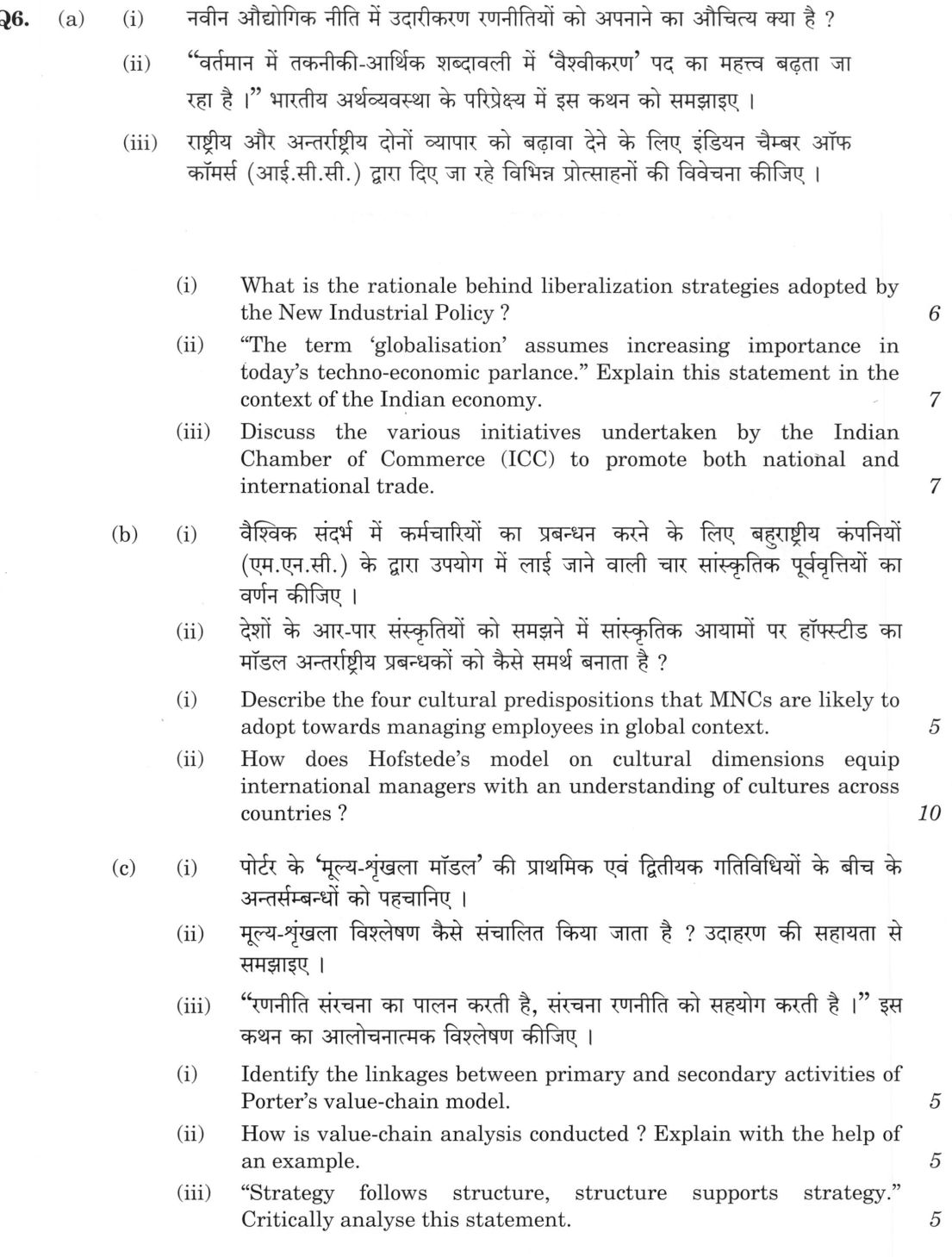
What is the rationale behind liberalization strategies adopted by the New Industrial Policy? 6 marks
"The term 'globalisation' assumes increasing importance in today's techno-economic parlance." Explain this statement in the context of the Indian economy. 7 marks
Discuss the various initiatives undertaken by the Indian Chamber of Commerce (ICC) to promote both national and international trade. 7 marks
Describe the four cultural predispositions that MNCs are likely to adopt towards managing employees in global context. 5 marks
How does Hofstede's model on cultural dimensions equip international managers with an understanding of cultures across countries? 10 marks
Identify the linkages between primary and secondary activities of Porter's value-chain model. 5 marks
How is value-chain analysis conducted? Explain with the help of an example. 5 marks
"Strategy follows structure, structure supports strategy." Critically analyse this statement. 5 marks
हिंदी में प्रश्न पढ़ें
नवीन औद्योगिक नीति में उदारीकरण रणनीतियों को अपनाने का औचित्य क्या है ? (6 अंक)
"वर्तमान में तकनीकी-आर्थिक शब्दावली में 'वैश्वीकरण' पद का महत्व बढ़ता जा रहा है।" भारतीय अर्थव्यवस्था के परिप्रेक्ष्य में इस कथन को समझाइए। (7 अंक)
राष्ट्रीय और अंतर्राष्ट्रीय दोनों व्यापार को बढ़ावा देने के लिए इंडियन चैम्बर ऑफ कॉमर्स (आई.सी.सी.) द्वारा दिए जा रहे विभिन्न प्रोत्साहनों की विवेचना कीजिए। (7 अंक)
वैश्विक संदर्भ में कर्मचारियों का प्रबंधन करने के लिए बहुराष्ट्रीय कंपनियों (एम.एन.सी.) के द्वारा उपयोग में लाई जाने वाली चार सांस्कृतिक पूर्ववृत्तियों का वर्णन कीजिए । (5 अंक)
देशों के आर-पार संस्कृतियों को समझने में सांस्कृतिक आयामों पर हॉफस्टीड का मॉडल अंतर्राष्ट्रीय प्रबंधकों को कैसे समर्थ बनाता है ? (10 अंक)
पोर्टर के 'मूल्य-श्रृंखला मॉडल' की प्राथमिक एवं द्वितीयक गतिविधियों के बीच के अंतर्संबंधों को पहचानिए । (5 अंक)
मूल्य-श्रृंखला विश्लेषण कैसे संचालित किया जाता है ? उदाहरण की सहायता से समझाइए । (5 अंक)
"रणनीति संरचना का पालन करती है, संरचना रणनीति को सहयोग करती है ।" इस कथन का आलोचनात्मक विश्लेषण कीजिए । (5 अंक)
Model answer
Written by UPSC Answer Check against this question's marking rubric, to the expected length. UPSC does not publish answers for Mains — this is one way to score well, not an official key.
Liberalisation and Global Integration
The New Industrial Policy (NIP) 1991 marked a paradigmatic shift from state-directed planning to market-led growth. Its primary rationale was dismantling the stifling 'licence-permit-quota raj', abolishing industrial licensing for most sectors, and relaxing the pre-entry scrutiny under the MRTP Act and restrictive FERA provisions. This aimed to inject domestic competitiveness, attract foreign direct investment (FDI), enable modern technology infusion, eliminate public-sector monopolies, and integrate India into the global trading system.
In today's techno-economic parlance, globalisation signifies India's deep integration into Global Value Chains (GVCs) following WTO accession. Beyond tariff rationalisation and unprecedented FDI inflows across services and manufacturing, globalisation has driven the expansion of India’s IT-BPM sector, digital public infrastructure (such as UPI), and pharmaceutical exports. However, it also exposes the domestic economy to external shocks, trade deficits in electronics, and the structural challenge of jobless growth, necessitating initiatives like the Production Linked Incentive (PLI) scheme to secure strategic self-reliance.
To facilitate trade expansion, the Indian Chamber of Commerce (ICC) actively drives national and international commerce through targeted initiatives. ICC organizes flagship trade expos and international business delegations, facilitates bilateral trade dialogues via joint business councils, and conducts evidence-based policy advocacy with ministries. Furthermore, it empowers MSMEs through export readiness programs, runs specialized dispute resolution via the ICC Arbitration Centre, and champions regional economic integration through initiatives aligned with the Act East Policy.
Cross-Cultural Management in MNCs
MNCs manage global workforces through four distinct cultural predispositions within Perlmutter's EPRG framework:
- Ethnocentric: Parent-country nationals (PCNs) hold key positions; home-country practices dominate (e.g., traditional Japanese MNCs).
- Polycentric: Host-country nationals (HCNs) manage local subsidiaries, adapting fully to local culture (e.g., Unilever's localized marketing).
- Regiocentric: Personnel and policies are coordinated within regional clusters (e.g., Coca-Cola's Latin America or South Asia divisions).
- Geocentric: A truly global approach selecting the best talent regardless of nationality (e.g., Google, IBM).
Hofstede’s cultural dimensions equip international managers to navigate these cross-border complexities:
- Power Distance Index (PDI) guides hierarchy and decision-making; high-PDI cultures (India, China) accept authoritative leadership, whereas low-PDI cultures (Nordics) demand consultative styles.
- Individualism vs. Collectivism (IDV) dictates incentive structures; individual merit bonuses suit the US, while team-based rewards suit collectivist societies.
- Masculinity vs. Femininity (MAS) informs work-life balance and negotiation tactics.
- Uncertainty Avoidance Index (UAI) shapes risk tolerance, formalisation, and standard operating procedures.
- Long-Term vs. Short-Term Orientation (LTO) guides strategic investment horizons.
- Indulgence vs. Restraint (IND) influences consumer marketing and workplace regulation.
Value-Chain Dynamics and Strategic Alignment
Michael Porter’s Value-Chain model emphasizes that competitive advantage arises not from discrete activities, but from linkages between primary activities (inbound logistics, operations, outbound logistics, marketing and sales, service) and support activities (procurement, technology development, human resource management, firm infrastructure). For instance, an advanced enterprise procurement system (support) reduces component costs and optimizes inbound logistics (primary), while cutting-edge HR practices ensure superior after-sales service quality.
Value-chain analysis is conducted in three core steps:
- Activity Disaggregation: Dividing the firm into distinct strategic processes.
- Cost and Value Driver Analysis: Identifying cost drivers (scale, capacity utilisation) and differentiation drivers for each activity.
- Developing Competitive Advantage: Reconfiguring linkages to lower costs or enhance differentiation.
For example, Maruti Suzuki conducts value-chain analysis by co-locating tier-1 suppliers in adjacent vendor parks (linking procurement, technology, and inbound logistics), achieving Just-In-Time inventory, reduced working capital, and unbeatable cost leadership in the automobile sector.
Critical Analysis: Strategy-Structure Reciprocity
Alfred Chandler’s classical thesis posits that structure follows strategy, asserting that when corporate strategy alters (such as diversification or geographic expansion), structural realignment (from functional to multidivisional) is necessary to allocate resources efficiently. Conversely, the view that structure supports strategy highlights that without appropriate organizational architecture—reporting lines, control systems, and culture—strategic execution falters.
Critically, this linear causality is incomplete. As Henry Mintzberg argued, structure also constrains and shapes strategy; an established bureaucratic or rigid hierarchy filters information, stifling emergent strategies and innovation. In contemporary dynamic environments characterized by digital platforms and ecosystem networks, structure and strategy exist in a reciprocal, iterative relationship. Ultimately, strategy and structure must co-evolve: strategy directs organizational purpose, but dynamic, agile structures actively enable strategic pivoting and sustainable competitive advantage.
What "Critically analyse" is asking you to do
Break the subject into its working parts and show how they act on each other. The marks are in the interconnections — which factor drives which, and what the resulting structure explains — not in the inventory of factors. “Critically” is not a section added at the end: name the yardstick you are judging by — the evidence, the stated objective, a constitutional principle, a rival explanation — and let a verdict close each part of the body. Where the question quotes a claim, that verdict must land on the claim itself, accepted, qualified or rejected, and not on the theme in general.
Structure that answers it
Define the whole → separate it into its parts → show which part drives which → what that interaction produces → what the structure implies
Where marks are lost
Merits in one paragraph, demerits in the next, and a conclusion calling for a balanced and holistic approach. That is a survey with the judgement left out and it holds the answer in the middle band. The opposite error is reading “critically” as permission to attack — and with the odd pairings, critically describe or critically explain, the exposition still carries most of the marks, the judgement being a layer on it rather than a substitute for it.
How this answer will be evaluated
Approach
Framework: Porter's Value Chain Model, Hofstede's Cultural Dimensions, MNC HR Strategies. (a(i)) explain: definition/context > points in order > small example > short close | (a(ii)) explain: definition/context > points in order > small example > short close | (a(iii)) discuss: intro > 3-4 dimensions > example > balanced close | (b(i)) describe: define > structure or process in order > labelled diagram > significance | (b(ii)) explain: definition/context > points in order > small example > short close | (c(i)) enumerate: list the items in order > one line each > no commentary | (c(ii)) explain: definition/context > points in order > small example > short close | (c(iii)) analyse: intro > causes > effects > stakeholders/linkages > way forward Full marks: Comprehensive coverage of all required elements with specific examples and critical analysis
Key points expected
- Define New Industrial Policy (NIP) context
- Identify key liberalization strategies
- Explain economic rationale for each strategy
- Link rationale to policy objectives
- Define globalisation in techno-economic terms
- Explain its increasing importance
- Contextualize within Indian economy
- Provide specific examples of Indian globalisation
Evaluation rubric
Each sub-part is marked on its own, against the marks and word limit printed on the paper.
- (a(i)) Rationale for liberalization in the New Industrial Policy. 6 marks
explain— definition/context → points in order → small example → short close
Must cover
- Define New Industrial Policy (NIP) context
- Identify key liberalization strategies
- Explain economic rationale for each strategy
- Link rationale to policy objectives
Loses marks
- Vague generalizations without specific strategies
- Confusing NIP with other policies
- Lack of clear rationale for each strategy
Earns more
- Mention specific policy changes (e.g., licensing)
- Reference economic growth targets
- Cite specific industrial sectors
- Mention foreign investment incentives
Extra mark
- Reference specific NIP year (e.g., 1991)
- Cite specific economic data pre/post NIP
- (a(ii)) Explain 'globalisation' in the context of the Indian economy. 7 marks
explain— definition/context → points in order → small example → short close
Must cover
- Define globalisation in techno-economic terms
- Explain its increasing importance
- Contextualize within Indian economy
- Provide specific examples of Indian globalisation
Loses marks
- Generic definition without Indian context
- Ignoring techno-economic aspect
- Lack of specific examples
Earns more
- Mention IT sector growth
- Reference FDI inflows
- Cite specific globalisation initiatives
- Discuss impact on Indian industries
Extra mark
- Reference specific globalisation treaties
- Cite recent Indian globalisation statistics
- (a(iii)) Discuss ICC initiatives for national and international trade. 7 marks
discuss— intro → 3-4 dimensions → example → balanced close
Must cover
- Identify ICC's role in trade promotion
- List specific national trade initiatives
- List specific international trade initiatives
- Explain impact of these initiatives
Loses marks
- Vague description without specific initiatives
- Confusing ICC with other trade bodies
- Lack of distinction between national and international
Earns more
- Mention specific trade fairs organized
- Reference bilateral trade agreements
- Cite specific export promotion programs
- Discuss digital trade initiatives
Extra mark
- Reference specific ICC reports
- Cite recent ICC trade statistics
- (b(i)) Describe four cultural predispositions of MNCs in global context. 5 marks
describe— define → structure or process in order → labelled diagram → significance
Must cover
- Identify four distinct cultural predispositions
- Describe each predisposition clearly
- Explain application in global context
- Provide examples of each predisposition
Loses marks
- Vague descriptions without clear distinction
- Confusing cultural predispositions with other concepts
- Lack of global context application
Earns more
- Mention ethnocentric approach
- Reference polycentric approach
- Cite geocentric approach
- Discuss regiocentric approach
Extra mark
- Reference specific MNC examples
- Cite recent MNC HR strategies
- (b(ii)) Explain how Hofstede's model helps international managers understand cultures. 10 marks
explain— definition/context → points in order → small example → short close
Must cover
- Define Hofstede's cultural dimensions model
- Explain each cultural dimension
- Show how model aids cultural understanding
- Provide examples of cross-cultural application
Loses marks
- Incomplete description of cultural dimensions
- Lack of practical application examples
- Confusing Hofstede with other cultural models
Earns more
- Mention power distance dimension
- Reference individualism vs collectivism
- Cite masculinity vs femininity dimension
- Discuss uncertainty avoidance dimension
Extra mark
- Reference specific Hofstede country comparisons
- Cite recent Hofstede research updates
- (c(i)) Identify linkages between primary and secondary activities in Porter's value chain. 5 marks
enumerate— list the items in order → one line each → no commentary
Must cover
- Define Porter's value chain model
- Identify primary activities
- Identify secondary activities
- Explain specific linkages between them
Loses marks
- Vague description without specific linkages
- Confusing primary and secondary activities
- Lack of clear value chain structure
Earns more
- Mention infrastructure support
- Reference human resource management
- Cite technology development linkages
- Discuss procurement connections
Extra mark
- Reference specific industry examples
- Cite recent value chain applications
- (c(ii)) Explain how value-chain analysis is conducted with an example. 5 marks
explain— definition/context → points in order → small example → short close
Must cover
- Define value-chain analysis process
- Describe step-by-step methodology
- Provide a concrete example
- Explain analysis outcomes
Loses marks
- Vague methodology without clear steps
- Lack of concrete example
- Confusing value-chain with other analysis methods
Earns more
- Mention cost analysis steps
- Reference value identification process
- Cite specific industry example
- Discuss competitive advantage identification
Extra mark
- Reference specific company case study
- Cite recent value-chain analysis tools
- (c(iii)) Critically analyse 'Strategy follows structure, structure supports strategy.' 5 marks
analyse— intro → causes → effects → stakeholders/linkages → way forward
Must cover
- Explain the statement's meaning
- Analyse 'strategy follows structure' aspect
- Analyse 'structure supports strategy' aspect
- Provide critical evaluation with examples
Loses marks
- One-sided analysis without critical evaluation
- Lack of specific examples
- Confusing strategy with structure concepts
Earns more
- Mention organizational structure types
- Reference strategy-structure alignment
- Cite specific company examples
- Discuss limitations of the statement
Extra mark
- Reference specific management theorists
- Cite recent organizational structure changes
Practice this exact question
Write your answer and it is marked point by point against the model answer above — what you covered, what you missed, what you got wrong.
Evaluate my answer →More from Management 2021 Paper II
- Q3 (a) (i) What is e-business architecture? Which technological innovations have had a major…
- Q4 (a) (i) How does the balancing line reduce the cost of idleness? Describe the steps invol…
- Q5 (a) "The Government of India has been making efforts to remove the regional imbalances in…
- Q6 (a) (i) What is the rationale behind liberalization strategies adopted by the New Industr…
- Q7 (a) (i) "Generic strategies help a firm to gain and sustain competitive advantage over it…
- Q8 (a) (i) What are the similarities and dissimilarities between domestic operations managem…