Paper II — Q5
(a) "The Government of India has been making efforts to remove the regional imbalances in development by providing incentives for…
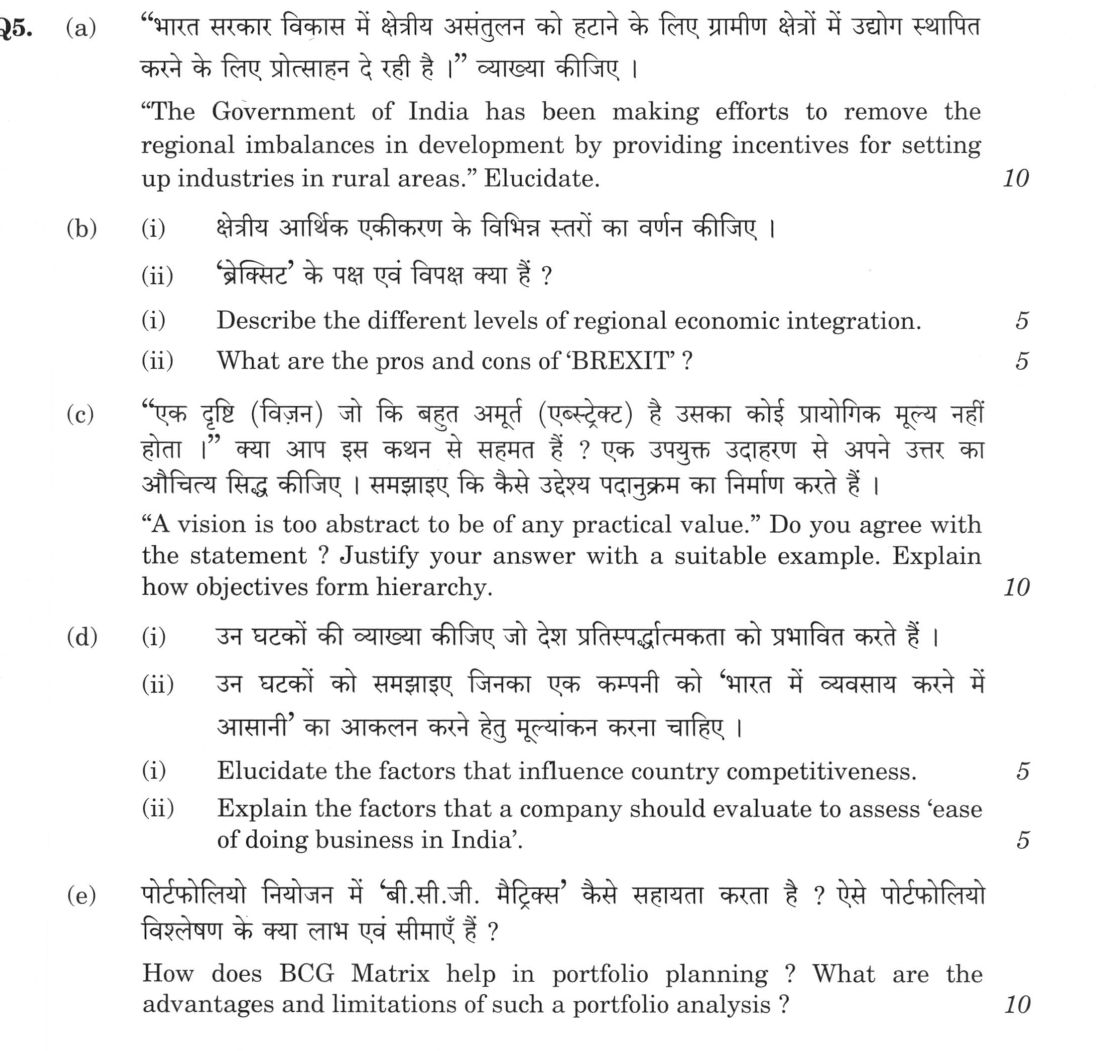
"The Government of India has been making efforts to remove the regional imbalances in development by providing incentives for setting up industries in rural areas." Elucidate. 10 marks
Describe the different levels of regional economic integration. 5 marks
What are the pros and cons of 'BREXIT'? 5 marks
"A vision is too abstract to be of any practical value." Do you agree with the statement? Justify your answer with a suitable example. Explain how objectives form hierarchy. 10 marks
Elucidate the factors that influence country competitiveness. 5 marks
Explain the factors that a company should evaluate to assess 'ease of doing business in India'. 5 marks
How does BCG Matrix help in portfolio planning? What are the advantages and limitations of such a portfolio analysis? 10 marks
हिंदी में प्रश्न पढ़ें
"भारत सरकार विकास में क्षेत्रीय असंतुलन को हटाने के लिए ग्रामीण क्षेत्रों में उद्योग स्थापित करने के लिए प्रोत्साहन दे रही है।" व्याख्या कीजिए। (10 अंक)
क्षेत्रीय आर्थिक एकीकरण के विभिन्न स्तरों का वर्णन कीजिए। (5 अंक)
'ब्रेक्सिट' के पक्ष एवं विपक्ष क्या हैं ? (5 अंक)
"एक दृष्टि (विजन) जो कि बहुत अमूर्त (एब्स्ट्रैक्ट) है उसका कोई प्रायोगिक मूल्य नहीं होता।" क्या आप इस कथन से सहमत हैं ? एक उपयुक्त उदाहरण से अपने उत्तर का औचित्य सिद्ध कीजिए। समझाइए कि कैसे उद्देश्य पदानुक्रम का निर्माण करते हैं। (10 अंक)
उन घटकों की व्याख्या कीजिए जो देश प्रतिस्पर्धात्मकता को प्रभावित करते हैं। (5 अंक)
उन घटकों को समझाइए जिनका एक कंपनी को 'भारत में व्यवसाय करने में आसानी' का आकलन करने हेतु मूल्यांकन करना चाहिए। (5 अंक)
पोर्टफोलियो नियोजन में 'बी.सी.जी. मैट्रिक्स' कैसे सहायता करता है ? ऐसे पोर्टफोलियो विश्लेषण के क्या लाभ एवं सीमाएं हैं ? (10 अंक)
Model answer
Written by UPSC Answer Check against this question's marking rubric, to the expected length. UPSC does not publish answers for Mains — this is one way to score well, not an official key.
The question links macroeconomic policy, regional integration, strategic planning and portfolio analysis. It asks how government policy, international trade arrangements, managerial vision, national competitiveness and strategic tools interact in a business environment.
(a) Rural industrial incentives
The Government of India has tried to reduce regional imbalance by encouraging industry outside metros. Schemes such as ASPIRE, SFURTI and the Cluster Development Programme aim to create rural employment, transfer technology to small clusters and build local value chains. ASPIRE focused on rural employment, SFURTI on technology transfer to clusters, and the Cluster Development Programme on strengthening local industrial ecosystems. Incentives have included tax holidays or exemptions under erstwhile Section 80-IB for industrial undertakings in special areas and Section 80-IC for special category states, along with infrastructure subsidies for power, roads, irrigation, industrial estates and credit support. The logic is that rural industries can use local raw materials, reduce migration, and spread income. However, effectiveness has been mixed. Incentives alone cannot overcome poor logistics, land and power constraints, weak skills, and the agglomeration advantages of cities. Regional imbalance is not only a tax issue; it is a question of market size, connectivity and human capital. Many rural clusters remain dependent on a few commodities, while high-growth industries concentrate in urban corridors. Thus, incentives help, but regional balance requires sustained infrastructure, education, and market access.
(b) Regional integration and Brexit
Regional economic integration has five levels. A Free Trade Area removes tariffs among members but each keeps its own external tariff, as in USMCA. A Customs Union adds a common external tariff, as in the EU’s original customs union. A Common Market allows free movement of goods, services, capital and labour. An Economic Union harmonizes fiscal, monetary and regulatory policies, often with a common currency, as in the eurozone. A Political Union creates supranational political institutions and shared sovereignty. The levels show a trade-off between market access and policy autonomy. For India, such integration matters because FTAs and customs unions affect exports, investment and supply chains. Brexit illustrates both benefits and costs. For the UK, leaving the EU promised sovereignty, control over immigration, and trade autonomy to negotiate its own agreements. In practice, it caused economic disruption: new customs and regulatory friction with the EU, uncertainty for firms, and relocation of financial services from London to Dublin, Frankfurt and Paris. The Northern Ireland Protocol also created a separate customs border in the Irish Sea, raising sovereignty and implementation issues. Thus, integration can deepen markets but exit can be costly.
(c) Vision and objectives
I do not agree that a vision is too abstract to be useful, provided it is translated into objectives. A vision gives direction, identity and a test for strategic choices. ISRO’s vision to make India a leading space power is broad, but it was operationalized through objectives such as reliable PSLV launches, Chandrayaan missions, Mangalyaan, and Gaganyaan. Tata Group’s “Leadership in Life” vision similarly guides businesses across steel, energy, telecom and services, but it gains value only when converted into measurable targets. These objectives made the vision measurable and practical. Objectives form a hierarchy. At the top is the corporate or organizational vision, followed by mission and long-term strategic objectives for five to ten years. These are broken into tactical objectives for business units or departments, and finally operational objectives for teams and projects. For example, ISRO’s strategic objective of lunar exploration leads to tactical objectives for propulsion, navigation and mission control, and operational objectives for launch windows, testing and data analysis. A vision without objectives remains a slogan; objectives without vision become fragmented.
(d) Competitiveness and ease of doing business
Country competitiveness is influenced by the factors in Porter’s Diamond and the World Economic Forum’s Global Competitiveness Index. Factor conditions include infrastructure, human capital and technology. Demand conditions reflect the sophistication of domestic customers. Related and supporting industries determine whether suppliers, logistics and services are efficient. Firm strategy, structure and rivalry shape innovation and productivity. Government policy, macro stability, institutions and chance also matter. In India, strong domestic demand in digital services and manufacturing, plus improving infrastructure, can enhance competitiveness if institutions remain stable. For a company assessing ease of doing business in India, key factors include GST, which simplified indirect taxes but requires compliance discipline; the Insolvency and Bankruptcy Code, which improved debt resolution; labour reforms, including the labour codes, which aim to reduce regulatory complexity; single-window clearance systems, which reduce approval delays; and India’s improved World Bank ranking, which reached 63 in 2020 before the index was discontinued. Ease of doing business is not only about starting a firm; it also includes enforcing contracts, resolving insolvency and complying with taxes. Digital public infrastructure, credit access, land and judicial efficiency also matter.
(e) BCG Matrix
The BCG Matrix helps portfolio planning by classifying businesses or products on two axes: market growth rate and relative market share. Stars have high growth and high share; they require investment to defend leadership. Cash Cows have low growth but high share; they generate cash to fund other units. Question Marks have high growth but low share; management must decide whether to invest or exit. Dogs have low growth and low share; they may be harvested or divested. The logic is to balance the portfolio: use cash cows to support stars and selective question marks, while pruning dogs. It also helps communicate strategy to managers by making investment priorities visible. In Reliance Industries, oil-to-chemicals can be viewed as a cash cow, Jio as a star, retail as a question mark, and some legacy low-growth businesses as dogs. Advantages are simplicity, clear resource allocation, and focus on portfolio balance. Limitations are that it is a static snapshot, ignores synergies, uses market share as a proxy for profitability, and can mislead in dynamic digital markets where growth and share change rapidly. However, it should be used with scenario planning and financial metrics, not as a standalone decision rule.
Together, these parts show that strategy operates at multiple levels. Government incentives, regional integration and national competitiveness shape the macro environment in which firms operate. Within that environment, a firm needs a clear vision, a hierarchy of objectives, and portfolio tools such as the BCG Matrix to allocate resources. For India, reducing regional imbalance, improving ease of doing business, and using strategic management tools will strengthen both national competitiveness and corporate performance.
What "Elucidate" is asking you to do
Make a stated proposition plain and then prove it with instances. Elucidate stems almost always carry a claim or a named concept, and very often the words “with examples” or “with suitable diagrams” — the illustration is part of the directive, not decoration.
Structure that answers it
Plain-language statement of what the proposition means → the part that is obscure, resolved → first illustration → second illustration → why the proposition holds
Where marks are lost
Adding terminology; elucidate rewards removing it. The commoner loss is a clean explanation with no example, when the stem asked for examples.
How this answer will be evaluated
Approach
Framework: BCG Matrix. (a) examine: intro > how/why with reasoning > evidence > conclusion | (b(i)) describe: define > structure or process in order > labelled diagram > significance | (b(ii)) comment: context > arguments both sides > judgment > close | (c) justify: claim > 3-4 reasons > evidence > conclusion | (d(i)) examine: intro > how/why with reasoning > evidence > conclusion | (d(ii)) explain: definition/context > points in order > small example > short close | (e) analyse: intro > causes > effects > stakeholders/linkages > way forward Full marks: Comprehensive, specific examples, clear frameworks, balanced analysis
Key points expected
- Define regional imbalance in development
- List specific incentives (tax/subsidy/infrastructure)
- Name a specific scheme (e.g., MIDH, PMEGP)
- Explain the mechanism of how incentives work
- Define regional economic integration
- List levels (Free Trade Area, Customs Union, etc.)
- Explain each level briefly
- Show progression from lower to higher levels
Evaluation rubric
Each sub-part is marked on its own, against the marks and word limit printed on the paper.
- (a) Explain government efforts to remove regional imbalances via rural industrial incentives. 10 marks
examine— intro → how/why with reasoning → evidence → conclusion
Must cover
- Define regional imbalance in development
- List specific incentives (tax/subsidy/infrastructure)
- Name a specific scheme (e.g., MIDH, PMEGP)
- Explain the mechanism of how incentives work
Loses marks
- Generic discussion without specific schemes
- Ignoring the 'rural' aspect
- No mention of government efforts
Earns more
- Mention specific rural industrial policies
- Reference specific states or regions
- Discuss impact on employment
- Mention infrastructure development
Extra mark
- Cite specific recent policy changes
- Provide data on rural industrial growth
- (b(i)) Describe the different levels of regional economic integration. 5 marks
describe— define → structure or process in order → labelled diagram → significance
Must cover
- Define regional economic integration
- List levels (Free Trade Area, Customs Union, etc.)
- Explain each level briefly
- Show progression from lower to higher levels
Loses marks
- Confusing levels of integration
- Missing key levels
- No explanation of progression
Earns more
- Mention specific examples (EU, NAFTA)
- Explain tariff elimination
- Discuss common market features
- Mention economic union
Extra mark
- Provide a diagram of integration levels
- Cite specific trade agreements
- (b(ii)) Discuss pros and cons of 'BREXIT'. 5 marks
comment— context → arguments both sides → judgment → close
Must cover
- Define BREXIT
- List at least 2 pros
- List at least 2 cons
- Provide balanced judgment
Loses marks
- One-sided argument
- No specific pros or cons
- Ignoring economic implications
Earns more
- Mention sovereignty arguments
- Discuss trade implications
- Reference labor mobility
- Mention regulatory autonomy
Extra mark
- Cite specific economic data
- Reference specific trade deals
- (c) Justify whether vision is too abstract; explain objective hierarchy. 10 marks
justify— claim → 3-4 reasons → evidence → conclusion
Must cover
- State position on the statement
- Provide suitable example
- Explain how objectives form hierarchy
- Link vision to practical objectives
Loses marks
- No clear position on statement
- Missing example
- No explanation of hierarchy
Earns more
- Use real company example
- Show vision-to-objective mapping
- Discuss strategic alignment
- Mention specific organizational goals
Extra mark
- Cite specific company vision statements
- Provide detailed objective hierarchy diagram
- (d(i)) Explain factors influencing country competitiveness. 5 marks
examine— intro → how/why with reasoning → evidence → conclusion
Must cover
- Define country competitiveness
- List key factors (infrastructure, policy, etc.)
- Explain 2-3 factors in detail
- Show how factors interrelate
Loses marks
- Generic list without explanation
- Missing key factors
- No interrelation shown
Earns more
- Mention World Economic Forum framework
- Discuss institutional factors
- Reference market size
- Mention innovation capacity
Extra mark
- Cite specific country examples
- Reference recent competitiveness rankings
- (d(ii)) Explain factors for assessing 'ease of doing business in India'. 5 marks
explain— definition/context → points in order → small example → short close
Must cover
- Define ease of doing business
- List specific factors (regulation, tax, etc.)
- Explain 2-3 factors relevant to India
- Show how company evaluates these
Loses marks
- Generic factors not specific to India
- No explanation of evaluation process
- Missing key business factors
Earns more
- Mention World Bank indicators
- Discuss regulatory environment
- Reference tax structure
- Mention labor laws
Extra mark
- Cite specific Indian reforms
- Reference recent ease of business rankings
- (e) Analyze BCG Matrix in portfolio planning; discuss advantages and limitations. 10 marks
analyse— intro → causes → effects → stakeholders/linkages → way forward
Must cover
- Explain BCG Matrix structure
- Show how it helps in portfolio planning
- List at least 2 advantages
- List at least 2 limitations
Loses marks
- No explanation of matrix structure
- Missing advantages or limitations
- No application to portfolio planning
Earns more
- Draw or describe the matrix
- Mention Stars, Cash Cows, Question Marks, Dogs
- Discuss resource allocation
- Reference market growth and share
Extra mark
- Provide real company portfolio example
- Compare with other portfolio tools
Practice this exact question
Write your answer and it is marked point by point against the model answer above — what you covered, what you missed, what you got wrong.
Evaluate my answer →More from Management 2021 Paper II
- Q2 (a) (i) 'A' can hit a target 4 times in 5 shots, 'B' 3 times in 4 shots and 'C' twice in…
- Q3 (a) (i) What is e-business architecture? Which technological innovations have had a major…
- Q4 (a) (i) How does the balancing line reduce the cost of idleness? Describe the steps invol…
- Q5 (a) "The Government of India has been making efforts to remove the regional imbalances in…
- Q6 (a) (i) What is the rationale behind liberalization strategies adopted by the New Industr…
- Q7 (a) (i) "Generic strategies help a firm to gain and sustain competitive advantage over it…
- Q8 (a) (i) What are the similarities and dissimilarities between domestic operations managem…