Paper II — Q8
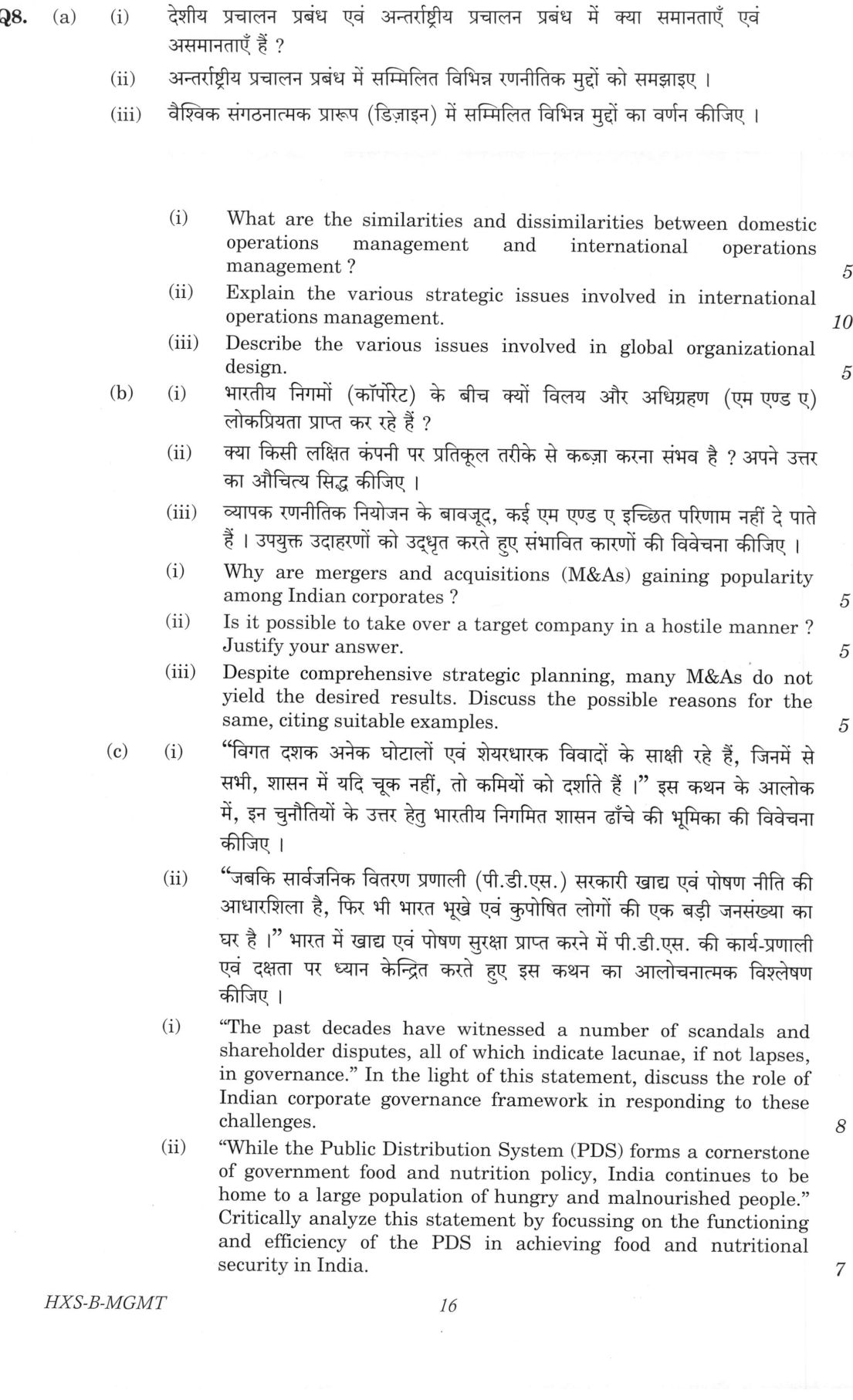
(a) (i) What are the similarities and dissimilarities between domestic operations management and international operations…
What are the similarities and dissimilarities between domestic operations management and international operations management ? 5 marks
Explain the various strategic issues involved in international operations management. 10 marks
Describe the various issues involved in global organizational design. 5 marks
Why are mergers and acquisitions (M&As) gaining popularity among Indian corporates ? 5 marks
Is it possible to take over a target company in a hostile manner ? Justify your answer. 5 marks
Despite comprehensive strategic planning, many M&As do not yield the desired results. Discuss the possible reasons for the same, citing suitable examples. 5 marks
"The past decades have witnessed a number of scandals and shareholder disputes, all of which indicate lacunae, if not lapses, in governance." In the light of this statement, discuss the role of Indian corporate governance framework in responding to these challenges. 8 marks
"While the Public Distribution System (PDS) forms a cornerstone of government food and nutrition policy, India continues to be home to a large population of hungry and malnourished people." Critically analyze this statement by focussing on the functioning and efficiency of the PDS in achieving food and nutritional security in India. 7 marks
हिंदी में प्रश्न पढ़ें
देशीय प्रचालन प्रबंध एवं अंतर्राष्ट्रीय प्रचालन प्रबंध में क्या समानताएँ एवं असमानताएँ हैं ? (5 अंक)
अंतर्राष्ट्रीय प्रचालन प्रबंध में सम्मिलित विभिन्न रणनीतिक मुद्दों को समझाइए । (10 अंक)
वैश्विक संगठनात्मक प्रारूप (डिजाइन) में सम्मिलित विभिन्न मुद्दों का वर्णन कीजिए । (5 अंक)
भारतीय निगमों (कॉर्पोरेट) के बीच क्यों विलय और अधिग्रहण (एम एंड ए) लोकप्रियता प्राप्त कर रहे हैं ? (5 अंक)
क्या किसी लक्षित कंपनी पर प्रतिकूल तरीके से कब्जा करना संभव है ? अपने उत्तर का औचित्य सिद्ध कीजिए । (5 अंक)
व्यापक रणनीतिक नियोजन के बावजूद, कई एम एंड ए इच्छित परिणाम नहीं दे पाते हैं । उपयुक्त उदाहरणों को उद्धृत करते हुए संभावित कारणों की विवेचना कीजिए । (5 अंक)
"विगत दशक अनेक घोटालों एवं शेयरधारक विवादों के साक्षी रहे हैं, जिनमें से सभी, शासन में यदि चूक नहीं, तो कमियों को दर्शाते हैं ।" इस कथन के आलोक में, इन चुनौतियों के उत्तर हेतु भारतीय निगमित शासन ढांचे की भूमिका की विवेचना कीजिए । (8 अंक)
"जबकि सार्वजनिक वितरण प्रणाली (पी.डी.एस.) सरकारी खाद्य एवं पोषण नीति की आधारशिला है, फिर भी भारत भुखे एवं कुपोषित लोगों की एक बड़ी जनसंख्या का घर है ।" भारत में खाद्य एवं पोषण सुरक्षा प्राप्त करने में पी.डी.एस. की कार्य-प्रणाली एवं दक्षता पर ध्यान केंद्रित करते हुए इस कथन का आलोचनात्मक विश्लेषण कीजिए । (7 अंक)
Model answer
Written by UPSC Answer Check against this question's marking rubric, to the expected length. UPSC does not publish answers for Mains — this is one way to score well, not an official key.
Operations management fundamentally transforms inputs into outputs across both domestic and international contexts, sharing core imperatives of quality control, capacity planning, and inventory optimization. However, international operations management diverges sharply in complexity. It must navigate foreign exchange volatility, geopolitical risks, disparate regulatory environments, cross-cultural workforce dynamics, and extended global supply chain coordination.
Strategic Issues and Global Organizational Design
Strategic decision-making in international operations revolves around critical trade-offs: market selection and entry modes (ranging from licensing and joint ventures to wholly-owned foreign direct investment); global supply chain configuration balancing centralized cost efficiencies against local responsiveness; managing currency and political risks; and resolving the tension between product standardization and local adaptation.
Structurally, global organizational design contends with the balance between central control and subsidiary autonomy. Utilizing frameworks such as Bartlett and Ghoshal’s typology, multinational enterprises assign differentiated roles to overseas units, from strategic leaders and contributors to implementers. Firms often adopt transnational matrix structures or global product divisions, requiring sophisticated coordination mechanisms, shared IT infrastructures, and cross-border lateral communication to manage geographic and functional dispersion.
Dynamics, Hostility, and Pitfalls in Mergers and Acquisitions
Indian corporates increasingly deploy mergers and acquisitions (M&As) to secure rapid market access, acquire proprietary technologies, achieve economies of scale, and consolidate fragmented sectors, particularly aided by the Insolvency and Bankruptcy Code (IBC) resolution framework.
Hostile takeovers are legally viable in India under the SEBI (Substantial Acquisition of Shares and Takeovers) Regulations, 2011. While historically rare due to concentrated promoter holdings, hostile bids can succeed through creeping acquisitions, purchasing stakes from institutional block-holders, and triggering mandatory open offers, as demonstrated by Larsen & Toubro’s hostile takeover of Mindtree in 2019.
Despite strategic planning, many M&As fail to create shareholder value. Primary drivers of failure include post-merger cultural incompatibilities, overestimation of operational synergies, inadequate due diligence, and the "winner’s curse" of excessive debt-financed premiums. This was evident in Tata Steel’s debt-laden acquisition of Corus and Daiichi Sankyo’s acquisition of Ranbaxy, which suffered from undisclosed regulatory liabilities.
Corporate Governance and Food Security Governance
Systemic corporate failures like Satyam, IL&FS, and Yes Bank exposed severe lacunae in board oversight, auditor independence, and related-party transactions. The Indian regulatory framework responded robustly through the Companies Act, 2013 and SEBI (Listing Obligations and Disclosure Requirements) Regulations, incorporating Uday Kotak Committee recommendations. These reforms enhanced board diversity, separated the roles of Chairperson and Managing Director, instituted mandatory secretarial audits, and empowered independent directors and Audit Committees to protect minority shareholder interests.
Parallel governance and operational challenges exist in public delivery systems. The Public Distribution System (PDS), institutionalized under the National Food Security Act (NFSA), 2013, provides vital calorie support to over 800 million citizens. However, India still faces persistent malnutrition due to historical operational deficits, including targeting errors, ghost beneficiaries, and diversions. While biometric Aadhaar authentication and end-to-end computerization have curbed leakages—drawing on successful decentralized procurement models in Chhattisgarh and universal PDS in Tamil Nadu—the system remains excessively cereal-centric. To eradicate hidden hunger and stunting, the PDS must pivot from mere calorie delivery toward nutritional security by distributing fortified staples, pulses, and millets.
Operational efficacy, whether in corporate boardrooms executing cross-border strategies or in state-led welfare delivery mechanisms, requires alignment between strategic intent and execution architecture. Sustainable corporate competitiveness demands strict governance and seamless post-merger integration, just as national nutritional security requires modernizing supply chains and diversifying public food baskets.
What "Discuss" is asking you to do
Lay the issue out from more than one side — how it arose, what is claimed for it, what is held against it, and where it now stands. UPSC attaches discuss to broad topics with several live dimensions, so coverage of the dimensions earns more than the strength of your opinion.
Structure that answers it
Set the issue up → the case as it is made → the case against → the dimension both sides leave out → where the balance now lies
Where marks are lost
Listing facts with no thread between them, or arguing one side throughout and calling it a discussion.
How this answer will be evaluated
Approach
Framework: null. (a(i)) compare: paired headings or table > key differences > significance > conclusion | (a(ii)) explain: definition/context > points in order > small example > short close | (a(iii)) describe: define > structure or process in order > labelled diagram > significance | (b(i)) account for: state the phenomenon > the causes in order of weight > conclusion | (b(ii)) justify: claim > 3-4 reasons > evidence > conclusion | (b(iii)) discuss: intro > 3-4 dimensions > example > balanced close | (c(i)) discuss: intro > 3-4 dimensions > example > balanced close | (c(ii)) critique: the claim > its strengths > its weaknesses > your judgment Full marks: Comprehensive, well-structured, uses specific frameworks/examples, addresses all parts of the prompt.
Key points expected
- Identify at least 3 similarities
- Identify at least 3 dissimilarities
- Reference specific OM functions (e.g., logistics, quality)
- Highlight environmental complexity difference
- Discuss global sourcing and supply chain strategy
- Address location decisions and market entry modes
- Explain impact of political/legal environments
- Mention currency and exchange rate risks
Evaluation rubric
Each sub-part is marked on its own, against the marks and word limit printed on the paper.
- (a(i)) Paired comparison of domestic vs international operations management. 5 marks
compare— paired headings or table → key differences → significance → conclusion
Must cover
- Identify at least 3 similarities
- Identify at least 3 dissimilarities
- Reference specific OM functions (e.g., logistics, quality)
- Highlight environmental complexity difference
Loses marks
- Listing points without comparative analysis
- Ignoring the 'dissimilarities' aspect
Earns more
- Use of a comparison table
- Mention of cultural/linguistic barriers
- Reference to supply chain scope
Extra mark
- Citation of a specific international standard (e.g., ISO)
- (a(ii)) Detailed explanation of strategic issues in international operations. 10 marks
explain— definition/context → points in order → small example → short close
Must cover
- Discuss global sourcing and supply chain strategy
- Address location decisions and market entry modes
- Explain impact of political/legal environments
- Mention currency and exchange rate risks
Loses marks
- Treating as general management issues
- Lack of specific operational focus
Earns more
- Reference to 'Global vs. Multi-domestic' strategy
- Discussion of technology transfer issues
- Mention of ethical/cultural challenges
Extra mark
- Example of a specific company's global strategy
- (a(iii)) Description of issues in global organizational design. 5 marks
describe— define → structure or process in order → labelled diagram → significance
Must cover
- Define global organizational design
- Discuss structural choices (e.g., matrix, global product)
- Mention coordination and control mechanisms
- Address cultural integration in structure
Loses marks
- Confusing with general HR issues
- Vague description without structural terms
Earns more
- Reference to 'Transnational' structure
- Mention of decision-making decentralization
Extra mark
- Simple diagram of a global structure
- (b(i)) Reasons for the popularity of M&As among Indian corporates. 5 marks
account for— state the phenomenon → the causes in order of weight → conclusion
Must cover
- Mention rapid market entry and expansion
- Discuss acquisition of technology/IP
- Reference diversification and synergy
- Mention competitive pressure/globalization
Loses marks
- Generic business reasons without M&A context
- Ignoring the 'Indian' context
Earns more
- Reference to 'Brownfield' vs 'Greenfield' investment
- Mention of regulatory ease (SEBI/CCI)
Extra mark
- Citation of a recent high-profile Indian M&A
- (b(ii)) Justification of the possibility of hostile takeovers. 5 marks
justify— claim → 3-4 reasons → evidence → conclusion
Must cover
- Define hostile takeover
- Explain the mechanism (open market/tender offer)
- Mention legal/regulatory feasibility in India
- Justify with reasons (e.g., undervalued assets)
Loses marks
- Confusing with friendly takeovers
- Failing to address the 'possibility' aspect
Earns more
- Reference to SEBI Takeover Regulations
- Mention of 'White Knight' defense
Extra mark
- Example of a hostile takeover attempt in India
- (b(iii)) Discussion of reasons for M&A failures despite planning. 5 marks
discuss— intro → 3-4 dimensions → example → balanced close
Must cover
- Mention cultural incompatibility
- Discuss integration challenges (systems/people)
- Reference overvaluation/financial mismanagement
- Cite at least one suitable example
Loses marks
- No examples cited
- Vague reasons like 'bad luck'
Earns more
- Mention of 'Synergy' failure
- Reference to management distraction
Extra mark
- Specific example like Dabur-Vim or similar
- (c(i)) Role of Indian corporate governance framework in addressing scandals. 8 marks
discuss— intro → 3-4 dimensions → example → balanced close
Must cover
- Reference to SEBI LODR Regulations
- Mention role of independent directors
- Discuss audit committee and whistleblower mechanisms
- Link framework to specific challenges (scandels/disputes)
Loses marks
- General talk on ethics without legal framework
- Ignoring the 'Indian' context
Earns more
- Reference to Companies Act 2013
- Mention of 'Comply or Explain' principle
- Reference to NCLT role
Extra mark
- Reference to a specific recent governance reform
- (c(ii)) Critical analysis of PDS efficiency in food security. 7 marks
critique— the claim → its strengths → its weaknesses → your judgment
Must cover
- Acknowledge PDS as a cornerstone
- Identify specific inefficiencies (leakage, exclusion)
- Discuss nutritional gaps (protein/micronutrients)
- Provide a balanced judgment on its effectiveness
Loses marks
- Purely negative or purely positive view
- Ignoring the 'functioning and efficiency' aspect
Earns more
- Mention of 'Direct Benefit Transfer' (DBT)
- Reference to 'One Nation One Ration Card'
- Mention of 'Mid-Day Meal' scheme linkage
Extra mark
- Citation of specific data on malnutrition rates
Practice this exact question
Write your answer and it is marked point by point against the model answer above — what you covered, what you missed, what you got wrong.
Evaluate my answer →More from Management 2021 Paper II
- Q5 (a) "The Government of India has been making efforts to remove the regional imbalances in…
- Q6 (a) (i) What is the rationale behind liberalization strategies adopted by the New Industr…
- Q7 (a) (i) "Generic strategies help a firm to gain and sustain competitive advantage over it…
- Q8 (a) (i) What are the similarities and dissimilarities between domestic operations managem…