Paper II — Q7
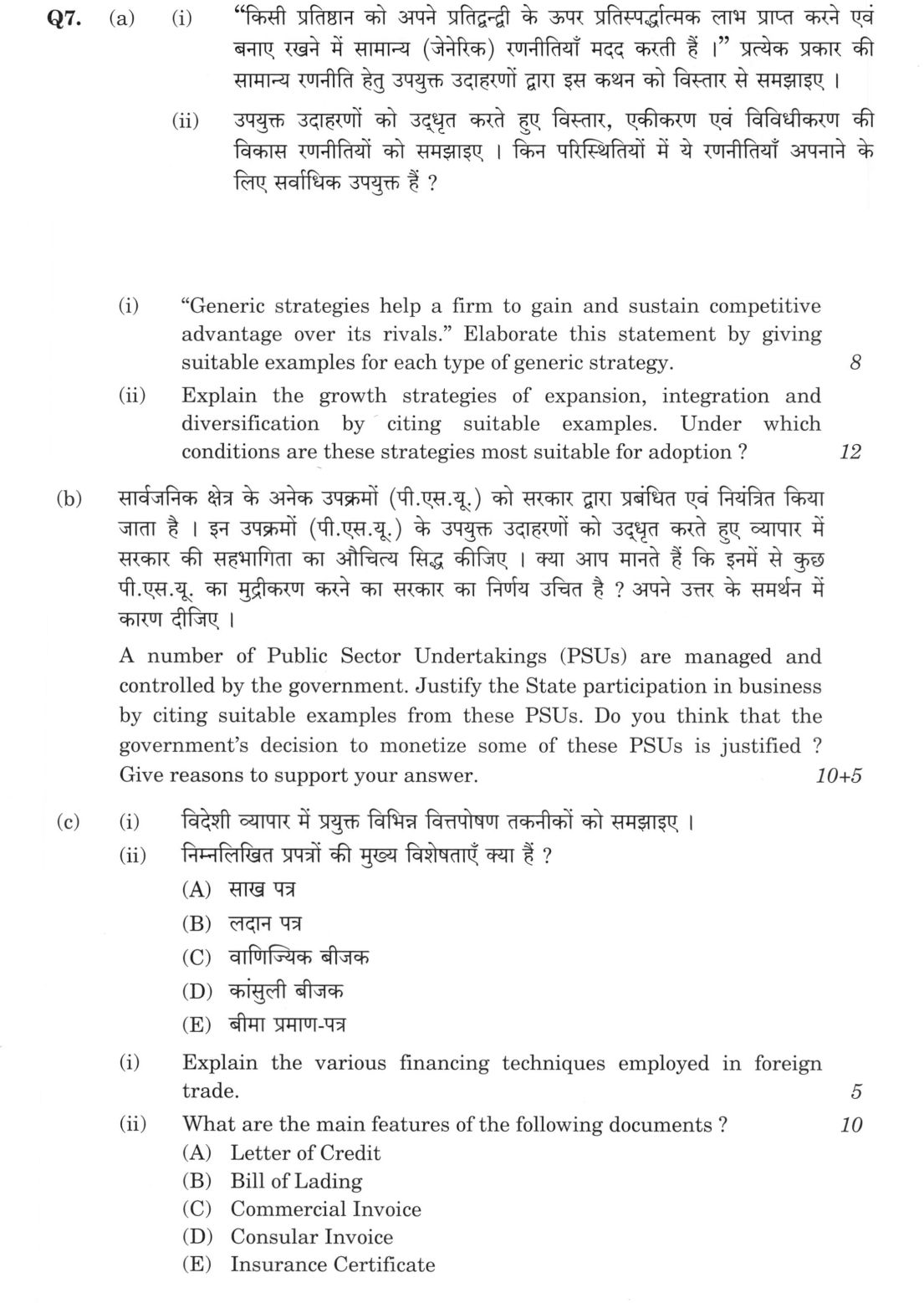
(a) (i) "Generic strategies help a firm to gain and sustain competitive advantage over its rivals." Elaborate this statement by…
"Generic strategies help a firm to gain and sustain competitive advantage over its rivals." Elaborate this statement by giving suitable examples for each type of generic strategy. 8 marks
Explain the growth strategies of expansion, integration and diversification by citing suitable examples. Under which conditions are these strategies most suitable for adoption ? 12 marks
A number of Public Sector Undertakings (PSUs) are managed and controlled by the government. Justify the State participation in business by citing suitable examples from these PSUs. Do you think that the government's decision to monetize some of these PSUs is justified ? Give reasons to support your answer. (10+5 marks)
Explain the various financing techniques employed in foreign trade. 5 marks
What are the main features of the following documents ? (10 marks) (A) Letter of Credit (B) Bill of Lading (C) Commercial Invoice (D) Consular Invoice (E) Insurance Certificate
हिंदी में प्रश्न पढ़ें
"किसी प्रतिष्ठान को अपने प्रतिद्वंद्वी के ऊपर प्रतिस्पर्धात्मक लाभ प्राप्त करने एवं बनाए रखने में सामान्य (जेनेरिक) रणनीतियाँ मदद करती हैं ।" प्रत्येक प्रकार की सामान्य रणनीति हेतु उपयुक्त उदाहरणों द्वारा इस कथन को विस्तार से समझाइए । (8 अंक)
उपयुक्त उदाहरणों को उद्धृत करते हुए विस्तार, एकीकरण एवं विविधीकरण की विकास रणनीतियों को समझाइए । किन परिस्थितियों में ये रणनीतियाँ अपनाने के लिए सर्वाधिक उपयुक्त हैं ? (12 अंक)
सार्वजनिक क्षेत्र के अनेक उपक्रमों (पी.एस.यू.) को सरकार द्वारा प्रबंधित एवं नियंत्रित किया जाता है । इन उपक्रमों (पी.एस.यू.) के उपयुक्त उदाहरणों को उद्धृत करते हुए व्यापार में सरकार की सहभागिता का औचित्य सिद्ध कीजिए । क्या आप मानते हैं कि इनमें से कुछ पी.एस.यू. का मुद्रीकरण करने का सरकार का निर्णय उचित है ? अपने उत्तर के समर्थन में कारण दीजिए । (10+5 अंक)
विदेशी व्यापार में प्रयुक्त विभिन्न वित्तपोषण तकनीकों को समझाइए । (5 अंक)
निम्नलिखित प्रपत्रों की मुख्य विशेषताएँ क्या हैं ? (10 अंक) (A) साख पत्र (B) लदान पत्र (C) वाणिज्यिक बीजक (D) कांसुली बीजक (E) बीमा प्रमाण-पत्र
Model answer
Written by UPSC Answer Check against this question's marking rubric, to the expected length. UPSC does not publish answers for Mains — this is one way to score well, not an official key.
Generic Strategies and Competitive Advantage
Michael Porter’s generic strategies help firms achieve above-average industry returns by establishing defensible market positioning:
Cost Leadership: Targets a broad market by becoming the lowest-cost producer through scale economies, proprietary technology, and lean operations. For instance, Amul maintains cost leadership in dairy via its vertically integrated cooperative supply chain, while IndiGo leverages a standardized single-aircraft fleet for low unit costs.
Differentiation: Creates products perceived as unique across industry-wide dimensions such as design, brand equity, or customer service, commanding price premiums. For example, Titan differentiates via premium sub-brands (Tanishq, Fastrack) and superior retail design.
Focus: Concentrates on a narrow competitive segment or niche. It branches into Cost Focus (e.g., regional low-cost airlines or localized fast-moving consumer goods) and Differentiation Focus (e.g., Forest Essentials targeting high-end luxury Ayurvedic personal care).
Growth Strategies and Conditions for Adoption
Expansion: Involves market penetration (deepening reach in existing markets) or market development (entering new geographies/segments). It is most suitable when the current industry is growing, market share gains are viable, and core capabilities can be scaled without substantial changes in product architecture.
Integration: Involves expanding value chain activities. Backward integration absorbs upstream supplier functions (e.g., Reliance Industries integrating backward from textiles into petrochemicals and refining to secure raw materials). Forward integration captures downstream distribution (e.g., Raymond establishing company-owned retail outlets). Integration is optimal when supplier/buyer bargaining power is high, market transaction costs are prohibitive, or supply certainty is critical.
Diversification: Expands into new products and markets. Concentric diversification shares technological or marketing synergies with core lines (e.g., ITC expanding from tobacco to packaged foods). Conglomerate diversification enters unrelated domains (e.g., Tata Group operating from steel to software). Diversification is appropriate when existing core markets face saturation, regulatory ceilings, or when surplus cash flows can generate higher returns by spreading risk across counter-cyclical industries.
State Participation in Business and Asset Monetization
State participation through Public Sector Undertakings (PSUs) is justified by the mandate to occupy the "commanding heights" of the economy, overcome market failures, mobilize large capital outlays with long gestation periods, and drive balanced regional development. Strategic PSUs such as ONGC secure domestic energy reserves; SAIL established foundational industrial infrastructure in underdeveloped regions; and BHEL anchored self-reliance in heavy electrical manufacturing while generating mass employment and equitable social capital.
The government’s decision to monetize non-core and brownfield PSU infrastructure under the National Monetization Pipeline (NMP) is justified. It unlocks the value of locked public capital to finance new greenfield infrastructure without relinquishing sovereign asset ownership. It also induces private sector operational efficiencies. However, monetization must be calibrated: asset leasing should not create private monopolies, inflate user tariffs, or compromise public interest services. Transparent regulatory frameworks, as recommended by the Kelkar Committee, are essential to safeguard the public interest.
Foreign Trade Financing Techniques
Trade financing resolves liquidity gaps and cross-border payment risks through:
Pre-shipment Finance (Packing Credit): Concessional working capital extended to exporters for procuring raw materials, manufacturing, and packing goods prior to shipment.
Post-shipment Finance: Liquidity provided against accepted shipping documents through discounting, negotiation, or purchase of export bills before realization.
Trade Credit: Comprises Supplier’s Credit (short-term credit extended by the overseas supplier) and Buyer’s Credit (short-term loans arranged by the importer from offshore banks against a Letter of Undertaking).
Factoring and Forfaiting: Receivables financing where an intermediary buys trade debts. Factoring handles short-term trade receivables; forfaiting finances medium-to-long-term capital goods exports on a non-recourse basis.
Features of Key Export Documents
Letter of Credit (LC): A financial commitment issued by an importer's bank guaranteeing payment to the exporter, provided stipulated documents strictly complying with Uniform Customs and Practice for Documentary Credits (UCP 600) terms are presented.
Bill of Lading (B/L): A quasi-negotiable document of title issued by a shipping carrier. It acts as a receipt of goods, evidence of the contract of carriage, and a transferable document enabling ownership transfer via endorsement.
Commercial Invoice: The primary accounting document issued by the seller detailing item descriptions, quantities, unit prices, total value, and Incoterms, serving as the legal basis for customs assessment and payment claims.
Consular Invoice: A document certified or legalized by the importing country’s consulate located in the exporting nation, verifying the authentic value and origin of merchandise to prevent customs duty fraud.
Insurance Certificate: Evidences specific marine cargo risk coverage for goods in transit, outlining covered perils, valuation, and claims procedures to protect against voyage loss or damage.
Aligning generic positioning with integrated growth strategies allows domestic firms to build scalable global competitiveness. Simultaneously, optimizing public capital through asset monetization and leveraging modern trade financing structures ensures that both private and state enterprises navigate external trade risks and sustain long-term economic expansion.
What "Elaborate" is asking you to do
Give the full detailed account the question has compressed into a line — every dimension of it, with specifics. Elaborate rewards completeness and detail rather than clarification or argument: the examiner is checking whether you can fill out a topic without being told what its parts are.
Structure that answers it
State the proposition → first dimension in detail → second dimension in detail → the part the statement leaves implicit → the consolidated picture
Where marks are lost
Repeating the statement at greater length instead of adding substance. Elaborate also punishes narrowness: omitting a whole dimension costs more here than anywhere else in this family.
How this answer will be evaluated
Approach
Framework: Porter's Generic Strategies; Ansoff Matrix; ITC Rules. (a(i)) explain: definition/context > points in order > small example > short close | (a(ii)) explain: definition/context > points in order > small example > short close | (b) justify: claim > 3-4 reasons > evidence > conclusion | (c(i)) explain: definition/context > points in order > small example > short close | (c(ii)) describe: define > structure or process in order > labelled diagram > significance Full marks: Comprehensive coverage of all points with specific examples and clear reasoning.
Key points expected
- Define generic strategies and competitive advantage
- Explain Cost Leadership with example
- Explain Differentiation with example
- Explain Focus strategy with example
- Define and exemplify expansion strategy
- Define and exemplify integration (vertical/horizontal)
- Define and exemplify diversification (related/unrelated)
- State conditions for adopting each strategy
Evaluation rubric
Each sub-part is marked on its own, against the marks and word limit printed on the paper.
- (a(i)) Elaborate generic strategies for competitive advantage with examples. 8 marks
explain— definition/context → points in order → small example → short close
Must cover
- Define generic strategies and competitive advantage
- Explain Cost Leadership with example
- Explain Differentiation with example
- Explain Focus strategy with example
Loses marks
- Defining strategies without examples
- Confusing generic strategies with functional strategies
Earns more
- Mention Porter's framework explicitly
- Distinguish between cost focus and differentiation focus
- Link strategy to sustaining advantage
Extra mark
- Cite a specific recent corporate example
- Mention the 'stuck in the middle' risk
- (a(ii)) Explain expansion, integration, and diversification strategies with examples and conditions. 12 marks
explain— definition/context → points in order → small example → short close
Must cover
- Define and exemplify expansion strategy
- Define and exemplify integration (vertical/horizontal)
- Define and exemplify diversification (related/unrelated)
- State conditions for adopting each strategy
Loses marks
- Listing strategies without conditions for adoption
- Failing to distinguish between types of integration
Earns more
- Use Ansoff Matrix as a framework
- Distinguish between internal and external growth
- Provide specific industry examples for each
Extra mark
- Reference specific M&A case studies
- Discuss synergy in integration
- (b) Justify state participation in PSUs and evaluate the decision to monetize them. 15 marks
justify— claim → 3-4 reasons → evidence → conclusion
Must cover
- Justify state participation with PSU examples
- State reasons for government decision to monetize
- Provide arguments supporting the monetization decision
- Provide arguments against or risks of monetization
Loses marks
- Generalizing without specific PSU examples
- Failing to provide a balanced view on monetization
Earns more
- Mention specific PSUs (e.g., SBI, LIC, ONGC)
- Discuss fiscal deficit reduction as a motive
- Address the 'strategic sectors' argument
Extra mark
- Cite specific recent disinvestment targets
- Reference the 'Golden Share' concept
- (c(i)) Explain various financing techniques employed in foreign trade. 5 marks
explain— definition/context → points in order → small example → short close
Must cover
- Define foreign trade financing
- Explain at least 3 distinct techniques
- Mention the role of banks or financial institutions
- Briefly explain the mechanism of each technique
Loses marks
- Listing techniques without explaining how they work
- Confusing domestic trade finance with foreign trade finance
Earns more
- Mention Export Credit Guarantee Corporation (ECGC)
- Distinguish between pre-shipment and post-shipment finance
- Reference specific instruments like LC or SBLC
Extra mark
- Mention specific government schemes (e.g., ECGC)
- Reference specific international bodies (e.g., IFC)
- (c(ii)) Describe the main features of the five listed trade documents. 10 marks
describe— define → structure or process in order → labelled diagram → significance
Must cover
- Define Letter of Credit and its function
- Define Bill of Lading and its function
- Define Commercial Invoice and its function
- Define Consular Invoice and Insurance Certificate
Loses marks
- Providing only definitions without features
- Confusing the functions of different documents
Earns more
- Mention the parties involved in each document
- Explain the legal significance of each document
- Distinguish between negotiable and non-negotiable documents
Extra mark
- Reference UCP 600 for LC
- Mention specific clauses in Bill of Lading
Practice this exact question
Write your answer and it is marked point by point against the model answer above — what you covered, what you missed, what you got wrong.
Evaluate my answer →More from Management 2021 Paper II
- Q4 (a) (i) How does the balancing line reduce the cost of idleness? Describe the steps invol…
- Q5 (a) "The Government of India has been making efforts to remove the regional imbalances in…
- Q6 (a) (i) What is the rationale behind liberalization strategies adopted by the New Industr…
- Q7 (a) (i) "Generic strategies help a firm to gain and sustain competitive advantage over it…
- Q8 (a) (i) What are the similarities and dissimilarities between domestic operations managem…