Paper II — Q4
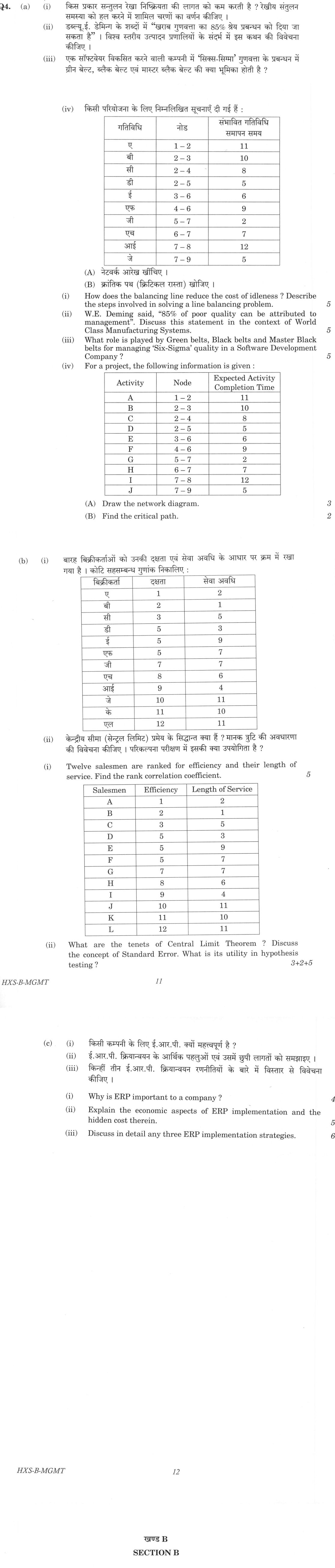
(a) (i) How does the balancing line reduce the cost of idleness? Describe the steps involved in solving a line balancing problem…
How does the balancing line reduce the cost of idleness? Describe the steps involved in solving a line balancing problem. 5 marks
W.E. Deming said, "85% of poor quality can be attributed to management". Discuss this statement in the context of World Class Manufacturing Systems. 5 marks
What role is played by Green belts, Black belts and Master Black belts for managing 'Six-Sigma' quality in a Software Development Company? 5 marks
For a project, the following information is given:
| Activity | Node | Expected Activity Completion Time |
|---|---|---|
| A | 1 – 2 | 11 |
| B | 2 – 3 | 10 |
| C | 2 – 4 | 8 |
| D | 2 – 5 | 5 |
| E | 3 – 6 | 6 |
| F | 4 – 6 | 9 |
| G | 5 – 7 | 2 |
| H | 6 – 7 | 7 |
| I | 7 – 8 | 12 |
| J | 7 – 9 | 5 |
(A) Draw the network diagram. 3 marks (B) Find the critical path. 2 marks
Twelve salesmen are ranked for efficiency and their length of service. Find the rank correlation coefficient.
| Salesmen | Efficiency | Length of Service |
|---|---|---|
| A | 1 | 2 |
| B | 2 | 1 |
| C | 3 | 5 |
| D | 5 | 3 |
| E | 5 | 9 |
| F | 5 | 7 |
| G | 7 | 7 |
| H | 8 | 6 |
| I | 9 | 4 |
| J | 10 | 11 |
| K | 11 | 10 |
| L | 12 | 11 |
What are the tenets of Central Limit Theorem? Discuss the concept of Standard Error. What is its utility in hypothesis testing? 3+2+5 marks
Why is ERP important to a company? 4 marks
Explain the economic aspects of ERP implementation and the hidden cost therein. 5 marks
Discuss in detail any three ERP implementation strategies. 6 marks
हिंदी में प्रश्न पढ़ें
किस प्रकार संतुलन रेखा निश्चितता की लागत को कम करती है? रेखीय संतुलन समस्या को हल करने में शामिल चरणों का वर्णन कीजिए।
डब्ल्यू.ई. डेमिंग के शब्दों में "खराब गुणवत्ता का 85% श्रेय प्रबंधन को दिया जा सकता है"। विश्व स्तरीय उत्पादन प्रणालियों के संदर्भ में इस कथन की विवेचना कीजिए।
एक सॉफ्टवेयर विकसित करने वाली कंपनी में 'सिक्स-सिग्मा' गुणवत्ता के प्रबंधन में ग्रीन बेल्ट, ब्लैक बेल्ट एवं मास्टर ब्लैक बेल्ट की क्या भूमिका होती है?
किसी परियोजना के लिए निम्नलिखित सूचनाएं दी गई हैं:
| गतिविधि | नोड | संभावित गतिविधि समापन समय |
|---|---|---|
| ए | 1 – 2 | 11 |
| बी | 2 – 3 | 10 |
| सी | 2 – 4 | 8 |
| डी | 2 – 5 | 5 |
| ई | 3 – 6 | 6 |
| एफ | 4 – 6 | 9 |
| जी | 5 – 7 | 2 |
| एच | 6 – 7 | 7 |
| आई | 7 – 8 | 12 |
| जे | 7 – 9 | 5 |
(A) नेटवर्क आरेख खींचिए। (B) क्रांतिक पथ (क्रिटिकल रास्ता) खोजिए।
बारह बिक्रीकर्ताओं को उनकी दक्षता एवं सेवा अवधि के आधार पर क्रम में रखा गया है। कोटि सहसंबंध गुणांक निकालिए:
| बिक्रीकर्ता | दक्षता | सेवा अवधि |
|---|---|---|
| ए | 1 | 2 |
| बी | 2 | 1 |
| सी | 3 | 5 |
| डी | 5 | 3 |
| ई | 5 | 9 |
| एफ | 5 | 7 |
| जी | 7 | 7 |
| एच | 8 | 6 |
| आई | 9 | 4 |
| जे | 10 | 11 |
| के | 11 | 10 |
| एल | 12 | 11 |
केन्द्रीय सीमा (सेन्ट्रल लिमिट) प्रमेय के सिद्धान्त क्या हैं? मानक त्रुटि की अवधारणा की विवेचना कीजिए। परिकल्पना परीक्षण में इसकी क्या उपयोगिता है?
किसी कम्पनी के लिए ई.आर.पी. क्यों महत्त्वपूर्ण है?
ई.आर.पी. क्रियान्वयन के आर्थिक पहलुओं एवं उसमें छुपी लागतों को समझाइए।
किन्हीं तीन ई.आर.पी. क्रियान्वयन रणनीतियों के बारे में विस्तार से विवेचना कीजिए।
Model answer
Written by UPSC Answer Check against this question's marking rubric, to the expected length. UPSC does not publish answers for Mains — this is one way to score well, not an official key.
Line balancing. Balancing a line reduces the cost of idleness by equalising the work content of stations to the takt/cycle time, so that no station waits excessively, WIP and labour cost fall, and balance delay is minimised. The steps are: estimate demand and cycle time; list tasks, times and precedence; compute minimum stations N=Σt/C; assign tasks using heuristics such as longest task, most followers or ranked positional weight; check precedence and station time; compute efficiency Σt/(NC) and balance delay; iterate until cost is acceptable.
Deming’s 85% rule. Deming’s statement means most poor quality arises from systems, processes, training and supplier choices controlled by management, not from workers. In World Class Manufacturing this shifts responsibility to management for reducing variation, kaizen, total productive maintenance, supplier quality, employee empowerment and continuous improvement, as seen in Indian auto and electronics plants that use quality circles and JIT rather than blaming operators.
Six Sigma belts. In a software company, belts manage quality through DMAIC. Green belts work part-time, collect defect data and run small projects. Black belts lead full-time projects, use statistical tools, automate code reviews and release management, and reduce defect escape. Master Black belts deploy the programme, train belts, design methodology and manage the portfolio.
Network and critical path. Draw nodes 1 to 9 with arcs A 1–2, B 2–3, C 2–4, D 2–5, E 3–6, F 4–6, G 5–7, H 6–7, I 7–8 and J 7–9. The paths 1-2-3-6-7-8, 1-2-3-6-7-9, 1-2-4-6-7-8, 1-2-4-6-7-9, 1-2-5-7-8 and 1-2-5-7-9 have lengths 44, 37, 45, 38, 30 and 23; the critical path is A-C-F-H-I, i.e. 1-2-4-6-7-8, with 45 days.
Rank correlation. Assign midranks to ties: efficiency D,E,F =5; service F,G=7.5 and J,L=11.5. Σd²=64.5. The exact Spearman coefficient, computed as Pearson correlation on midranks, is approximately +0.770, indicating a moderate positive relationship between efficiency and length of service.
CLT and standard error. The Central Limit Theorem states that for large n, usually n≥30, the sampling distribution of the mean is approximately normal with mean μ and variance σ²/n, even if the population is not normal. Standard error is σ/√n, or s/√n when σ is unknown; it measures the variability of sample means around the population mean. It forms the denominator of the z-statistic, (x̄−μ)/(σ/√n). In hypothesis testing it is used to build z-tests and confidence intervals, calculate p-values, determine required sample size, and justify normal approximation for proportions.
ERP importance. ERP is important because it integrates finance, inventory, production, HR and sales into one real-time database, improving supply-chain coordination, regulatory compliance such as GST, and decision support; for Indian MSMEs it supports digitisation and audit trails.
ERP economics. Economically, ERP implementation involves total cost of ownership: software licences, hardware, implementation, training and maintenance. Hidden costs include excessive customisation, data migration errors, change-management resistance, productivity dip, vendor lock-in, and post-implementation support. These can exceed licence costs if not controlled.
ERP strategies. Three implementation strategies are Big Bang, Phased and Parallel/pilot. Big Bang converts all modules and sites at once; it is fast and avoids dual running, but high risk and disruptive. Phased implementation rolls out modules or sites sequentially, reducing risk and allowing learning, but may create interface problems and longer duration. Parallel/pilot runs the new system alongside the old in a limited process or site, giving validation and lower risk, though it is costlier and slower. Big Bang suits small firms; phased suits large multi-site; parallel suits high-risk finance or production. A careful choice depends on company size, process complexity and change readiness.
Thus, line balancing, quality systems, statistical inference and ERP choices all show that performance depends on well-designed management systems, not isolated efforts.
What "Discuss" is asking you to do
Lay the issue out from more than one side — how it arose, what is claimed for it, what is held against it, and where it now stands. UPSC attaches discuss to broad topics with several live dimensions, so coverage of the dimensions earns more than the strength of your opinion.
Structure that answers it
Set the issue up → the case as it is made → the case against → the dimension both sides leave out → where the balance now lies
Where marks are lost
Listing facts with no thread between them, or arguing one side throughout and calling it a discussion.
How this answer will be evaluated
Approach
Framework: CPM/PERT, Spearman's Rank, Central Limit Theorem, ERP Implementation. (a(i)) describe: define > structure or process in order > labelled diagram > significance | (a(ii)) discuss: intro > 3-4 dimensions > example > balanced close | (a(iii)) explain: definition/context > points in order > small example > short close | (a(iv)(a)) map: locate accurately > label > one line on why it matters | (a(iv)(b)) calculate: given > formula > substitution > result with units > interpretation | (b(i)) calculate: given > formula > substitution > result with units > interpretation | (b(ii)) explain: definition/context > points in order > small example > short close | (c(i)) justify: claim > 3-4 reasons > evidence > conclusion | (c(ii)) explain: definition/context > points in order > small example > short close | (c(iii)) discuss: intro > 3-4 dimensions > example > balanced close Full marks: Accurate calculations, clear diagrams, deep conceptual understanding with real-world application.
Key points expected
- Define line balancing and its cost impact
- List steps: task times, precedence, cycle time
- Mention heuristic methods (e.g., Ranked Positional Weight)
- Link balancing to reduced idle time
- Explain the 85/15 rule (system vs individual)
- Link to WCM pillars (quality, cost, delivery)
- Discuss management's role in system design
- Provide a balanced view of the statement
Evaluation rubric
Each sub-part is marked on its own, against the marks and word limit printed on the paper.
- (a(i)) Explain how line balancing reduces idleness and list the solution steps. 5 marks
describe— define → structure or process in order → labelled diagram → significance
Must cover
- Define line balancing and its cost impact
- List steps: task times, precedence, cycle time
- Mention heuristic methods (e.g., Ranked Positional Weight)
- Link balancing to reduced idle time
Loses marks
- Vague definition without steps
- Confusing line balancing with leveling
Earns more
- Mention efficiency calculation
- Reference specific heuristic algorithms
Extra mark
- Real-world assembly line example
- (a(ii)) Analyze Deming's 85% management responsibility claim in WCM context. 5 marks
discuss— intro → 3-4 dimensions → example → balanced close
Must cover
- Explain the 85/15 rule (system vs individual)
- Link to WCM pillars (quality, cost, delivery)
- Discuss management's role in system design
- Provide a balanced view of the statement
Loses marks
- Blaming workers for quality issues
- Ignoring the 'system' aspect of management
Earns more
- Reference Deming's 14 points
- Mention specific WCM tools (TQM, Kaizen)
Extra mark
- Cite a specific company's quality turnaround
- (a(iii)) Define roles of Green, Black, and Master Black belts in software Six Sigma. 5 marks
explain— definition/context → points in order → small example → short close
Must cover
- Define Green Belt role (part-time, basic tools)
- Define Black Belt role (full-time, project lead)
- Define Master Black Belt role (mentor, strategy)
- Contextualize for software development (e.g., bug reduction)
Loses marks
- Confusing belt levels or responsibilities
- Generic quality talk without software context
Earns more
- Mention specific software metrics (defect density)
- Reference DMAIC phases
Extra mark
- Example of a software process improvement project
- (a(iv)(a)) Draw the network diagram based on the provided activity table. 3 marks
map— locate accurately → label → one line on why it matters
Must cover
- Correct nodes (1-9) and activities (A-J)
- Accurate arrows showing precedence
- Label activities and durations clearly
Loses marks
- Missing activities or incorrect node connections
- Illegible or unlabeled diagram
Earns more
- Use of standard AON or AOA notation
- Clear, legible diagram layout
Extra mark
- Highlighting parallel paths visually
- (a(iv)(b)) Identify the critical path and its total duration. 2 marks
calculate— given → formula → substitution → result with units → interpretation
Must cover
- List all possible paths from start to end
- Calculate duration for each path
- Identify the longest path as critical
- State the total project duration
Loses marks
- Incorrect path duration calculation
- Failing to identify the longest path
Earns more
- Showing path calculations explicitly
- Identifying float for non-critical activities
Extra mark
- Mentioning impact of delay on critical path
- (b(i)) Compute the rank correlation coefficient for the given data. 5 marks
calculate— given → formula → substitution → result with units → interpretation
Must cover
- Handle tied ranks correctly (average ranks)
- Calculate d^2 (sum of squared differences)
- Apply Spearman's formula correctly
- State the final coefficient value
Loses marks
- Ignoring tied ranks in calculation
- Arithmetic errors in d^2 or formula application
Earns more
- Showing the table of ranks and differences
- Interpreting the strength of correlation
Extra mark
- Mentioning the significance of the correlation
- (b(ii)) Explain CLT tenets, Standard Error, and its utility in hypothesis testing. 10 marks
explain— definition/context → points in order → small example → short close
Must cover
- State CLT: sample mean distribution approaches normal
- Define Standard Error (sigma/sqrt(n))
- Explain SE's role in confidence intervals
- Link SE to test statistics (Z or t-score)
Loses marks
- Confusing Standard Error with Standard Deviation
- Vague explanation of CLT without normal distribution
Earns more
- Mentioning sample size requirements for CLT
- Distinguishing SE from standard deviation
Extra mark
- Example of a hypothesis test using SE
- (c(i)) Justify the importance of ERP to a company. 4 marks
justify— claim → 3-4 reasons → evidence → conclusion
Must cover
- Integration of business processes
- Real-time data availability
- Improved decision-making
- Operational efficiency and cost reduction
Loses marks
- Generic IT benefits without ERP specifics
- Ignoring the integration aspect
Earns more
- Mentioning specific modules (Finance, HR, Supply Chain)
- Reference to competitive advantage
Extra mark
- Example of a company benefiting from ERP
- (c(ii)) Explain economic aspects and hidden costs of ERP implementation. 5 marks
explain— definition/context → points in order → small example → short close
Must cover
- Direct costs: software, hardware, consulting
- Hidden costs: training, data migration, downtime
- Opportunity costs and productivity loss
- Long-term ROI vs initial investment
Loses marks
- Only listing direct costs
- Ignoring the 'hidden' aspect of the question
Earns more
- Mentioning change management costs
- Reference to total cost of ownership (TCO)
Extra mark
- Specific percentage of hidden costs in total budget
- (c(iii)) Discuss three ERP implementation strategies in detail. 6 marks
discuss— intro → 3-4 dimensions → example → balanced close
Must cover
- Big Bang: all modules at once
- Phased: modules in stages
- Pilot: test in one unit first
- Pros and cons of each strategy
Loses marks
- Listing strategies without detailed discussion
- Confusing implementation with maintenance
Earns more
- Mentioning risk associated with each
- Suitability of each strategy for company size
Extra mark
- Example of a company using a specific strategy
Practice this exact question
Write your answer and it is marked point by point against the model answer above — what you covered, what you missed, what you got wrong.
Evaluate my answer →More from Management 2021 Paper II
- Q1 (a) The mean annual income of workers in a company is ₹ 5,000 with a standard deviation o…
- Q2 (a) (i) 'A' can hit a target 4 times in 5 shots, 'B' 3 times in 4 shots and 'C' twice in…
- Q3 (a) (i) What is e-business architecture? Which technological innovations have had a major…
- Q4 (a) (i) How does the balancing line reduce the cost of idleness? Describe the steps invol…
- Q5 (a) "The Government of India has been making efforts to remove the regional imbalances in…
- Q6 (a) (i) What is the rationale behind liberalization strategies adopted by the New Industr…
- Q7 (a) (i) "Generic strategies help a firm to gain and sustain competitive advantage over it…