Paper I — Q1
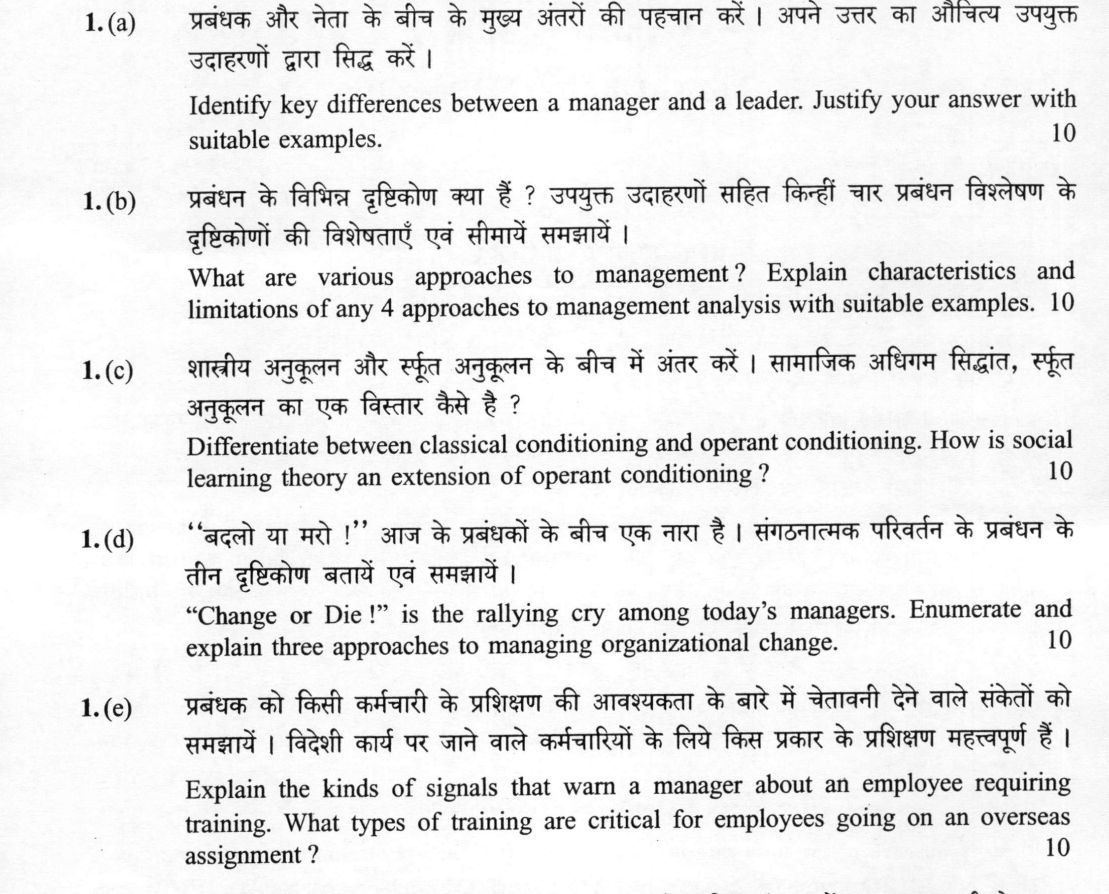
(a) Identify key differences between a manager and a leader. Justify your answer with suitable examples. (10 marks) (b) What are…
Identify key differences between a manager and a leader. Justify your answer with suitable examples. 10 marks
What are various approaches to management ? Explain characteristics and limitations of any 4 approaches to management analysis with suitable examples. 10 marks
Differentiate between classical conditioning and operant conditioning. How is social learning theory an extension of operant conditioning ? 10 marks
"Change or Die !" is the rallying cry among today's managers. Enumerate and explain three approaches to managing organizational change. 10 marks
Explain the kinds of signals that warn a manager about an employee requiring training. What types of training are critical for employees going on an overseas assignment ? 10 marks
हिंदी में प्रश्न पढ़ें
प्रबंधक और नेता के बीच के मुख्य अंतरों की पहचान करें । अपने उत्तर का औचित्य उपयुक्त उदाहरणों द्वारा सिद्ध करें । (10 अंक)
प्रबंधन के विभिन्न दृष्टिकोण क्या हैं ? उपयुक्त उदाहरणों सहित किन्हीं चार प्रबंधन विश्लेषण के दृष्टिकोणों की विशेषताएं एवं सीमाएं समझाएं । (10 अंक)
शास्त्रीय अनुकूलन और स्कृंट अनुकूलन के बीच में अंतर करें । सामाजिक अधिगम सिद्धांत, स्कृंट अनुकूलन का एक विस्तार कैसे है ? (10 अंक)
"बदलो या मरो !" आज के प्रबंधकों के बीच एक नारा है । संगठनात्मक परिवर्तन के प्रबंधन के तीन दृष्टिकोण बताएं एवं समझाएं । (10 अंक)
प्रबंधक को किसी कर्मचारी के प्रशिक्षण की आवश्यकता के बारे में चेतावनी देने वाले संकेतों को समझाएं । विदेशी कार्य पर जाने वाले कर्मचारियों के लिए किस प्रकार के प्रशिक्षण महत्वपूर्ण हैं । (10 अंक)
Model answer
Written by UPSC Answer Check against this question's marking rubric, to the expected length. UPSC does not publish answers for Mains — this is one way to score well, not an official key.
(a) Key Differences Between a Manager and a Leader
The distinction between a manager and a leader lies fundamentally in orientation, process, and behavioral engagement. Abraham Zaleznik posited that managers seek order, stability, and control, whereas leaders tolerate chaos and seek substantive, transformative change. John Kotter formalized this distinction by defining management as the capacity to cope with complexity through planning, budgeting, organizing, and problem-solving, while leadership is the capacity to cope with change through setting strategic direction, aligning coalitions, and inspiring people.
| Distinguishing Criteria | Manager | Leader | | :--- | :--- | :--- | | Primary Focus | Execution, operational efficiency, and systems maintenance. | Innovation, long-term vision, and organizational transformation. | | Source of Authority | Legitimate, positional power derived from hierarchy. | Personal power, charisma, referent power, and trust. | | Approach to Risk | Risk-averse; focuses on predictability and mitigation. | Risk-seeking; challenges the status quo and explores ambiguity. | | Human Orientation | Directs and monitors tasks through transactional relationships. | Empowers, coaches, and motivates through transformational ties. | | Time Horizon | Short-to-medium term (quarterly targets, annual budgets). | Long-term (industry foresight, legacy creation). |
For example, a Plant Operations Manager at Tata Steel Jamshedpur exemplifies management by optimizing blast furnace throughput, enforcing Six Sigma compliance, and adhering to strict cost parameters. Conversely, Ratan Tata exemplified leadership when he articulated a bold global vision for the Tata Group, mobilizing resources and transforming organizational identity to acquire Corus and Jaguar Land Rover despite significant industry skepticism.
(b) Approaches to Management Analysis
Scientific Management Approach (F.W. Taylor) Characteristics:
- Replaces rule-of-thumb methods with scientifically determined standard times, motions, and fatigue studies.
- Advocates functional foremanship and differential piece-rate wage systems to maximize physical productivity. Limitation: Adopts a mechanistic view of labor, treating workers as passive economic units ("economic man") while neglecting social and psychological dynamics. Example: Maruti Suzuki India utilizes precise standard operating procedures and time-and-motion studies along its assembly lines to maintain high manufacturing efficiency.
Administrative Management Approach (Henri Fayol) Characteristics:
- Proposes a universal functional framework of management: Planning, Organizing, Commanding, Coordinating, and Controlling (POCCC).
- Outlines 14 principles of management, emphasizing unity of command, scalar chain, and division of work. Limitation: The principles are excessively rigid and formalistic, assuming a closed, predictable organizational environment. Example: Indian Railways utilizes a strict hierarchical scalar chain and administrative command structure to coordinate operations across multiple zones.
Human Relations Approach (Elton Mayo) Characteristics:
- Highlights the "Hawthorne Effect," demonstrating that social recognition, group norms, and interpersonal relations drive productivity more than physical working conditions.
- Emphasizes the role of informal workgroups and open communication in shaping workplace morale. Limitation: Overemphasizes social contentment at the expense of economic rationality, structural design, and external competitive pressures. Example: The Aditya Birla Group’s institutionalization of holistic employee welfare schemes and collaborative councils to address psycho-social workplace needs.
Systems and Contingency Approach (Ludwig von Bertalanffy, Fred Fiedler) Characteristics:
- Views the organization as an open, dynamic system composed of interrelated subsystems interacting with an external macro-environment.
- Contends that there is "no single best way" to manage; managerial action is contingent upon situational variables such as technology, environment, and task structure. Limitation: Complex to operationalize in real-time decision-making due to the vast number of interdependent environmental variables. Example: Infosys adjusts its organizational structure and software delivery methodologies (from Waterfall to Agile/DevOps) dynamically depending on client geographies and technological shifts.
(c) Classical Conditioning vs. Operant Conditioning and Social Learning Extension
| Distinguishing Criteria | Classical Conditioning (Ivan Pavlov) | Operant Conditioning (B.F. Skinner) | | :--- | :--- | :--- | | Nature of Response | Involuntary, automatic, and reflexive. | Voluntary, goal-directed, and deliberate. | | Stimulus-Response Sequence | Stimulus precedes the response (S → R). | Consequence follows the response (R → S). | | Learner's Role | Passive; learner's behavior does not alter the environment. | Active; learner operates upon the environment to generate consequences. | | Mechanism of Learning | Association between an unconditioned stimulus and a conditioned stimulus. | Reinforcement (positive/negative) or punishment following a behavior. |
Social Learning Theory as an Extension: Albert Bandura extended Skinner's operant framework by arguing that human learning is not restricted to direct, trial-and-error reinforcement. Social Learning Theory introduces:
- Vicarious Learning (Observational Learning): Individuals acquire complex behaviors simply by observing the actions and consequences of "models" (e.g., senior executives), bypassing direct reinforcement.
- Cognitive Mediational Processes: Unlike Skinner’s pure behaviorism, Bandura integrates cognitive elements: Attention, Retention, Motor Reproduction, and Motivation.
- Self-Efficacy and Reciprocal Determinism: Behavior is shaped by the continuous triadic interaction between cognitive/personal factors, environmental influences, and behavioral patterns, enabling self-regulation and intrinsic motivation.
(d) Three Approaches to Managing Organizational Change
1. Kurt Lewin’s Three-Step Model: Lewin views change as a dynamic balance between driving forces (pushing for change) and restraining forces (resisting change). The process requires:
- Unfreezing: Breaking equilibrium by raising awareness, highlighting performance gaps, and destabilizing existing mindsets.
- Changing (Moving): Introducing new behaviors, technologies, and structures to shift the system to a new state.
- Refreezing: Institutionalizing the change through supportive reward systems, formal policies, and cultural norms. Example: State Bank of India implemented this through "Project Shikhar" and widespread digital orientation to transition millions of traditional branch users to the YONO digital banking ecosystem.
2. John Kotter’s 8-Step Change Process: Kotter provides an execution-oriented, sequence-driven framework:
- Establish a sense of urgency.
- Form a powerful guiding coalition.
- Create a strategic vision and initiatives.
- Communicate the vision broadly.
- Empower employees for broad-based action by removing structural barriers.
- Generate visible, short-term wins.
- Consolidate gains and produce more change.
- Anchor new approaches in the corporate culture. Example: ITC Limited navigated its strategic pivot away from core tobacco dependence into non-cigarette FMCG, paperboards, and hospitality under Y.C. Deveshwar by building a clear vision and empowering cross-functional divisional heads.
3. Action Research Model: A data-based, problem-oriented, cyclical approach involving five continuous phases:
- Diagnosis: Gathering data from employees regarding systemic problems.
- Analysis: Interpreting patterns and root causes collaboratively.
- Feedback: Sharing findings openly with stakeholders to build alignment.
- Action: Jointly developing and executing targeted interventions.
- Evaluation: Measuring the outcomes against baseline metrics to begin the next iteration.
(e) Training Need Signals and Critical Overseas Assignment Training
Signals Warning a Manager of Training Needs:
- Performance and Quality Deficits: Sharp drops in output, rising rework, elevated scrap rates, or failure to meet service level agreements (SLAs).
- Technological and Process Gaps: Introduction of new enterprise systems (e.g., SAP, AI integration) resulting in operational bottlenecks or employee hesitation.
- Escalating Customer Complaints: Increased grievances, adverse customer satisfaction (CSAT) scores, and repeated procedural errors in client-facing tasks.
- Safety and Compliance Breaches: Increased workplace accidents, audit non-compliances, or deviations from statutory regulations.
- Behavioral Indicators: Surges in employee absenteeism, workplace stress, interpersonal friction, and excessive employee turnover.
Critical Training for Overseas Assignments (Expatriate Preparation):
- Cross-Cultural Sensitivity and Intelligence (CQ): Training on Geert Hofstede's cultural dimensions (e.g., Power Distance, Individualism vs. Collectivism, High vs. Low Context communication) to prevent ethnocentric bias and culture shock.
- Host-Country Language Proficiency: Contextual conversational training to navigate daily living, build trust, and communicate with local stakeholders.
- Local Business Etiquette and Negotiation Norms: Specific protocols regarding negotiation styles, meeting decorum, gift-giving, and hierarchy management (e.g., understanding Guanxi in China or Nemawashi in Japan).
- Family and Spousal Adjustment Programs: Addressing the leading cause of expatriate failure by preparing the spouse and dependents for schooling, healthcare, and socio-cultural assimilation.
- Legal, Regulatory, and Security Protocols: Briefings on local labor laws, taxation treaties, personal safety protocols, and emergency evacuation mechanisms in the destination nation.
What "Differentiate" is asking you to do
Fix the criteria on which the two differ and apply each criterion to both, so the pair can no longer be mixed up. Differentiate stems usually carry a further task attached — describe the mechanism, set out the principles, discuss the applications — and that task carries its own marks.
Structure that answers it
Criterion 1 applied to both → criterion 2 → criterion 3 → summary line or table → the attached second demand answered in full
Where marks are lost
Two standalone definitions placed side by side, leaving the reader to extract the difference. The second common loss is running out of space before the attached task, which is often worth as much as the differentiation.
How this answer will be evaluated
Approach
Framework: Kotter's 8-Step Change Model / Lewin's Change Management Model. (a) compare: paired headings or table > key differences > significance > conclusion | (b) explain: definition/context > points in order > small example > short close | (c) compare: paired headings or table > key differences > significance > conclusion | (d) enumerate: list the items in order > one line each > no commentary | (e) explain: definition/context > points in order > small example > short close Full marks: Comprehensive coverage of all sub-parts with specific examples and theoretical depth.
Key points expected
- Contrast planning/organizing vs inspiring/visioning
- Differentiate status-based power vs influence-based power
- Provide one concrete example for each role
- Highlight the 'do things right' vs 'do the right thing' distinction
- Identify 4 distinct approaches (e.g., Classical, Behavioral, Systems, Contingency)
- List key characteristics for each selected approach
- State specific limitations for each selected approach
- Provide a suitable example for each approach
Evaluation rubric
Each sub-part is marked on its own, against the marks and word limit printed on the paper.
- (a) Distinguish manager vs leader roles with examples. 10 marks
compare— paired headings or table → key differences → significance → conclusion
Must cover
- Contrast planning/organizing vs inspiring/visioning
- Differentiate status-based power vs influence-based power
- Provide one concrete example for each role
- Highlight the 'do things right' vs 'do the right thing' distinction
Loses marks
- Treating the terms as synonyms
- Defining without providing the requested examples
- Ignoring the 'justify' aspect of the prompt
Earns more
- Reference to Mintzberg's managerial roles
- Mention of transformational vs transactional leadership
- Discussion of risk tolerance differences
Extra mark
- Citing a specific CEO (e.g., Satya Nadella) as a leader-manager hybrid
- Reference to a specific management theory (e.g., Fiedler's Contingency Theory)
- (b) Detail 4 management approaches with characteristics and limits. 10 marks
explain— definition/context → points in order → small example → short close
Must cover
- Identify 4 distinct approaches (e.g., Classical, Behavioral, Systems, Contingency)
- List key characteristics for each selected approach
- State specific limitations for each selected approach
- Provide a suitable example for each approach
Loses marks
- Listing more than 4 approaches without depth
- Failing to mention limitations for any of the 4
- Vague descriptions without specific characteristics
Earns more
- Mentioning specific theorists (e.g., Taylor, Mayo, Simon)
- Comparing the approaches briefly
- Linking approaches to modern management practices
Extra mark
- Reference to a specific case study (e.g., Ford's assembly line for Classical)
- Mentioning the 'Human Relations Movement' explicitly
- (c) Differentiate conditioning types and link to social learning. 10 marks
compare— paired headings or table → key differences → significance → conclusion
Must cover
- Define Classical Conditioning (Pavlov) with stimulus-response
- Define Operant Conditioning (Skinner) with reinforcement/punishment
- Explain Social Learning Theory (Bandura) as an extension
- Highlight the role of observation/modeling in Social Learning
Loses marks
- Confusing the definitions of the two conditioning types
- Failing to explain the 'extension' aspect of Social Learning
- Ignoring the specific theorists (Pavlov, Skinner, Bandura)
Earns more
- Using the 'Little Albert' experiment as an example
- Mentioning 'vicarious reinforcement'
- Discussing the cognitive element in Social Learning
Extra mark
- Reference to the Bobo Doll experiment
- Mentioning 'self-efficacy' as a component of Social Learning
- (d) List and explain 3 approaches to managing change. 10 marks
enumerate— list the items in order → one line each → no commentary
Must cover
- Identify 3 distinct approaches (e.g., Lewin, Kotter, ADKAR)
- Explain the steps or logic of each approach
- Connect the approaches to the 'Change or Die' context
- Provide a brief application or example for each
Loses marks
- Listing only 2 approaches
- Failing to explain the approaches (just listing names)
- Ignoring the 'organizational' context
Earns more
- Mentioning 'unfreeze-change-refreeze' (Lewin)
- Discussing 'creating urgency' (Kotter)
- Addressing resistance to change
Extra mark
- Reference to a specific company turnaround (e.g., IBM under Gersheneker)
- Mentioning 'change agents' or 'champions'
- (e) Identify training signals and overseas training types. 10 marks
explain— definition/context → points in order → small example → short close
Must cover
- List signals for training need (e.g., low performance, new tech)
- Explain why these signals indicate a training gap
- Identify critical training for overseas assignments (e.g., cultural)
- Explain the importance of cross-cultural training
Loses marks
- Failing to distinguish between signals and training types
- Ignoring the 'overseas' specific context
- Vague examples of signals
Earns more
- Mentioning 'performance appraisals' as a signal
- Discussing 'language training' for overseas
- Mentioning 'legal/compliance training' for overseas
Extra mark
- Reference to 'Hofstede's cultural dimensions' for overseas training
- Mentioning 'reverse culture shock' training
Practice this exact question
Write your answer and it is marked point by point against the model answer above — what you covered, what you missed, what you got wrong.
Evaluate my answer →More from Management 2022 Paper I
- Q1 (a) Identify key differences between a manager and a leader. Justify your answer with sui…
- Q2 (a) Differentiate between 'Entrepreneur' and 'Intrapreneur' with suitable examples. Ident…
- Q3 (a) Recent international events such as the pandemic Covid-19 and the Russian-Ukraine war…
- Q4 (a) Explain the management concepts of Frederick W. Taylor and Henri Fayol. Identify key…