Paper I — Q2
(a) Differentiate between 'Entrepreneur' and 'Intrapreneur' with suitable examples. Identify key traits of a successful…
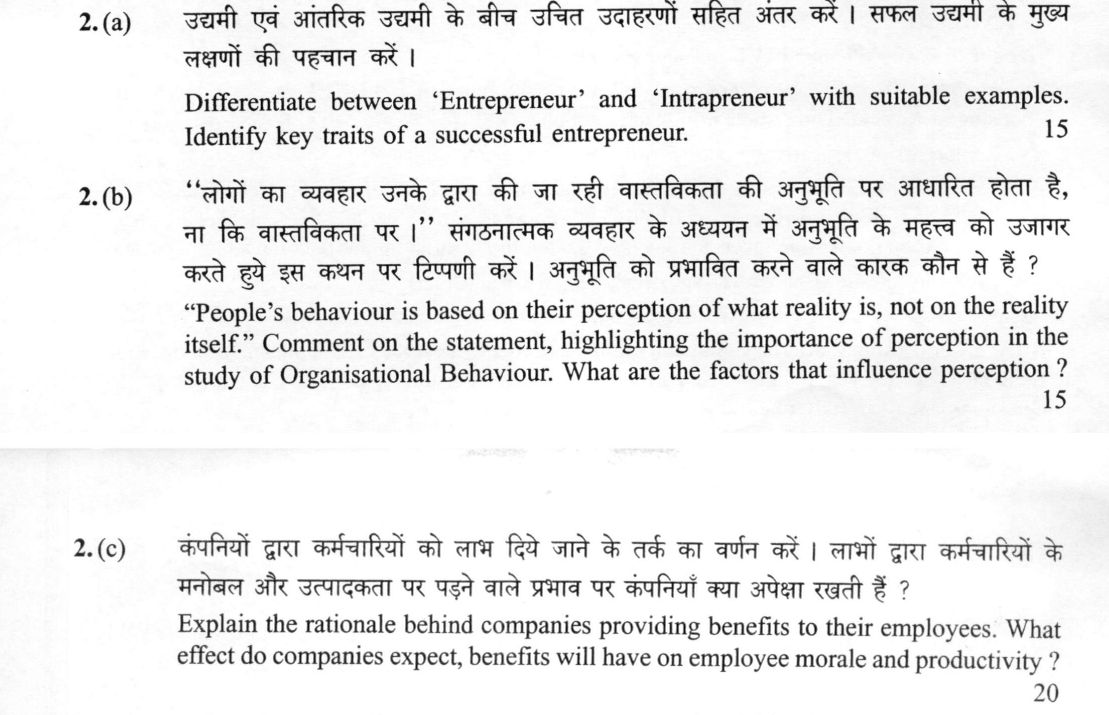
Differentiate between 'Entrepreneur' and 'Intrapreneur' with suitable examples. Identify key traits of a successful entrepreneur. 15 marks
"People's behaviour is based on their perception of what reality is, not on the reality itself." Comment on the statement, highlighting the importance of perception in the study of Organisational Behaviour. What are the factors that influence perception ? 15 marks
Explain the rationale behind companies providing benefits to their employees. What effect do companies expect, benefits will have on employee morale and productivity ? 20 marks
हिंदी में प्रश्न पढ़ें
उद्यमी एवं आंतरिक उद्यमी के बीच उचित उदाहरणों सहित अंतर करें । सफल उद्यमी के मुख्य लक्षणों की पहचान करें । (15 अंक)
"लोगों का व्यवहार उनके द्वारा की जा रही वास्तविकता की अनुभूति पर आधारित होता है, ना कि वास्तविकता पर ।" संगठनात्मक व्यवहार के अध्ययन में अनुभूति के महत्व को उजागर करते हुए इस कथन पर टिप्पणी करें । अनुभूति को प्रभावित करने वाले कारक कौन से हैं ? (15 अंक)
कंपनियों द्वारा कर्मचारियों को लाभ दिये जाने के तर्क का वर्णन करें । लाभों द्वारा कर्मचारियों के मनोबल और उत्पादकता पर पड़ने वाले प्रभाव पर कंपनियां क्या अपेक्षा रखती हैं ? (20 अंक)
Model answer
Written by UPSC Answer Check against this question's marking rubric, to the expected length. UPSC does not publish answers for Mains — this is one way to score well, not an official key.
Organizational effectiveness rests upon the twin pillars of entrepreneurial dynamism and the behavioral alignment of human capital.
Entrepreneur versus Intrapreneur
While both drive innovation, they differ fundamentally across ownership, risk, and resource access. An entrepreneur is an independent innovator who establishes a new venture, bears total financial and operational risk, and owns the equity (e.g., N.R. Narayana Murthy founding Infosys). Conversely, an intrapreneur operates as an internal entrepreneur within an established enterprise, utilizing the host firm’s capital, infrastructure, and brand while the parent firm absorbs the financial downside (e.g., engineering leads developing the Tata Ace under Ratan Tata’s backing at Tata Motors).
Key traits of a successful entrepreneur include:
- High Need for Achievement (n-Ach): McClelland’s drive for personal excellence and challenging goals.
- Calculated Risk-Taking Propensity: Willingness to navigate financial and reputational stakes.
- Internal Locus of Control: The conviction that personal actions determine outcomes rather than external fate.
- Tolerance for Ambiguity: Ability to operate effectively in uncertain, rapidly evolving markets.
- Innovation and Creativity: Schumpeterian capacity to recombine resources into novel market offerings.
- Resilience: Persistence to recover swiftly from strategic setbacks.
Perception and Organisational Behaviour
The premise that behavior responds to perceived rather than objective reality is central to Organisational Behaviour (OB). Through the perceptual process model, individuals selectively screen, organize, and interpret environmental stimuli. Consequently, employees act upon their subjective construction of the workplace. In OB, perception governs employee reactions to performance appraisals, organizational justice, and leadership credibility; a nominally fair incentive system fails if employees perceive favoritism.
Perception is shaped by three interactive sets of factors:
- Perceiver Characteristics: Motives, past experiences, personality, and unfulfilled needs that create perceptual defense or halo effects.
- Target Characteristics: Physical attributes, novelty, motion, sound, and background contrast that draw selective attention.
- Situational Context: The physical, social, and temporal setting in which the interaction occurs, altering how the stimulus is interpreted.
Rationale and Effects of Employee Benefits
Companies provide fringe benefits—such as healthcare, retirement provisions, and childcare—driven by distinct theoretical and strategic imperatives. Under Human Capital Theory, benefits protect and enhance the firm's core assets by safeguarding employee health and longevity. Under Social Exchange Theory, benefits trigger the norm of reciprocity: when organizations provide comprehensive support, employees reciprocate with loyalty. Strategically, benefits aid talent attraction, enhance market competitiveness, and fulfill statutory mandates (such as the Employees' Provident Funds and Miscellaneous Provisions Act in India).
Companies expect benefits to yield significant organizational gains:
- Morale Effects: Comprehensive benefits elevate job satisfaction, foster affective organizational commitment, and reduce turnover intentions by providing psychological and economic security.
- Productivity Effects: Health and wellness initiatives lower absenteeism, counter presenteeism, and free cognitive bandwidth, translating into higher discretionary effort and Organizational Citizenship Behaviour (OCB).
However, these benefits operate with caveats. According to Herzberg’s Two-Factor Theory, standardized benefits often act merely as hygiene factors; their absence causes severe dissatisfaction, but their presence does not automatically motivate unless tailored to individual employee life-stages.
To build an enduring competitive advantage, organizations must synchronize these elements: empowering internal and external entrepreneurial talent, aligning management practices with employee perceptual frameworks, and strategically deploying benefits to convert human capability into high-performance outcomes.
What "Differentiate" is asking you to do
Fix the criteria on which the two differ and apply each criterion to both, so the pair can no longer be mixed up. Differentiate stems usually carry a further task attached — describe the mechanism, set out the principles, discuss the applications — and that task carries its own marks.
Structure that answers it
Criterion 1 applied to both → criterion 2 → criterion 3 → summary line or table → the attached second demand answered in full
Where marks are lost
Two standalone definitions placed side by side, leaving the reader to extract the difference. The second common loss is running out of space before the attached task, which is often worth as much as the differentiation.
How this answer will be evaluated
Approach
Framework: Perception Process Model (Stimulus-Field-Perceiver). (a) compare: paired headings or table > key differences > significance > conclusion | (b) comment: context > arguments both sides > judgment > close | (c) explain: definition/context > points in order > small example > short close Full marks: Clear differentiation, named frameworks, concrete examples, and balanced judgment across all parts.
Key points expected
- Define Entrepreneur and Intrapreneur clearly
- Provide at least 3 distinct points of differentiation
- Give suitable examples for both roles
- List key traits of a successful entrepreneur
- Explain the meaning of the given statement
- Highlight importance of perception in Organisational Behaviour
- List factors that influence perception
- Provide a balanced judgment or conclusion
Evaluation rubric
Each sub-part is marked on its own, against the marks and word limit printed on the paper.
- (a) Differentiate Entrepreneur vs Intrapreneur and identify key traits of a successful entrepreneur. 15 marks
compare— paired headings or table → key differences → significance → conclusion
Must cover
- Define Entrepreneur and Intrapreneur clearly
- Provide at least 3 distinct points of differentiation
- Give suitable examples for both roles
- List key traits of a successful entrepreneur
Loses marks
- Textbook definitions without application
- No examples provided
- Confusing the two roles
Earns more
- Use a table or matrix for comparison
- Mention risk ownership difference
- Cite specific examples (e.g., Steve Jobs as Intrapreneur)
- Link traits to real-world success
Extra mark
- Reference a named framework (e.g., Drucker's Intrapreneurship)
- Include a recent regulatory or market example
- (b) Comment on the statement about perception vs reality and identify factors influencing perception. 15 marks
comment— context → arguments both sides → judgment → close
Must cover
- Explain the meaning of the given statement
- Highlight importance of perception in Organisational Behaviour
- List factors that influence perception
- Provide a balanced judgment or conclusion
Loses marks
- Ignoring the 'factors' part of the question
- No link to Organisational Behaviour
- Vague or generic statements without substance
Earns more
- Use a named model (e.g., Perception Process Model)
- Give an organisational example
- Differentiate between individual and group perception
- Link to decision-making or conflict
Extra mark
- Cite a specific study or case
- Mention a recent organisational change affecting perception
- (c) Explain rationale for employee benefits and their expected effect on morale and productivity. 20 marks
explain— definition/context → points in order → small example → short close
Must cover
- Define employee benefits and their types
- Explain the rationale behind providing them
- Describe expected impact on employee morale
- Describe expected impact on productivity
Loses marks
- No distinction between morale and productivity
- Generic list without explanation
- Ignoring the 'rationale' part
Earns more
- Use a framework (e.g., Herzberg’s Two-Factor Theory)
- Give concrete examples of benefits (health, retirement, etc.)
- Link to retention and engagement
- Mention cost-benefit perspective
Extra mark
- Cite a specific company’s benefit policy
- Reference a recent regulatory change in benefits
Practice this exact question
Write your answer and it is marked point by point against the model answer above — what you covered, what you missed, what you got wrong.
Evaluate my answer →More from Management 2022 Paper I
- Q1 (a) Identify key differences between a manager and a leader. Justify your answer with sui…
- Q2 (a) Differentiate between 'Entrepreneur' and 'Intrapreneur' with suitable examples. Ident…
- Q3 (a) Recent international events such as the pandemic Covid-19 and the Russian-Ukraine war…
- Q4 (a) Explain the management concepts of Frederick W. Taylor and Henri Fayol. Identify key…
- Q5 (a) Highlight various limitations of financial statements. How can these be minimized or…