Paper I — Q8
(a) The data below relates to ABC Ltd. which makes and sells laptops. [Table showing: February - Sales 8000 units, Production…
The data below relates to ABC Ltd. which makes and sells laptops. [Table showing: February - Sales 8000 units, Production 12000 units; January - Sales 12000 units, Production 8000 units; Selling Price ₹120/unit; Variable production cost ₹60/unit; Fixed production overhead ₹1,50,000; Predetermined overhead absorption rate ₹10/unit; Selling, Distribution and Administration cost (all fixed) ₹75,000] You are required to present comparative profit statements for each month using : (i) Absorption costing (ii) Marginal costing 20 marks
What are the primary causes of corporate distress ? Highlight the appropriate restructuring strategies that can be adopted to deal with different causes of corporate distress. 15 marks
Identify key areas where Information and Communication Technology (ICT) has transformed prevailing marketing practices in the past 5 years. Justify your answer with suitable examples. 15 marks
हिंदी में प्रश्न पढ़ें
नीचे दी गयी जानकारी ABC लिमिटेड से संबंधित है जो लैपटॉप बनाते और बेचते हैं। [तालिका दिखाते हुए: फरवरी - बिक्री 8000 इकाई, उत्पादन 12000 इकाई; जनवरी - बिक्री 12000 इकाई, उत्पादन 8000 इकाई; प्रति यूनिट बिक्री मूल्य ₹120; प्रति यूनिट परिवर्तनीय उत्पादन लागत ₹60; निश्चित उत्पादन ऊपरी लागत ₹1,50,000; पूर्वनिर्धारित ऊपरी अवशोषण दर ₹10/इकाई; बिक्री, वितरण, प्रशासन लागत (सभी निश्चित) ₹75,000] निम्नलिखित का उपयोग करते हुए आपको हर महीने के लिये तुलनात्मक लाभ विवरण प्रस्तुत करना है : (i) अवशोषण की लागत (ii) सीमांत लागत (20 अंक)
निगमित संकट के मुख्य कारण क्या हैं ? निगमित संकट के विभिन्न कारणों से निपटने के लिये अपनायी जाने वाली उपयुक्त पुनर्गठन रणनीतियों पर प्रकाश डालें। (15 अंक)
प्रमुख क्षेत्रों की पहचान करें जिनमें पिछले 5 वर्षों में सूचना-संचार प्रौद्योगिकी ने प्रचलित विपणन प्रथाओं को परिवर्तित कर दिया है। अपने उत्तर को उपयुक्त उदाहरणों द्वारा उचित सिद्ध करें। (15 अंक)
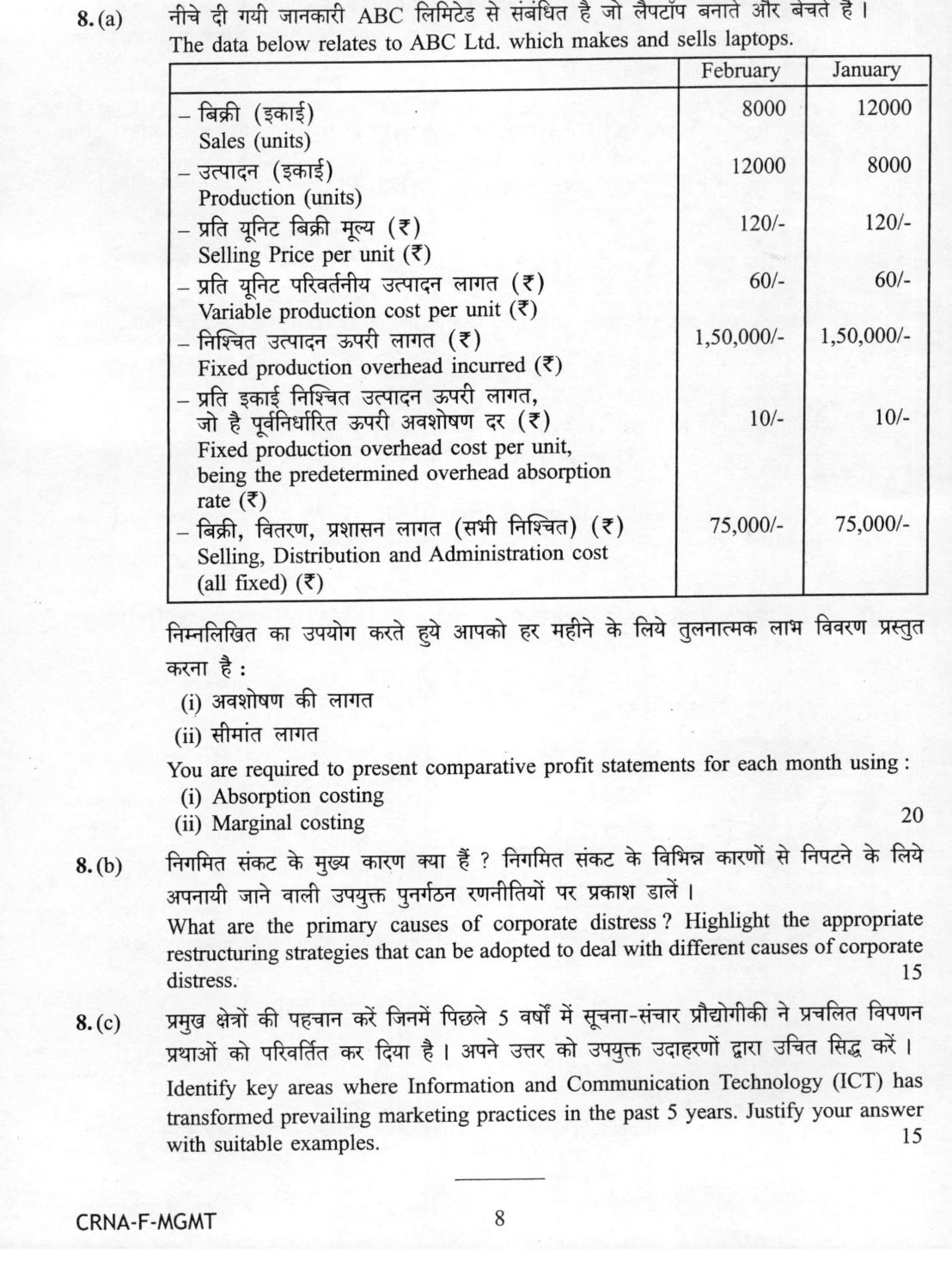
The figure this question refers to, in words
The question paper is a scan and the diagram did not survive as text. This is the figure as read from the original page — every component, value and label — so the question can be worked from the text below.
(a) Table with columns for February and January:
- Sales (units): February = 8000, January = 12000
- Production (units): February = 12000, January = 8000
- Selling Price per unit (Rs): February = 120/-, January = 120/-
- Variable production cost per unit (Rs): February = 60/-, January = 60/-
- Fixed production overhead incurred (Rs): February = 1,50,000/-, January = 1,50,000/-
- Fixed production overhead cost per unit, being the predetermined overhead absorption rate (Rs): February = 10/-, January = 10/-
- Selling, Distribution and Administration cost (all fixed) (Rs): February = 75,000/-, January = 75,000/-
Model answer
Written by UPSC Answer Check against this question's marking rubric, to the expected length. UPSC does not publish answers for Mains — this is one way to score well, not an official key.
(a) (i) Absorption costing Method: fixed production overhead is absorbed into product cost at the predetermined rate of ₹10/unit; any under- or over-absorption is adjusted after gross profit.
- January: Sales = 12,000 units × ₹120 = ₹14,40,000. Variable production cost of sales = 12,000 × ₹60 = ₹7,20,000. Fixed production OH absorbed in cost of sales = 12,000 × ₹10 = ₹1,20,000. Cost of sales = ₹8,40,000. Gross profit = ₹14,40,000 − ₹8,40,000 = ₹6,00,000. Fixed OH absorbed on production = 8,000 × ₹10 = ₹80,000. Underabsorbed OH = ₹1,50,000 − ₹80,000 = ₹70,000. Less fixed S&D = ₹75,000. Net profit = ₹6,00,000 − ₹70,000 − ₹75,000 = ₹4,55,000.
- February: Sales = 8,000 units × ₹120 = ₹9,60,000. Variable production cost of sales = 8,000 × ₹60 = ₹4,80,000. Fixed production OH absorbed in cost of sales = 8,000 × ₹10 = ₹80,000. Cost of sales = ₹5,60,000. Gross profit = ₹9,60,000 − ₹5,60,000 = ₹4,00,000. Fixed OH absorbed on production = 12,000 × ₹10 = ₹1,20,000. Underabsorbed OH = ₹1,50,000 − ₹1,20,000 = ₹30,000. Less fixed S&D = ₹75,000. Net profit = ₹4,00,000 − ₹30,000 − ₹75,000 = ₹2,95,000.
(ii) Marginal costing Method: only variable production cost is treated as product cost; fixed production overhead and fixed S&D are period costs.
- January: Sales = 12,000 × ₹120 = ₹14,40,000. Less variable production cost = 12,000 × ₹60 = ₹7,20,000. Contribution = ₹7,20,000. Less fixed production OH = ₹1,50,000. Less fixed S&D = ₹75,000. Net profit = ₹7,20,000 − ₹1,50,000 − ₹75,000 = ₹4,95,000.
- February: Sales = 8,000 × ₹120 = ₹9,60,000. Less variable production cost = 8,000 × ₹60 = ₹4,80,000. Contribution = ₹4,80,000. Less fixed production OH = ₹1,50,000. Less fixed S&D = ₹75,000. Net profit = ₹4,80,000 − ₹1,50,000 − ₹75,000 = ₹2,55,000.
Reconciliation: Absorption profit − marginal profit = absorption rate × (production − sales). January: ₹10 × (8,000 − 12,000) = −₹40,000; ₹4,55,000 − ₹4,95,000 = −₹40,000. February: ₹10 × (12,000 − 8,000) = +₹40,000; ₹2,95,000 − ₹2,55,000 = +₹40,000. Total profit over two months is ₹7,50,000 under both methods. Condition: unit variable cost and absorption rate remain constant and inventory is valued at standard absorption cost.
(b) Primary causes of corporate distress:
- Financial: excessive debt, high interest, liquidity crunch, poor working capital, maturity mismatch, forex losses.
- Operational: cost inefficiency, low productivity, obsolete plant, supply-chain failure, poor quality.
- Strategic: wrong product-market focus, loss of competitiveness, failed diversification, technological obsolescence.
- Managerial/governance: weak leadership, fraud, poor internal controls, board failure, succession problems.
- External: recession, demand shocks, regulatory change, intense competition, pandemic or commodity shocks.
Appropriate restructuring strategies:
- Financial cause: financial restructuring—debt-equity swap, refinancing, maturity extension, interest haircut, fresh equity, asset monetisation, insolvency resolution under IBC.
- Operational cause: operational restructuring—cost reduction, lean manufacturing, working-capital control, supply-chain redesign, divestment of non-core assets.
- Strategic cause: portfolio/strategic restructuring—refocus on core, mergers/acquisitions, joint ventures, new markets, digital business model.
- Governance/management cause: organisational restructuring—leadership change, board reconstitution, stronger controls, performance-linked pay, downsizing and reskilling.
- External shock: turnaround management—liquidity support, debt moratorium, scenario planning, flexible cost structure, hedging and diversification.
- Technology disruption: digital transformation—automation, e-commerce, analytics, platform-based services.
- Legal/regulatory cause: compliance restructuring—settlements, governance reform, regulatory capital, exit from prohibited businesses.
(c) Key areas where ICT has transformed marketing in the past five years:
- Data-driven personalisation: AI and machine learning use browsing and purchase data to customise offers. Examples: Amazon and Netflix recommendations; Nykaa and Flipkart personalised feeds.
- Social media and influencer marketing: Instagram Reels, YouTube, WhatsApp Business and nano-influencers enable low-cost engagement. Examples: Zomato, Amul and D2C brands.
- Omnichannel and D2C commerce: websites, apps, quick commerce and click-and-collect integrate offline and online. Examples: Shopify, Amazon, Blinkit, Nykaa.
- Marketing automation and chatbots: CRM, email/WhatsApp automation and AI chatbots give 24×7 response. Examples: Salesforce, HubSpot, ChatGPT-based service bots.
- Programmatic and performance advertising: Google Ads, Meta Ads and OTT platforms use real-time bidding and measurable ROI.
- Content and SEO marketing: blogs, podcasts, short videos and user-generated content build pull demand. Examples: HubSpot, YouTube.
- Mobile, location and payment-linked marketing: UPI, QR codes, app push notifications and geo-targeting. Examples: PhonePe, Paytm.
- Real-time feedback and social listening: sentiment analysis and review platforms guide product and campaign changes.
- Privacy-first marketing: post-cookie consent, first-party data and loyalty apps are replacing third-party tracking.
Thus ICT has shifted marketing from mass, one-way and offline campaigns to personalised, interactive, data-driven and omnichannel engagement.
What "Solve" is asking you to do
Choose the method, then carry it through to a final answer. Identifying what kind of problem this is and why that method applies is the first thing marked; a correct figure arrived at invisibly earns almost nothing.
Structure that answers it
Given data and what is required → method chosen, with the reason it applies → set-up (equation, circuit, free body, trial balance) → working, step by step → answer with units and any condition of validity
Where marks are lost
Doing the middle steps mentally and writing only the result. In mathematics papers, a further loss comes from giving a decimal where the exact value in surds or fractions was wanted, or from skipping the justification a part explicitly asks for.
How this answer will be evaluated
Approach
Framework: Absorption vs. Marginal Costing. (a) compare: paired headings or table > key differences > significance > conclusion | (b) highlight: name the salient points > one line of substance each > close | (c) justify: claim > 3-4 reasons > evidence > conclusion Full marks: Accurate calculations with reconciliation; precise cause-strategy mapping; specific ICT examples with clear justification.
Key points expected
- Correct calculation of unit cost under both methods
- Absorption statement showing fixed overhead absorption
- Marginal statement showing contribution and fixed costs
- Reconciliation of profit difference due to inventory change
- Identification of internal causes (e.g., management, operations)
- Identification of external causes (e.g., market, regulation)
- Mapping of specific strategies to specific causes
- Mention of financial or operational restructuring
Evaluation rubric
Each sub-part is marked on its own, against the marks and word limit printed on the paper.
- (a) Comparative profit statements for Jan and Feb using Absorption and Marginal costing. 20 marks
compare— paired headings or table → key differences → significance → conclusion
Must cover
- Correct calculation of unit cost under both methods
- Absorption statement showing fixed overhead absorption
- Marginal statement showing contribution and fixed costs
- Reconciliation of profit difference due to inventory change
Loses marks
- Treating fixed overheads as variable in marginal costing
- Failing to account for the 4000 unit inventory change
Earns more
- Explicit calculation of closing stock value
- Clear tabular presentation of both months
Extra mark
- Highlighting the impact of production vs sales volume
- (b) Primary causes of corporate distress and corresponding restructuring strategies. 15 marks
highlight— name the salient points → one line of substance each → close
Must cover
- Identification of internal causes (e.g., management, operations)
- Identification of external causes (e.g., market, regulation)
- Mapping of specific strategies to specific causes
- Mention of financial or operational restructuring
Loses marks
- Listing causes without linking them to strategies
- Generic advice not specific to corporate distress
Earns more
- Reference to IBC 2016 or specific Indian context
- Distinction between turnaround and liquidation
Extra mark
- Citing a specific Indian corporate restructuring case
- (c) Key areas of ICT transformation in marketing with examples. 15 marks
justify— claim → 3-4 reasons → evidence → conclusion
Must cover
- Identification of at least 3 key areas (e.g., digital, data)
- Explanation of how ICT transformed the practice
- Suitable examples for each area identified
- Justification of the impact on marketing outcomes
Loses marks
- General statements about technology without marketing focus
- Lack of specific examples to justify the transformation
Earns more
- Mention of specific tools (AI, CRM, Big Data)
- Reference to recent trends (last 5 years)
Extra mark
- Specific brand examples (e.g., Amazon, Netflix)
Practice this exact question
Write your answer and it is marked point by point against the model answer above — what you covered, what you missed, what you got wrong.
Evaluate my answer →More from Management 2022 Paper I
- Q5 (a) Highlight various limitations of financial statements. How can these be minimized or…
- Q6 (a) Explain the circumstances under which different methods of depreciation can be employ…
- Q7 (a) Why is Budgetary control required in a business concern ? What are its limitations ?…
- Q8 (a) The data below relates to ABC Ltd. which makes and sells laptops. [Table showing: Feb…