Paper I — Q6
(a) Explain the circumstances under which different methods of depreciation can be employed by giving suitable examples. (20…
Explain the circumstances under which different methods of depreciation can be employed by giving suitable examples. 20 marks
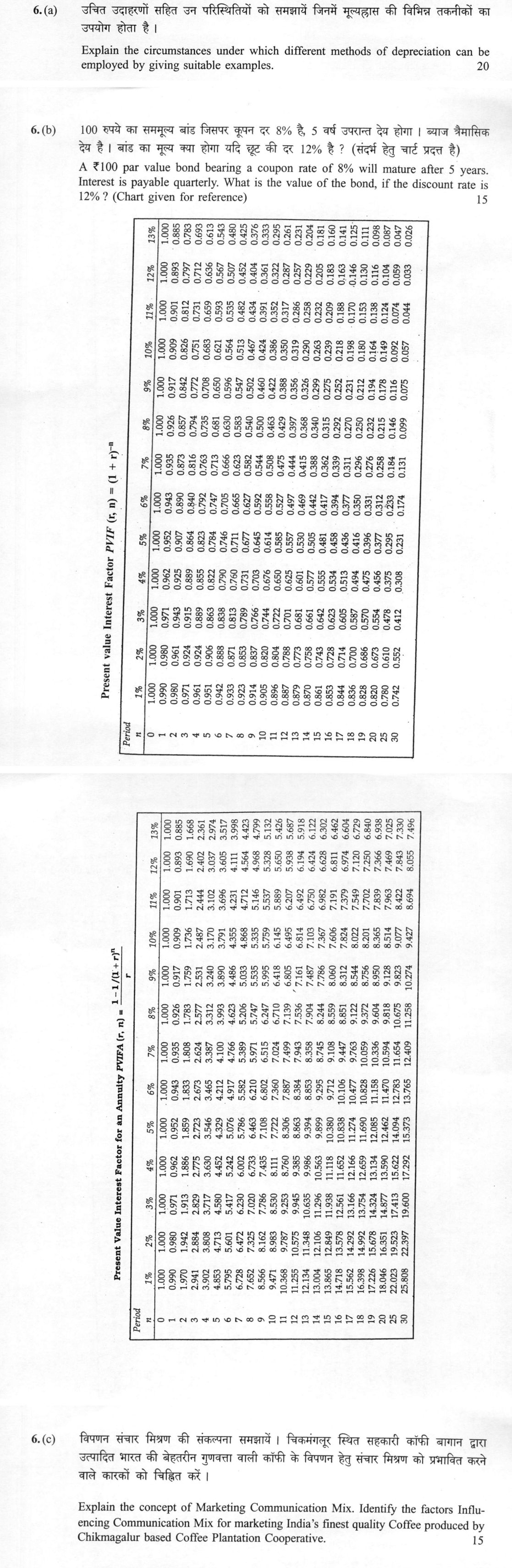
A ₹100 par value bond bearing a coupon rate of 8% will mature after 5 years. Interest is payable quarterly. What is the value of the bond, if the discount rate is 12% ? (Chart given for reference) 15 marks
Explain the concept of Marketing Communication Mix. Identify the factors Influencing Communication Mix for marketing India's finest quality Coffee produced by Chikmagalur based Coffee Plantation Cooperative. 15 marks
हिंदी में प्रश्न पढ़ें
उचित उदाहरणों सहित उन परिस्थितियों को समझाएं जिनमें मूल्यह्रास की विभिन्न तकनीकों का उपयोग होता है। (20 अंक)
100 रुपये का सममूल्य बांड जिसपर कूपन दर 8% है, 5 वर्ष उपरान्त देय होगा । ब्याज त्रैमासिक देय है । बांड का मूल्य क्या होगा यदि छूट की दर 12% है ? (संदर्भ हेतु चार्ट प्रदत्त है) (15 अंक)
विपणन संचार मिश्रण की संकल्पना समझायें । चिकमंगलूर स्थित सहकारी कॉफी बागान द्वारा उत्पादित भारत की बेहतरीन गुणवत्ता वाली कॉफी के विपणन हेतु संचार मिश्रण को प्रभावित करने वाले कारकों को चिह्नित करें । (15 अंक)
Model answer
Written by UPSC Answer Check against this question's marking rubric, to the expected length. UPSC does not publish answers for Mains — this is one way to score well, not an official key.
Methods of Depreciation: Circumstances and Applications
Depreciation allocates an asset’s depreciable base over its estimated useful life, reflecting asset consumption under Ind AS 16 and Schedule II of the Companies Act, 2013. The choice of method depends on the pattern of economic benefits derived from the asset.
Straight-Line Method (SLM): Applied when an asset delivers uniform economic utility across its life, maintenance costs remain stable, and technological obsolescence is minimal. For instance, commercial buildings, leasehold land improvements, and office furniture at Larsen & Toubro are depreciated under SLM due to constant, predictable usage.
Written Down Value (WDV) Method: Suitable where an asset provides higher productive efficiency in initial years, accompanied by escalating repair costs and rapid obsolescence. Applying WDV generates a declining depreciation charge which, combined with rising maintenance, yields an even total annual cost. It is mandated for tax purposes under the Income Tax Act, 1961, and adopted by firms like Infosys for servers, software, and IT hardware prone to technological decay.
Units of Production Method: Applied when asset wear is primarily a function of operational output rather than elapsed time. Mining extraction equipment at Coal India or aircraft engines at IndiGo utilize this method to match depreciation expense directly with unit production volumes and seasonal capacity utilization.
Sum-of-the-Years'-Digits (SYD) Method: An accelerated method used when assets experience sharp early declines in market value and earning capacity, such as commercial logistics vehicle fleets operating under heavy initial freight contracts.
Valuation of Bond
To value a bond paying quarterly coupons, cash flows and discount rates are adjusted to a quarterly periodicity.
Given: Face Value (F) = ₹100 Coupon Rate = 8% per annum Quarterly Coupon Payment (C) = (8% × ₹100)/4 = ₹2.00 Maturity (t) = 5 years → Total periods (n) = 5 × 4 = 20 quarters Annual Discount Rate (YTM) = 12% → Quarterly Discount Rate (k_d) = (12%)/4 = 3% = 0.03
The intrinsic value (V₀) under SEBI valuation principles is the present value of the quarterly annuity plus the present value of the par value at redemption:
V₀ = C × [ (1 - (1 + k_d)⁻ⁿ)/(k_d) ] + F/((1 + k_d)ⁿ)
V₀ = 2 × [ (1 - (1.03)⁻²⁰)/0.03 ] + 100 × (1.03)⁻²⁰
Using discount factors: Present Value Interest Factor of Annuity (PVIFA₃%, 20) = (1 - 0.5537)/0.03 = 14.8775 Present Value Interest Factor (PVIF₃%, 20) = (1.03)⁻²⁰ = 0.5537
V₀ = (2 × 14.8775) + (100 × 0.5537) = 29.755 + 55.37 = ₹85.13
Because the market discount rate (12%) exceeds the coupon rate (8%), the bond trades at a discount to its par value, pricing at ₹85.13.
Marketing Communication Mix for Chikmagalur Coffee Plantation Cooperative
The Marketing Communication Mix is the specific blend of advertising, personal selling, sales promotion, public relations (PR), direct marketing, and digital outreach deployed through the 6M framework (Market, Mission, Message, Media, Money, Measurement) to achieve promotional objectives.
For a Chikmagalur-based Coffee Plantation Cooperative marketing India's finest specialty coffee, the mix is shaped by specific strategic factors:
Product Differentiation and GI Tag: Chikmagalur Arabica Coffee holds a Geographical Indication (GI) tag. Communication must emphasize artisanal heritage, shade-grown ecology, and high cupping scores. PR, heritage storytelling, and origin certification labeling serve as the primary communication tools rather than price discounts.
Target Market Characteristics: The audience comprises affluent, urban specialty coffee consumers and premium institutional buyers (B2B boutique roasters). Digital media channels (Instagram, specialty blogs) and experiential pop-up cupping events in Tier-1 cities provide precise reach without mass-media waste.
Competitive Landscape: Facing competition from established brands like Blue Tokai, Subko, and Starbucks, the cooperative must employ direct-to-consumer (D2C) marketing, micro-influencer tasting endorsements, and barista partnerships to establish artisanal credibility.
Budgetary Constraints and Channel Strategy: Constrained by cooperative pooling limits, expenditure must bypass high-cost television advertising in favor of cost-effective content marketing, subscription commerce portals, and trade fair exhibitions at the India International Coffee Festival.
Strategic Synthesis
Managerial decisions operate within an interconnected framework: capital asset depreciation policies directly dictate reported operating cash flows and tax shields, thereby preserving liquidity to service debt instruments like bonds. Concurrently, capital allocated to building brand equity through the marketing communication mix enhances product realizations, driving the long-term cash generation essential for capital maintenance and enterprise solvency.
What "Explain" is asking you to do
Make the working of something clear — what sets it off, what follows from what, and what it produces. Explain is the Commission's mechanism word: it dominates the technical papers and the “explain why” stems, where the marks sit in the causal chain and not in the label.
Structure that answers it
State what it is → the initiating condition → the chain of cause, step by step → an instance where it plays out → what the chain produces
Where marks are lost
Describing what something looks like instead of why it works that way. Naming the stages without linking them reads as description too.
How this answer will be evaluated
Approach
Framework: Depreciation methods (SLM/WDV), Bond Valuation (PV of Annuity + PV of Par), Marketing Communication Mix (Promotion Mix). (a) explain: definition/context > points in order > small example > short close | (b) calculate: given > formula > substitution > result with units > interpretation | (c) explain: definition/context > points in order > small example > short close Full marks: Part (a) covers 3+ methods with context; Part (b) correctly adjusts for quarterly compounding; Part (c) links GI status to specific communication channels.
Key points expected
- Straight Line Method (SLM) for uniform usage
- Written Down Value (WDV) for rapid obsolescence
- Units of Production for variable output
- Suitable examples for each method
- Adjustment of rates to quarterly (2% coupon, 3% discount)
- Adjustment of period to quarters (n=20)
- Calculation of PV of coupons (Annuity)
- Calculation of PV of par value (Single sum)
Evaluation rubric
Each sub-part is marked on its own, against the marks and word limit printed on the paper.
- (a) Circumstances for using different depreciation methods with examples. 20 marks
explain— definition/context → points in order → small example → short close
Must cover
- Straight Line Method (SLM) for uniform usage
- Written Down Value (WDV) for rapid obsolescence
- Units of Production for variable output
- Suitable examples for each method
Loses marks
- Defining methods without stating when to use them
- Confusing capital expenditure with revenue expenditure
Earns more
- Mention of tax implications (e.g., Income Tax Act)
- Comparison of profit impact between methods
- Reference to useful life vs. economic life
Extra mark
- Mention of specific industry examples (e.g., IT hardware for WDV)
- (b) Value of a bond with quarterly coupons using provided charts. 15 marks
calculate— given → formula → substitution → result with units → interpretation
Must cover
- Adjustment of rates to quarterly (2% coupon, 3% discount)
- Adjustment of period to quarters (n=20)
- Calculation of PV of coupons (Annuity)
- Calculation of PV of par value (Single sum)
Loses marks
- Using annual periods (n=5) instead of quarterly
- Using annual rates (8%, 12%) instead of quarterly
Earns more
- Correct use of the provided PVIF and PVIFA tables
- Clear step-by-step substitution of values
Extra mark
- Explicit statement of the final bond price formula
- (c) Concept of Marketing Communication Mix and factors for Chikmagalur Coffee. 15 marks
explain— definition/context → points in order → small example → short close
Must cover
- Definition of Marketing Communication Mix (Promotion Mix)
- Identification of key elements (Advertising, Sales Promo, etc.)
- Factors specific to Chikmagalur Coffee (e.g., GI tag, quality)
- Application of factors to the specific cooperative context
Loses marks
- Generic marketing theory without application to coffee
- Ignoring the specific location (Chikmagalur) or product type
Earns more
- Mention of 'Chikmagalur' as a Geographical Indication (GI)
- Reference to target market (premium vs. mass)
- Discussion of digital vs. traditional channels
Extra mark
- Specific reference to a real marketing campaign for Indian coffee
Practice this exact question
Write your answer and it is marked point by point against the model answer above — what you covered, what you missed, what you got wrong.
Evaluate my answer →More from Management 2022 Paper I
- Q3 (a) Recent international events such as the pandemic Covid-19 and the Russian-Ukraine war…
- Q4 (a) Explain the management concepts of Frederick W. Taylor and Henri Fayol. Identify key…
- Q5 (a) Highlight various limitations of financial statements. How can these be minimized or…
- Q6 (a) Explain the circumstances under which different methods of depreciation can be employ…
- Q7 (a) Why is Budgetary control required in a business concern ? What are its limitations ?…
- Q8 (a) The data below relates to ABC Ltd. which makes and sells laptops. [Table showing: Feb…