Paper I — Q7
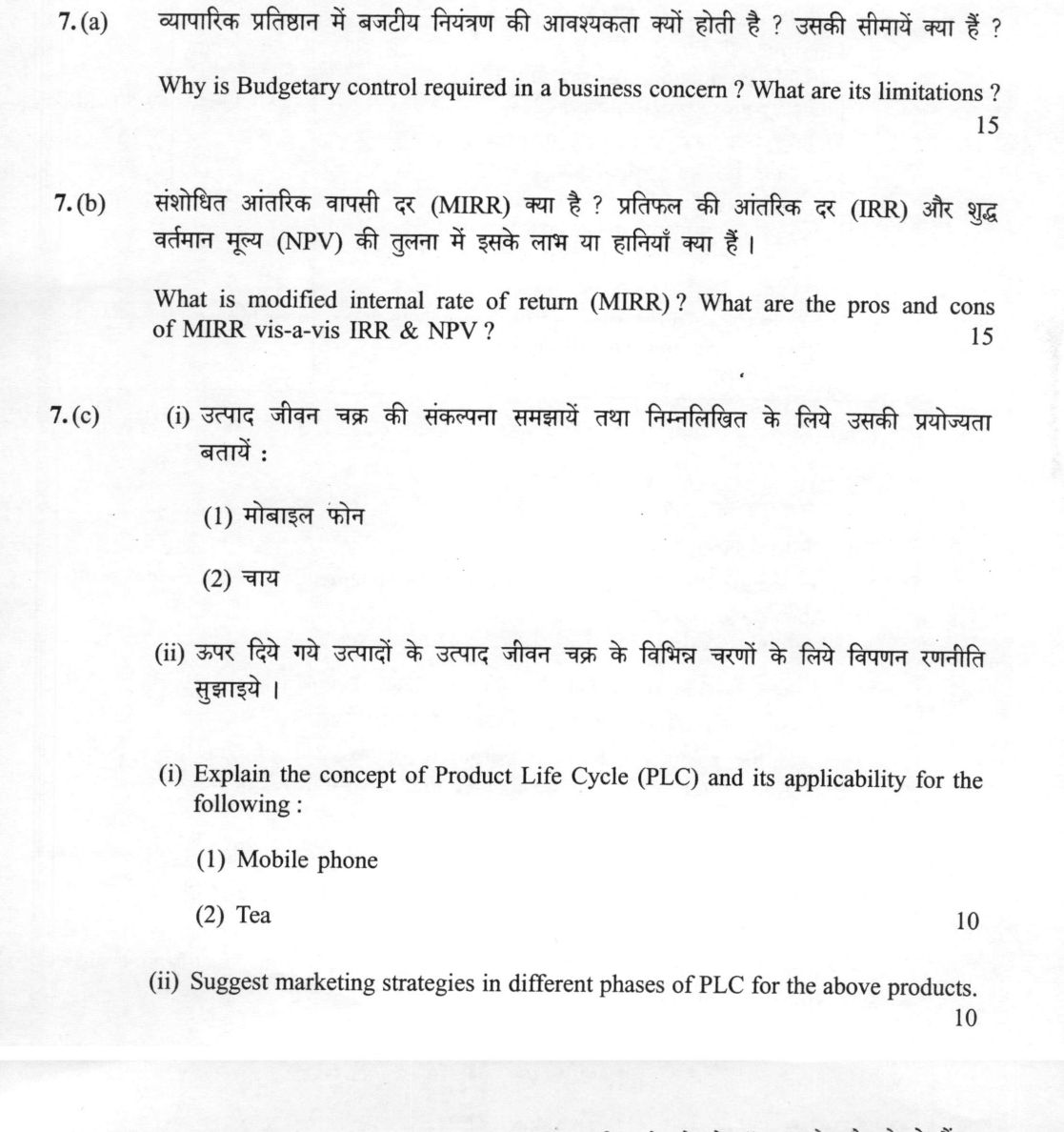
(a) Why is Budgetary control required in a business concern ? What are its limitations ? (15 marks) (b) What is modified internal…
Why is Budgetary control required in a business concern ? What are its limitations ? 15 marks
What is modified internal rate of return (MIRR) ? What are the pros and cons of MIRR vis-a-vis IRR & NPV ? 15 marks
Explain the concept of Product Life Cycle (PLC) and its applicability for the following : (1) Mobile phone (2) Tea 10 marks
Suggest marketing strategies in different phases of PLC for the above products. 10 marks
हिंदी में प्रश्न पढ़ें
व्यापारिक प्रतिष्ठान में बजटीय नियंत्रण की आवश्यकता क्यों होती है ? उसकी सीमायें क्या हैं ? (15 अंक)
संशोधित आंतरिक वापसी दर (MIRR) क्या है ? प्रतिफल की आंतरिक दर (IRR) और शुद्ध वर्तमान मूल्य (NPV) की तुलना में इसके लाभ या हानियाँ क्या हैं । (15 अंक)
उत्पाद जीवन चक्र की संकल्पना समझायें तथा निम्नलिखित के लिये उसकी प्रयोज्यता बतायें : (1) मोबाइल फोन (2) चाय (10 अंक)
उपर दिये गये उत्पादों के उत्पाद जीवन चक्र के विभिन्न चरणों के लिये विपणन रणनीति सुझाइये । (10 अंक)
Model answer
Written by UPSC Answer Check against this question's marking rubric, to the expected length. UPSC does not publish answers for Mains — this is one way to score well, not an official key.
Budgetary Control: Rationale and Limitations
Budgetary control establishes quantitative financial targets to direct organizational operations and measure deviations. It is essential because it translates strategic goals into operational plans across departments, fosters inter-functional coordination (such as synchronizing production schedules with sales forecasts), enables management by exception through real-time variance analysis, and provides objective criteria for performance evaluation and managerial accountability.
Its operational efficacy faces clear limitations. It introduces organizational rigidity when managers adhere strictly to line-item limits rather than responding to market opportunities. Time lags in variance reporting delay corrective actions. Behavioral resistance often emerges, leading to budgetary slack, inter-departmental conflict, and suboptimal spending to protect future allocations. Furthermore, dynamic macroeconomic volatility—such as inflation, input price fluctuations, and demand shifts—can quickly render static budgetary assumptions obsolete.
Modified Internal Rate of Return (MIRR) vis-a-vis IRR and NPV
MIRR addresses the reinvestment rate paradox inherent in traditional Internal Rate of Return (IRR). While IRR assumes that intermediate cash inflows are reinvested at the project’s own internal rate, MIRR assumes that cash inflows are reinvested at the firm's cost of capital to calculate a terminal value, and initial outlays are discounted back at the financing rate. The MIRR is the discount rate that equates the present value of the investment outlay to the present value of the terminal cash flows.
Pros: MIRR eliminates the multiple IRR problem that occurs when cash flows switch signs (non-conventional cash flows). It provides a more realistic measure of profitability than IRR by adopting the cost of capital as the reinvestment rate, aligning closer with Net Present Value (NPV) principles while retaining the intuitive percentage-return metric preferred by decision-makers.
Cons: MIRR increases computational complexity relative to standard IRR. Selecting an appropriate reinvestment rate introduces subjectivity if the cost of capital fluctuates over time. Moreover, like IRR, MIRR can still conflict with NPV rankings when evaluating mutually exclusive projects of differing scales or lifespans, where NPV remains the theoretically superior determinant of shareholder wealth maximization.
Product Life Cycle (PLC): Mobile Phones and Tea
The Product Life Cycle conceptualizes a product’s market trajectory across four stages: Introduction, Growth, Maturity, and Decline.
Mobile Phones: Represent a fast-cycle product category characterized by a short, compressed PLC. Continuous technological innovation, rapid hardware obsolescence, and intense competition accelerate movement from introduction to maturity within 12 to 24 months, necessitating rapid capital amortization.
Tea: Operates as a slow-cycle, high-continuity product. Deep cultural integration, habit-driven consumption, and strong brand loyalty in India afford tea an extended, multi-decade maturity stage, with the overall category displaying sustained resilience against decline.
Phase-Specific Marketing Strategies
Mobile Phones:
- Introduction: Deploy price-skimming strategies, target early adopters, and heavily promote unique technological features.
- Growth: Expand into mass retail channels, adopt competitive pricing, and scale mass-media promotion to capture market share.
- Maturity: Implement feature differentiation (such as enhanced cameras or artificial intelligence), offer trade-in/upgrade incentives, and drive ecosystem lock-in.
- Decline: Harvest remaining cash flows, rationalize production, discount legacy stock, and divest to free resources for next-generation devices.
Tea:
- Introduction (Specialty/Herbal Blends): Focus on consumer education, experiential sampling, and premium health-benefit positioning.
- Growth: Drive intensive FMCG distribution expansion, secure regional shelf-space dominance, and execute wide-reach emotional brand building.
- Maturity (Packaged Black/Green Tea): Launch line extensions (flavors, ready-to-drink options), vary pack sizes (sachets to bulk packs), and maintain brand equity via loyalty programs.
- Decline (Generic Loose-Leaf): Reposition into niche artisanal segments, rationalize low-yield distribution routes, or reformulate into functional wellness products.
Strategic success requires integrating financial analytics with lifecycle dynamics. Utilizing MIRR ensures disciplined capital deployment across high-velocity product investments like mobile phones and stable cash-generating assets like tea, providing the analytical foundation necessary for effective, adaptive budgetary control.
What "Explain" is asking you to do
Make the working of something clear — what sets it off, what follows from what, and what it produces. Explain is the Commission's mechanism word: it dominates the technical papers and the “explain why” stems, where the marks sit in the causal chain and not in the label.
Structure that answers it
State what it is → the initiating condition → the chain of cause, step by step → an instance where it plays out → what the chain produces
Where marks are lost
Describing what something looks like instead of why it works that way. Naming the stages without linking them reads as description too.
How this answer will be evaluated
Approach
Framework: Product Life Cycle (PLC) Model. (a) explain: Definition of Budgetary Control > Points on Necessity (Planning, Coordination, Control) > Points on Limitations (Rigidity, Time-consuming) > Short Conclusion | (b) explain: Definition of MIRR > Comparison with IRR (Reinvestment assumption) > Comparison with NPV (Absolute vs Relative) > Pros and Cons analysis | (c) explain: PLC Concept (4 Stages) > Application to Mobile Phone (Short cycle) > Application to Tea (Long cycle) > Marketing Strategies for each phase Full marks: Clear frameworks, specific application to Mobile/Tea, nuanced comparison of MIRR/IRR/NPV.
Key points expected
- Budgetary Control: Planning, Coordination, Control, Rigidity
- MIRR: Reinvestment at cost of capital, No multiple IRRs, Realistic
- PLC: Introduction, Growth, Maturity, Decline
- Mobile Phone: Short PLC, Rapid innovation, High marketing spend
- Tea: Long PLC, Stable demand, Brand loyalty focus
Evaluation rubric
Each sub-part is marked on its own, against the marks and word limit printed on the paper.
- (a) Justify the need for budgetary control and critically analyze its constraints. 15 marks
explain— Definition of Budgetary Control → Points on Necessity (Planning, Coordination, Control) → Points on Limitations (Rigidity, Time-consuming) → Short Conclusion
Must cover
- Define budgetary control as a management tool
- Explain necessity: Planning, Coordination, Performance Evaluation
- Explain necessity: Resource allocation and Cost control
- List limitations: Rigidity, Time-consuming, Subjective estimates
Loses marks
- Defining budget but not explaining control
- Listing limitations without context
Earns more
- Mention 'Management by Objectives' (MBO) link
- Note 'Gaming' or manipulation of figures
- Reference to 'Zero-based budgeting' as a solution
Extra mark
- Example of a company using rolling budgets
- Reference to specific accounting standards
- (b) Define MIRR and evaluate its advantages and disadvantages relative to IRR and NPV. 15 marks
explain— Definition of MIRR → Comparison with IRR (Reinvestment assumption) → Comparison with NPV (Absolute vs Relative) → Pros and Cons analysis
Must cover
- Define MIRR (reinvests at cost of capital)
- Contrast with IRR (reinvests at IRR - unrealistic)
- Contrast with NPV (MIRR is %, NPV is absolute value)
- Pros: No multiple IRRs, realistic reinvestment
Loses marks
- Confusing MIRR with standard IRR
- Failing to mention the reinvestment rate assumption
Earns more
- Cons: Ignores scale of investment
- Mention 'Terminal Value' calculation in MIRR
- Note MIRR is easier to interpret than NPV
Extra mark
- Simple numerical example of MIRR vs IRR
- Reference to specific financial software output
- (c) Explain PLC concept, apply it to Mobile Phones and Tea, and suggest marketing strategies for each phase. 10 marks
explain— PLC Concept (4 Stages) → Application to Mobile Phone (Short cycle) → Application to Tea (Long cycle) → Marketing Strategies for each phase
Must cover
- Define PLC stages: Intro, Growth, Maturity, Decline
- Apply to Mobile: Short cycle, rapid obsolescence
- Apply to Tea: Long cycle, stable demand
- Strategies: Intro (Awareness), Growth (Quality), Maturity (Differentiation)
Loses marks
- Treating Mobile and Tea as having the same cycle length
- Listing strategies without linking to specific PLC phases
Earns more
- Strategies: Decline (Harvest/Divest)
- Mention 'Product Mix' for Mobile (new models)
- Mention 'Brand Loyalty' for Tea
Extra mark
- Diagram of PLC curve for both products
- Reference to specific brand (e.g., Apple vs Tata Tea)
Practice this exact question
Write your answer and it is marked point by point against the model answer above — what you covered, what you missed, what you got wrong.
Evaluate my answer →More from Management 2022 Paper I
- Q4 (a) Explain the management concepts of Frederick W. Taylor and Henri Fayol. Identify key…
- Q5 (a) Highlight various limitations of financial statements. How can these be minimized or…
- Q6 (a) Explain the circumstances under which different methods of depreciation can be employ…
- Q7 (a) Why is Budgetary control required in a business concern ? What are its limitations ?…
- Q8 (a) The data below relates to ABC Ltd. which makes and sells laptops. [Table showing: Feb…