Paper I — Q4
(a) Explain the management concepts of Frederick W. Taylor and Henri Fayol. Identify key differences between the two and their…
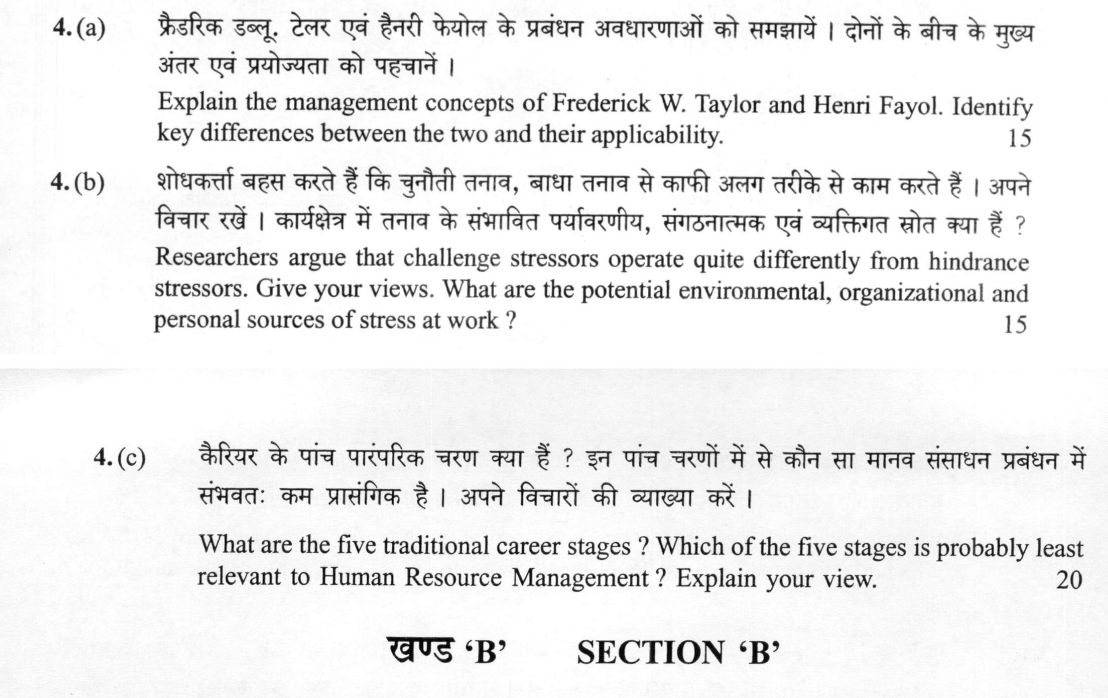
Explain the management concepts of Frederick W. Taylor and Henri Fayol. Identify key differences between the two and their applicability. 15 marks
Researchers argue that challenge stressors operate quite differently from hindrance stressors. Give your views. What are the potential environmental, organizational and personal sources of stress at work ? 15 marks
What are the five traditional career stages ? Which of the five stages is probably least relevant to Human Resource Management ? Explain your view. 20 marks
हिंदी में प्रश्न पढ़ें
फ्रेडरिक डब्लू. टेलर एवं हेनरी फयोल के प्रबंधन अवधारणाओं को समझायें । दोनों के बीच के मुख्य अंतर एवं प्रयोज्यता को पहचानें । (15 अंक)
शोधकर्ता बहस करते हैं कि चुनौती तनाव, बाधा तनाव से काफी अलग तरीके से काम करते हैं । अपने विचार रखें । कार्यक्षेत्र में तनाव के संभावित पर्यावरणीय, संगठनात्मक एवं व्यक्तिगत स्रोत क्या हैं ? (15 अंक)
कैरियर के पांच पारंपरिक चरण क्या हैं ? इन पांच चरणों में से कौन सा मानव संसाधन प्रबंधन में संभवतः कम प्रासंगिक है। अपने विचारों की व्याख्या करें। (20 अंक)
Model answer
Written by UPSC Answer Check against this question's marking rubric, to the expected length. UPSC does not publish answers for Mains — this is one way to score well, not an official key.
Classical management theory provided the foundational scaffolding for contemporary organisational design, bifurcated into Frederick W. Taylor’s micro-level shop-floor rationalisation and Henri Fayol’s macro-administrative paradigm.
Taylor and Fayol: Concepts, Differences, and Applicability
Taylor’s Scientific Management focused on bottom-up efficiency through time-and-motion studies, functional foremanship (separating planning from execution across eight specialized foremen), and differential piece-rate wage systems to eliminate soldiering and maximize physical productivity. Conversely, Fayol formulated an administrative theory comprising universal functions (Planning, Organising, Commanding, Coordinating, Controlling) and fourteen principles (including Unity of Command, Scalar Chain, and Esprit de Corps), conceptualizing management as a top-down, teachable executive discipline applicable to all collective endeavors.
The primary differences lie in their orientation and structural design: Taylor adopted an inductive, engineering perspective focused on physical task execution, subordinating administrative cohesion to functional specialization. Fayol adopted a deductive, executive perspective centered on managerial hierarchy, strictly preserving unity of command. Regarding applicability, Taylorism remains vital in standardized, cost-sensitive manufacturing environments such as the Tirupur garment clusters and warehouse fulfillment hubs where micro-level process efficiency governs survival. Fayol’s principles remain the architectural bedrock for large-scale administrative governance, such as Indian Railways and Central Public Sector Enterprises (CPSEs).
Challenge versus Hindrance Stressors and Sources of Work Stress
Following the framework of Cavanaugh et al., workplace stressors operate through distinct cognitive appraisals. Challenge stressors (such as expansive job scope, high responsibility, and tight yet achievable deadlines) are perceived as opportunities for mastery and future rewards. These trigger problem-focused coping, which sustains motivation and organizational commitment despite high physiological arousal. Conversely, hindrance stressors (such as administrative red tape, role ambiguity, and office politics) represent insurmountable barriers that thwart goal attainment without any developmental payoff, leading causally to emotional exhaustion, alienation, and burnout.
Stress originates from three distinct domains. Environmental sources encompass macroeconomic volatility and technological displacement, exemplified by layoff anxieties in the Indian IT sector and income precarity within the gig economy. Organizational sources involve rigid appraisal mechanisms (such as forced-distribution bell curves), uncompensated demands for Organizational Citizenship Behaviour (OCB), and chronic role overload. Personal sources stem from Type A behavioral patterns, maladaptive perfectionism, and acute work-family conflict exacerbated by boundary-blurring hybrid work arrangements.
Career Stages and HRM Relevance
Super’s traditional model conceptualizes careers across five sequential stages: Exploration (pre-employment vocational trial), Establishment (skill acquisition, assimilation, and upward mobility), Mid-Career (maintenance or strategic reassessment), Late Career (mentorship and deceleration), and Decline (disengagement from active professional duties).
The Decline stage is traditionally considered the least relevant to Human Resource Management. Historically, corporate strategy prioritizes capital allocation toward high-return phases: talent acquisition during Exploration and leadership development during Establishment. In India’s young demographic landscape, HRM focuses heavily on the Establishment stage, where high attrition and career velocity directly dictate organizational competitiveness, while treating the Decline phase merely as an administrative exit routine.
However, contemporary HRM is critically re-evaluating this obsolescence. The rise of portfolio careers, gig engagements, and higher retirement ages has dismantled the assumption of linear disengagement. Forward-looking HRM practices in Indian public sector undertakings and family businesses actively redesign the Decline stage into structured knowledge-transfer and reverse-mentoring initiatives. Rather than passive phase-outs, HRM utilizes retiring cohorts for institutional governance, risk mitigation, and cultural continuity.
Classical administrative efficiency, nuanced stress mitigation, and lifecycle-aligned career architecture together provide the essential framework for sustaining modern organizational human capital.
What "Explain" is asking you to do
Make the working of something clear — what sets it off, what follows from what, and what it produces. Explain is the Commission's mechanism word: it dominates the technical papers and the “explain why” stems, where the marks sit in the causal chain and not in the label.
Structure that answers it
State what it is → the initiating condition → the chain of cause, step by step → an instance where it plays out → what the chain produces
Where marks are lost
Describing what something looks like instead of why it works that way. Naming the stages without linking them reads as description too.
How this answer will be evaluated
Approach
Framework: Scientific Management vs. Administrative Theory; Challenge vs. Hindrance Stressors; Five-Stage Career Model. (a) compare: paired headings or table > key differences > significance > conclusion | (b) comment: context > arguments both sides > judgment > close | (c) explain: definition/context > points in order > small example > short close Full marks: Comprehensive, well-structured, with clear distinctions and specific examples.
Key points expected
- Define Taylor's Scientific Management principles
- Define Fayol's 14 Principles of Management
- Identify key differences (e.g., shop-floor vs. top-down)
- Discuss applicability in modern contexts
- Define challenge stressors (e.g., workload, time pressure)
- Define hindrance stressors (e.g., role ambiguity, bureaucracy)
- Explain how they operate differently (motivation vs. frustration)
- List environmental, organizational, and personal sources
Evaluation rubric
Each sub-part is marked on its own, against the marks and word limit printed on the paper.
- (a) Contrast Taylor's and Fayol's management concepts and their applicability. 15 marks
compare— paired headings or table → key differences → significance → conclusion
Must cover
- Define Taylor's Scientific Management principles
- Define Fayol's 14 Principles of Management
- Identify key differences (e.g., shop-floor vs. top-down)
- Discuss applicability in modern contexts
Loses marks
- Confusing Taylor's and Fayol's specific principles
- Failing to distinguish between the two concepts
- Ignoring the 'applicability' aspect of the question
Earns more
- Mention specific Taylor elements (time-motion, differential piece rate)
- Mention specific Fayol elements (span of control, scalar chain)
- Reference 'Principles of Scientific Management' or 'General and Industrial Management'
Extra mark
- Reference a specific modern company applying these (e.g., Amazon logistics)
- Mention a specific contemporary management theory bridging the two
- (b) Discuss the difference between challenge and hindrance stressors and their sources. 15 marks
comment— context → arguments both sides → judgment → close
Must cover
- Define challenge stressors (e.g., workload, time pressure)
- Define hindrance stressors (e.g., role ambiguity, bureaucracy)
- Explain how they operate differently (motivation vs. frustration)
- List environmental, organizational, and personal sources
Loses marks
- Treating all stressors as identical
- Failing to distinguish between the three source categories
- Ignoring the 'different operation' aspect of the question
Earns more
- Reference the 'Challenge-Hindrance Stressor Framework' (e.g., Cavanaugh et al.)
- Provide specific examples for each source category
- Discuss the impact on employee well-being and performance
Extra mark
- Reference a specific study or statistic on workplace stress
- Mention a specific organizational policy to mitigate hindrance stressors
- (c) Describe the five career stages and identify the least relevant one for HRM. 20 marks
explain— definition/context → points in order → small example → short close
Must cover
- List the five traditional career stages (e.g., Exploration, Establishment, Maintenance, Disengagement, Retirement)
- Briefly describe each stage
- Identify the stage least relevant to HRM
- Explain why that stage is least relevant
Loses marks
- Listing fewer than five stages
- Failing to identify the least relevant stage
- Providing no explanation for the chosen stage
Earns more
- Reference a specific career theory (e.g., Super's Career Development Theory)
- Discuss HRM interventions for each stage
- Provide examples of HRM practices for each stage
Extra mark
- Reference a specific study on career development
- Mention a specific HRM policy for a particular career stage
Practice this exact question
Write your answer and it is marked point by point against the model answer above — what you covered, what you missed, what you got wrong.
Evaluate my answer →More from Management 2022 Paper I
- Q1 (a) Identify key differences between a manager and a leader. Justify your answer with sui…
- Q2 (a) Differentiate between 'Entrepreneur' and 'Intrapreneur' with suitable examples. Ident…
- Q3 (a) Recent international events such as the pandemic Covid-19 and the Russian-Ukraine war…
- Q4 (a) Explain the management concepts of Frederick W. Taylor and Henri Fayol. Identify key…
- Q5 (a) Highlight various limitations of financial statements. How can these be minimized or…
- Q6 (a) Explain the circumstances under which different methods of depreciation can be employ…
- Q7 (a) Why is Budgetary control required in a business concern ? What are its limitations ?…