Paper I — Q5
(a) Highlight various limitations of financial statements. How can these be minimized or resolved ? (10 marks) (b) Highlight the…
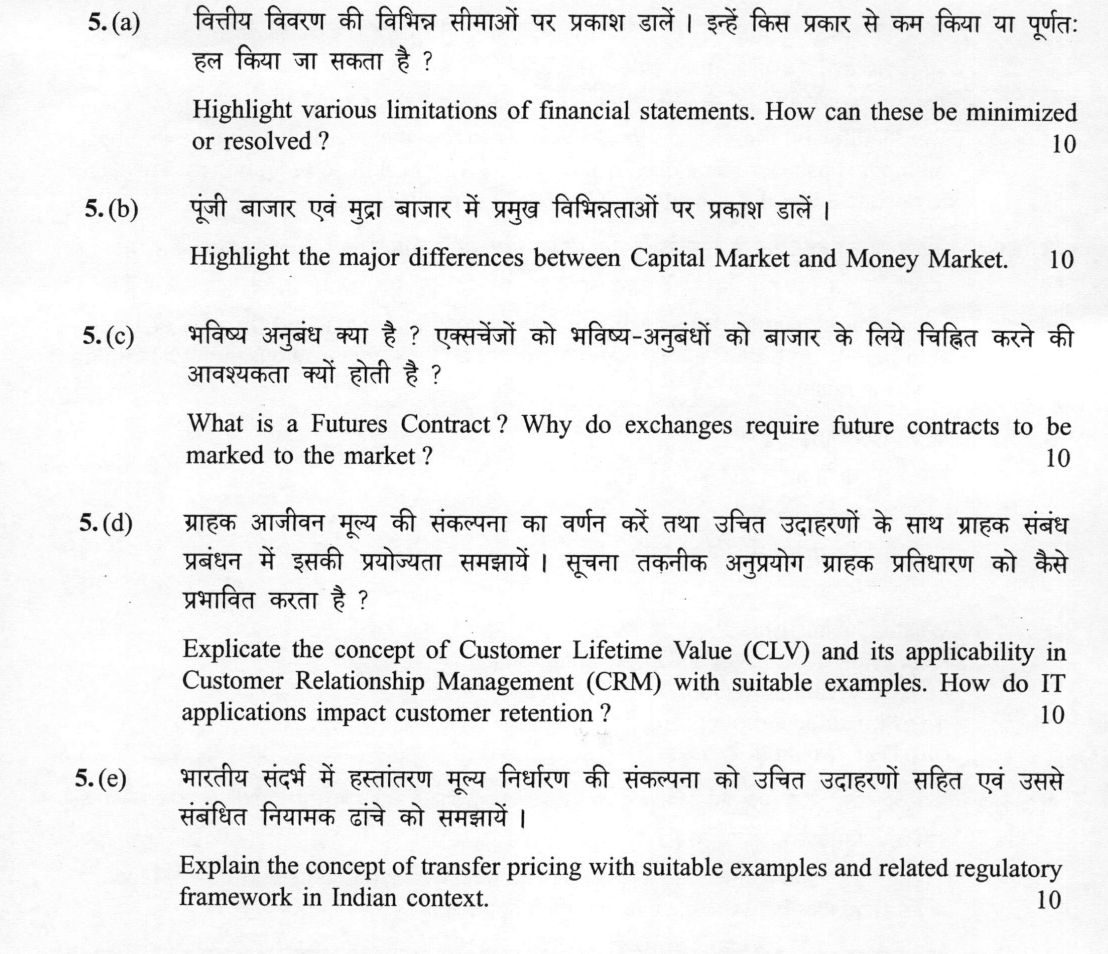
Highlight various limitations of financial statements. How can these be minimized or resolved ? 10 marks
Highlight the major differences between Capital Market and Money Market. 10 marks
What is a Futures Contract ? Why do exchanges require future contracts to be marked to the market ? 10 marks
Explicate the concept of Customer Lifetime Value (CLV) and its applicability in Customer Relationship Management (CRM) with suitable examples. How do IT applications impact customer retention ? 10 marks
Explain the concept of transfer pricing with suitable examples and related regulatory framework in Indian context. 10 marks
हिंदी में प्रश्न पढ़ें
वित्तीय विवरण की विभिन्न सीमाओं पर प्रकाश डालें। इन्हें किस प्रकार से कम किया या पूर्णतः हल किया जा सकता है ? (10 अंक)
पूंजी बाजार एवं मुद्रा बाजार में प्रमुख विभिन्नताओं पर प्रकाश डालें। (10 अंक)
भविष्य अनुबंध क्या है ? एक्सचेंजों को भविष्य-अनुबंधों को बाजार के लिए चिह्नित करने की आवश्यकता क्यों होती है ? (10 अंक)
ग्राहक आजीवन मूल्य की संकल्पना का वर्णन करें तथा उचित उदाहरणों के साथ ग्राहक संबंध प्रबंधन में इसकी प्रयोज्यता समझाएं। सूचना तकनीक अनुप्रयोग ग्राहक प्रतिधारण को कैसे प्रभावित करता है ? (10 अंक)
भारतीय संदर्भ में हस्तांतरण मूल्य निर्धारण की संकल्पना को उचित उदाहरणों सहित एवं उससे संबंधित नियामक ढांचे को समझाएं। (10 अंक)
Model answer
Written by UPSC Answer Check against this question's marking rubric, to the expected length. UPSC does not publish answers for Mains — this is one way to score well, not an official key.
Modern enterprise management demands a robust convergence of financial discipline, strategic marketing, and statutory compliance. From balance sheet fidelity and market liquidity to customer relationship equity and cross-border tax integrity, managerial decision-making rests on transparent accounting, well-functioning capital mechanisms, and precise analytical tools.
Limitations of Financial Statements and Remedial Measures
Financial statements suffer from inherent structural constraints. First, they rely predominantly on the historical cost convention, failing to reflect current replacement costs or changing purchasing power. Second, window dressing allows management to temporarily inflate liquidity or suppress liabilities before reporting dates. Third, financial statements entirely omit critical non-monetary assets such as human capital, brand value, intellectual property, and corporate culture. Fourth, they ignore the distortive impact of price-level changes, leading to overstated paper profits and capital erosion during inflationary periods. Finally, subjective estimations regarding depreciation schedules, bad debt provisions, and inventory valuation introduce human bias into reported earnings.
These limitations can be minimized through structured accounting interventions. Enterprises can adopt inflation-adjusted accounting, employing Current Purchasing Power (CPP) and Current Cost Accounting (CCA) techniques. Supplementary disclosures, including segment reporting under Ind AS 108 and comprehensive cash flow analyses under Ind AS 7, bridge information asymmetries. Furthermore, adopting the Integrated Reporting framework endorsed by the International Integrated Reporting Council (IIRC) alongside SEBI's Business Responsibility and Sustainability Reporting (BRSR) ensures that manufactured, intellectual, human, and social capitals are reported alongside traditional financial metrics.
Major Differences Between Capital Market and Money Market
The capital market and money market serve distinct economic functions, differentiated by maturity, instruments, regulatory oversight, and risk profiles.
In terms of maturity and purpose, the capital market facilitates medium and long-term capital formation exceeding one year, funding capital expenditures and corporate expansion. Conversely, the money market manages short-term liquidity imbalances with instruments maturing anywhere from overnight up to one year.
Instrumentally, capital markets deploy equity shares, preference shares, debentures, and zero-coupon bonds. The money market relies on instruments such as Treasury Bills, Commercial Papers, Certificates of Deposit, Call and Notice Money, and Repurchase Agreements (Repo).
The regulatory framework reflects this functional division. In India, capital markets fall under the statutory jurisdiction of the Securities and Exchange Board of India (SEBI), operating via organized exchanges like the National Stock Exchange (NSE) and Bombay Stock Exchange (BSE). The money market is regulated by the Reserve Bank of India (RBI) and operates predominantly through interbank electronic networks and the Clearing Corporation of India Limited (CCIL).
Finally, participant profiles and risk differ significantly. Capital markets involve diverse participants, including retail investors, mutual funds, and foreign portfolio investors, bearing higher price volatility and default risk for higher long-term yields. Money market participants are restricted largely to institutional players such as commercial banks, primary dealers, and corporate treasuries, characterized by high liquidity, low default risk, and large wholesale transaction sizes.
Futures Contract and the Rationale for Mark-to-Market
A futures contract is a standardized, legally binding agreement traded on a recognized exchange to buy or sell a specified quantity of an underlying asset—such as an equity index, commodity, or currency—at a predetermined price on a specified future settlement date. Unlike customized forward contracts, futures are strictly standardized in contract size, expiration dates, and tick sizes, and are backed by the exchange clearing corporation acting as the central counterparty.
Exchanges mandate that futures contracts be marked to the market (MTM) on a daily basis to eliminate counterparty credit risk. Under the MTM mechanism, the clearing house adjusts the value of open positions at the end of each trading day based on the official closing settlement price. Gains are credited to, and losses debited from, the respective trader’s margin account overnight.
This daily cash settlement prevents the accumulation of substantial unrealized liabilities over the contract’s life. If a trader’s margin drops below the specified maintenance margin, an immediate margin call is triggered. Failure to replenish the account leads to automated liquidation of the position by the exchange. Daily MTM settlement insulates market participants from systemic counterparty default and prevents default cascades across the clearing ecosystem.
Customer Lifetime Value, CRM Applicability, and IT in Retention
Customer Lifetime Value (CLV) is a metric that quantifies the total net profit attributed to the entire future relationship with a customer. It is computed either through historic models by aggregating past realized margins, or predictive models using parameters such as average purchase value, purchase frequency, gross margin, and customer retention rate discounted by the firm’s cost of capital.
In Customer Relationship Management (CRM), CLV serves as the benchmark for value-based customer segmentation, categorizing clients into tiers such as platinum, gold, iron, and lead. It determines appropriate Customer Acquisition Cost (CAC) ceilings, ensuring marketing spends do not exceed expected lifetime earnings. Furthermore, CLV directs disproportionate resource allocation, prioritizing retention workflows and personalized loyalty rewards for high-value segments.
Information technology applications fundamentally enhance customer retention. Modern enterprise CRM platforms, big data warehouses, and machine learning models analyze behavioral touchpoints in real time. In India, e-commerce platforms like Flipkart use predictive analytics to identify churn propensity, triggering automated hyper-personalized discount triggers and cart-recovery communications. Similarly, the Tata Neu super-app integrates customer data across aviation, hospitality, and retail to run unified loyalty programs, optimizing cross-sell opportunities, reducing customer attrition, and elevating aggregate lifetime value.
Transfer Pricing Concept, Methods, and Indian Regulatory Framework
Transfer pricing refers to the value assigned to transactions involving the transfer of goods, services, intellectual property, or financial loans between associated enterprises across different tax jurisdictions. Multinational corporations may use internal pricing to shift taxable profits from high-tax countries to low-tax jurisdictions. For example, if an Indian subsidiary provides IT engineering services to its parent company in the United States, it must invoice the parent at an objective market rate rather than an artificially deflated price that depresses Indian taxable revenue.
To determine an arm’s length price (ALP), international standards and Indian law recognize five primary methods: Comparable Uncontrolled Price (CUP) method, Resale Price Method (RPM), Cost Plus Method (CPM), Transactional Net Margin Method (TNMM), and Profit Split Method (PSM).
In India, transfer pricing is governed by Sections 92 to 92F of the Income Tax Act, 1961. The statutory framework mandates that any international transaction or Specified Domestic Transaction between associated enterprises must be computed having regard to the arm's length price. Taxpayers are mandated to maintain comprehensive transfer pricing documentation and submit an annual accountant’s report in Form 3CEB. The Central Board of Direct Taxes (CBDT) aligns Indian compliance with OECD Base Erosion and Profit Shifting (BEPS) Action 13 via Master File and Country-by-Country (CbC) reporting. To mitigate protracted tax litigation, the regulatory architecture incorporates dispute resolution mechanisms including the Advance Pricing Agreement (APA) scheme under Section 92CC and Safe Harbour Rules under Section 92CB.
Systematic alignment across financial reporting integrity, capital allocation efficiency, predictive customer analytics, and statutory transfer pricing compliance reinforces corporate transparency. These integrated mechanisms safeguard stakeholder trust, fortify corporate governance, and establish long-term enterprise sustainability in an increasingly interconnected global economy.
What "Highlight" is asking you to do
Bring the notable features of the named material forward and make their weight visible — what each feature is, and what gives it importance. Highlight expects substantive coverage of the features, not a thin selection from them.
Structure that answers it
The material and what makes a feature notable within it → feature, with the point that gives it weight → the same for each further feature → the composite picture they form
Where marks are lost
Naming features flatly as a list and never showing why any one of them signifies.
How this answer will be evaluated
Approach
Framework: Concept > Named framework > Application > Limitation and recommendation. (a) highlight: name the salient points > one line of substance each > close | (b) compare: paired headings or table > key differences > significance > conclusion | (c) explain: definition/context > points in order > small example > short close | (d) explain: definition/context > points in order > small example > short close | (e) explain: definition/context > points in order > small example > short close Full marks: Precise definitions, named frameworks (e.g., TNMM, RFM), and specific statutory references (Sections 92-92F).
Key points expected
- Limitations: historical cost, non-cash items, qualitative factors
- Limitations: window dressing, inflation effects
- Resolution: CFS, notes to accounts, ratio analysis
- Resolution: management discussion and analysis (MD&A)
- Difference in maturity (long-term vs short-term)
- Difference in instruments (equity/bonds vs T-bills/CDs)
- Difference in risk and return profile
- Difference in participants (investors vs institutions)
Evaluation rubric
Each sub-part is marked on its own, against the marks and word limit printed on the paper.
- (a) Name salient limitations of financial statements and methods to minimize them. 10 marks
highlight— name the salient points → one line of substance each → close
Must cover
- Limitations: historical cost, non-cash items, qualitative factors
- Limitations: window dressing, inflation effects
- Resolution: CFS, notes to accounts, ratio analysis
- Resolution: management discussion and analysis (MD&A)
Loses marks
- Listing limitations without any resolution strategy
- Confusing financial statements with tax returns
Earns more
- Mention of IFRS/GAAP standardization
- Reference to non-financial reporting (ESG)
Extra mark
- Specific example of a company's window dressing
- Reference to a specific accounting standard (e.g., Ind AS 101)
- (b) Paired comparison of Capital Market and Money Market features. 10 marks
compare— paired headings or table → key differences → significance → conclusion
Must cover
- Difference in maturity (long-term vs short-term)
- Difference in instruments (equity/bonds vs T-bills/CDs)
- Difference in risk and return profile
- Difference in participants (investors vs institutions)
Loses marks
- Defining markets without comparing them
- Confusing primary and secondary markets
Earns more
- Reference to specific Indian instruments (e.g., NCDs vs CPs)
- Mention of SEBI vs RBI regulatory roles
Extra mark
- Table format for comparison
- Reference to a specific recent market event
- (c) Define Futures Contract and explain the 'mark to market' mechanism. 10 marks
explain— definition/context → points in order → small example → short close
Must cover
- Definition: standardized contract for future delivery
- Mechanism: daily settlement of gains/losses
- Purpose: reduces counterparty/default risk
- Process: margin adjustments (variation margin)
Loses marks
- Confusing futures with spot transactions
- Failing to link MTM to risk management
Earns more
- Distinction between futures and forwards
- Mention of clearing house role
Extra mark
- Numerical example of daily P&L calculation
- Reference to NSE/BSE specific rules
- (d) Explain CLV concept, its role in CRM, and IT's impact on retention. 10 marks
explain— definition/context → points in order → small example → short close
Must cover
- Definition of CLV (present value of future cash flows)
- Application: segmenting customers by value (RFM)
- IT impact: data analytics, personalization, automation
- Link to retention: reducing churn via targeted offers
Loses marks
- Defining CLV without linking to CRM strategy
- Ignoring the IT/technology component of the question
Earns more
- Example: Telecom or E-commerce industry
- Mention of specific CRM tools (Salesforce, HubSpot)
Extra mark
- Formula for CLV calculation
- Reference to a specific company's CRM strategy
- (e) Explain transfer pricing with examples and Indian regulatory framework. 10 marks
explain— definition/context → points in order → small example → short close
Must cover
- Definition: pricing of transactions between related parties
- Indian Law: Income Tax Act, 1961 (Sections 92-92F)
- Methods: CUP, TNMM, Cost Plus, Residual Profit
- Regulator: CBDT and Transfer Pricing Officer (TPO)
Loses marks
- Discussing general pricing without 'related party' context
- Ignoring the specific Indian regulatory framework
Earns more
- Example: MNC moving IP to low-tax jurisdiction
- Mention of Advance Ruling (AR) mechanism
Extra mark
- Reference to OECD Guidelines
- Mention of specific penalty provisions (Section 271AA)
Practice this exact question
Write your answer and it is marked point by point against the model answer above — what you covered, what you missed, what you got wrong.
Evaluate my answer →More from Management 2022 Paper I
- Q2 (a) Differentiate between 'Entrepreneur' and 'Intrapreneur' with suitable examples. Ident…
- Q3 (a) Recent international events such as the pandemic Covid-19 and the Russian-Ukraine war…
- Q4 (a) Explain the management concepts of Frederick W. Taylor and Henri Fayol. Identify key…
- Q5 (a) Highlight various limitations of financial statements. How can these be minimized or…
- Q6 (a) Explain the circumstances under which different methods of depreciation can be employ…
- Q7 (a) Why is Budgetary control required in a business concern ? What are its limitations ?…
- Q8 (a) The data below relates to ABC Ltd. which makes and sells laptops. [Table showing: Feb…