Paper I — Q3
(a) Recent international events such as the pandemic Covid-19 and the Russian-Ukraine war significantly impacted global business…
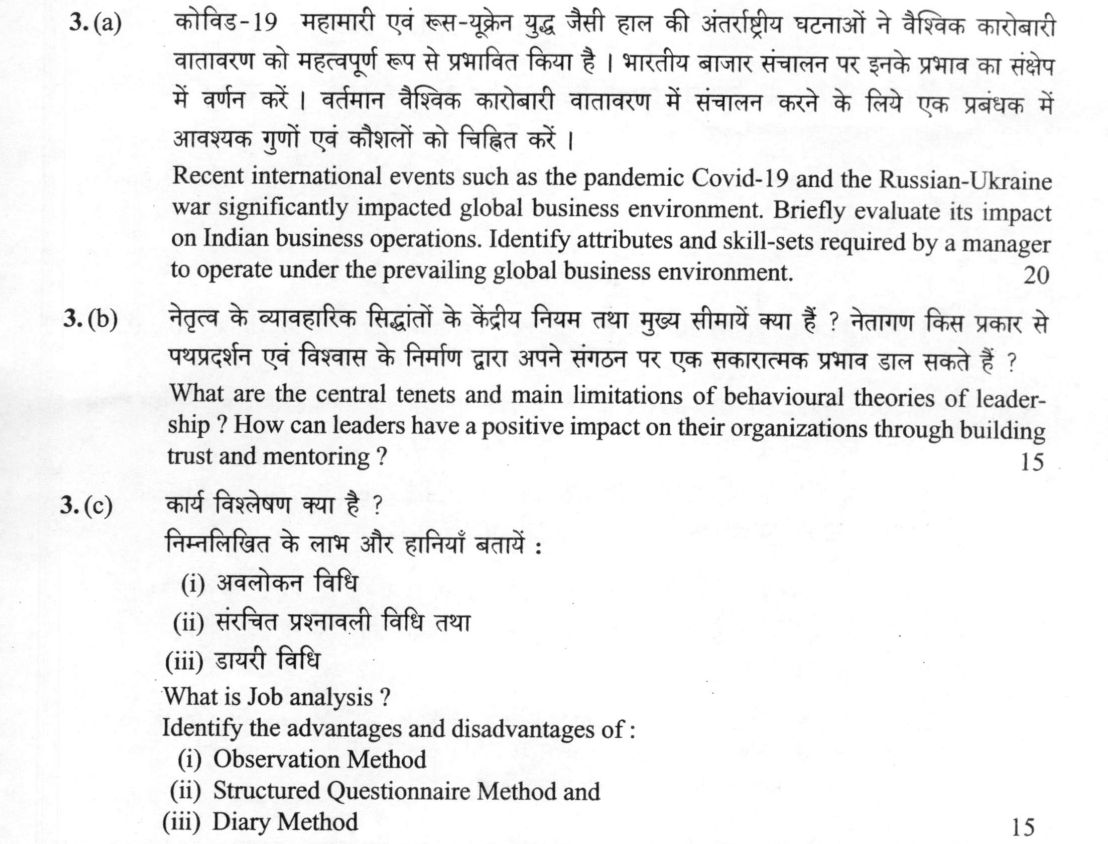
Recent international events such as the pandemic Covid-19 and the Russian-Ukraine war significantly impacted global business environment. Briefly evaluate its impact on Indian business operations. Identify attributes and skill-sets required by a manager to operate under the prevailing global business environment. 20 marks
What are the central tenets and main limitations of behavioural theories of leadership ? How can leaders have a positive impact on their organizations through building trust and mentoring ? 15 marks
What is Job analysis ? Identify the advantages and disadvantages of : (i) Observation Method (ii) Structured Questionnaire Method and (iii) Diary Method 15 marks
हिंदी में प्रश्न पढ़ें
कोविड-19 महामारी एवं रूस-यूक्रेन युद्ध जैसी हाल की अंतर्राष्ट्रीय घटनाओं ने वैश्विक कारोबारी वातावरण को महत्वपूर्ण रूप से प्रभावित किया है । भारतीय बाजार संचालन पर इनके प्रभाव का संक्षेप में वर्णन करें । वर्तमान वैश्विक कारोबारी वातावरण में संचालन करने के लिये एक प्रबंधक में आवश्यक गुणों एवं कौशलों को चिह्नित करें । (20 अंक)
नेतृत्व के व्यवहारिक सिद्धांतों के केंद्रीय नियम तथा मुख्य सीमायें क्या हैं ? नेता गण किस प्रकार से पथप्रदर्शन एवं विश्वास के निर्माण द्वारा अपने संगठन पर एक सकारात्मक प्रभाव डाल सकते हैं ? (15 अंक)
कार्य विश्लेषण क्या है ? निम्नलिखित के लाभ और हानियाँ बतायें : (i) अवलोकन विधि (ii) संरचित प्रश्नावली विधि तथा (iii) डायरी विधि (15 अंक)
Model answer
Written by UPSC Answer Check against this question's marking rubric, to the expected length. UPSC does not publish answers for Mains — this is one way to score well, not an official key.
Impact of Global Shocks on Indian Business and Required Managerial Competencies
The compounding shocks of the COVID-19 pandemic and the Russia-Ukraine conflict created acute Volatility, Uncertainty, Complexity, and Ambiguity (VUCA) across global markets. For Indian businesses, the immediate evaluation reveals severe operational vulnerabilities: critical supply chain bottlenecks (notably semiconductor and active pharmaceutical ingredient deficits), margin compression due to crude oil, fertilizer, and edible oil price inflation, and heightened forex volatility impacting import-heavy sectors. Conversely, this disruption functioned as a structural catalyst. Indian industry accelerated domestic capability building under the Atmanirbhar Bharat framework and Production Linked Incentive (PLI) schemes, diversified sourcing away from single-country dependence (China+1 strategy), and expedited enterprise-wide digitalization.
Navigating this operating environment requires specific managerial attributes and skill-sets:
- Strategic Agility and Scenario Planning: The capability to rapidly reconfigure supply chains, shift procurement channels, and hedge commodity risks under fluctuating geopolitical conditions.
- Digital and Analytical Acumen: Leveraging artificial intelligence, cloud ERP, and predictive analytics to achieve real-time operational visibility and demand forecasting.
- Emotional Resilience and Crisis Leadership: Fostering adaptive work environments, managing remote or hybrid workforces, and preserving team morale during systemic shocks.
- Cross-Border Stakeholder Management: Understanding multilateral trade dynamics, non-tariff barriers, and ESG compliance across diverse global jurisdictions.
Central Tenets and Limitations of Behavioural Theories of Leadership
Behavioural theories shift the leadership paradigm from innate traits to learnable actions, proposing that leadership effectiveness depends on specific behavioural patterns. Seminal frameworks include:
- Ohio State Studies: Identified two independent dimensions—*Initiating Structure* (task definition, organization, scheduling) and Consideration (mutual trust, respect for employees' ideas, relationship building).
- University of Michigan Studies: Contrasted Production-Oriented leadership (emphasis on technical aspects and quotas) with Employee-Oriented leadership (focus on interpersonal relations and human needs).
- Blake and Mouton’s Managerial Grid: Evaluated leaders on a two-dimensional grid—*Concern for Production* versus *Concern for People*—advocating the (9,9) "Team Management" style as optimal.
Limitations: The primary flaw of behavioural theories is their universalist assumption that a single behavioural pattern fits all contexts. They neglect situational contingencies (such as task ambiguity, follower maturity, and environmental turbulence), struggle to establish definitive causal links between behaviour and organizational performance, and rely on subjective behavioural assessment metrics.
Trust and Mentoring: Leaders mitigate these limitations by establishing organizational trust through operational transparency, distributive and procedural justice, and predictable ethical conduct. Through transformational mentoring—offering individualized consideration, psychological safety, and targeted capability building—leaders align individual growth with strategic vision, thereby enhancing organizational commitment and retention.
Job Analysis: Methods, Advantages, and Disadvantages
Job analysis is the fundamental human resource process of systematically collecting, evaluating, and organizing information regarding the duties, responsibilities, work environment, and required human competencies of a role. It yields two primary outputs: the Job Description (task boundaries and reporting relationships) and the Job Specification (minimum qualifications, skills, and attributes required).
1. Observation Method: Advantages: Yields firsthand, objective, and real-time data, reducing reliance on incumbent recall; highly effective for repetitive, manual, and short-cycle physical tasks. Disadvantages: Vulnerable to the Hawthorne effect (workers altering behavior when observed); impractical for cognitive, analytical, or managerial roles where work processes are non-observable.
2. Structured Questionnaire Method: Advantages: Highly cost-effective and standardized; allows rapid data collection from large, geographically dispersed samples, producing quantifiable data suitable for statistical evaluation (such as the Position Analysis Questionnaire). Disadvantages: Rigid formats can miss nuanced or evolving job dimensions; prone to respondent misinterpretation, self-serving inflation of responsibilities, and low response fidelity.
3. Diary/Log Method: Advantages: Generates a comprehensive, chronological, and longitudinal record of work routines, capturing non-routine, cyclical, and intermittent duties over extended periods. Disadvantages: Highly time-consuming and burdensome for employees; prone to selective or post-hoc recording, which degrades data reliability and completeness.
Conclusion
An overall evaluation indicates that operational resilience in a fragmented global economy depends on a coherent human resource chain: rigorous job analysis establishes foundational clarity and adaptive role design, while behavioural leaders—grounded in trust and active mentoring—translate these structured capabilities into organizational agility and sustained competitive performance.
What "Evaluate" is asking you to do
Judge how well something has performed against the standard it set for itself — its stated aim, mandate or promise — and commit to a verdict. Name the yardstick before you judge; an unanchored judgement reads as opinion.
Structure that answers it
Name the yardstick — stated aim, mandate or benchmark → performance against it → shortfall against it → why the gap exists → verdict
Where marks are lost
Presenting both sides and then declining to decide, or delivering a verdict against a standard you never stated, which makes it look arbitrary.
How this answer will be evaluated
Approach
Framework: null. (a) evaluate: criteria > evidence > balanced judgment | (b) explain: definition/context > points in order > small example > short close | (c) describe: define > structure or process in order > labelled diagram > significance Full marks: Comprehensive, well-structured, with specific examples and balanced judgment.
Key points expected
- Impact of pandemic and war on Indian operations
- Attributes required for global business environment
- Skill-sets for managers in current context
- Balanced judgment on the impact
- Central tenets of behavioural theories
- Main limitations of these theories
- Positive impact of building trust
- Positive impact of mentoring
Evaluation rubric
Each sub-part is marked on its own, against the marks and word limit printed on the paper.
- (a) Assess impact of global events on Indian business and identify required managerial attributes. 20 marks
evaluate— criteria → evidence → balanced judgment
Must cover
- Impact of pandemic and war on Indian operations
- Attributes required for global business environment
- Skill-sets for managers in current context
- Balanced judgment on the impact
Loses marks
- Textbook definitions without application
- Ignoring the specific events mentioned
- Listing skills without context
Earns more
- Specific examples of Indian business impact
- Linkage between global events and local operations
- Distinction between attributes and skills
- Reference to specific sectors affected
Extra mark
- Recent regulatory changes in India
- Specific company examples
- (b) Explain tenets/limits of behavioural leadership and impact of trust/mentoring. 15 marks
explain— definition/context → points in order → small example → short close
Must cover
- Central tenets of behavioural theories
- Main limitations of these theories
- Positive impact of building trust
- Positive impact of mentoring
Loses marks
- Confusing behavioural with trait theories
- Vague statements on trust/mentoring
- Ignoring the limitations part
Earns more
- Reference to specific behavioural theories (e.g., Ohio, Michigan)
- Concrete examples of trust-building
- Link between mentoring and organizational outcomes
- Distinction between tenets and limitations
Extra mark
- Reference to specific leadership models
- Case study of a leader
- (c) Define job analysis and list pros/cons of three specific methods. 15 marks
describe— define → structure or process in order → labelled diagram → significance
Must cover
- Definition of Job Analysis
- Advantages and disadvantages of Observation Method
- Advantages and disadvantages of Structured Questionnaire Method
- Advantages and disadvantages of Diary Method
Loses marks
- Confusing job analysis with job description
- Listing only advantages or only disadvantages
- Vague descriptions of the methods
Earns more
- Clear distinction between the three methods
- Specific examples of when each method is used
- Balanced view of pros and cons
- Reference to specific job types
Extra mark
- Comparison table of the three methods
- Reference to specific job analysis tools
Practice this exact question
Write your answer and it is marked point by point against the model answer above — what you covered, what you missed, what you got wrong.
Evaluate my answer →More from Management 2022 Paper I
- Q1 (a) Identify key differences between a manager and a leader. Justify your answer with sui…
- Q2 (a) Differentiate between 'Entrepreneur' and 'Intrapreneur' with suitable examples. Ident…
- Q3 (a) Recent international events such as the pandemic Covid-19 and the Russian-Ukraine war…
- Q4 (a) Explain the management concepts of Frederick W. Taylor and Henri Fayol. Identify key…
- Q5 (a) Highlight various limitations of financial statements. How can these be minimized or…
- Q6 (a) Explain the circumstances under which different methods of depreciation can be employ…