Paper II — Q1
(a) A newly constructed house can collapse due to fault in its design. It can also collapse even if it does not have a design…
A newly constructed house can collapse due to fault in its design. It can also collapse even if it does not have a design fault. The probability that the design of the newly constructed house is faulty is 0·1. The probability that this house collapses if the design is faulty is 0·95, whereas, the probability that the house collapses without any fault in design is 0·45. It is seen that the house has collapsed. What is the probability that it is due to fault in design? 10 marks
Define 'knowledge-based expert system'. Briefly discuss its major applications in business. 10 marks
"The difference between management of manufacturing (goods) and service operations is reducing." Discuss this statement in the light of the fundamental differences existing between goods and service operations. 10 marks
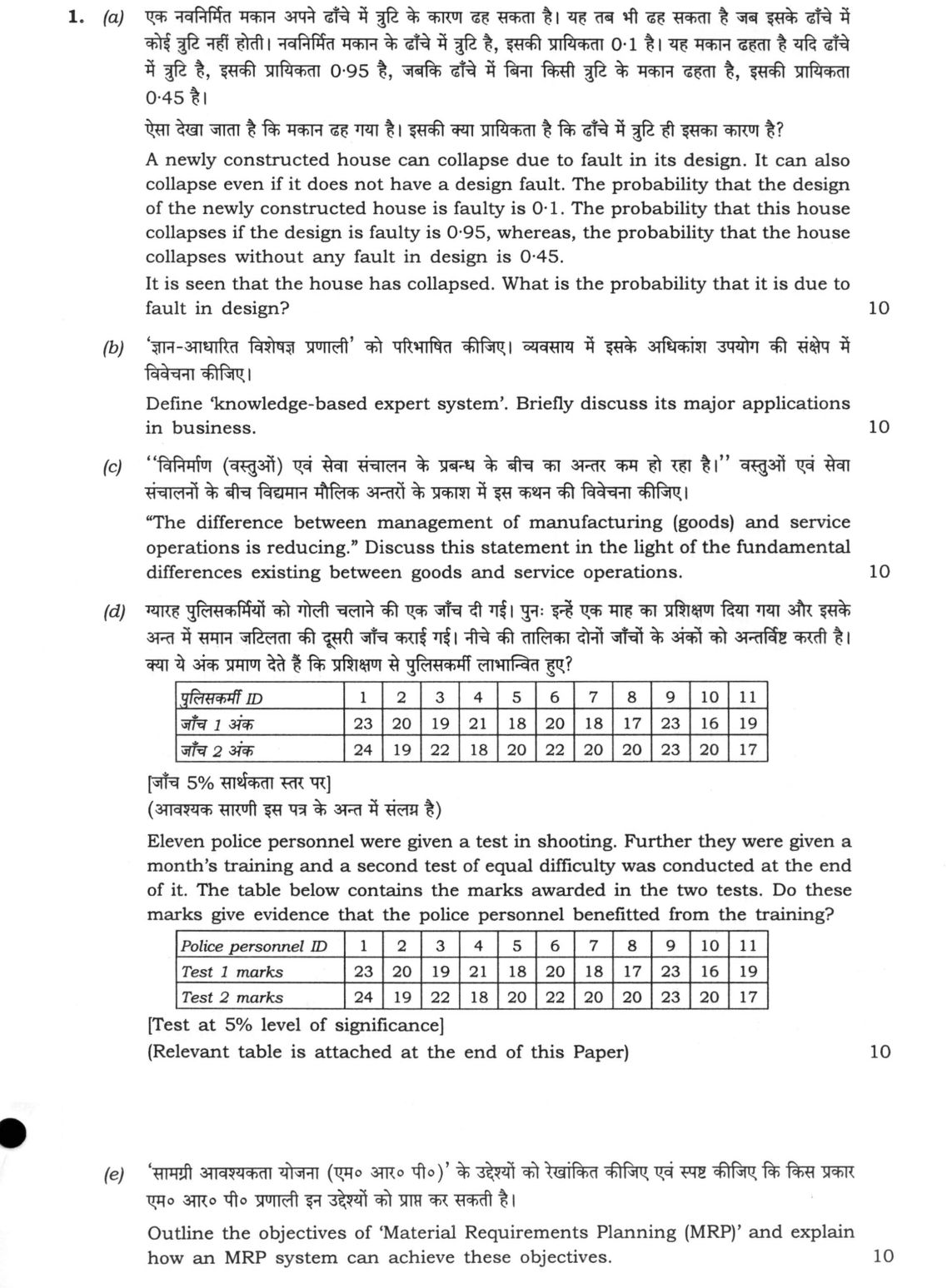
Eleven police personnel were given a test in shooting. Further they were given a month's training and a second test of equal difficulty was conducted at the end of it. The table below contains the marks awarded in the two tests. Do these marks give evidence that the police personnel benefitted from the training? [Test at 5% level of significance] (Relevant table is attached at the end of this Paper) 10 marks
Outline the objectives of 'Material Requirements Planning (MRP)' and explain how an MRP system can achieve these objectives. 10 marks
हिंदी में प्रश्न पढ़ें
एक नवनिर्मित मकान अपने डाँचे में त्रुटि के कारण ढह सकता है। यह तब भी ढह सकता है जब इसके डाँचे में कोई त्रुटि नहीं होती। नवनिर्मित मकान के डाँचे में त्रुटि है, इसकी प्रायिकता 0·1 है। यह मकान ढहता है यदि डाँचे में त्रुटि है, इसकी प्रायिकता 0·95 है, जबकि डाँचे में बिना किसी त्रुटि के मकान ढहता है, इसकी प्रायिकता 0·45 है। ऐसा देखा जाता है कि मकान ढह गया है। इसकी क्या प्रायिकता है कि डाँचे में त्रुटि ही इसका कारण है? (10 अंक)
'ज्ञान-आधारित विशेषज्ञ प्रणाली' को परिभाषित कीजिए। व्यवसाय में इसके अधिकांश उपयोग की संक्षेप में विवेचना कीजिए। (10 अंक)
"विनिर्माण (वस्तुओं) एवं सेवा संचालन के प्रबंध के बीच का अंतर कम हो रहा है।" वस्तुओं एवं सेवा संचालनों के बीच विद्यमान मौलिक अंतरों के प्रकाश में इस कथन की विवेचना कीजिए। (10 अंक)
ग्यारह पुलिसकर्मियों को गोली चलाने की एक जाँच दी गई। पुनः इन्हें एक माह का प्रशिक्षण दिया गया और इसके अंत में समान जटिलता की दूसरी जाँच कराई गई। नीचे की तालिका दोनों जाँचों के अंकों को अंतर्विष्ट करती है। क्या ये अंक प्रमाण देते हैं कि प्रशिक्षण से पुलिसकर्मी लाभान्वित हुए? [जाँच 5% सार्थकता स्तर पर] (आवश्यक सारणी इस पत्र के अंत में संलग्न है) (10 अंक)
'सामग्री आवश्यकता योजना (एम० आर० पी०)' के उद्देश्यों को रेखांकित कीजिए एवं स्पष्ट कीजिए कि किस प्रकार एम० आर० पी० प्रणाली इन उद्देश्यों को प्राप्त कर सकती है। (10 अंक)
The figure this question refers to, in words
The question paper is a scan and the diagram did not survive as text. This is the figure as read from the original page — every component, value and label — so the question can be worked from the text below.
(d) A table showing marks for eleven police personnel: Police personnel ID: 1, 2, 3, 4, 5, 6, 7, 8, 9, 10, 11 Test 1 marks: 23, 20, 19, 21, 18, 20, 18, 17, 23, 16, 19 Test 2 marks: 24, 19, 22, 18, 20, 22, 20, 20, 23, 20, 17
Model answer
Written by UPSC Answer Check against this question's marking rubric, to the expected length. UPSC does not publish answers for Mains — this is one way to score well, not an official key.
(a) Let F = event that the design is faulty, N = event that there is no design fault, and C = event that the house collapses. By Bayes’ theorem, we first find P(C), the total probability that the house collapses.
Given: P(F) = 0·1, so P(N) = 1 − 0·1 = 0·9. P(C|F) = 0·95. P(C|N) = 0·45.
Using the theorem of total probability: P(C) = P(C|F)P(F) + P(C|N)P(N) = 0·95 × 0·1 + 0·45 × 0·9 = 0·095 + 0·405 = 0·500.
Now applying Bayes’ theorem: P(F|C) = P(C|F)P(F) / P(C) = (0·95 × 0·1) / 0·500 = 0·095 / 0·500 = 0·190.
Final answer: The probability that the collapse is due to a fault in design is 0·19, i.e. 19%.
(b) A knowledge-based expert system (KBES) is a computer-based information system that uses a stored body of knowledge and a set of inference rules to imitate the problem-solving and decision-making ability of a human expert in a narrow domain. Its main components are the knowledge base, inference engine, working memory, knowledge-acquisition module, explanation facility, and user interface. The knowledge base contains facts, heuristics, rules of thumb, and domain-specific relationships. The inference engine applies logical rules to the facts to derive conclusions or recommendations. Unlike conventional programs, a KBES separates knowledge from the control mechanism, so it can be updated as expert knowledge improves.
Major applications of KBES in business include:
- Financial decision-making: credit appraisal, loan approval, risk assessment, portfolio selection, bankruptcy prediction, and fraud detection.
- Insurance: underwriting, claim settlement, policy pricing, and risk classification.
- Customer service: help desks, complaint diagnosis, troubleshooting, and automated advisory systems.
- Manufacturing: fault diagnosis, preventive maintenance, process control, quality assurance, and production scheduling.
- Marketing and sales: customer profiling, product recommendation, pricing support, and sales forecasting.
- Human resource management: candidate screening, job matching, training needs diagnosis, and performance advisory systems.
- Accounting and auditing: tax planning, audit risk assessment, internal control evaluation, and compliance checking.
- Strategic management: scenario analysis, competitive intelligence, and decision support under uncertainty.
KBES improves consistency, preserves expert knowledge, reduces dependence on scarce experts, shortens decision time, and supports training. Its limitations include high knowledge-acquisition effort, difficulty in handling novel situations, maintenance cost, and inability to replace human judgement in unstructured problems.
(c) The traditional distinction between manufacturing and service operations rests on certain fundamental differences. Goods are tangible, storable, transportable, and often produced before consumption. Services are intangible, perishable, inseparable from the provider, heterogeneous, and usually consumed while produced. In manufacturing, customer contact is low, production can be decoupled from consumption, inventory can buffer demand, quality can be inspected before delivery, and productivity is easier to measure. In services, customer participation is high, production and consumption coincide, capacity cannot be stored, variability is greater, and quality depends heavily on front-line employees and customer behaviour.
However, the statement that the difference between management of manufacturing and service operations is reducing is largely valid today. Several forces have narrowed the gap:
- Servitization: Manufacturers increasingly add after-sales service, maintenance, leasing, analytics, and product-service systems, making their operations more service-like.
- Industrialisation of services: Service firms now use standardisation, automation, self-service technology, modularisation, and mass customisation, making their operations more factory-like.
- Information technology: Digital platforms, ERP, CRM, IoT, and AI allow real-time coordination, remote diagnosis, and customisation in both sectors.
- Quality management: TQM, Six Sigma, and lean principles are now applied in hospitals, banks, retail, and government as well as factories.
- Customer focus: Manufacturers design products around customer experience, while service firms design processes around customer journeys.
- Capacity and demand management: Both sectors use scheduling, yield management, queuing theory, and demand forecasting.
- Measurement: Both now use productivity, cost, quality, cycle time, and customer satisfaction metrics, though service measurement remains harder.
Still, the convergence is not complete. Services cannot be inventoried, customer-induced variability remains high, and many personal services require physical presence and emotional labour. Therefore, the distinction is not disappearing but shifting from a goods-versus-services dichotomy to a goods-service continuum. Managers must combine manufacturing-efficiency tools with service-oriented flexibility and customer responsiveness.
(d) Since the same eleven police personnel are measured before and after training, the data are paired. The appropriate test is the paired t-test for small samples. Let d = Test 2 marks − Test 1 marks. A positive mean difference would indicate benefit from training.
Hypotheses: H₀: μd = 0, i.e. training produced no improvement. H₁: μd > 0, i.e. the police personnel benefited from training.
The differences are: 1, −1, 3, −3, 2, 2, 2, 3, 0, 4, −2.
Number of pairs n = 11. Σd = 1 − 1 + 3 − 3 + 2 + 2 + 2 + 3 + 0 + 4 − 2 = 11. Mean difference d̄ = Σd / n = 11 / 11 = 1.
Now compute Σd²: 1² + (−1)² + 3² + (−3)² + 2² + 2² + 2² + 3² + 0² + 4² + (−2)² = 1 + 1 + 9 + 9 + 4 + 4 + 4 + 9 + 0 + 16 + 4 = 61.
Sample variance: s² = [Σd² − (Σd)²/n] / (n − 1) = [61 − 11²/11] / (11 − 1) = [61 − 121/11] / 10 = [61 − 11] / 10 = 50 / 10 = 5.
So s = √5 ≈ 2·2361.
Standard error: SE = s / √n = √5 / √11 = √(5/11) ≈ 0·6742.
Paired t-statistic: t = d̄ / SE = 1 / √(5/11) = √(11/5) ≈ 1·483.
Degrees of freedom = n − 1 = 10. At 5% level of significance for a one-tailed test, the critical value is t₀.₀₅,₁₀ = 1·812.
Since calculated t = 1·483 < 1·812, we fail to reject H₀. The result is not significant at the 5% level. If a two-tailed test were used, the critical value would be 2·228, and the conclusion would still be the same.
Final answer: The marks do not give sufficient statistical evidence at the 5% level that the police personnel benefited from the training. The test assumes paired observations, independent differences, and approximate normality of the differences.
(e) Material Requirements Planning (MRP) is a computer-based production planning and inventory control system used mainly for dependent-demand items. It translates the Master Production Schedule (MPS) into detailed requirements for raw materials, components, and sub-assemblies needed to produce finished products on time.
The main objectives of MRP are:
- Ensure that materials and components are available when required for production.
- Ensure that finished products are available to meet customer delivery schedules.
- Maintain the lowest possible inventory levels without causing stock-outs.
- Plan and control manufacturing activities, purchase orders, and delivery schedules.
- Reduce production delays, idle time, and expediting costs.
- Improve capacity utilisation and production efficiency.
- Provide valid priorities and schedules for shop-floor and purchase operations.
- Improve customer service through reliable delivery performance.
An MRP system achieves these objectives through the following logic:
- Master Production Schedule: It states what end products are required, in what quantity, and by when.
- Bill of Materials (BOM): It shows the structure of each product, listing all components, sub-assemblies, and raw materials needed.
- Inventory Records File: It provides current stock on hand, scheduled receipts, lead times, lot-sizing rules, and safety stock.
- Explosion: MRP explodes the MPS through the BOM to calculate gross requirements of each dependent-demand item at each level.
- Netting: It subtracts available inventory and scheduled receipts from gross requirements to obtain net requirements.
- Lot sizing: It converts net requirements into planned order quantities using rules such as lot-for-lot, economic order quantity, or periodic order quantity.
- Lead-time offsetting: It schedules planned order releases backward from required dates using lead times.
- Planned orders: It generates planned order receipts and planned order releases for purchasing and production.
- Exception reports: It highlights shortages, delays, excess inventories, and schedule conflicts so managers can act.
- Capacity Requirements Planning: It checks whether the planned orders are feasible with available capacity and feedback is sent to the MPS.
- Feedback and rescheduling: Actual production, purchases, and inventory changes update the system continuously.
Thus, MRP integrates demand, product structure, inventory, and lead-time information to ensure the right materials are available at the right time, in the right quantity, while minimising inventory and improving delivery performance. Its effectiveness depends on accurate MPS, BOM, inventory data, lead times, and disciplined updating.
What "Solve" is asking you to do
Choose the method, then carry it through to a final answer. Identifying what kind of problem this is and why that method applies is the first thing marked; a correct figure arrived at invisibly earns almost nothing.
Structure that answers it
Given data and what is required → method chosen, with the reason it applies → set-up (equation, circuit, free body, trial balance) → working, step by step → answer with units and any condition of validity
Where marks are lost
Doing the middle steps mentally and writing only the result. In mathematics papers, a further loss comes from giving a decimal where the exact value in surds or fractions was wanted, or from skipping the justification a part explicitly asks for.
How this answer will be evaluated
Approach
Framework: Bayes' Theorem, Paired t-test, MRP. (a) calculate: given > formula > substitution > result with units > interpretation | (b) define: precise definition > the distinguishing feature > one example | (c) discuss: intro > 3-4 dimensions > example > balanced close | (d) calculate: given > formula > substitution > result with units > interpretation | (e) explain: definition/context > points in order > small example > short close Full marks: Accurate calculations, clear frameworks, balanced arguments, specific examples.
Key points expected
- Define events: Faulty design (F) and Collapse (C)
- State P(F)=0.1, P(C|F)=0.95, P(C|F')=0.45
- Apply Bayes' formula: P(F|C) = P(C|F)P(F) / P(C)
- Calculate P(C) = 0.95(0.1) + 0.45(0.9) = 0.5
- Define KBS (knowledge base + inference engine)
- Mention rule-based logic or heuristics
- List 2-3 business applications (e.g., credit scoring, diagnostics)
- Briefly explain value added by KBS
Evaluation rubric
Each sub-part is marked on its own, against the marks and word limit printed on the paper.
- (a) Probability of design fault given house collapse using Bayes' Theorem. 10 marks
calculate— given → formula → substitution → result with units → interpretation
Must cover
- Define events: Faulty design (F) and Collapse (C)
- State P(F)=0.1, P(C|F)=0.95, P(C|F')=0.45
- Apply Bayes' formula: P(F|C) = P(C|F)P(F) / P(C)
- Calculate P(C) = 0.95(0.1) + 0.45(0.9) = 0.5
Loses marks
- Using P(F) as the final answer
- Arithmetic errors in P(C) calculation
Earns more
- Correct final answer 0.19
- Clear step-by-step substitution
Extra mark
- Interpretation of the result in context
- (b) Definition of knowledge-based expert system and its business applications. 10 marks
define— precise definition → the distinguishing feature → one example
Must cover
- Define KBS (knowledge base + inference engine)
- Mention rule-based logic or heuristics
- List 2-3 business applications (e.g., credit scoring, diagnostics)
- Briefly explain value added by KBS
Loses marks
- Confusing KBS with general AI
- No specific business examples
Earns more
- Mention of specific software or industry
- Comparison with traditional systems
Extra mark
- Example of a specific named expert system
- (c) Analysis of the statement that differences between goods and service management are reducing. 10 marks
discuss— intro → 3-4 dimensions → example → balanced close
Must cover
- List fundamental differences (intangibility, perishability, etc.)
- Argue for convergence (e.g., service elements in manufacturing)
- Argue against convergence (e.g., core nature remains different)
- Provide a balanced conclusion
Loses marks
- One-sided argument without counter-view
- Vague generalities without specific differences
Earns more
- Use of terms like 'servitization' or 'servitization'
- Concrete examples of hybrid operations
Extra mark
- Reference to specific industry trends
- (d) Statistical test to determine if training improved shooting scores. 10 marks
calculate— given → formula → substitution → result with units → interpretation
Must cover
- Identify test as Paired t-test
- Calculate differences (d) for each pair
- Compute mean difference and standard deviation
- Compare t-statistic with critical value at 5% level
Loses marks
- Using independent t-test instead of paired
- Incorrect calculation of standard deviation
Earns more
- Correct null and alternative hypotheses
- Clear conclusion based on t-value
Extra mark
- Mention of degrees of freedom (n-1)
- (e) Objectives of MRP and how the system achieves them. 10 marks
explain— definition/context → points in order → small example → short close
Must cover
- List objectives (inventory reduction, delivery reliability)
- Explain MRP inputs (BOM, lead times, demand)
- Describe MRP process (netting, time-phasing)
- Link process to specific objectives
Loses marks
- Confusing MRP with simple reorder point systems
- No link between process and objectives
Earns more
- Mention of 'planned order releases'
- Discussion of 'explosion' of demand
Extra mark
- Mention of MRP II or ERP integration
Practice this exact question
Write your answer and it is marked point by point against the model answer above — what you covered, what you missed, what you got wrong.
Evaluate my answer →More from Management 2022 Paper II
- Q1 (a) A newly constructed house can collapse due to fault in its design. It can also collap…
- Q2 (a) The area sales manager of a company has compiled the following data for the eight ter…
- Q3 (a) (i) List the strategic objectives of aggregate planning. 5 (ii) Describe the chase an…
- Q4 (a) What exactly is an information system? How does it work? What are its management, org…