Paper II — Q7
(a) "Strategies are formulated and operated at different levels of management." Discuss this statement. Explain with examples how…
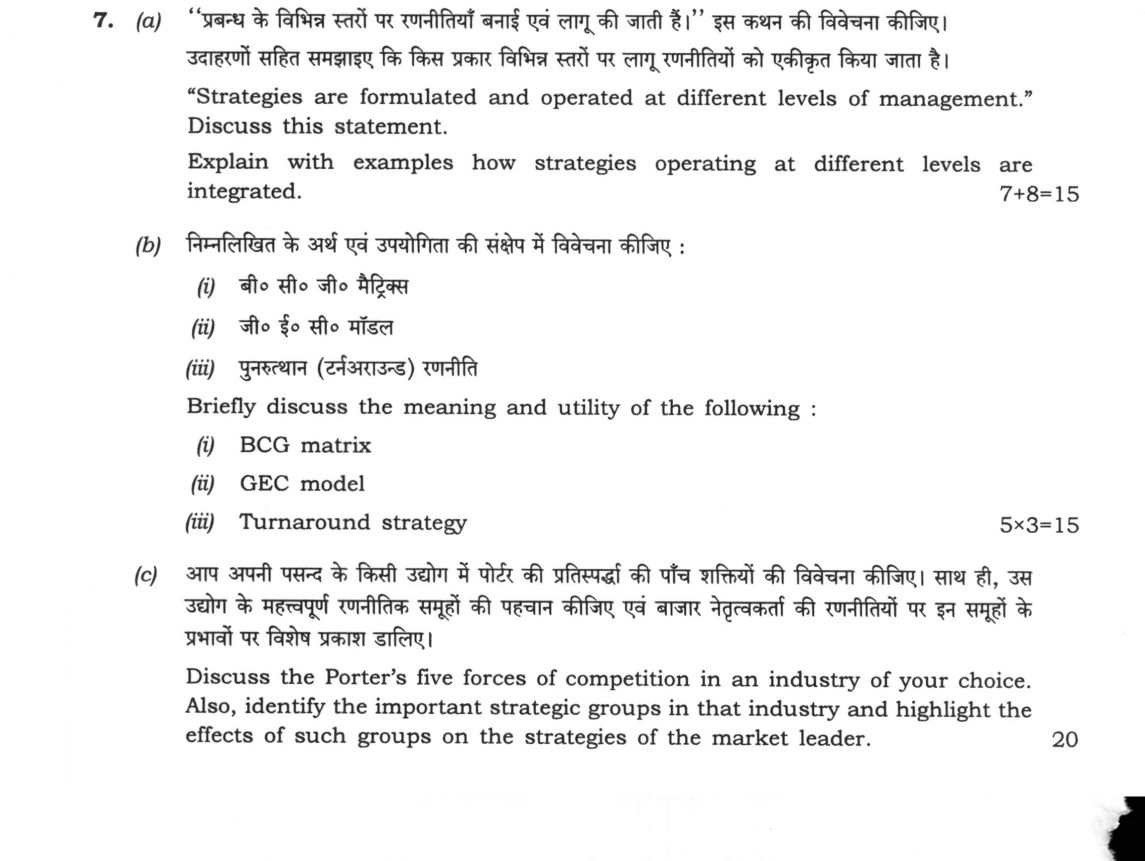
"Strategies are formulated and operated at different levels of management." Discuss this statement. Explain with examples how strategies operating at different levels are integrated. 7+8=15
Briefly discuss the meaning and utility of the following: BCG matrix
GEC model
Turnaround strategy 5×3=15
Discuss the Porter's five forces of competition in an industry of your choice. Also, identify the important strategic groups in that industry and highlight the effects of such groups on the strategies of the market leader. 20 marks
हिंदी में प्रश्न पढ़ें
"प्रबंध के विभिन्न स्तरों पर रणनीतियाँ बनाई एवं लागू की जाती हैं।" इस कथन की विवेचना कीजिए। उदाहरणों सहित समझाइए कि किस प्रकार विभिन्न स्तरों पर लागू रणनीतियों को एकीकृत किया जाता है। 7+8=15
निम्नलिखित के अर्थ एवं उपयोगिता की संक्षेप में विवेचना कीजिए: बी० सी० जी० मैट्रिक्स
जी० ई० सी० मॉडल
पुनरुत्थान (टर्नअराउंड) रणनीति 5×3=15
आप अपनी पसंद के किसी उद्योग में पोर्टर की प्रतिस्पर्धा की पाँच शक्तियों की विवेचना कीजिए। साथ ही, उस उद्योग के महत्त्वपूर्ण रणनीतिक समूहों की पहचान कीजिए एवं बाजार नेतृत्वकर्ता की रणनीतियों पर इन समूहों के प्रभावों पर विशेष प्रकाश डालिए। 20
Model answer
Written by UPSC Answer Check against this question's marking rubric, to the expected length. UPSC does not publish answers for Mains — this is one way to score well, not an official key.
Levels of Strategy and Their Integration
Strategic management operates hierarchically across three interconnected levels. Corporate-level strategy defines the overall scope and purpose of the enterprise, determining which businesses to enter, hold, or exit (e.g., Tata Sons allocating capital to electric mobility and digital services). Business-level (SBU) strategy focuses on building competitive advantage within specific markets through cost leadership or differentiation (e.g., Tata Motors Passenger Vehicles positioning the Nexon EV). Functional-level strategy translates SBU goals into actionable operational, marketing, financial, and R&D tactics (e.g., localization of battery supply chains).
Integration among these levels is achieved through vertical alignment and horizontal coordination. Key integration mechanisms include: Strategic Planning Systems: Top-down objective formulation combined with bottom-up operational inputs during annual planning cycles. The Balanced Scorecard (BSC): Cascading high-level corporate metrics into operational Key Performance Indicators across financial, customer, internal process, and learning dimensions. Management by Objectives (MBO): Harmonizing individual and departmental goals with corporate milestones, reinforced by performance-linked resource allocations.
Portfolio Models and Turnaround Strategy
BCG Growth-Share Matrix: Formulated on the axes of Market Growth Rate and Relative Market Share, it classifies SBUs into Stars (high growth, high share), Cash Cows (low growth, high share), Question Marks (high growth, low share), and Dogs (low growth, low share). Utility: Provides a clear cash-flow mapping tool to finance growth from mature units. Limitation: Oversimplifies market dynamics by using only two indicators and ignores inter-unit synergies.
GEC (McKinsey) Model: A 3x3 matrix evaluating SBUs across Industry Attractiveness (market size, growth, profitability, competitive intensity) and Business Unit Strength (brand equity, market share, technological capabilities). Utility: Offers a multi-factor, nuanced strategic direction categorized into Invest/Grow, Selectivity/Hold, and Harvest/Divest. Limitation: Qualitative weighting and scoring can introduce subjective biases.
Turnaround Strategy: A restorative strategy deployed to halt and reverse persistent corporate decline. It typically progresses through three phases: Contraction/Retrenchment (cost-cutting, asset divestment), Stabilization (liquidity preservation, operational consolidation), and Re-positioning/Growth (strategic restructuring, renewed core focus). Utility: Restores solvency and operational viability in distressed firms (e.g., SAIL’s operational turnaround). Limitation: Aggressive retrenchment carries risks of asset destruction, brain drain, and employee demotivation.
Porter’s Five Forces and Strategic Groups in the Indian Telecom Industry
Applying Michael Porter’s Five Forces to the Indian telecommunications sector: Threat of New Entrants (Low): Enormous capital expenditure requirements, spectrum auction pricing, and established subscriber scale create formidable entry barriers. Bargaining Power of Suppliers (Moderate to High): Heavy reliance on a limited set of global telecom gear manufacturers (Ericsson, Nokia) and dependency on the Department of Telecommunications (DoT) for spectrum allocation give suppliers significant leverage. Bargaining Power of Buyers (Moderate): Although low switching costs and Mobile Number Portability (MNP) empower consumers, rapid industry consolidation into an oligopoly has constrained alternative choices. Threat of Substitutes (Low to Moderate): OTT communication platforms substitute traditional voice/SMS, yet they still depend on underlying data infrastructure. Rivalry Among Existing Competitors (High): Intense structural competition over 5G infrastructure rollouts, spectrum holdings, and bundled content ecosystems.
`` High ^ | [ Strategic Group A ] | • Reliance Jio, Bharti Airtel | (High Capex, Pan-India 5G, Digital Platforms) Capex & | Technology | [ Strategic Group B ] Investment | • Vodafone Idea (Vi) | (Constrained Capex, 4G Defense, Debt-Restructuring) | | [ Strategic Group C ] | • BSNL / MTNL | (PSU, Rural Mandate, Delayed 4G/5G) Low +----------------------------------------------------> Low Market Reach & ARPU High ``
Effects of Strategic Groups on the Market Leader (Reliance Jio): High mobility barriers (massive capex, spectrum portfolios) insulate Group A from Group B and C. However, close rivalry with Bharti Airtel forces the market leader to utilize competitive signaling—such as matching tariff revisions and spectrum acquisitions—while orchestrating offensive enterprise-solution strategies and defensive bundling (JioFiber, OTT tie-ups) to lock in Average Revenue Per User (ARPU).
Sustained competitive advantage requires integrating multi-level strategies while using portfolio matrices and dynamic strategic group mapping to adapt to industry shifts.
What "Discuss" is asking you to do
Lay the issue out from more than one side — how it arose, what is claimed for it, what is held against it, and where it now stands. UPSC attaches discuss to broad topics with several live dimensions, so coverage of the dimensions earns more than the strength of your opinion.
Structure that answers it
Set the issue up → the case as it is made → the case against → the dimension both sides leave out → where the balance now lies
Where marks are lost
Listing facts with no thread between them, or arguing one side throughout and calling it a discussion.
How this answer will be evaluated
Approach
Framework: Multi-level Strategy (Corporate, Business, Functional). (a) discuss: intro > 3-4 dimensions > example > balanced close | (b) discuss: intro > 3-4 dimensions > example > balanced close | (c) discuss: intro > 3-4 dimensions > example > balanced close Full marks: Integrates levels, distinguishes BCG/GEC, and applies 5 Forces to a specific industry with strategic group analysis.
Key points expected
- Corporate vs Business vs Functional strategy
- BCG Matrix quadrants
- GEC 9x9 grid
- Turnaround strategy actions
- Porter's 5 Forces
- Strategic groups definition
Evaluation rubric
Each sub-part is marked on its own, against the marks and word limit printed on the paper.
- (a) Define the three levels of strategy and demonstrate their vertical integration. 15 marks
discuss— intro → 3-4 dimensions → example → balanced close
Must cover
- Define Corporate, Business, and Functional levels
- Explain the top-down flow of strategy
- Explain the bottom-up feedback loop
- Provide a concrete integration example
Loses marks
- Defining levels without showing integration
- Ignoring the 'operated at' aspect
Earns more
- Mention Mintzberg's emergent strategy
- Use a specific company (e.g., TCS, Reliance)
Extra mark
- Draw a simple hierarchy diagram
- (b) Define and state the utility of BCG, GEC, and Turnaround strategy. 15 marks
discuss— intro → 3-4 dimensions → example → balanced close
Must cover
- BCG: 4 quadrants and cash flow logic
- GEC: 9x9 grid and attractiveness
- Turnaround: specific recovery actions
- State utility for each tool
Loses marks
- Confusing GEC with BCG
- Defining Turnaround as just 'restructuring'
Earns more
- Mention BCG's 'Question Marks' vs 'Stars'
- Distinguish GEC from BCG (multi-factor)
Extra mark
- Draw the BCG matrix
- (c) Apply Porter's 5 Forces to a chosen industry and analyze strategic groups' impact on the leader. 20 marks
discuss— intro → 3-4 dimensions → example → balanced close
Must cover
- Name a specific industry
- Analyze all 5 forces for that industry
- Identify 2-3 strategic groups
- Explain impact of groups on market leader
Loses marks
- Generic 5 forces without industry context
- Ignoring the 'strategic groups' sub-part
Earns more
- Use a dynamic industry (e.g., EV, Fintech)
- Link strategic groups to specific barriers
Extra mark
- Mention a recent regulatory change
Practice this exact question
Write your answer and it is marked point by point against the model answer above — what you covered, what you missed, what you got wrong.
Evaluate my answer →More from Management 2022 Paper II
- Q4 (a) What exactly is an information system? How does it work? What are its management, org…
- Q5 (a) Is State participation in business essential? Discuss the objectives of liberalizatio…
- Q6 (a) Critically examine government's policy with regard to Small-Scale Industries (SSIs).…
- Q7 (a) "Strategies are formulated and operated at different levels of management." Discuss t…
- Q8 (a) (i) Discuss the importance of Foreign Direct Investment (FDI) for developing economie…