Paper II — Q4
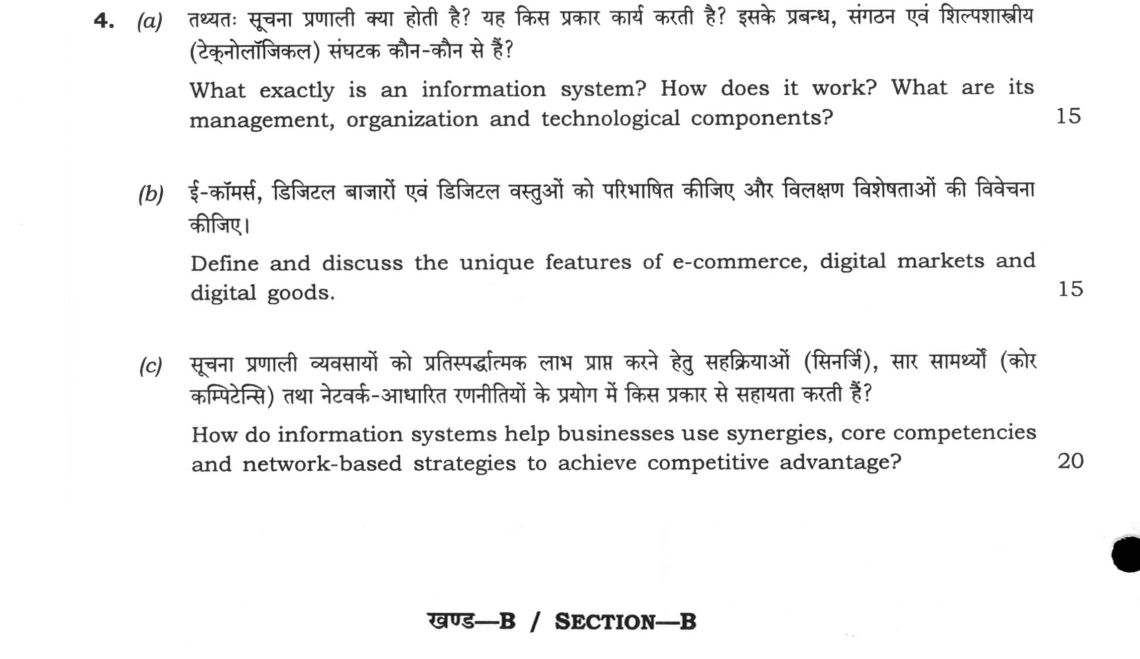
(a) What exactly is an information system? How does it work? What are its management, organization and technological components?…
What exactly is an information system? How does it work? What are its management, organization and technological components? 15 marks
Define and discuss the unique features of e-commerce, digital markets and digital goods. 15 marks
How do information systems help businesses use synergies, core competencies and network-based strategies to achieve competitive advantage? 20 marks
हिंदी में प्रश्न पढ़ें
(क) तथ्यतः सूचना प्रणाली क्या होती है? यह किस प्रकार कार्य करती है? इसके प्रबंध, संगठन एवं शिल्पशास्त्रीय (टेक्नोलॉजिकल) संघटक कौन-कौन से हैं? (ख) ई-कॉमर्स, डिजिटल बाज़ारों एवं डिजिटल वस्तुओं को परिभाषित कीजिए और विलक्षण विशेषताओं की विवेचना कीजिए। (ग) सूचना प्रणाली व्यवसायों को प्रतिस्पर्धात्मक लाभ प्राप्त करने हेतु सहक्रियाओं (सिनर्जी), सार सामर्थ्यों (कोर कम्पिटेंसी) तथा नेटवर्क-आधारित रणनीतियों के प्रयोग में किस प्रकार से सहायता करती है?
Model answer
Written by UPSC Answer Check against this question's marking rubric, to the expected length. UPSC does not publish answers for Mains — this is one way to score well, not an official key.
Information system and its components. An information system (IS) is an interrelated set of components that collects, processes, stores and distributes information to support decision-making, coordination and control. It works through an input–processing–output–feedback loop: raw data from transactions, sensors, customers or documents enter; hardware/software transform it into meaningful information; reports, dashboards, alerts or decisions are produced; feedback compares outcomes with targets and corrects inputs. Its management component comprises leadership, strategy and governance that decide what information is needed and how it serves objectives. The organizational component includes hierarchy, culture, roles and business processes that determine how people use information. The technological component includes hardware, software, databases, networks and security. These are interdependent: strategy shapes technology choices, processes shape data flows, and technology enables new management routines. In practice, a bank’s strategy to offer instant loans requires management approval, organizational changes in credit appraisal, and technology for data capture and risk scoring; if any component lags, the system fails.
E-commerce, digital markets and digital goods. E-commerce is the digitally enabled conduct of commercial transactions—buying, selling, payment and service delivery—over networks. Its unique features are ubiquity and global reach, allowing firms to be open 24/7 to dispersed customers; universal standards such as TCP/IP, HTTP and payment protocols that lower compatibility costs; richness and interactivity, where media, search, chat and personalization/customization make exchanges more informative and responsive; high information density, which reduces search and comparison costs; and social technology, which lets users review, recommend and co-create value. Digital markets are online marketplaces where these features intensify: search costs fall, price transparency rises, and disintermediation or re-intermediation through platforms changes channel power. Digital goods—software, music, e-books, data, apps—differ from physical goods because reproduction has near-zero marginal cost, consumption can be non-rivalrous, and they are often experience goods whose quality is learned after use. Some digital goods or platforms exhibit direct network effects, others indirect effects, and some none; the key is that value may rise with user base, data or complementary assets.
IS, strategy and competitive advantage. Information systems help businesses create synergy by integrating functions: shared databases let sales, finance, inventory and after-sales units see the same customer and order, reducing duplication and enabling supply-chain coordination. This integration turns separate units into a coherent value chain. IS also strengthens core competencies by capturing tacit knowledge, standardizing best practices, and providing decision support systems that make expertise reusable and faster. For example, a firm’s core competency in customer service can be scaled through CRM analytics and knowledge bases. Network-based strategies use IS to build platforms and ecosystems where value grows with participation. Network economics and Metcalfe’s Law imply that platform value often scales quadratically, roughly proportional to n(n−1)/2 possible connections, not exponentially; more users attract more users and complementors. This creates a reinforcing cycle: better data improves decisions, which improve service, which attracts more users. Indian examples show this: UPI’s interoperable payments network lowers transaction costs and creates indirect network effects; ONDC aims to open digital markets by reducing platform lock-in; Reliance Jio combines connectivity, payments and content into an ecosystem; Flipkart’s marketplace reduces search costs and leverages seller-buyer matching. Aadhaar and Digital India’s public digital infrastructure lower participation costs and widen the base for such strategies. In modern enterprises, the same IS infrastructure—cloud, analytics, APIs, cybersecurity—simultaneously enables synergy, core-competency leverage and network strategies. Thus, information systems are not merely administrative tools but the connective tissue of digital transformation, allowing Indian firms and institutions to convert data, networks and organizational capability into sustainable competitive advantage.
What "Explain" is asking you to do
Make the working of something clear — what sets it off, what follows from what, and what it produces. Explain is the Commission's mechanism word: it dominates the technical papers and the “explain why” stems, where the marks sit in the causal chain and not in the label.
Structure that answers it
State what it is → the initiating condition → the chain of cause, step by step → an instance where it plays out → what the chain produces
Where marks are lost
Describing what something looks like instead of why it works that way. Naming the stages without linking them reads as description too.
How this answer will be evaluated
Approach
Framework: Laudon & Laudon Information Systems Framework. (a) explain: definition/context > points in order > small example > short close | (b) discuss: intro > 3-4 dimensions > example > balanced close | (c) analyse: intro > causes > effects > stakeholders/linkages > way forward Full marks: Clear definitions, named frameworks, concrete examples, and critical analysis of limitations.
Key points expected
- Precise definition of an information system
- Explanation of the IS working process (input, processing, output, feedback)
- Identification of management, organizational, and technological components
- Linkage between the three components
- Clear definitions of e-commerce, digital markets, and digital goods
- Discussion of unique features of each concept
- Distinction between digital goods and physical goods
- Example illustrating digital market dynamics
Evaluation rubric
Each sub-part is marked on its own, against the marks and word limit printed on the paper.
- (a) Define IS, explain its working, and identify management, organizational, and technological components. 15 marks
explain— definition/context → points in order → small example → short close
Must cover
- Precise definition of an information system
- Explanation of the IS working process (input, processing, output, feedback)
- Identification of management, organizational, and technological components
- Linkage between the three components
Loses marks
- Textbook definitions without application
- Listing components without explaining their interplay
- Confusing information system with information technology
Earns more
- Reference to Laudon & Laudon framework
- Concrete example of IS in an organization
- Distinction between data and information
- Mention of specific technologies (e.g., ERP, CRM)
Extra mark
- Recent regulatory change affecting IS (e.g., GDPR, DPDP Act)
- Real company example of IS implementation
- (b) Define e-commerce, digital markets, and digital goods; discuss their unique features. 15 marks
discuss— intro → 3-4 dimensions → example → balanced close
Must cover
- Clear definitions of e-commerce, digital markets, and digital goods
- Discussion of unique features of each concept
- Distinction between digital goods and physical goods
- Example illustrating digital market dynamics
Loses marks
- Vague definitions without distinguishing features
- Treating e-commerce and digital markets as identical
- No examples or application
Earns more
- Mention of network effects in digital markets
- Reference to zero marginal cost of digital goods
- Example of a specific digital platform (e.g., Amazon, Netflix)
- Discussion of disintermediation in e-commerce
Extra mark
- Recent regulatory change in digital markets (e.g., EU Digital Markets Act)
- Real company example of digital goods strategy
- (c) Analyse how IS help businesses use synergies, core competencies, and network-based strategies for competitive advantage. 20 marks
analyse— intro → causes → effects → stakeholders/linkages → way forward
Must cover
- Explanation of how IS enables synergies
- Explanation of how IS supports core competencies
- Explanation of network-based strategies via IS
- Linkage to competitive advantage
Loses marks
- Generic statements without linking IS to specific strategies
- No concrete examples or application
- Confusing competitive advantage with mere efficiency
Earns more
- Use of Porter's Five Forces or Value Chain
- Concrete example of synergy through IS (e.g., supply chain integration)
- Example of core competency reinforced by IS (e.g., data analytics)
- Discussion of platform business models
Extra mark
- Real company example (e.g., Amazon, Alibaba)
- Reference to recent strategic shift enabled by IS
Practice this exact question
Write your answer and it is marked point by point against the model answer above — what you covered, what you missed, what you got wrong.
Evaluate my answer →More from Management 2022 Paper II
- Q1 (a) A newly constructed house can collapse due to fault in its design. It can also collap…
- Q2 (a) The area sales manager of a company has compiled the following data for the eight ter…
- Q3 (a) (i) List the strategic objectives of aggregate planning. 5 (ii) Describe the chase an…
- Q4 (a) What exactly is an information system? How does it work? What are its management, org…
- Q5 (a) Is State participation in business essential? Discuss the objectives of liberalizatio…
- Q6 (a) Critically examine government's policy with regard to Small-Scale Industries (SSIs).…
- Q7 (a) "Strategies are formulated and operated at different levels of management." Discuss t…