Paper II — Q5
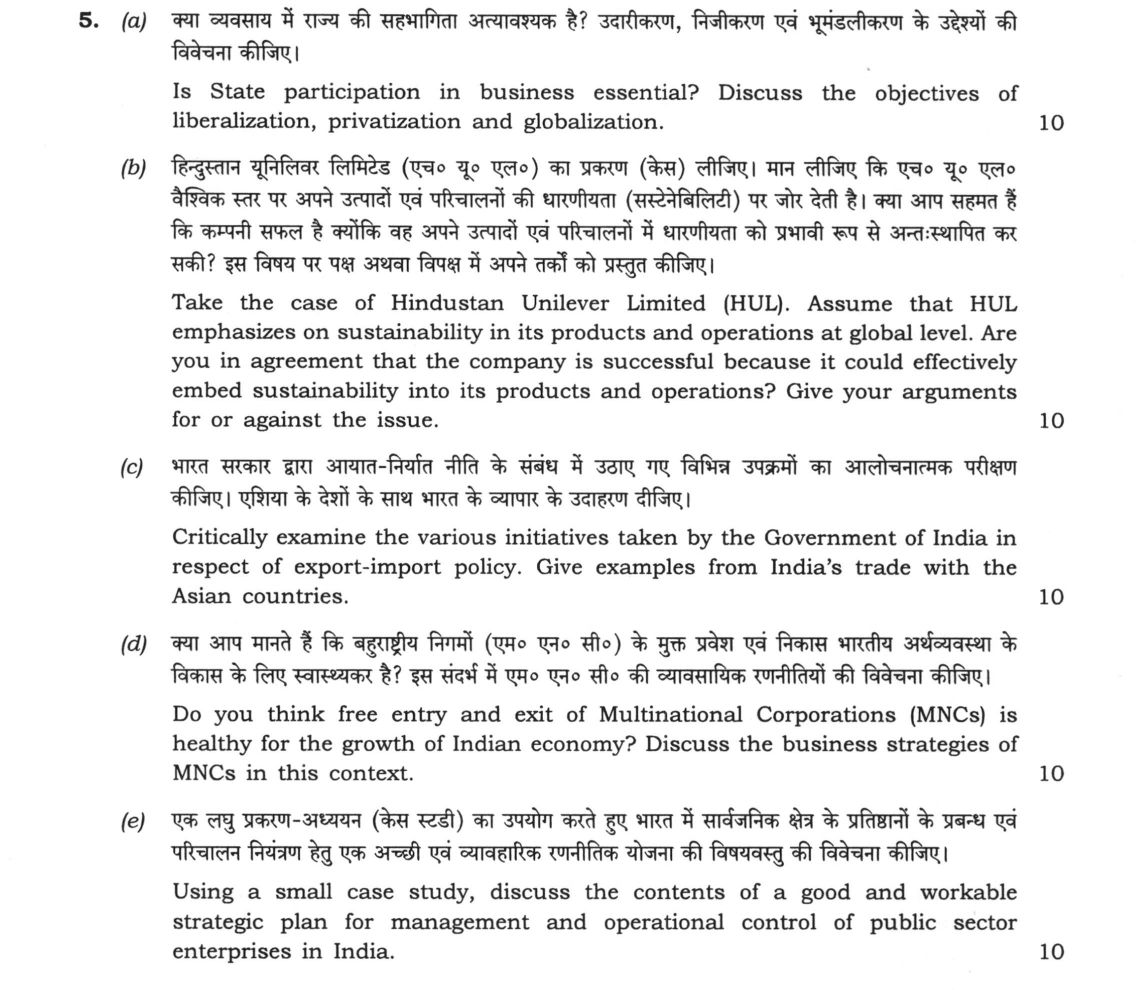
(a) Is State participation in business essential? Discuss the objectives of liberalization, privatization and globalization. (10…
Is State participation in business essential? Discuss the objectives of liberalization, privatization and globalization. 10 marks
Take the case of Hindustan Unilever Limited (HUL). Assume that HUL emphasizes on sustainability in its products and operations at global level. Are you in agreement that the company is successful because it could effectively embed sustainability into its products and operations? Give your arguments for or against the issue. 10 marks
Critically examine the various initiatives taken by the Government of India in respect of export-import policy. Give examples from India's trade with the Asian countries. 10 marks
Do you think free entry and exit of Multinational Corporations (MNCs) is healthy for the growth of Indian economy? Discuss the business strategies of MNCs in this context. 10 marks
Using a small case study, discuss the contents of a good and workable strategic plan for management and operational control of public sector enterprises in India. 10 marks
हिंदी में प्रश्न पढ़ें
क्या व्यवसाय में राज्य की सहभागिता अत्यावश्यक है? उदारीकरण, निजीकरण एवं भूमंडलीकरण के उद्देश्यों की विवेचना कीजिए। (10 अंक)
हिन्दुस्तान यूनिलिवर लिमिटेड (एच० यू० एल०) का प्रकरण (केस) लीजिए। मान लीजिए कि एच० यू० एल० वैश्विक स्तर पर अपने उत्पादों एवं परिचालनों की धारणीयता (सस्टेनेबिलिटी) पर जोर देती है। क्या आप सहमत हैं कि कम्पनी सफल है क्योंकि वह अपने उत्पादों एवं परिचालनों में धारणीयता को प्रभावी रूप से अन्तःस्थापित कर सकी? इस विषय पर पक्ष अथवा विपक्ष में अपने तर्कों को प्रस्तुत कीजिए। (10 अंक)
भारत सरकार द्वारा आयात-निर्यात नीति के संबंध में उठाए गए विभिन्न उपक्रमों का आलोचनात्मक परीक्षण कीजिए। एशिया के देशों के साथ भारत के व्यापार के उदाहरण दीजिए। (10 अंक)
क्या आप मानते हैं कि बहुराष्ट्रीय निगमों (एम० एन० सी०) के मुक्त प्रवेश एवं निकास भारतीय अर्थव्यवस्था के विकास के लिए स्वास्थ्यकर है? इस संदर्भ में एम० एन० सी० की व्यावसायिक रणनीतियों की विवेचना कीजिए। (10 अंक)
एक लघु प्रकरण-अध्ययन (केस स्टडी) का उपयोग करते हुए भारत में सार्वजनिक क्षेत्र के प्रतिष्ठानों के प्रबंध एवं परिचालन नियंत्रण हेतु एक अच्छी एवं व्यावहारिक रणनीतिक योजना की विषयवस्तु की विवेचना कीजिए। (10 अंक)
Model answer
Written by UPSC Answer Check against this question's marking rubric, to the expected length. UPSC does not publish answers for Mains — this is one way to score well, not an official key.
India’s economic transformation since the 1991 balance-of-payments crisis redefined the boundaries between the state, domestic enterprise, and global capital, transitioning the country from an import-substitution regime to an outward-oriented, market-driven economy.
State Participation in Business and LPG Objectives
The necessity of state participation in business remains a contested debate in public economics. Proponents argue that state involvement is essential to correct market failures, prevent private monopolies in strategic sectors, build capital-intensive infrastructure with long gestation periods, and achieve socio-economic justice as mandated under Article 39(b) and (c) of the Constitution. Public sector enterprises historically built India’s heavy industrial base and ensured balanced regional development. Conversely, critics highlight the chronic inefficiencies of the public sector: bureaucratic inertia, soft budget constraints, political interference, low return on capital, and the crowding out of private enterprise.
The 1991 New Economic Policy introduced Liberalization, Privatization, and Globalization (LPG) to dismantle these structural rigidities: Liberalization aimed to eliminate the License-Permit-Quota Raj, abolish industrial licensing in most sectors, relax Monopolies and Restrictive Trade Practices (MRTP) limits, and simplify regulatory clearances to stimulate domestic private enterprise. Privatization intended to reduce the fiscal burden on the exchequer, enhance enterprise efficiency through private management and market discipline, and unlock public assets through strategic disinvestment and minority stake sales. Globalization sought to integrate the domestic economy with the global market through tariff rationalization, opening sectors to Foreign Direct Investment (FDI), achieving current account convertibility, and aligning domestic trade laws with World Trade Organization norms.
HUL and Sustainability as a Driver of Corporate Success
Hindustan Unilever Limited (HUL) has systematically embedded sustainability into its corporate strategy under the Unilever Sustainable Living Plan (USLP) and the Unilever Compass.
The argument in favour of sustainability driving HUL’s success holds that sustainability initiatives have created tangible competitive advantages. Project Shakti empowered over 1.9 lakh rural women micro-entrepreneurs, expanding distribution while fostering social equity. Supply chain interventions, such as sustainable sourcing of agricultural inputs, water conservation via the HUL Foundation, and commitments to plastic waste collection, have generated brand trust, reduced resource costs, and attracted ESG-focused institutional investors.
However, attributing HUL’s market dominance solely to sustainability overstates its commercial role. HUL’s leadership is primarily driven by traditional competitive moats: an unmatched distribution network reaching over nine million retail outlets, aggressive product localization, deep pricing power via the sachet revolution, and formidable advertising budgets. In India's price-sensitive mass market, consumers prioritize affordability and performance over sustainability claims. Furthermore, FMCG majors face persistent scrutiny regarding greenwashing, as post-consumer plastic collection and multi-layered sachet packaging continue to pose severe environmental challenges. Sustainability strengthens corporate reputation, but commercial success remains anchored in scale, distribution, and price-value architecture.
Critical Examination of EXIM Policy and Asian Trade
India’s Export-Import (EXIM) policy, governed by successive Foreign Trade Policies (FTP 2015-20 and FTP 2023), has shifted from direct subsidies to WTO-compliant trade facilitation, duty remission, and technology upgradation. Key initiatives include the Export Promotion Capital Goods (EPCG) scheme, Special Economic Zones (SEZs), and the Remission of Duties and Taxes on Exported Products (RoDTEP) scheme replacing the Merchandise Exports from India Scheme (MEIS). The FTP 2023 further focuses on e-commerce exports, merchanting trade, and internationalizing the Indian Rupee.
However, India’s trade dynamics across Asia reveal deep structural vulnerabilities: With ASEAN, Japan (CEPA), and South Korea (CEPA), trade agreements have resulted in asymmetric trade balance deterioration. Indian exporters face non-tariff barriers and stringent rules of origin, while tariff concessions have facilitated cheaper intermediate and finished goods imports into India, widening the trade deficit. With China, India experiences a structural trade deficit exceeding $85 billion, reflecting critical import dependencies in active pharmaceutical ingredients (APIs), solar modules, and telecom hardware, despite domestic Production Linked Incentive (PLI) interventions. These structural imbalances and the risk of uninhibited Chinese imports through third countries directly influenced India’s 2019 decision to withdraw from the Regional Comprehensive Economic Partnership (RCEP).
MNC Free Entry and Exit and Business Strategies
Unrestricted entry and exit of Multinational Corporations (MNCs) presents distinct economic trade-offs. The benefits include access to non-debt capital, cutting-edge technology transfer, managerial best practices, integration into global value chains, and enhanced consumer welfare. Smooth exit mechanisms, supported by the Insolvency and Bankruptcy Code (IBC) 2016, reduce the sovereign risk premium and improve the ease of doing business.
Conversely, unfettered entry can suppress domestic micro, small, and medium enterprises (MSMEs) through predatory pricing and superior capital access. Free exit can lead to capital flight, sudden employment shocks, and macroeconomic volatility. Moreover, MNCs frequently deploy transfer pricing and base erosion to minimize domestic tax liabilities.
In this operating environment, MNCs employ several key strategies: Glocalization: Customizing products to Indian consumer tastes and price sensitivities, as demonstrated by automobile and fast-food multinationals. Joint Ventures and Strategic Alliances: Partnering with domestic firms to navigate complex local regulations and leverage existing distribution networks. Local Sourcing and PLI Alignment: Establishing domestic manufacturing ecosystems to meet local value-addition norms and secure fiscal incentives. Institutional Lobbying: Actively engaging with regulatory bodies and industry associations to influence tariff structures and sector-specific FDI policies.
Strategic Planning in Public Sector Enterprises: A Case Study of NTPC
NTPC Limited, a Maharatna public sector enterprise navigating the green energy transition, provides a model for public sector strategic management and operational control.
A viable strategic plan for a PSU requires several integrated components: Vision and Mission: NTPC reframed its mission from purely thermal power generation to delivering reliable, affordable, and clean energy. Environmental Scanning and SWOT: Assessing external regulatory pressures (COP emission targets, carbon taxes) and internal capabilities (strong cash flows, engineering talent vs. high thermal carbon footprint). Strategic Objectives: Setting clear, quantifiable targets, such as establishing 60 GW of renewable energy capacity by 2032. Strategy Formulation and Execution: Carving out a dedicated clean energy subsidiary (NTPC Green Energy Limited), bidding aggressively for solar and wind projects, and investing in green hydrogen and biomass co-firing. Operational Control Mechanisms: The cornerstone of PSU control is the Department of Public Enterprises (DPE) Memorandum of Understanding (MoU) system. NTPC signs annual performance contracts setting measurable Key Performance Indicators (KPIs) covering Plant Load Factor (PLF), heat rate efficiency, renewable capex deployment, and corporate governance compliance. This system, combined with quarterly performance reviews and balanced scorecards, ensures managerial accountability while preserving operational autonomy.
Conclusion
Navigating a globalized economy requires harmonizing state steering with market efficiency. Sustainable growth depends on moving from direct state ownership to strong regulatory oversight, maintaining an open yet calibrated FDI and trade regime, and granting strategic autonomy to public sector enterprises to compete globally.
What "Discuss" is asking you to do
Lay the issue out from more than one side — how it arose, what is claimed for it, what is held against it, and where it now stands. UPSC attaches discuss to broad topics with several live dimensions, so coverage of the dimensions earns more than the strength of your opinion.
Structure that answers it
Set the issue up → the case as it is made → the case against → the dimension both sides leave out → where the balance now lies
Where marks are lost
Listing facts with no thread between them, or arguing one side throughout and calling it a discussion.
How this answer will be evaluated
Approach
Framework: null. (a) discuss: intro > 3-4 dimensions > example > balanced close | (b) comment: context > arguments both sides > judgment > close | (c) examine: intro > how/why with reasoning > evidence > conclusion | (d) comment: context > arguments both sides > judgment > close | (e) discuss: intro > 3-4 dimensions > example > balanced close Full marks: Comprehensive, well-structured, specific examples, clear judgment.
Key points expected
- Arguments for/against state participation in business
- Objectives of Liberalization (market access)
- Objectives of Privatization (efficiency/ownership)
- Objectives of Globalization (integration)
- Arguments supporting sustainability as a success driver
- Arguments against (costs, market resistance)
- Specific HUL examples (products/operations)
- Clear final judgment on the issue
Evaluation rubric
Each sub-part is marked on its own, against the marks and word limit printed on the paper.
- (a) Evaluate the necessity of state participation and the objectives of LPG reforms. 10 marks
discuss— intro → 3-4 dimensions → example → balanced close
Must cover
- Arguments for/against state participation in business
- Objectives of Liberalization (market access)
- Objectives of Privatization (efficiency/ownership)
- Objectives of Globalization (integration)
Loses marks
- Defining terms without discussing objectives
- Ignoring the 'essentiality' aspect of state participation
Earns more
- Reference to 1991 LPG reforms
- Distinction between public and private sector roles
Extra mark
- Specific example of a privatized PSU
- Reference to specific policy document
- (b) Provide a balanced judgment on HUL's success via sustainability. 10 marks
comment— context → arguments both sides → judgment → close
Must cover
- Arguments supporting sustainability as a success driver
- Arguments against (costs, market resistance)
- Specific HUL examples (products/operations)
- Clear final judgment on the issue
Loses marks
- One-sided argument without counter-view
- Generic sustainability points not applied to HUL
Earns more
- Mention of 'Sustainable Living Plan'
- Reference to consumer behavior changes
Extra mark
- Specific financial data on HUL's sustainability
- Comparison with a competitor
- (c) Critically analyze India's export-import policy initiatives with Asian examples. 10 marks
examine— intro → how/why with reasoning → evidence → conclusion
Must cover
- Specific government initiatives (e.g., FTAs, PLI)
- Critical evaluation of these initiatives
- Examples from trade with Asian countries
- Reasoning on the impact of these policies
Loses marks
- Listing initiatives without critical examination
- Ignoring the specific requirement for Asian trade examples
Earns more
- Mention of India-Japan CEPA or India-Australia ECTA
- Reference to 'Act East' policy
Extra mark
- Specific trade deficit/surplus data with Asia
- Reference to a specific trade agreement clause
- (d) Assess the health of free MNC entry/exit for Indian economy. 10 marks
comment— context → arguments both sides → judgment → close
Must cover
- Arguments for free entry/exit (competition, tech)
- Arguments against (job losses, capital flight)
- Discussion of MNC business strategies
- Balanced judgment on 'healthiness'
Loses marks
- Ignoring the 'business strategies' requirement
- Vague generalities about MNCs without specific context
Earns more
- Reference to FDI policy changes
- Example of a specific MNC strategy (e.g., localization)
Extra mark
- Reference to a specific MNC exit/entry case
- Mention of 'Make in India' impact on MNCs
- (e) Outline a strategic plan for public sector enterprises using a case study. 10 marks
discuss— intro → 3-4 dimensions → example → balanced close
Must cover
- Use of a small case study
- Contents of a strategic plan (goals, KPIs)
- Management control mechanisms
- Operational control mechanisms
Loses marks
- Generic plan without a specific case study
- Confusing strategic planning with operational details
Earns more
- Reference to a specific PSU (e.g., BHEL, SAIL)
- Mention of 'Board of Directors' role
Extra mark
- Reference to a specific audit report
- Mention of 'CAG' recommendations
Practice this exact question
Write your answer and it is marked point by point against the model answer above — what you covered, what you missed, what you got wrong.
Evaluate my answer →More from Management 2022 Paper II
- Q2 (a) The area sales manager of a company has compiled the following data for the eight ter…
- Q3 (a) (i) List the strategic objectives of aggregate planning. 5 (ii) Describe the chase an…
- Q4 (a) What exactly is an information system? How does it work? What are its management, org…
- Q5 (a) Is State participation in business essential? Discuss the objectives of liberalizatio…
- Q6 (a) Critically examine government's policy with regard to Small-Scale Industries (SSIs).…
- Q7 (a) "Strategies are formulated and operated at different levels of management." Discuss t…
- Q8 (a) (i) Discuss the importance of Foreign Direct Investment (FDI) for developing economie…