Paper II — Q8
(a) (i) Discuss the importance of Foreign Direct Investment (FDI) for developing economies like India. Should these countries go…
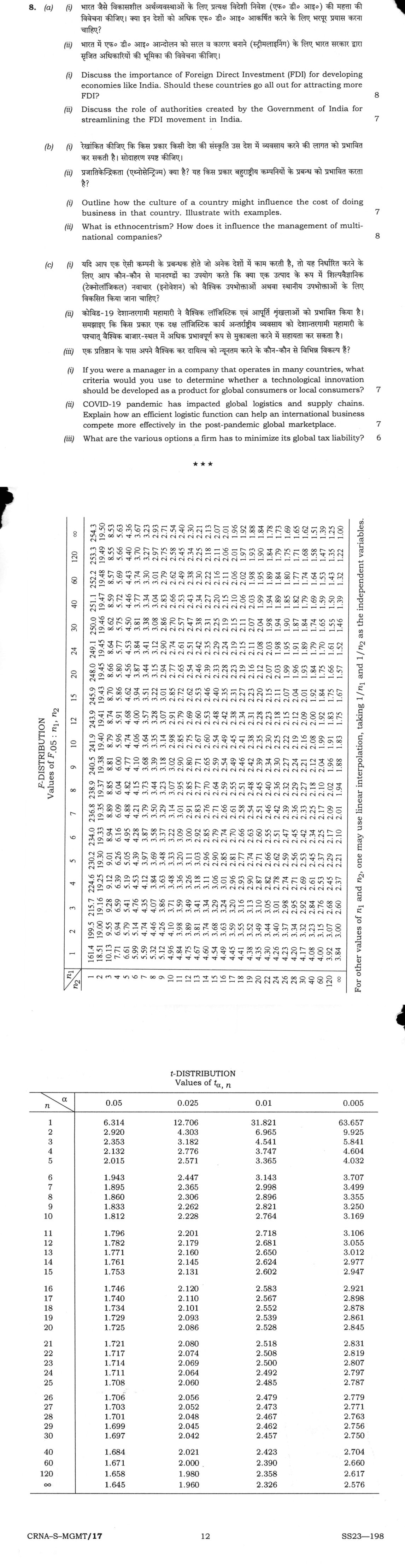
Discuss the importance of Foreign Direct Investment (FDI) for developing economies like India. Should these countries go all out for attracting more FDI? 8 marks
Discuss the role of authorities created by the Government of India for streamlining the FDI movement in India. 7 marks
Outline how the culture of a country might influence the cost of doing business in that country. Illustrate with examples. 7 marks
What is ethnocentrism? How does it influence the management of multi-national companies? 8 marks
If you were a manager in a company that operates in many countries, what criteria would you use to determine whether a technological innovation should be developed as a product for global consumers or local consumers? 7 marks
COVID-19 pandemic has impacted global logistics and supply chains. Explain how an efficient logistic function can help an international business compete more effectively in the post-pandemic global marketplace. 7 marks
What are the various options a firm has to minimize its global tax liability? 6 marks
हिंदी में प्रश्न पढ़ें
भारत जैसे विकासशील अर्थव्यवस्थाओं के लिए प्रत्यक्ष विदेशी निवेश (एफ० डी० आई०) की महत्ता की विवेचना कीजिए। क्या इन देशों को अधिक एफ० डी० आई० आकर्षित करने के लिए भरपूर प्रयास करना चाहिए? 8 marks
भारत में एफ० डी० आई० आंदोलन को सरल व कारगर बनाने (स्ट्रीमलाइनिंग) के लिए भारत सरकार द्वारा सृजित अधिकारियों की भूमिका की विवेचना कीजिए। 7
रेखांकित कीजिए कि किस प्रकार किसी देश की संस्कृति उस देश में व्यवसाय करने की लागत को प्रभावित कर सकती है। सोदाहरण स्पष्ट कीजिए। 7
प्रजातिकेंद्रिकता (एथ्नोसेंट्रिज्म) क्या है? यह किस प्रकार बहुराष्ट्रीय कम्पनियों के प्रबन्ध को प्रभावित करता है? 8 marks
यदि आप एक ऐसी कम्पनी के प्रबन्धक होते जो अनेक देशों में काम करती है, तो यह निर्धारित करने के लिए आप कौन-कौन से मानदण्डों का उपयोग करते कि क्या एक उत्पाद के रूप में शिल्पवैज्ञानिक (टेक्नोलॉजिकल) नवाचार (इनोवेशन) को वैश्विक उपभोक्ताओं अथवा स्थानीय उपभोक्ताओं के लिए विकसित किया जाना चाहिए? 7 marks
कोविड-19 देशान्तरगामी महामारी ने वैश्विक लॉजिस्टिक एवं आपूर्ति श्रृंखलाओं को प्रभावित किया है। समझाइए कि किस प्रकार एक दक्ष लॉजिस्टिक कार्य अन्तर्राष्ट्रीय व्यवसाय को देशान्तरगामी महामारी के पश्चात् वैश्विक बाजार-स्थल में अधिक प्रभावपूर्ण रूप से मुकाबला करने में सहायता कर सकता है। 7
एक प्रतिष्ठान के पास अपने वैश्विक कर दायित्व को न्यूनतम करने के कौन-कौन से विभिन्न विकल्प हैं? 6 marks
Model answer
Written by UPSC Answer Check against this question's marking rubric, to the expected length. UPSC does not publish answers for Mains — this is one way to score well, not an official key.
Globalisation has made cross-border capital, goods and ideas central to development. For developing economies like India, FDI is important because it supplements domestic savings, brings advanced technology and managerial know-how, creates employment, promotes exports, and integrates firms into global value chains. It can also improve productivity, competition and consumer choice. However, the view that India should go all out for FDI must be balanced. Excessive inflows may cause profit repatriation, exchange-rate pressure, crowding out of domestic firms, and policy conditionality that weakens regulatory autonomy. India’s approach—sectoral caps, automatic route for many sectors and government route for sensitive ones—shows that FDI should be attracted selectively, with safeguards for employment, technology transfer, local content and national security.
Regulatory streamlining The Government has created a layered architecture. DPIIT formulates FDI policy and issues sectoral guidelines; RBI administers capital-account regulations and ensures compliance with FEMA; SEBI distinguishes FII/FPI flows from FDI and regulates securities markets; CCI screens mergers and acquisitions for competition concerns. Together they reduce uncertainty, prevent abuse, and make India’s FDI regime predictable while preserving policy space.
Culture and business cost National culture affects the cost of doing business. Using Hofstede’s dimensions, high power distance can raise costs of hierarchical approvals and slow decision-making; high uncertainty avoidance can increase expenses of detailed contracts, litigation and compliance; collectivist societies may require more time for relationship-building and consensus, while individualist settings may make labour relations more transactional. For example, in India, relationship-based networks and regulatory caution can raise transaction costs, whereas in Japan, consensus decision-making may delay contracts but reduce disputes.
Ethnocentrism in MNCs Ethnocentrism is the belief that home-country practices are superior. In MNCs it appears as centralized decision-making, expatriate-heavy staffing, and standardized products and policies. This can create cultural resistance, lower local responsiveness and higher costs. Perlmutter’s ethnocentric, polycentric, regiocentric and geocentric orientations show the spectrum: from home-country dominance to global integration with local adaptation. Heenan’s similar framework warns that excessive ethnocentrism undermines subsidiary autonomy and innovation.
Global versus local innovation A manager deciding whether an innovation should be global or local would examine market homogeneity, scale economies, competitive pressure, regulatory requirements, cultural adaptability and distribution infrastructure. If consumer preferences, standards and regulations are similar, and scale is decisive—as in smartphones or industrial equipment—a global product is preferable. If tastes, climate, income levels, language or law differ—as in food, personal care or financial services—local adaptation is better. Levitt’s globalization-of-markets argument supports standardization, but customization arguments caution against ignoring local needs.
Post-pandemic logistics COVID-19 exposed fragile just-in-time chains. Efficient logistics now helps international businesses compete through nearshoring and friendshoring, digitalization using blockchain and IoT for visibility, inventory optimization, and multimodal integration. For India, improved ports, logistics parks, digital single-window systems and corridor connectivity can reduce lead times and make exports more reliable. Resilient logistics turns supply-chain risk into competitive advantage.
Tax minimisation Firms may minimize global tax liability through transfer pricing, locating intellectual property or financing in low-tax jurisdictions, and using tax havens. However, BEPS rules, country-by-country reporting and India’s participation in the MLI constrain treaty shopping and profit shifting. The MLI implements tax-treaty-related BEPS measures; the global minimum corporate tax is Pillar Two, implemented through domestic rules, not the MLI. India’s evolving domestic measures and treaty network require firms to balance legitimate planning with compliance.
In conclusion, FDI, culture, ethnocentrism, product strategy, logistics and taxation are interconnected. India should attract FDI selectively, use its regulatory institutions to balance openness with control, and encourage MNCs to move beyond ethnocentrism toward geocentric management. Post-pandemic competitiveness will depend on resilient logistics, culturally intelligent operations, and tax strategies that are efficient but compliant.
What "Discuss" is asking you to do
Lay the issue out from more than one side — how it arose, what is claimed for it, what is held against it, and where it now stands. UPSC attaches discuss to broad topics with several live dimensions, so coverage of the dimensions earns more than the strength of your opinion.
Structure that answers it
Set the issue up → the case as it is made → the case against → the dimension both sides leave out → where the balance now lies
Where marks are lost
Listing facts with no thread between them, or arguing one side throughout and calling it a discussion.
How this answer will be evaluated
Approach
Framework: null. (a(i)) discuss: intro > 3-4 dimensions > example > balanced close | (a(ii)) discuss: intro > 3-4 dimensions > example > balanced close | (b(i)) enumerate: list the items in order > one line each > no commentary | (b(ii)) define: precise definition > the distinguishing feature > one example | (c(i)) analyse: intro > causes > effects > stakeholders/linkages > way forward | (c(ii)) explain: definition/context > points in order > small example > short close | (c(iii)) enumerate: list the items in order > one line each > no commentary Full marks: Comprehensive, well-structured, specific examples, clear verdicts, no errors.
Key points expected
- Importance: capital, technology, employment, export growth
- Risks: crowding out, balance of payments, sovereignty
- Balanced verdict on 'going all out' for FDI
- Specific reference to Indian context
- Role of DIPP (now DPIIT) in policy formulation
- Role of RBI in regulatory compliance
- Role of FIPB (historical) or current automatic route
- Mechanism for streamlining (e.g., single window clearance)
Evaluation rubric
Each sub-part is marked on its own, against the marks and word limit printed on the paper.
- (a(i)) Assess FDI's role in development and the strategy for attracting it. 8 marks
discuss— intro → 3-4 dimensions → example → balanced close
Must cover
- Importance: capital, technology, employment, export growth
- Risks: crowding out, balance of payments, sovereignty
- Balanced verdict on 'going all out' for FDI
- Specific reference to Indian context
Loses marks
- Generic definition of FDI without application
- Ignoring the 'should they go all out' debate
Earns more
- Mention of FDI vs FPI distinction
- Reference to specific sectors (e.g., IT, Pharma)
- Discussion of 'Make in India' or PLI schemes
Extra mark
- Citing specific FDI inflow data or recent policy changes
- Reference to RBI guidelines or DIPP notifications
- (a(ii)) Explain the role of Indian authorities in streamlining FDI. 7 marks
discuss— intro → 3-4 dimensions → example → balanced close
Must cover
- Role of DIPP (now DPIIT) in policy formulation
- Role of RBI in regulatory compliance
- Role of FIPB (historical) or current automatic route
- Mechanism for streamlining (e.g., single window clearance)
Loses marks
- Listing authorities without explaining their specific roles
- Confusing FDI with general trade policy
Earns more
- Mention of SEBI for listed companies
- Reference to specific FDI policy circulars
- Discussion of ease of doing business reforms
Extra mark
- Citing specific recent FDI policy amendments
- Reference to specific government committees or task forces
- (b(i)) Link national culture to business costs with examples. 7 marks
enumerate— list the items in order → one line each → no commentary
Must cover
- Definition of culture's impact on business
- Specific cost drivers (e.g., labor, compliance, negotiation)
- Concrete examples of cultural influence
- Linkage to 'cost of doing business'
Loses marks
- Vague generalizations about culture
- Failing to link culture to specific business costs
Earns more
- Reference to Hofstede's cultural dimensions
- Examples from specific countries (e.g., Japan, USA)
- Discussion of 'cultural distance' concept
Extra mark
- Citing specific cultural indices or surveys
- Reference to specific cross-cultural management theories
- (b(ii)) Define ethnocentrism and its impact on MNC management. 8 marks
define— precise definition → the distinguishing feature → one example
Must cover
- Precise definition of ethnocentrism
- Impact on HRM (expatriate vs local hiring)
- Impact on strategy (standardization vs adaptation)
- Consequences for MNC performance
Loses marks
- Confusing ethnocentrism with nationalism
- Failing to link definition to management practices
Earns more
- Contrast with polycentric or geocentric approaches
- Examples of ethnocentric management failures
- Discussion of 'cultural imperialism' in business
Extra mark
- Reference to specific MNC case studies
- Citing specific academic models of MNC management
- (c(i)) Criteria for global vs local product development. 7 marks
analyse— intro → causes → effects → stakeholders/linkages → way forward
Must cover
- Criteria: market size, cultural similarity, regulation
- Criteria: technology transfer, IP protection, cost
- Decision framework for global vs local
- Application to a specific industry or product
Loses marks
- Listing criteria without a decision framework
- Ignoring the 'manager' perspective in the question
Earns more
- Reference to 'globalization vs localization' debate
- Discussion of 'glocalization' strategy
- Examples of successful global vs local products
Extra mark
- Citing specific market entry strategies
- Reference to specific product development frameworks
- (c(ii)) Role of efficient logistics in post-pandemic competition. 7 marks
explain— definition/context → points in order → small example → short close
Must cover
- Impact of pandemic on global supply chains
- Efficiency: speed, cost, reliability, visibility
- Competitive advantage in post-pandemic market
- Specific logistics functions (e.g., warehousing, transport)
Loses marks
- Generic description of logistics without pandemic context
- Failing to link efficiency to competitive advantage
Earns more
- Reference to 'just-in-time' vs 'just-in-case' inventory
- Discussion of supply chain resilience
- Examples of companies with efficient logistics
Extra mark
- Citing specific logistics technologies (e.g., AI, blockchain)
- Reference to specific post-pandemic supply chain reports
- (c(iii)) Options for minimizing global tax liability. 6 marks
enumerate— list the items in order → one line each → no commentary
Must cover
- Tax planning: transfer pricing, tax havens
- Structuring: holding companies, IP ownership
- Compliance: double taxation treaties, tax credits
- Ethical and legal boundaries of tax minimization
Loses marks
- Listing options without explaining how they work
- Ignoring the legal and ethical implications
Earns more
- Reference to BEPS (Base Erosion and Profit Shifting)
- Discussion of 'tax inversion' strategies
- Examples of specific tax planning techniques
Extra mark
- Citing specific international tax treaties
- Reference to specific tax planning case studies
Practice this exact question
Write your answer and it is marked point by point against the model answer above — what you covered, what you missed, what you got wrong.
Evaluate my answer →More from Management 2022 Paper II
- Q5 (a) Is State participation in business essential? Discuss the objectives of liberalizatio…
- Q6 (a) Critically examine government's policy with regard to Small-Scale Industries (SSIs).…
- Q7 (a) "Strategies are formulated and operated at different levels of management." Discuss t…
- Q8 (a) (i) Discuss the importance of Foreign Direct Investment (FDI) for developing economie…