Paper II — Q6
(a) Critically examine government's policy with regard to Small-Scale Industries (SSIs). Highlight the role of Industrial…
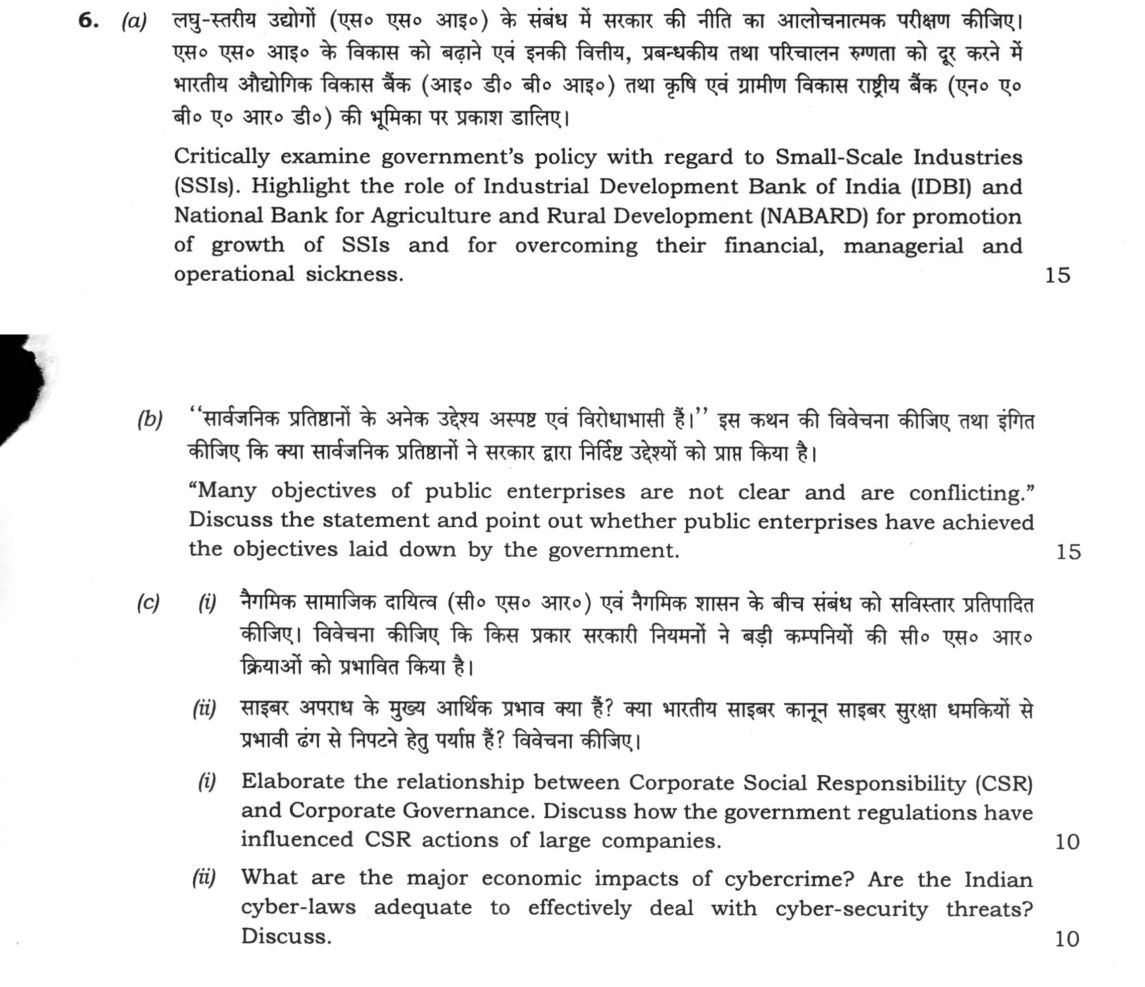
Critically examine government's policy with regard to Small-Scale Industries (SSIs). Highlight the role of Industrial Development Bank of India (IDBI) and National Bank for Agriculture and Rural Development (NABARD) for promotion of growth of SSIs and for overcoming their financial, managerial and operational sickness. 15 marks
"Many objectives of public enterprises are not clear and are conflicting." Discuss the statement and point out whether public enterprises have achieved the objectives laid down by the government. 15 marks
Elaborate the relationship between Corporate Social Responsibility (CSR) and Corporate Governance. Discuss how the government regulations have influenced CSR actions of large companies. 10 marks
What are the major economic impacts of cybercrime? Are the Indian cyber-laws adequate to effectively deal with cyber-security threats? Discuss. 10 marks
हिंदी में प्रश्न पढ़ें
लघु-स्तरीय उद्योगों (एस० एस० आई०) के संबंध में सरकार की नीति का आलोचनात्मक परीक्षण कीजिए। एस० एस० आई० के विकास को बढ़ाने एवं इनकी वित्तीय, प्रबंधकीय तथा परिचालन रुग्णता को दूर करने में भारतीय औद्योगिक विकास बैंक (आई० डी० बी० आई०) तथा कृषि एवं ग्रामीण विकास राष्ट्रीय बैंक (एन० ए० बी० ए० आर० डी०) की भूमिका पर प्रकाश डालिए। (15 अंक)
"सार्वजनिक प्रतिष्ठानों के अनेक उद्देश्य अस्पष्ट एवं विरोधाभासी हैं।" इस कथन की विवेचना कीजिए तथा इंगित कीजिए कि क्या सार्वजनिक प्रतिष्ठानों ने सरकार द्वारा निर्दिष्ट उद्देश्यों को प्राप्त किया है। (15 अंक)
नैगमिक सामाजिक दायित्व (सी० एस० आर०) एवं नैगमिक शासन के बीच संबंध को सविस्तार प्रतिपादित कीजिए। विवेचना कीजिए कि किस प्रकार सरकारी नियमों ने बड़ी कम्पनियों की सी० एस० आर० क्रियाओं को प्रभावित किया है। (10 अंक)
साइबर अपराध के मुख्य आर्थिक प्रभाव क्या हैं? क्या भारतीय साइबर कानून साइबर सुरक्षा धमकियों से प्रभावी ढंग से निपटने हेतु पर्याप्त हैं? विवेचना कीजिए। (10 अंक)
Model answer
Written by UPSC Answer Check against this question's marking rubric, to the expected length. UPSC does not publish answers for Mains — this is one way to score well, not an official key.
The government-industry interface in India has shifted from sheltering small units to enabling them to compete, and the success of that shift is uneven. SSIs and finance Product reservation, introduced in 1967 and expanded later, protected SSIs from large-scale competition but also encouraged low productivity, fragmented markets and technology stagnation. Post-1991 de-reservation, the MSME Act 2006 and cluster-based development moved policy towards credit, technology, marketing and institutional support. Cluster development reduces transaction costs through shared infrastructure. This was necessary, yet implementation has been patchy: delayed payments by large buyers, working-capital stress, marketing constraints and obsolescence continue to cause operational and managerial sickness. IDBI addressed financial and managerial weakness through direct and indirect refinance, bills rediscounting, seed capital and rehabilitation finance; its rehabilitation packages were tied to management audits, restructuring plans and advisory support, helping units correct poor planning, cost control and credit discipline. NABARD promoted rural SSIs through SHG-Bank linkage, RIDF and microfinance institutions, while also strengthening managerial capacity through training, bookkeeping, credit discipline and cluster facilitation. Thus, the policy has moved in the right direction, but it remains incomplete unless credit, management support and market access are delivered together.
Public enterprises Public enterprises carry social welfare, commercial viability and national-interest objectives, which often conflict. These include employment, regional balance, national security, profitability and strategic capacity. BHEL and NTPC illustrate the tension: BHEL has served strategic equipment needs but suffered losses, while NTPC has achieved commercial scale yet remains exposed to policy and fuel-cost risks. Navratna/Maharatna status was meant to reward performance and grant autonomy, but it has not fully resolved the conflict between public service obligations and profit. Disinvestment and turnarounds show mixed achievement: some PSUs improved through professional management, while BSNL and MTNL show that strategic objectives can be undermined by technological change, competition and governance delays. On balance, public enterprises have met some national objectives but have not consistently achieved commercial efficiency.
CSR and governance CSR and corporate governance are linked through stakeholder, agency and legitimacy theories: good governance creates accountability, while CSR extends accountability beyond shareholders to communities and the environment. Section 135 of the Companies Act 2013 and Schedule VII made a mandatory spending threshold, disclosure, CSR committees and impact assessment compulsory for qualifying companies, converting voluntary philanthropy into a regulated governance function. Schedule VII channels CSR into education, health, environment and rural development. Penal provisions for non-compliance and the requirement to transfer unspent CSR amounts have further strengthened accountability. This has increased transparency and institutionalised CSR, but it can also become compliance-driven if not linked to material risks and local needs.
Cybercrime Cybercrime imposes direct costs through financial fraud, IP theft and data breaches, indirect costs through reputational damage and compliance spending, and macroeconomic costs by reducing investor confidence, FDI and GDP growth. It also disrupts critical infrastructure. NASSCOM estimates have placed India’s cybercrime losses at over $1 billion annually, rising to several billion dollars. The IT Act 2000 and 2008 amendments provide a useful framework, but gaps remain: data protection was weak until the DPDP Act 2023, CERT-In powers are limited against fast-moving attacks, cross-border enforcement is difficult, and emerging threats such as crypto-jacking are not fully addressed. Indian cyber-laws are therefore partially adequate; they need stronger data-protection enforcement, better jurisdictional cooperation and alignment with global frameworks such as GDPR.
Government policy has improved the institutional architecture for SSIs, public enterprises, CSR and cyber-security, but critical examination shows that outcomes remain constrained by implementation, conflicting mandates and evolving risks. A coherent approach is needed: SSI policy must combine credit, management and market support; PSUs need clearer mandates; CSR must be outcome-based; cyber law must be modernised.
What "Critically examine" is asking you to do
Test the proposition the question puts to you and return a finding on how far it holds. Examine stems carry a claim, or ask whether something has happened, and expect evidence weighed both ways before the extent is stated — often with remedial measures attached. “Critically” is not a section added at the end: name the yardstick you are judging by — the evidence, the stated objective, a constitutional principle, a rival explanation — and let a verdict close each part of the body. Where the question quotes a claim, that verdict must land on the claim itself, accepted, qualified or rejected, and not on the theme in general.
Structure that answers it
Restate the claim as the question frames it → evidence that supports it → evidence that undercuts it → the conditions under which it holds → verdict on how far it stands
Where marks are lost
Merits in one paragraph, demerits in the next, and a conclusion calling for a balanced and holistic approach. That is a survey with the judgement left out and it holds the answer in the middle band. The opposite error is reading “critically” as permission to attack — and with the odd pairings, critically describe or critically explain, the exposition still carries most of the marks, the judgement being a layer on it rather than a substitute for it.
How this answer will be evaluated
Approach
Framework: null. (a) examine: intro > how/why with reasoning > evidence > conclusion | (b) discuss: intro > 3-4 dimensions > example > balanced close | (c(i)) explain: definition/context > points in order > small example > short close | (c(ii)) discuss: intro > 3-4 dimensions > example > balanced close Full marks: Comprehensive analysis with specific examples, balanced views, and clear application of concepts to the question.
Key points expected
- Critical examination of SSI policy
- IDBI role in SSI growth
- NABARD role in SSI growth
- Overcoming financial/managerial/operational sickness
- Discussion of conflicting objectives
- Analysis of objective clarity
- Assessment of objective achievement
- Balanced conclusion on performance
Evaluation rubric
Each sub-part is marked on its own, against the marks and word limit printed on the paper.
- (a) Critical analysis of SSI policy and IDBI/NABARD roles in addressing sickness. 15 marks
examine— intro → how/why with reasoning → evidence → conclusion
Must cover
- Critical examination of SSI policy
- IDBI role in SSI growth
- NABARD role in SSI growth
- Overcoming financial/managerial/operational sickness
Loses marks
- Textbook definitions without policy analysis
- Ignoring the 'sickness' aspect
- No critical evaluation of policy
Earns more
- Mention of specific SSI schemes
- Details on IDBI/NABARD credit mechanisms
- Analysis of sickness causes
- Balanced view of policy effectiveness
Extra mark
- Recent regulatory changes in SSI sector
- Specific data on SSI sickness rates
- (b) Discussion on conflicting objectives of public enterprises and their achievement. 15 marks
discuss— intro → 3-4 dimensions → example → balanced close
Must cover
- Discussion of conflicting objectives
- Analysis of objective clarity
- Assessment of objective achievement
- Balanced conclusion on performance
Loses marks
- One-sided view without balance
- Ignoring the 'conflicting' aspect
- No assessment of achievement
Earns more
- Examples of conflicting objectives
- Reference to specific public enterprises
- Analysis of government vs commercial goals
- Evaluation of social vs economic objectives
Extra mark
- Reference to specific PSU performance data
- Mention of recent privatization trends
- (c(i)) Elaboration on CSR-Corporate Governance relationship and regulatory influence. 10 marks
explain— definition/context → points in order → small example → short close
Must cover
- Relationship between CSR and governance
- Influence of government regulations
- Impact on large companies' CSR
- Clear connection between regulation and action
Loses marks
- Treating CSR and governance as separate
- Ignoring regulatory influence
- No focus on large companies
Earns more
- Reference to Companies Act CSR provisions
- Examples of regulatory impact
- Analysis of governance structures
- Discussion of compliance vs voluntary CSR
Extra mark
- Specific regulatory citations
- Recent CSR policy changes
- (c(ii)) Discussion on cybercrime economic impacts and adequacy of Indian cyber-laws. 10 marks
discuss— intro → 3-4 dimensions → example → balanced close
Must cover
- Major economic impacts of cybercrime
- Adequacy of Indian cyber-laws
- Effectiveness against cyber-security threats
- Balanced discussion of legal framework
Loses marks
- Ignoring economic impacts
- No assessment of law adequacy
- One-sided view without balance
Earns more
- Specific economic impact examples
- Reference to IT Act provisions
- Analysis of legal gaps
- Comparison with international standards
Extra mark
- Recent cybercrime statistics
- Specific legal amendments
Practice this exact question
Write your answer and it is marked point by point against the model answer above — what you covered, what you missed, what you got wrong.
Evaluate my answer →More from Management 2022 Paper II
- Q3 (a) (i) List the strategic objectives of aggregate planning. 5 (ii) Describe the chase an…
- Q4 (a) What exactly is an information system? How does it work? What are its management, org…
- Q5 (a) Is State participation in business essential? Discuss the objectives of liberalizatio…
- Q6 (a) Critically examine government's policy with regard to Small-Scale Industries (SSIs).…
- Q7 (a) "Strategies are formulated and operated at different levels of management." Discuss t…
- Q8 (a) (i) Discuss the importance of Foreign Direct Investment (FDI) for developing economie…