Paper I — Q1
(a) Elucidate the three categories of roles which a manager has to perform as suggested by Henry Mintzberg. 10 marks (b) What are…
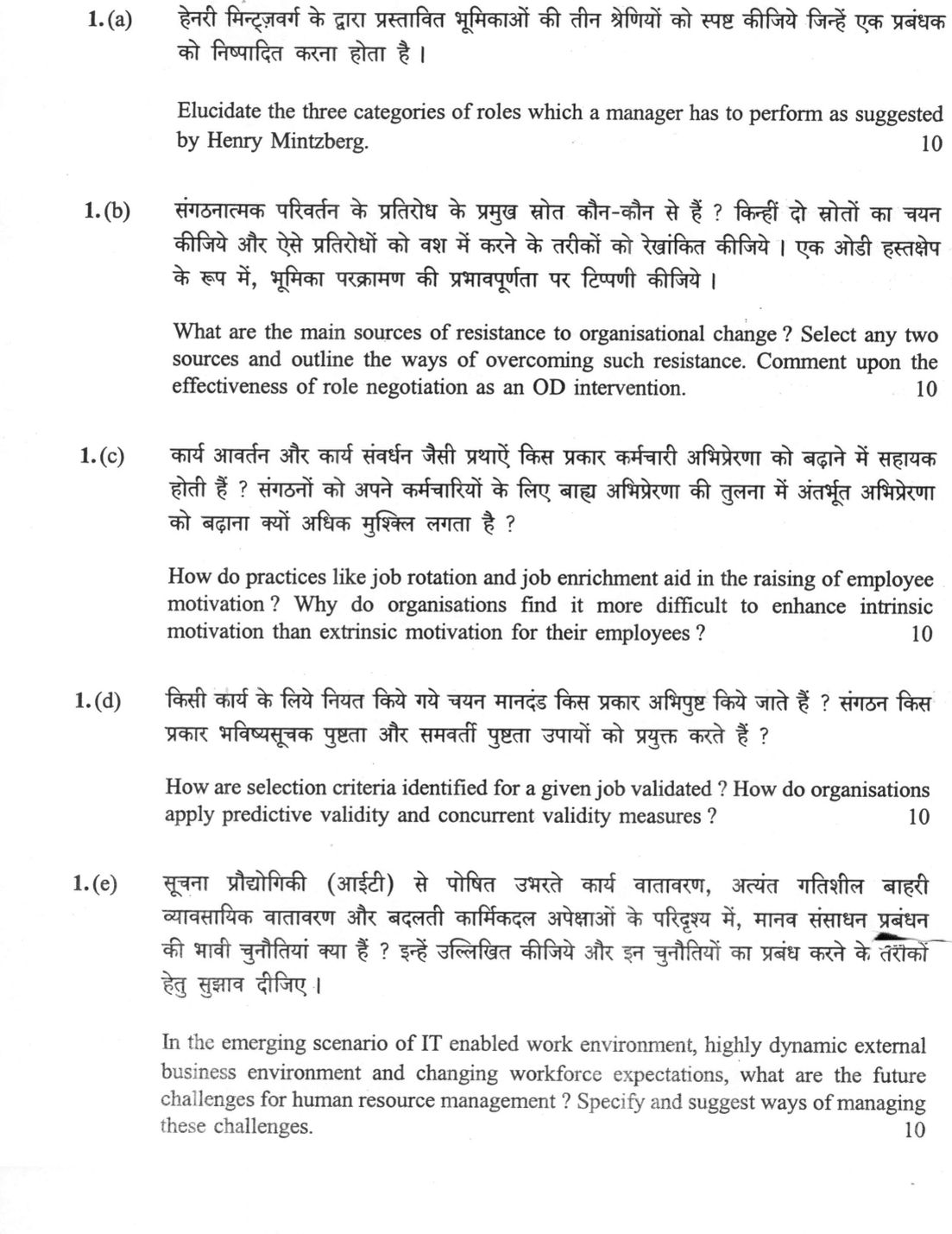
Elucidate the three categories of roles which a manager has to perform as suggested by Henry Mintzberg. 10 marks
What are the main sources of resistance to organisational change ? Select any two sources and outline the ways of overcoming such resistance. Comment upon the effectiveness of role negotiation as an OD intervention. 10 marks
How do practices like job rotation and job enrichment aid in the raising of employee motivation ? Why do organisations find it more difficult to enhance intrinsic motivation than extrinsic motivation for their employees ? 10 marks
How are selection criteria identified for a given job validated ? How do organisations apply predictive validity and concurrent validity measures ? 10 marks
In the emerging scenario of IT enabled work environment, highly dynamic external business environment and changing workforce expectations, what are the future challenges for human resource management ? Specify and suggest ways of managing these challenges. 10 marks
हिंदी में प्रश्न पढ़ें
हेनरी मिंटज़बर्ग के द्वारा प्रस्तावित भूमिकाओं की तीन श्रेणियों को स्पष्ट कीजिये जिन्हें एक प्रबंधक को निष्पादित करना होता है। 10 अंक
संगठनात्मक परिवर्तन के प्रतिरोध के प्रमुख स्रोत कौन-कौन से हैं ? किन्हीं दो स्रोतों का चयन कीजिये और ऐसे प्रतिरोधों को वश में करने के तरीकों को रेखांकित कीजिये। एक ओडी हस्तक्षेप के रूप में, भूमिका परक्रामण की प्रभावपूर्णता पर टिप्पणी कीजिये। 10 अंक
कार्य आवर्तन और कार्य संवर्धन जैसी प्रथाएँ किस प्रकार कर्मचारी अभिप्रेरणा को बढ़ाने में सहायक होती हैं ? संगठनों को अपने कर्मचारियों के लिए बाह्य अभिप्रेरणा की तुलना में अंतर्भूत अभिप्रेरणा को बढ़ाना क्यों अधिक मुश्किल लगता है ? 10 अंक
किसी कार्य के लिये नियत किये गये चयन मानदंड किस प्रकार अभिपुष्ट किये जाते हैं ? संगठन किस प्रकार भाविष्यसूचक पुष्टता और समवर्ती पुष्टता उपायों को प्रयुक्त करते हैं ? 10 अंक
सूचना प्रौद्योगिकी (आईटी) से पोषित उभरते कार्य वातावरण, अत्यंत गतिशील बाहरी व्यावसायिक वातावरण और बदलती कार्मिकदल अपेक्षाओं के परिदृश्य में, मानव संसाधन प्रबंधन की भावी चुनौतियाँ क्या हैं ? इन्हें उल्लिखित कीजिये और इन चुनौतियों का प्रबंध करने के तरीकों हेतु सुझाव दीजिये। 10 अंक
Model answer
Written by UPSC Answer Check against this question's marking rubric, to the expected length. UPSC does not publish answers for Mains — this is one way to score well, not an official key.
(a) Henry Mintzberg’s Managerial Roles
Henry Mintzberg categorised managerial work into ten distinct roles grouped under three interrelated categories, emanating directly from a manager’s formal authority and status within an organisation:
- Interpersonal Roles: These roles focus on developing and maintaining human contacts and organizational relationships. As a Figurehead, the manager performs symbolic, ceremonial, and legal duties (e.g., attending social functions, signing official documents). As a Leader, the manager builds the work climate, hires, trains, motivates, and aligns subordinate efforts with organizational goals. As a Liaison, the manager establishes an external network of horizontal contacts, peers, and outside stakeholders to secure information and cooperation.
- Informational Roles: These roles position the manager as the nerve centre of organizational communication. As a Monitor, the manager perpetually scans internal operations and external environments to collect critical data. As a Disseminator, the manager transmits privileged factual and value-based information downward to team members. As a Spokesperson, the manager represents the unit or enterprise by communicating official policies, performance, and plans to external constituents like boards, media, and regulators.
- Decisional Roles: These roles involve leveraging information to make strategic choices. As an Entrepreneur, the manager initiates change, drives innovation, and designs projects to exploit emerging opportunities. As a Disturbance Handler, the manager resolves unexpected crises, industrial disputes, or operational bottlenecks. As a Resource Allocator, the manager determines priorities by scheduling, budgeting, and deploying financial and human capital. As a Negotiator, the manager engages in formal bargaining with unions, vendors, or clients to safeguard organizational interests.
(b) Sources of Resistance to Change, Overcoming Mechanisms, and Role Negotiation
Resistance to change stems from both individual and organizational origins. Individual sources include ingrained habits, economic insecurity, fear of the unknown, and selective perception. Organizational sources include structural inertia, group norms, threats to established power distributions, and a limited focus of change.
Addressing Economic Insecurity: Employees resist change when they anticipate pay cuts, job displacement, or increased workload without proportional compensation. Organizations can overcome this by providing income security, guarantees against retrenchment during transitions, and introducing gain-sharing or productivity-linked incentives. During its modernization drives, Tata Steel successfully mitigated economic fears by offering voluntary separation schemes with lifelong pension safety nets and redeployment opportunities.
Addressing Fear of the Unknown and Skill Obsolescence: Technological shifts generate anxiety regarding one's competence. This is overcome through transparent, two-way communication, participatory transition planning, and structured reskilling programs before implementation. Involving employees in system design builds self-efficacy and ownership, transforming perceived threats into avenues for professional growth.
Effectiveness of Role Negotiation as an OD Intervention: Developed by Roger Harrison, role negotiation is a structured, behavioral contracting intervention where interdependent individuals or teams formally negotiate mutual role expectations. It operates on a quid-pro-quo principle: "I will change my behavior if you change yours." It is highly effective in matrix structures and newly reorganized units to resolve role ambiguity, role overlap, and interpersonal friction without delving into deep psychological territory. However, its effectiveness is limited when underlying resistance is driven by structural inequities, deep-seated lack of trust, or macroeconomic pressures that cannot be solved merely through interpersonal adjustments.
(c) Job Rotation, Job Enrichment, and the Dynamics of Motivation
Job rotation involves horizontally shifting employees among varied tasks at the same organizational level. It alleviates routine boredom, widens the employee’s skill repertoire, and enhances task variety. Job enrichment, in contrast, involves vertical loading by adding higher-level responsibilities, autonomy, decision-making authority, and direct performance feedback.
Applying Frederick Herzberg’s Two-Factor Theory, job enrichment directly embeds intrinsic *motivators*—such as achievement, recognition, the work itself, responsibility, and personal growth—into the job architecture. While basic hygiene factors (salary, supervision, working conditions) prevent dissatisfaction, job enrichment and rotation activate higher-order self-actualization and esteem needs, generating durable internal drive as posited in the Hackman-Oldham Job Characteristics Model.
Why Organizations Find Intrinsic Motivation Harder to Enhance: Extrinsic motivation relies on transactional, measurable, and standardized levers like wage hikes, bonuses, and promotions. Conversely, intrinsic motivation is deeply psychological, idiosyncratic, and non-linear. Organizations face several hurdles: first, the difficulty of designing genuinely autonomous and meaningful work within bureaucratic, control-oriented hierarchies; second, high individual heterogeneity, where a task perceived as stimulating by one employee may create stress for another; third, measurement ambiguities, since intrinsic fulfillment cannot be directly audited; and fourth, organizational cultures that historically prioritize short-term, output-driven extrinsic rewards over long-term employee empowerment.
(d) Selection Criteria Validation: Predictive and Concurrent Approaches
Validating selection criteria ensures that selection instruments (tests, interviews, simulations) legitimately predict actual job performance, satisfying both technical efficacy and legal compliance.
The Validation Process: The process begins with rigorous Job Analysis to identify essential Knowledge, Skills, Abilities, and Other characteristics (KSAOs). Next, Criterion Identification establishes objective, measurable performance standards (e.g., sales volume, error rates, supervisory ratings). Predictor Development follows, designing tests or assessment batteries mapped to these KSAOs. Finally, an Empirical Validation Study is executed to compute statistical correlation coefficients between predictor scores and criterion performance.
Predictive Validity: Predictor tests are administered to a cohort of job applicants. Selection decisions are made without relying on these test scores. After a designated tenure (e.g., six to twelve months), actual performance is measured. A statistical correlation is then calculated between the baseline test scores and subsequent on-the-job performance. Organizations use predictive validity when hiring at scale for new profiles or high-stakes roles. While it offers high ecological validity and avoids range-restriction bias, it is time-consuming and expensive.
Concurrent Validity: Predictor tests are administered to current employees, and their test scores are immediately correlated with their current performance appraisals. Organizations apply concurrent validity when time and budget constraints preclude waiting for longitudinal data. While rapid and cost-effective, it suffers from survivor bias, restriction of range (as poor performers have already exited), and lower test motivation among tenured employees compared to genuine applicants.
(e) Future HRM Challenges and Strategic Responses
The convergence of IT-enabled environments, dynamic business ecosystems, and shifting workforce demographics introduces critical human resource management challenges:
- Hybrid and Remote Workforce Governance: Distributed work models dilute organizational culture, hinder spontaneous cross-functional innovation, and complicate performance oversight. Strategic response: Shift performance appraisal systems from physical presenteeism to output-based, milestone-driven metrics, supported by structured asynchronous collaboration frameworks.
- Rapid Technological Disruption and Skill Obsolescence: The integration of Artificial Intelligence and automation accelerates the half-life of technical competencies. Strategic response: Institute enterprise-wide continuous learning ecosystems, micro-credentialing platforms, and AI-driven personalized upskilling pathways.
- Integration of Gig and Contingent Talent: Fluid project demands require blending permanent core employees with contract workers, raising issues of loyalty, equity, and IP security. Strategic response: Develop blended workforce models with transparent, flexible contracting, clear knowledge-transfer protocols, and equitable compensation frameworks.
- Multi-Generational Workplace Dynamics: Aligning diverse expectations spanning Gen Z, Millennials, and senior cohorts requires balancing demands for flat hierarchies, social purpose, and traditional stability. Strategic response: Establish reverse-mentoring initiatives, flexible benefits packages, and inclusive leadership styles grounded in psychological safety.
- Employee Wellbeing and Digital Exhaustion: The "always-on" digital work environment causes cognitive overload and burnout, alongside data privacy challenges under regulations like India’s Digital Personal Data Protection (DPDP) Act, 2023. Strategic response: Institutionalize digital detox protocols, proactive mental health assistance programs, and ethical employee monitoring guidelines that strictly respect personal privacy.
In synthesis, modern management demands an integrated approach where structural job design, robust validation mechanisms, empathetic change leadership, and agile human resource policies coalesce to navigate an increasingly complex organizational frontier.
What "Elucidate" is asking you to do
Make a stated proposition plain and then prove it with instances. Elucidate stems almost always carry a claim or a named concept, and very often the words “with examples” or “with suitable diagrams” — the illustration is part of the directive, not decoration.
Structure that answers it
Plain-language statement of what the proposition means → the part that is obscure, resolved → first illustration → second illustration → why the proposition holds
Where marks are lost
Adding terminology; elucidate rewards removing it. The commoner loss is a clean explanation with no example, when the stem asked for examples.
How this answer will be evaluated
Approach
Framework: Mintzberg's Managerial Roles. (a) explain: definition/context > points in order > small example > short close | (b) comment: context > arguments both sides > judgment > close | (c) explain: definition/context > points in order > small example > short close | (d) explain: definition/context > points in order > small example > short close | (e) challenges: 3-4 challenges > solutions mapped to them > conclusion Full marks: Comprehensive, well-structured, uses named frameworks, provides concrete examples, and critically evaluates.
Key points expected
- Identify Interpersonal, Informational, Decisional categories
- List all 10 specific roles correctly
- Provide a concrete example for at least 3 roles
- Briefly explain the function of each category
- List at least 3 main sources of resistance
- Detail 2 sources with specific examples
- Outline specific ways to overcome these 2 sources
- Critically evaluate role negotiation as an OD tool
Evaluation rubric
Each sub-part is marked on its own, against the marks and word limit printed on the paper.
- (a) Define and categorize Mintzberg's 10 roles into 3 groups with examples. 10 marks
explain— definition/context → points in order → small example → short close
Must cover
- Identify Interpersonal, Informational, Decisional categories
- List all 10 specific roles correctly
- Provide a concrete example for at least 3 roles
- Briefly explain the function of each category
Loses marks
- Listing roles without categorization
- Confusing roles with functions
- Textbook definitions without application
Earns more
- Mention the source (1973 book)
- Link roles to specific managerial levels
- Use a real company example
Extra mark
- Mention Mintzberg's critique of classical theory
- Reference specific academic papers by Mintzberg
- (b) List resistance sources, detail two, and evaluate role negotiation. 10 marks
comment— context → arguments both sides → judgment → close
Must cover
- List at least 3 main sources of resistance
- Detail 2 sources with specific examples
- Outline specific ways to overcome these 2 sources
- Critically evaluate role negotiation as an OD tool
Loses marks
- Listing sources without analysis
- Ignoring the 'role negotiation' part
- Vague generalizations about change
Earns more
- Mention Lewin's Force Field Analysis
- Distinguish individual vs group resistance
- Provide a case study of successful OD
Extra mark
- Reference Kotter's 8-step model
- Cite specific OD literature (e.g., Beckhard)
- (c) Explain how job rotation/enrichment boost motivation and why intrinsic is harder. 10 marks
explain— definition/context → points in order → small example → short close
Must cover
- Define job rotation and job enrichment
- Link these practices to specific motivation theories
- Explain the mechanism of increased motivation
- Analyze why intrinsic motivation is harder to enhance
Loses marks
- Confusing rotation with enrichment
- Ignoring the 'intrinsic vs extrinsic' distinction
- Vague statements about 'happiness'
Earns more
- Reference Herzberg's Two-Factor Theory
- Mention Job Characteristics Model (Hackman & Oldham)
- Provide examples of enrichment in practice
Extra mark
- Cite specific studies on job enrichment outcomes
- Mention specific software or tools for job design
- (d) Explain validation of selection criteria and application of validity measures. 10 marks
explain— definition/context → points in order → small example → short close
Must cover
- Define selection criteria and validation
- Explain the process of identifying criteria
- Define and distinguish predictive vs concurrent validity
- Give examples of how organizations apply these measures
Loses marks
- Confusing reliability with validity
- Ignoring the 'application' part
- Vague definitions without examples
Earns more
- Mention content validity
- Reference specific psychometric tests
- Explain the statistical basis (correlation)
Extra mark
- Cite specific legal cases on validity
- Mention specific software for validation
- (e) Identify future HRM challenges in IT/dynamic environment and suggest management ways. 10 marks
challenges— 3-4 challenges → solutions mapped to them → conclusion
Must cover
- Identify at least 3 specific future challenges
- Link challenges to IT/dynamic environment
- Suggest specific ways to manage each challenge
- Provide a conclusion on the future of HRM
Loses marks
- Vague generalizations about 'change'
- Ignoring the 'IT enabled' context
- Listing challenges without solutions
Earns more
- Mention specific technologies (AI, Blockchain)
- Reference specific workforce trends (gig economy)
- Provide examples of companies managing these challenges
Extra mark
- Cite specific future-of-work reports
- Mention specific regulatory changes
Practice this exact question
Write your answer and it is marked point by point against the model answer above — what you covered, what you missed, what you got wrong.
Evaluate my answer →More from Management 2024 Paper I
- Q1 (a) Elucidate the three categories of roles which a manager has to perform as suggested b…
- Q2 (a) Discuss the various types of "Control Mechanisms" a manager can apply in order to tak…
- Q3 (a) Discuss the key determinants of organisational structure and design. Among the emergi…
- Q4 (a) How do variables like organisational culture and choice of performance criteria affec…