Paper I — Q3
(a) Discuss the key determinants of organisational structure and design. Among the emerging organisational design trends, comment…
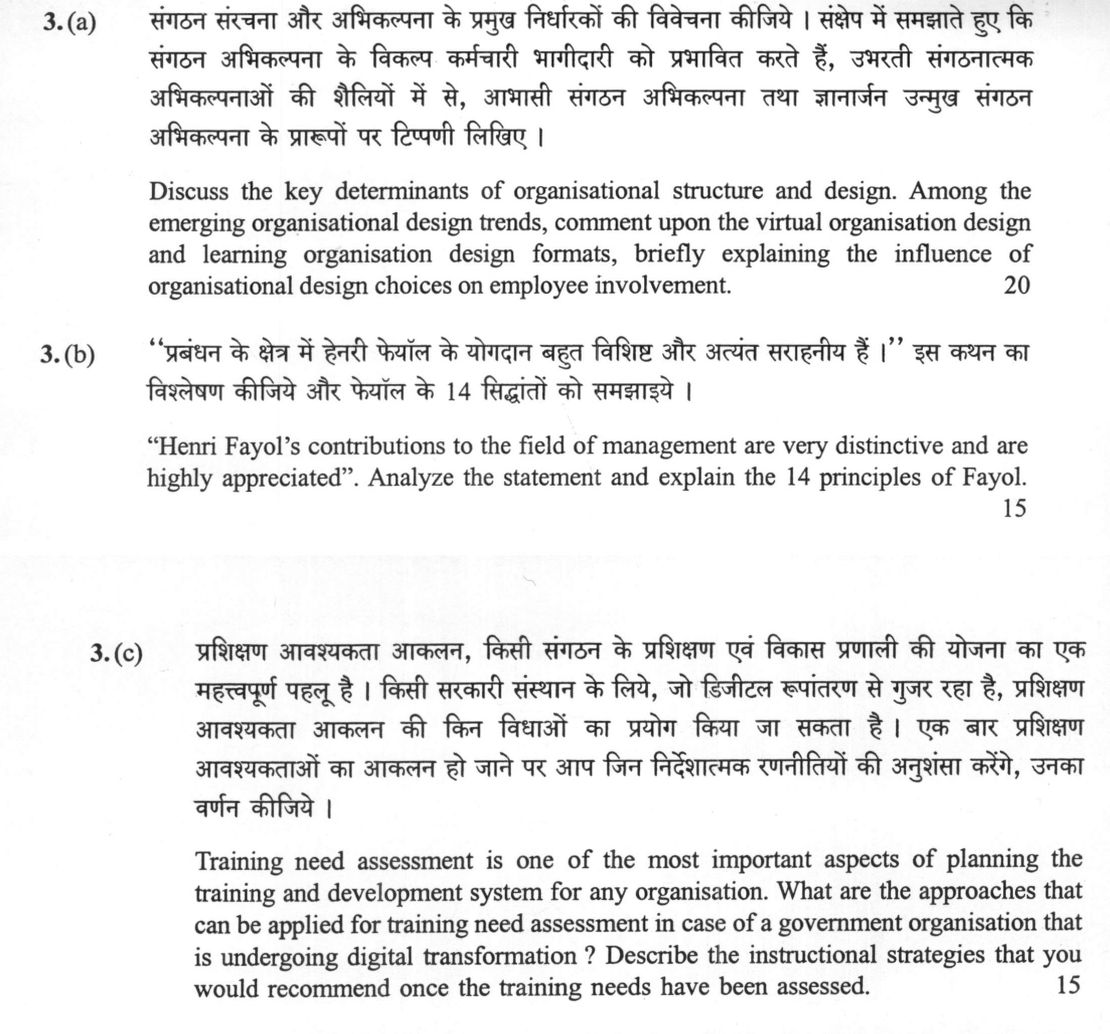
Discuss the key determinants of organisational structure and design. Among the emerging organisational design trends, comment upon the virtual organisation design and learning organisation design formats, briefly explaining the influence of organisational design choices on employee involvement. 20 marks
"Henri Fayol's contributions to the field of management are very distinctive and are highly appreciated". Analyze the statement and explain the 14 principles of Fayol. 15 marks
Training need assessment is one of the most important aspects of planning the training and development system for any organisation. What are the approaches that can be applied for training need assessment in case of a government organisation that is undergoing digital transformation ? Describe the instructional strategies that you would recommend once the training needs have been assessed. 15 marks
हिंदी में प्रश्न पढ़ें
संगठन संरचना और अभिकल्पना के प्रमुख निर्धारकों की विवेचना कीजिये । संक्षेप में समझाते हुए कि संगठन अभिकल्पना के विकल्प कर्मचारी भागीदारी को प्रभावित करते हैं, उभरती संगठनात्मक अभिकल्पनाओं की शैलियों में से, आभासी संगठन अभिकल्पना तथा ज्ञानार्जन उन्मुख संगठन अभिकल्पना के प्रारूपों पर टिप्पणी लिखिए । (20 अंक)
"प्रबंधन के क्षेत्र में हेनरी फेयोल के योगदान बहुत विशिष्ट और अत्यंत सराहनीय हैं ।" इस कथन का विश्लेषण कीजिये और फेयोल के 14 सिद्धांतों को समझाइये । (15 अंक)
प्रशिक्षण आवश्यकता आकलन, किसी संगठन के प्रशिक्षण एवं विकास प्रणाली की योजना का एक महत्वपूर्ण पहलू है । किसी सरकारी संस्थान के लिये, जो डिजिटल रूपांतरण से गुजर रहा है, प्रशिक्षण आवश्यकता आकलन की किन विधाओं का प्रयोग किया जा सकता है । एक बार प्रशिक्षण आवश्यकताओं का आकलन हो जाने पर आप जिन निर्देशात्मक रणनीतियों की अनुशंसा करेंगे, उनका वर्णन कीजिये । (15 अंक)
Model answer
Written by UPSC Answer Check against this question's marking rubric, to the expected length. UPSC does not publish answers for Mains — this is one way to score well, not an official key.
Determinants of Organisational Structure, Emerging Designs, and Employee Involvement
Organisational structure defines how tasks are allocated, coordinated, and supervised, while organisational design is the broader process of aligning structure with environment. Per contingency theory, the primary determinants include: strategy (Chandler’s thesis that structure follows strategy, such as cost leadership demanding mechanistic forms vs. differentiation demanding organic forms); size (larger organisations exhibit greater formalisation and decentralisation); technology (Woodward and Perrow’s frameworks showing routine technologies drive standardised structures while non-routine tasks demand flexibility); and environment (Burns and Stalker’s finding that dynamic environments require organic designs, whereas stable environments suit mechanistic systems).
Among emerging designs, the virtual organisation is a boundaryless, ICT-enabled network that outsources non-core functions to specialized external partners, achieving extreme agility and low overheads at the cost of direct control. In contrast, the learning organisation (pioneered by Peter Senge) institutionalises continuous adaptation through five disciplines: personal mastery, mental models, shared vision, team learning, and systems thinking.
Organisational design choices directly dictate the degree of employee involvement. Rigid, mechanistic designs restrict autonomy to predefined standard operating procedures. Conversely, organic, virtual, and learning designs empower employees by flattening hierarchies, facilitating cross-functional problem-solving, decentralising decision rights, and nurturing psychological safety, thereby transforming workers from passive executors into proactive innovators.
Fayol’s Classical Administrative Management and the 14 Principles
Henri Fayol’s contribution remains distinctive because, unlike F.W. Taylor’s shop-floor focus, Fayol developed the first comprehensive, top-down administrative theory applicable universally to all managerial endeavours across his POCCC framework (Planning, Organising, Commanding, Coordinating, Controlling).
Fayol articulated 14 principles of management: (1) Division of Work (specialisation enhances efficiency); (2) Authority and Responsibility (authority must parity accountability); (3) Discipline (respect for agreements and obedience); (4) Unity of Command (employees receive orders from one superior only); (5) Unity of Direction (one head, one plan for a group of activities with the same objective); (6) Subordination of Individual Interest to General Interest; (7) Remuneration (fair compensation for efforts); (8) Centralisation (balancing central authority with subordinate involvement); (9) Scalar Chain (the graded chain of superiors, moderated by the gang plank for horizontal cross-communication during urgency); (10) Order (a place for everything and everyone); (11) Equity (kindness and justice towards personnel); (12) Stability of Tenure (minimising turnover to ensure efficiency); (13) Initiative (encouraging worker zeal and free-thinking); and (14) Esprit de Corps (harmony and team unity).
While modern matrix and network forms challenge principles like strict unity of command and linear scalar chains, Fayol’s structural emphasis on equity, coordination, and administrative coherence remains universally applicable across public and private enterprises.
Training Need Assessment (TNA) and Instructional Strategies for Digital Transformation
For a government organisation undergoing digital transformation under initiatives like Digital India, TNA must be conducted systematically at three levels: Organisational Analysis: Assessing readiness against policy mandates (e.g., transitioning to e-Office, SPARROW, and CPGRAMS), determining institutional infrastructure constraints, and aligning with frameworks like the National Programme for Civil Services Capacity Building (Mission Karmayogi). Task Analysis: Evaluating restructured digital workflows and identifying the Functional, Behavioural, and Domain competencies required for paperless, algorithmic administration. Individual Analysis: Identifying personal capability deficits through diagnostic digital-literacy tests, error logs in automated systems, and self-assessment competency mapping (Framework for Roles, Activities, and Competencies - FRAC).
Post-assessment instructional strategies should include: (a) Blended asynchronous micro-learning delivered via platforms like iGOT Karmayogi; (b) Simulation labs and sandboxes allowing civil servants to navigate digital interfaces without operational risks; (c) Experiential on-the-job training guided by designated digital champions; and (d) Peer-driven Communities of Practice (CoPs) to resolve workflow bottlenecks collaboratively.
Integrating flexible organisational architectures with continuous competency-based training allows legacy public bureaucracies to harmonise Fayolian administrative rigor with digital agility.
What "Discuss" is asking you to do
Lay the issue out from more than one side — how it arose, what is claimed for it, what is held against it, and where it now stands. UPSC attaches discuss to broad topics with several live dimensions, so coverage of the dimensions earns more than the strength of your opinion.
Structure that answers it
Set the issue up → the case as it is made → the case against → the dimension both sides leave out → where the balance now lies
Where marks are lost
Listing facts with no thread between them, or arguing one side throughout and calling it a discussion.
How this answer will be evaluated
Approach
Framework: Fayol's 14 Principles of Management. (a) discuss: intro > 3-4 dimensions > example > balanced close | (b) explain: definition/context > points in order > small example > short close | (c) describe: define > structure or process in order > labelled diagram > significance Full marks: Comprehensive coverage of all sub-parts with specific examples and clear logical flow.
Key points expected
- Identify 3-4 key determinants (e.g., strategy, size, technology).
- Define and explain virtual organisation design.
- Define and explain learning organisation design.
- Link design choices to employee involvement levels.
- Analyze the statement regarding Fayol's distinctiveness.
- List all 14 principles of management.
- Provide a brief explanation for each principle.
- Contextualize the principles within administrative management.
Evaluation rubric
Each sub-part is marked on its own, against the marks and word limit printed on the paper.
- (a) Key determinants of structure, virtual/learning org designs, and impact on employee involvement. 20 marks
discuss— intro → 3-4 dimensions → example → balanced close
Must cover
- Identify 3-4 key determinants (e.g., strategy, size, technology).
- Define and explain virtual organisation design.
- Define and explain learning organisation design.
- Link design choices to employee involvement levels.
Loses marks
- Defining terms without discussing determinants.
- Ignoring the 'employee involvement' aspect.
- Treating virtual and learning orgs as identical.
Earns more
- Mention specific determinants like environment or culture.
- Contrast traditional vs. emerging structures.
- Provide a real-world example of a virtual or learning org.
Extra mark
- Reference specific scholars (e.g., Senge for learning orgs).
- Discuss the role of IT in virtual structures.
- (b) Analysis of Fayol's contribution and a detailed explanation of his 14 principles. 15 marks
explain— definition/context → points in order → small example → short close
Must cover
- Analyze the statement regarding Fayol's distinctiveness.
- List all 14 principles of management.
- Provide a brief explanation for each principle.
- Contextualize the principles within administrative management.
Loses marks
- Listing principles without explanation.
- Missing more than 2-3 principles.
- Failing to analyze the introductory statement.
Earns more
- Grouping principles logically (e.g., technical vs. human).
- Mentioning Fayol's background (mining engineer).
- Comparing Fayol's view with Taylor's scientific management.
Extra mark
- Citing specific examples from Fayol's 'Administration Industrielle et Générale'.
- Discussing the 'Scalar Chain' principle in detail.
- (c) TNA approaches for a government org in digital transformation and recommended instructional strategies. 15 marks
describe— define → structure or process in order → labelled diagram → significance
Must cover
- Identify TNA approaches suitable for digital transformation.
- Contextualize for a government organisation.
- Describe specific instructional strategies for the identified needs.
- Link the strategies to the assessed needs.
Loses marks
- Generic TNA discussion without digital context.
- Ignoring the 'government organisation' aspect.
- Listing strategies without linking them to the TNA.
Earns more
- Mentioning specific TNA models (e.g., Goldstein's model).
- Discussing e-learning or blended learning strategies.
- Addressing the specific challenges of government digitalization.
Extra mark
- Referencing specific government digital initiatives (e.g., Digital India).
- Suggesting specific software or platforms for training.
Practice this exact question
Write your answer and it is marked point by point against the model answer above — what you covered, what you missed, what you got wrong.
Evaluate my answer →More from Management 2024 Paper I
- Q1 (a) Elucidate the three categories of roles which a manager has to perform as suggested b…
- Q2 (a) Discuss the various types of "Control Mechanisms" a manager can apply in order to tak…
- Q3 (a) Discuss the key determinants of organisational structure and design. Among the emergi…
- Q4 (a) How do variables like organisational culture and choice of performance criteria affec…
- Q5 (a) How can Cost-Volume-Profit (CVP) analysis be used to assess the effect of changes in…
- Q6 (a) A proforma cost sheet of a company provides the following data : | Cost per unit | ₹…